Electric Toothbrushes 2026: 3 Mouths That Don't Need One

Electric toothbrushes have become a default upgrade recommendation, pushed by gift guides, dentist-office displays, and subscription startups alike. The global electric toothbrush market was roughly $3.53 billion in 2025 and is projected to keep climbing toward the mid-single-billion range by the early 2030s, according to multiple industry research firms, with US household penetration already estimated at 42–45%. That growth gets framed as proof everyone should own one. A closer look at the actual clinical evidence, the real multi-year cost of replacement heads, and basic travel logistics tells a narrower story: for at least three specific mouths, a $40–$250 electric brush adds cost and complexity without a meaningful upgrade over a $3 manual one.
This isn’t an argument that electric toothbrushes are overhyped junk. The clinical evidence for powered brushing is real, and we covered the category’s strongest performers in our electric toothbrush comparison. It’s an argument that “the category has solid evidence behind it” and “your specific mouth needs one” are different claims — and that for a few mouth types, the honest answer is to keep the manual brush already in the cup.
As an Amazon Associate, Arekore earns from qualifying purchases. The Amazon product links in this article include our affiliate tracking ID and may earn us a commission if you buy through them, at no additional cost to you. See our Links Policy for details on how we select products and how commissions do not influence our recommendations.
TL;DR / Quick Verdict
- Mouths with consistently good technique and no active gum disease get a statistically real but clinically modest benefit from switching to electric — the 2014 Cochrane review (56 trials, over 5,000 participants) found powered brushing reduced plaque by 11% at one to three months and 21% after three months, but its own authors noted “the clinical importance of these findings… remains unclear.”
- Budget-conscious or occasional brushers lose more to ongoing costs than they gain — electric replacement heads run $20–$60 a year depending on brand, versus $8–$16 a year for a comparable rotation of manual brushes, and manufacturers recommend replacing both on the same three-month schedule.
- Frequent travelers give up real convenience for a modest clinical edge — a manual brush needs no battery, no charger, and no TSA lithium-battery carry-on rule, while a dead or forgotten electric handle leaves you stuck with nothing.
- This isn’t the right call for everyone. Consumer Reports and multiple dental sources note that people with arthritis, limited hand dexterity, braces, or inconsistent brushing habits see a larger, more dependable benefit from an electric brush’s built-in timer and reduced hand motion.
- Technique matters more than the device. Dental sources are consistent that a manual toothbrush, used correctly for two full minutes twice a day, performs close to an electric one for most healthy adults — the main differentiator electric brushes add is that the timer and pressure sensor make good technique easier to maintain.
How We Reached These Conclusions (Methodology)
This is an editorial analysis, not a hands-on test. We did not personally test the products covered here. This guide synthesizes: (a) the Cochrane systematic review (Yaacob et al., 2014, CD002281) on powered versus manual toothbrushing, the most-cited independent synthesis in this category; (b) Consumer Reports’ published 2026 electric toothbrush test ratings and its separate editorial guidance comparing electric and manual brushes (we were not able to access the full paywalled test data, so specific CR claims below are attributed to that published guidance rather than to a precise data point we independently confirmed); (c) the German Stiftung Warentest’s November 2025 test of 48 electric toothbrush models, which found good budget models starting around €12–20 scoring well alongside premium models costing several times as much; (d) US retail pricing on amazon.com for manual brushes, electric handles, and replacement heads; (e) published 2026 industry market-sizing reports on the global electric toothbrush market; and (f) US TSA guidance on lithium-battery devices in carry-on versus checked luggage. Where a figure is a manufacturer’s own claim rather than an independently verified measurement, it is labeled as such. Prices are amazon.com figures at the time of writing (November 2026) and fluctuate.
Why Market Growth Doesn’t Mean Universal Fit
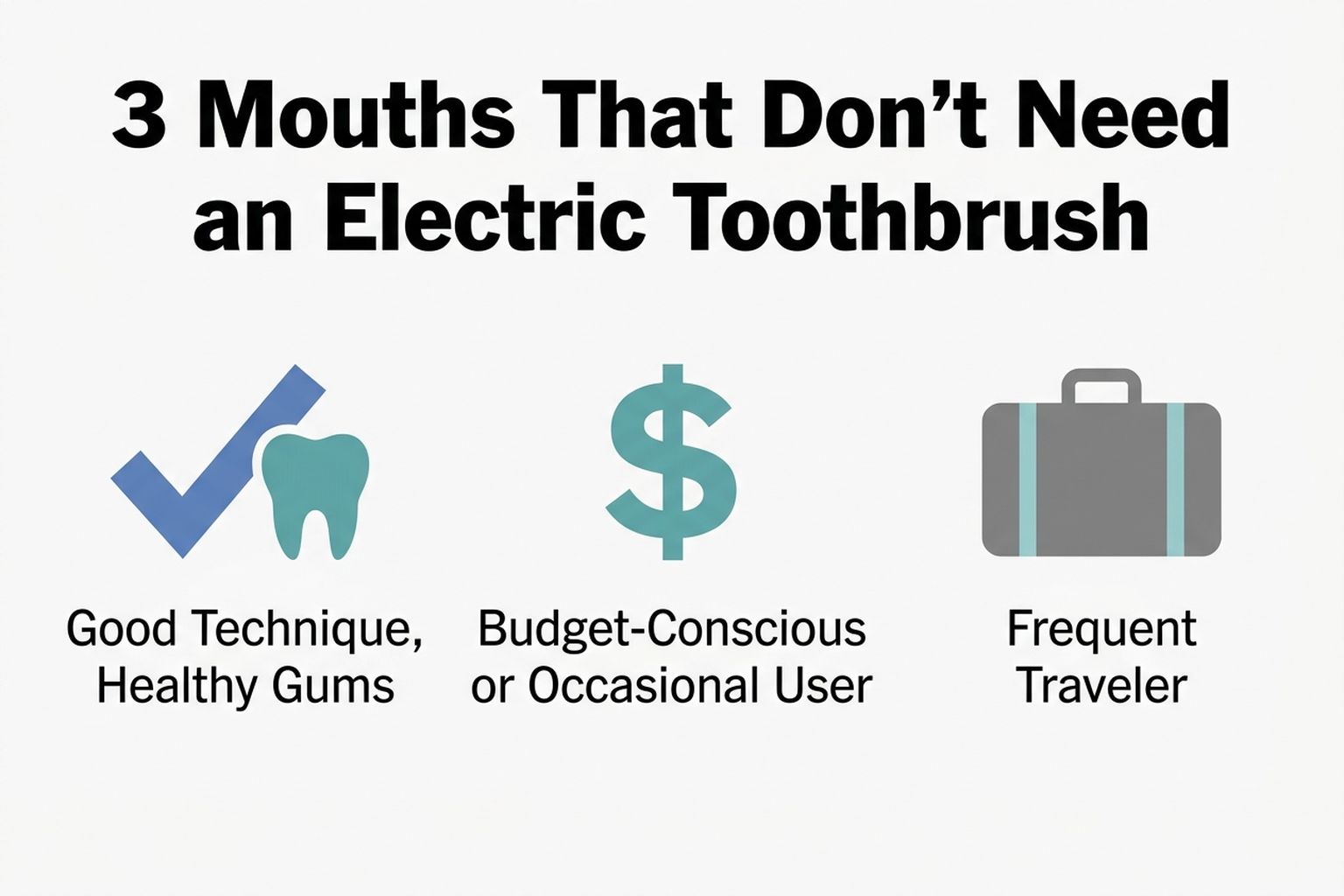
An electric toothbrush does one job well: it standardizes motion and timing so technique errors matter less, and the Cochrane review’s largest evidence base is specifically for oscillating-rotating brushes used consistently over months. That value is real for the people who need it. But the same review that electric-toothbrush marketing leans on also contains the caveat marketing leaves out — the authors rated the quality of evidence as moderate and said the clinical importance of the measured benefit “remains unclear,” even while confirming it was statistically significant.
Three mouth types get the smallest practical return on that benefit, each for a different reason:
- Mouths with good technique and healthy gums already get most of the benefit a toothbrush can offer. Dental sources consistently agree that a manual toothbrush used correctly — two full minutes, soft bristles, gentle pressure, covering every surface — performs close to an electric one for a healthy adult with no active gum disease. The electric brush’s edge is mostly in making good technique easier, not in cleaning teeth an optimally-used manual brush couldn’t reach.
- Budget-conscious or occasional users pay a recurring cost for a benefit they may not use consistently enough to realize. Electric brush heads need replacing on the same three-month cycle as a manual brush would be swapped, but cost several times more per unit — and the clinical benefit only accrues with consistent, correct daily use, which an occasional or inconsistent brusher won’t get regardless of device.
- Frequent travelers trade a modest clinical edge for real logistical friction. A manual brush survives being forgotten in a drawer, dropped in a sink, or left behind at a hotel without consequence beyond a $3 replacement. An electric handle adds a battery to manage, a charger to pack, and — per current US TSA guidance — a lithium-battery device that belongs in carry-on luggage, not checked bags.
None of this erases the real advantage electric brushes have for the right mouth: built-in timers, pressure sensors, and reduced hand motion that compensate for inconsistent technique or limited dexterity. But “the clinical literature supports electric brushing on average” and “your mouth specifically benefits enough to justify the cost and hassle” are different conclusions, and for the three mouths below, the gap doesn’t close.
The Three Mouths Where the Data Says Skip It
1. Good technique, healthy gums, no dexterity limitations
If you already brush for two full minutes twice a day, use gentle pressure, and don’t have arthritis, limited grip strength, or a history of gum disease, you’re in the group where a manual brush and an electric one land closest together in outcome. The Cochrane review’s authors — the people who ran the actual meta-analysis — stopped short of calling the measured plaque and gingivitis reduction clinically important, even while confirming it was statistically real across 56 trials. Multiple dental sources back this up directly: technique is repeatedly identified as the single biggest factor in brushing outcomes, with toothbrush type coming in second.
Germany’s Stiftung Warentest reinforces a related point from its November 2025 test of 48 electric models: inexpensive units priced around €12–20 earned good scores alongside premium models costing several times as much, with the top-rated Philips Sonicare 5500 and 7100 running roughly €90–140. If price-tier barely moves the needle within electric brushes, it’s a reasonable signal that device choice generally matters less than consistency and technique.
For this mouth type, a quality manual brush with soft, tapered bristles — something like the Oral-B Complete Deep Clean Toothbrush (ASIN B008I2ILDK, roughly $14 for a 4-count pack, soft bristles) — covers the fundamentals without an ongoing subscription to manage.
Check the Oral-B Complete Deep Clean Toothbrush (4-pack) on Amazon
2. Budget-conscious or occasional users
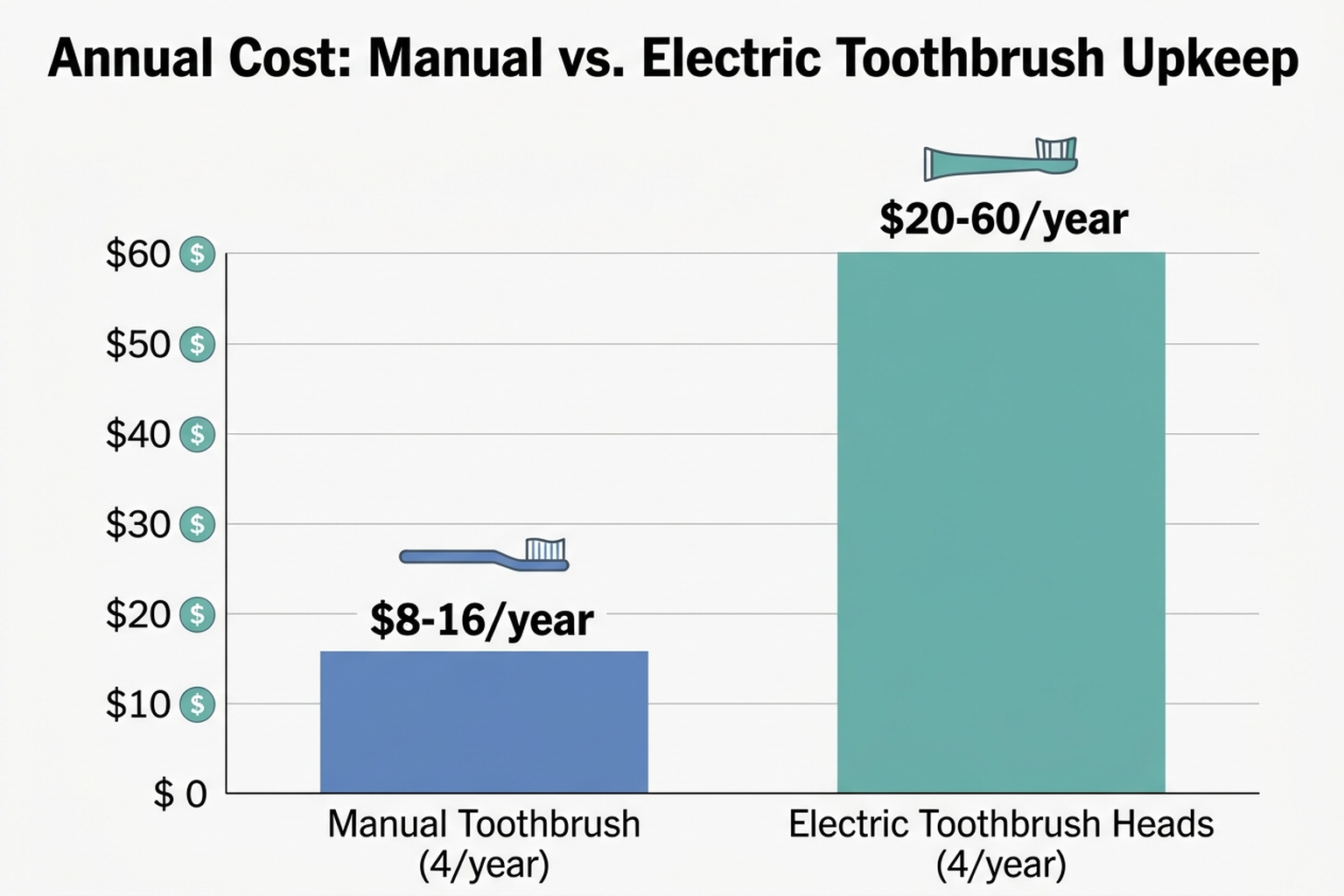
Manufacturers recommend replacing both manual brushes and electric brush heads roughly every three months — four times a year. The two paths diverge sharply on cost once you run that math. A rotation of four manual brushes a year typically runs $8–$16 total. Electric replacement heads run meaningfully higher: $24–$48 a year for Oral-B, $32–$48 a year for genuine Philips Sonicare heads, and $20–$60 a year across the category depending on brand and whether you buy individually or in bulk. Over a three-year span, replacement heads alone can exceed what the handle originally cost.
That math only pays off if the clinical benefit is actually being realized — which requires consistent, correct daily use. An occasional brusher, or someone who brushes inconsistently regardless of device, is paying the electric brush’s higher recurring cost without reliably capturing the benefit the Cochrane data describes, since that data is built on sustained daily use over months. For this mouth type, the recurring-cost math argues for putting the savings toward floss, mouthwash, or a dental cleaning instead of a subscription of replacement heads.
3. Frequent travelers
Electric toothbrushes with rechargeable lithium batteries fall under current US TSA guidance requiring lithium-battery devices to travel in carry-on luggage, not checked bags — one more item to remember when packing, and one more thing that can trigger a second look at a security checkpoint. Beyond the battery rule, the practical travel failure mode is simpler: a dead battery or a forgotten charger leaves an electric brush completely useless until the next outlet, while a manual brush works the moment it’s unwrapped, needs no charging cable, and costs little enough to buy a spare and leave it in a travel bag permanently.
This isn’t a case against bringing an electric brush on a single trip — most people do it without issue. It’s a case for the specific traveler who’s dealt with a dead handle at a hotel, a charger left in a hotel outlet, or the hassle of pulling a device out at security. For that traveler, a manual brush removes an entire category of travel friction that a modest clinical edge doesn’t offset.
When an Electric Toothbrush Still Makes Sense
None of this is an argument against the category broadly. Our own comparison of Philips Sonicare, Oral-B, and Burst covers the mouths that benefit most: people with arthritis or limited hand dexterity who struggle to maneuver a manual brush effectively, people managing braces or other orthodontic hardware, people with a history of gum disease who need the Cochrane-documented gingivitis reduction, and anyone who knows their own technique is inconsistent and wants a built-in timer and pressure sensor to compensate. Consumer Reports’ published guidance on choosing between electric and manual brushes specifically calls out older adults with arthritis as a group more likely to see real benefit, since hand dexterity — not brushing philosophy — is the limiting factor for that mouth.
For that audience, a budget-tier model like the Oral-B Pro 1000 (ASIN B003UKM9CO, roughly $50, ADA Seal of Acceptance) delivers the timer and pressure-sensor fundamentals without the premium price tag.
Check the Oral-B Pro 1000 on Amazon
Comparison Table
Prices are approximate amazon.com figures at the time of writing (November 2026) and fluctuate.
| Mouth profile | What the data suggests | Alternative | Typical annual cost |
|---|---|---|---|
| Good technique, healthy gums, no dexterity issues | Manual brush performs close to electric when used correctly | Oral-B Complete Deep Clean (B008I2ILDK) | ~$14 per 4-pack (~1 year) |
| Budget-conscious or occasional user | Replacement-head cost outpaces realized clinical benefit | Any quality manual brush, replaced quarterly | ~$8–$16/year |
| Frequent traveler | Battery, charger, and TSA rules add friction for modest gain | Manual brush, no charging required | ~$8–$16/year |
| Arthritis, limited dexterity, or inconsistent technique | Electric brush’s timer and reduced hand motion help meaningfully | Oral-B Pro 1000 (B003UKM9CO) | ~$50 handle + ~$24–$44/year heads |
Decision Flowchart
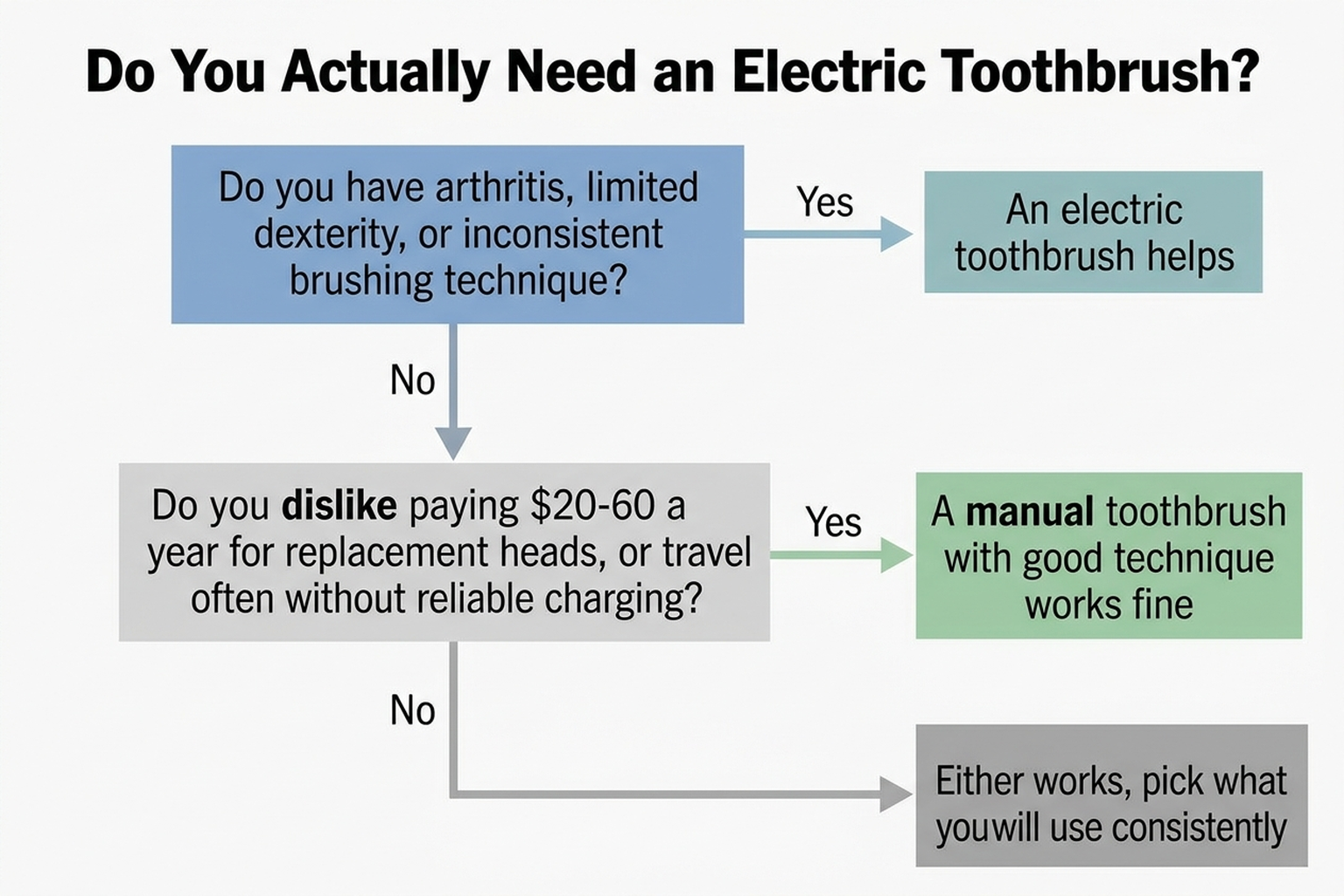
Start with dexterity and technique: if arthritis, limited grip strength, braces, or genuinely inconsistent brushing habits are part of the picture, an electric brush’s timer and pressure sensor offer a real, well-documented benefit — buy one. If none of that applies, ask about cost tolerance and travel habits: anyone who’d rather not pay $20–$60 a year for replacement heads, or who travels frequently and doesn’t want to manage a battery, charger, and TSA carry-on rule, is well served by a manual brush with good technique. Everyone else can reasonably pick either — the clinical literature supports both when used consistently and correctly.
Limitations
This analysis relies on the 2014 Cochrane systematic review, Consumer Reports’ published electric-versus-manual guidance, Stiftung Warentest’s November 2025 test results, published market-sizing reports, and published US retail and replacement-head pricing, rather than our own side-by-side clinical test. The Cochrane review is from 2014; while it remains the most-cited meta-analysis in this category and its findings are still referenced by current dental guidance, more recent individual studies exist and were not independently re-synthesized here. Replacement-head and manual-brush costs vary by brand, retailer, and whether items are bought in bulk; the ranges cited represent commonly reported US pricing rather than a single verified figure. The TSA guidance cited reflects current rules for lithium-battery devices and can change; travelers should confirm current requirements before a trip. Dental needs vary by individual — anyone with an existing gum disease diagnosis, orthodontic work, or dentist-specific guidance should follow their provider’s recommendation over this general analysis. Prices fluctuate on amazon.com and should be verified on the current product page before buying.
Bottom Line
Electric toothbrushes earned their market growth on real clinical evidence, and for mouths with limited dexterity, inconsistent technique, or active gum issues, that evidence translates into a genuine, well-documented benefit. But the same Cochrane review the category leans on also says the clinical importance of its own measured benefit is unclear for the average healthy mouth — and for budget-conscious users and frequent travelers, the recurring cost and logistical friction add up faster than the clinical gain. If your technique is already solid, your gums are healthy, and you’d rather skip the $20–$60-a-year replacement-head bill or the battery-and-charger travel hassle, the data points toward keeping the manual brush rather than adding a subscription to your bathroom counter.
Before you buy, paste the product link into Arekore — our AI assistant checks review authenticity, surfaces what the one-star reviews actually complain about, and compares prices, free, in about five minutes.