Best Electric Toothbrushes in 2026: Philips Sonicare vs Oral-B vs Burst — Three Technical Approaches, Compared
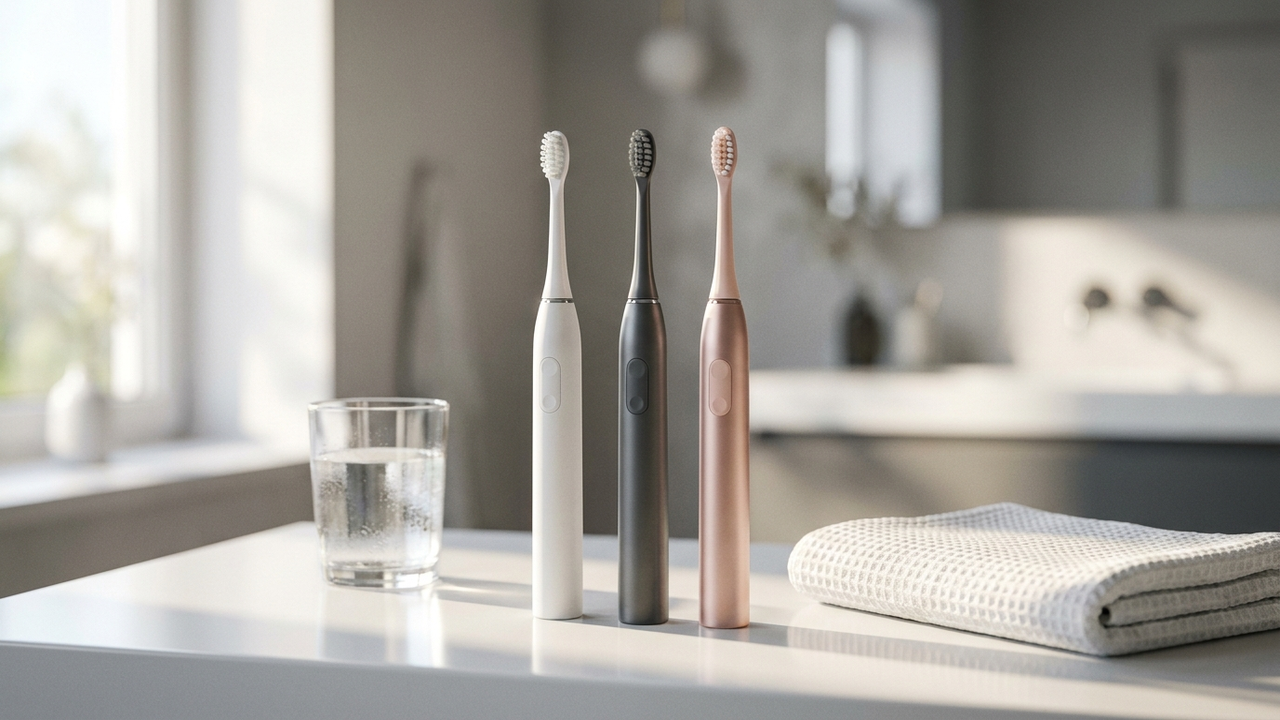
TL;DR. The US electric toothbrush market in 2026 is dominated by two giants and one challenger, and they make different engineering bets. Philips Sonicare uses high-frequency sonic vibration and was the cleaning-performance winner in Germany’s Stiftung Warentest December 2025 test. Oral-B (Procter & Gamble) uses oscillating-rotating round heads — the technology with the largest clinical evidence base in the Cochrane review. Burst is the sonic value/subscription challenger that Consumer Reports names the best subscription brush. Below: the technology behind each, what aggregated reviews and independent labs actually say, replacement-head running costs, and a use-case flowchart.
A note on links and methodology
As an Amazon Associate, Arekore earns from qualifying purchases. The Amazon product links in this article include our affiliate tracking ID and may earn us a commission if you buy through them, at no additional cost to you. See our Links Policy for details on how we select products and how commissions do not influence our recommendations.
We also did not personally test these products. Every claim below is an editorial synthesis of publicly available data, and the Methodology section explains exactly which sources we used.
Methodology
This article is an editorial analysis based on publicly available data collected in June 2026. We synthesized four categories of source:
- Customer reviews on amazon.com — we read the “Top reviews”, “Most recent reviews”, and the AI “Customers say” summary block on each ASIN’s product page to identify recurring positive and negative themes. We do not report a precise sample size N, because Amazon’s review panels do not expose a stable count; quoting a fake precise N would be misleading.
- Clinical and independent test data — the Cochrane systematic review (Yaacob et al., 2014, CD002281) on powered vs manual brushing, Consumer Reports’ 2026 lab tests, the German Stiftung Warentest December 2025 test, and product-level comparisons from Electric Teeth.
- Manufacturer specifications — official Philips Sonicare, Oral-B, and Burst product pages and Amazon listings. Manufacturer performance figures are labeled as manufacturer claims, not independently verified facts.
- Market data — US and global electric toothbrush market size and brand figures from Fortune Business Insights, Precedence Research, and market.us statistics.
We deliberately do not simulate first-person product experience, fabricate reviewer personas, or invent precise data points we cannot verify. Recommendations are editorial opinions formed from the synthesis above.
0. Market context: who actually buys electric toothbrushes in the US
The global electric toothbrush market was roughly USD 3.53 billion in 2025 and is projected to reach about USD 5.3 billion by 2034, a CAGR near 4.7% (Fortune Business Insights). North America alone accounted for approximately USD 1.27 billion in 2025, about 36% of the global total, and US household penetration of electric brushes is estimated at 42–45% as of 2025.
The category is unusually consolidated. Two companies command the majority of US sales: Procter & Gamble (Oral-B) and Philips (Sonicare). As a historical baseline for the scale of that duopoly, US power-toothbrush usage data (Statista, 2020 survey) showed Oral-B reaching roughly 47 million users versus Sonicare’s roughly 35 million — and that two-brand structure still defines the shelf today. The interesting 2026 story is the third lane: direct-to-consumer and subscription brands such as Burst and Quip that Consumer Reports now tests alongside the giants. This article compares one representative of each lane.
1. Three technical approaches to the same problem
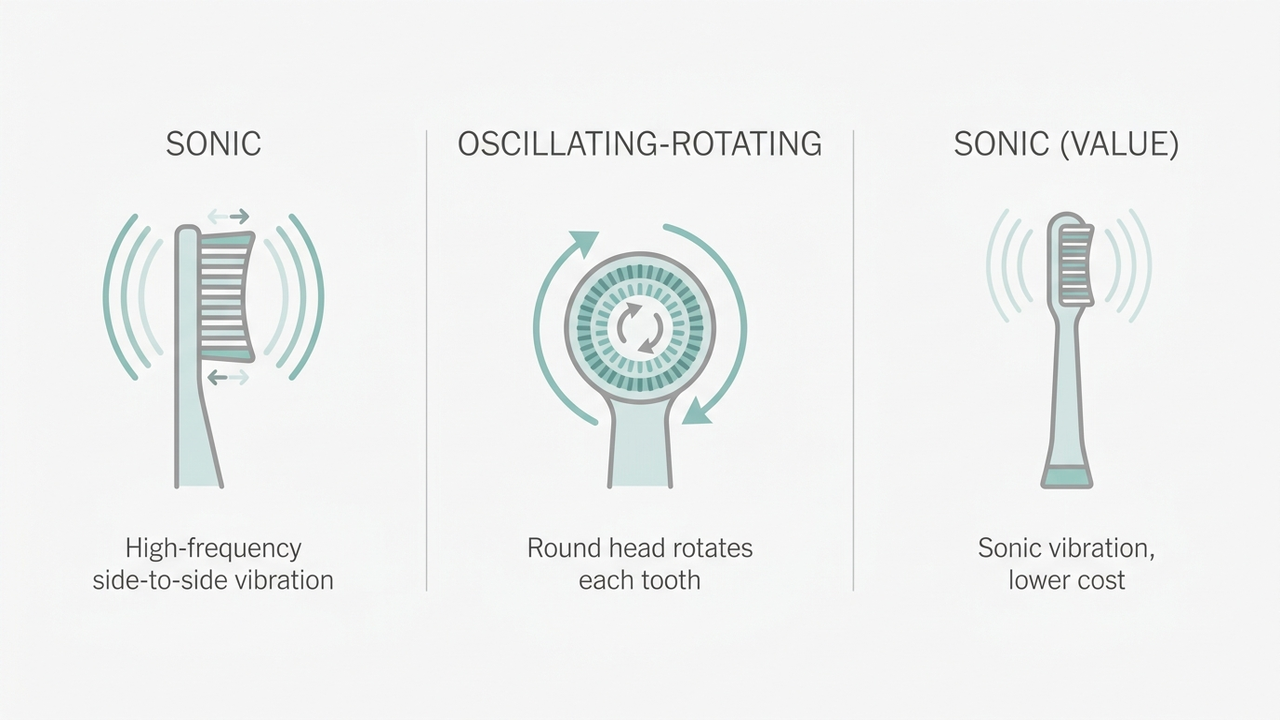
The first thing to understand is that these brands clean your teeth in mechanically different ways.
| Approach | Representative brand | How it moves | Manufacturer-claimed speed | Best at |
|---|---|---|---|---|
| Sonic | Philips Sonicare | High-frequency side-to-side vibration | ~31,000 strokes/min (Philips claim) | Between teeth, along the gumline |
| Oscillating-rotating | Oral-B | Round head rotates back and forth, pulsates | ”3D” micro-movements (Oral-B claim) | Surface plaque, stain removal |
| Sonic (value/subscription) | Burst | High-frequency sonic vibration | ~33,000 vibrations/min (Burst claim) | Low long-term cost, gentle feel |
The key clinical context comes from the Cochrane review (Yaacob et al., 2014), the most-cited independent synthesis in this category. Pooling many trials, it found powered brushes reduced plaque by 11% at one to three months and 21% after three months, and reduced gingivitis by 6% and 11% over the same windows, compared with manual brushing. Crucially, over half the studies used oscillating-rotating brushes, and that technology had “the greatest body of evidence” for a statistically significant benefit. That does not prove oscillating-rotating is superior to sonic in everyday use — it means it is the most thoroughly studied. Independent reviewers consistently rate both top sonic and top oscillating-rotating brushes as excellent cleaners.
If you understand which approach matches your mouth and budget, the rest of this article mostly confirms a decision you have nearly made.
2. Quick comparison table (2026)
Prices are approximate, captured at time of writing in June 2026, and fluctuate frequently — confirm the current price on the linked product page before buying. Full specs are in each brand’s section below.
| Product | Approx. price (USD) | Technology | Best for |
|---|---|---|---|
| Philips Sonicare DiamondClean Smart 9700 | ~$200 | Sonic | Gum-friendly premium, app coaching, travel |
| Philips Sonicare ProtectiveClean 4100 | ~$40 | Sonic | Best value entry into sonic |
| Oral-B iO Series 9 | ~$210 | Oscillating-rotating | Stain/plaque removal, smart pressure display |
| Oral-B Pro 1000 | ~$50 | Oscillating-rotating | Cheapest credible oscillating-rotating brush |
| Burst Original Sonic | ~$70 | Sonic (subscription) | Lowest replacement-head cost, gentle clean |
3. Philips Sonicare: the gum-friendly sonic specialist
Sonicare’s bet is sonic vibration: the brush head moves side to side at high frequency — Philips claims up to 31,000 strokes per minute — which the company says creates a “dynamic fluid action,” driving toothpaste and saliva between teeth and below the gumline where the bristles do not directly touch. In practice, independent reviewers describe the sonic feel as gentler against the gums than a rotating head, which makes Sonicare a frequent recommendation for sensitive gums and recession.
Independent verdict: Stiftung Warentest’s 2025 cleaning winner
Germany’s Stiftung Warentest, widely regarded as Europe’s most rigorous appliance-testing body, published an updated electric toothbrush test in December 2025. Philips Sonicare scored a “double win”: the Sonicare 5500 earned an overall “Gut” (good) grade of 1.7 as test winner, with the Sonicare 7100 close behind at 1.8, and both posted top cleaning-performance sub-grades (1.3 and 1.4 respectively) — the result was widely reported across the German dental press. Notably, the same report stressed that very inexpensive brushes — some from around €12 — cleaned almost as well, a useful reminder that the premium tier buys features and feel more than raw cleaning ability.
3-1. Sonicare DiamondClean Smart 9700 (premium)
The flagship sonic brush. It pairs with the Sonicare app to coach technique and highlight missed areas, includes a pressure sensor, multiple brushing modes and intensity levels, and ships with a USB-charging travel case. Independent comparisons (Electric Teeth) note that Sonicare’s battery life is a real advantage — typically two weeks or more per charge, where premium Oral-B iO handles often struggle to reach two weeks.
Philips Sonicare DiamondClean Smart 9700 (HX9957/81) — view on Amazon
3-2. Sonicare ProtectiveClean 4100 (value entry)
The brush most often recommended as a first sonic toothbrush. It has a built-in pressure sensor that pulses to warn you when you press too hard, a two-minute SmarTimer with QuadPacer, and an EasyStart mode that ramps power gradually over the first uses. Philips markets it as delivering “700% better plaque removal” than a manual brush when paired with its C2 head — a manufacturer claim, not an independent measurement.
Philips Sonicare ProtectiveClean 4100 (HX6810/50) — view on Amazon
Sonicare suits you if: you have sensitive gums, recession, or crowding between teeth; you value quiet operation and long battery life; or you want app coaching to fix your technique.
4. Oral-B: the plaque and stain champion
Oral-B’s signature is the round, oscillating-rotating head that rotates back and forth (and, on higher models, pulsates) to cup and scrub each tooth individually. This is the technology with the deepest clinical literature: in the Cochrane review, oscillating-rotating brushes had the largest evidence base for reducing plaque and gingivitis. Reviewers consistently single out Oral-B for removing surface stains — from coffee, tea, and tobacco — better than most sonic brushes, because the rotating action physically polishes the tooth face.
The trade-off, noted across customer reviews and dentist commentary, is that the rotating action can feel more aggressive, so people with sensitive gums sometimes find it harsh.
4-1. Oral-B iO Series 9 (premium)
The top of the iO line. It uses a quieter linear magnetic drive, a visible Smart Pressure Sensor that glows red (too hard), green (just right), or white, and an interactive display. Its companion app divides the mouth into zones and uses AI position detection to flag missed spots, and it offers seven cleaning modes. The honest caveat from independent comparisons (Electric Teeth) is battery life: the iO 7/8/9 handles can struggle to consistently reach two weeks per charge, where Sonicare typically exceeds it.
Oral-B iO Series 9 (Black, 4 brush heads, travel case) — view on Amazon
4-2. Oral-B Pro 1000 (value entry)
A long-standing budget benchmark and one of the most frequently recommended first electric toothbrushes in the US. It is deliberately simple — one main cleaning mode, a two-minute timer, and a pressure sensor that stops pulsations if you press too hard. Oral-B claims “300% more plaque removal along the gumline” versus a manual brush — again a manufacturer claim. It carries the ADA Seal of Acceptance, as do Oral-B’s and Philips’s qualifying lines.
Oral-B Pro 1000 (White) — view on Amazon
Oral-B suits you if: coffee, tea, or tobacco stains are your main concern; you want the most clinically studied mechanism; your gums are healthy; or you want the cheapest credible brand-name brush (Pro 1000).
5. Burst: the gentle sonic value challenger
Burst is the direct-to-consumer brand that broke into Consumer Reports’ tested field and earned the label best subscription-based electric toothbrush in its 2026 coverage. It is a sonic brush (Burst claims about 33,000 vibrations per minute), with charcoal-infused soft bristles, a pressure sensor, and up to four weeks of battery per charge (manufacturer figure). Burst markets aggressive performance numbers — “up to 10x more plaque removal,” “healthier gums in two weeks,” “3x less bleeding after 30 days” versus a manual brush — all of which are manufacturer claims drawn from comparisons against manual brushing, not against rival electric brushes.
Burst’s real differentiator is running cost. Replacement heads arrive by subscription roughly every 12 weeks for a few dollars each — substantially cheaper per head than name-brand Sonicare or Oral-B refills bought individually. Over three years, replacement heads often cost more than the handle itself, so this matters (see the running-cost table in Section 7).
One honest limitation: as of this writing, Consumer Reports lists Oral-B, Philips, and Quip as holding the ADA Seal of Acceptance, and Burst is not on that list. The ADA Seal is a voluntary program, and its absence is not evidence a brush is ineffective — but if a third-party seal matters to you, weigh it.
Burst Original Sonic Electric Toothbrush — view on Amazon
Burst suits you if: you want a gentle sonic clean at a lower upfront and ongoing price; you like the convenience of subscription refills; and a brand-independent seal is not a dealbreaker.
6. Which one is right for you?
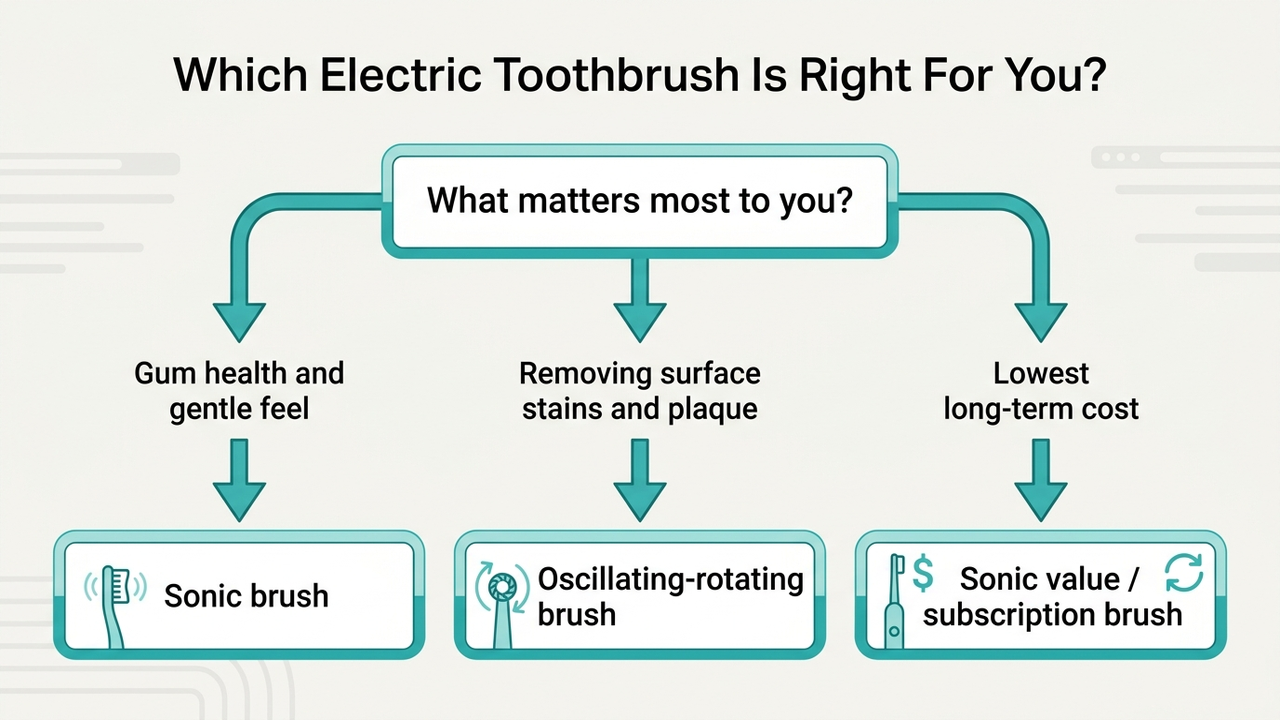
Start by being honest about your mouth and your priorities.
| Your top concern | Recommended lane | Why |
|---|---|---|
| Sensitive gums / recession | Sonicare or Burst (sonic) | Gentler side-to-side motion, no aggressive scrubbing |
| Coffee/tea/tobacco stains | Oral-B (oscillating-rotating) | Rotating head physically polishes the tooth surface |
| Most clinically studied mechanism | Oral-B | Largest evidence base in the Cochrane review |
| App coaching for technique | Sonicare 9700 or Oral-B iO | Both map missed areas with AI position detection |
| Longest battery life | Sonicare | Independent reviews note 2+ weeks vs iO’s struggle to hit it |
| Lowest long-term cost | Burst or Oral-B Pro 1000 | Cheap refills (Burst) or low entry price (Pro 1000) |
A budget-tier view of the same decision:
| Budget | Philips Sonicare | Oral-B | Burst |
|---|---|---|---|
| Under ~$60 (entry) | ProtectiveClean 4100 | Pro 1000 | — |
| ~$70–120 (mid) | ProtectiveClean 5100/6100 | iO Series 2/4 | Original Sonic |
| ~$150+ (premium) | DiamondClean Smart 9700 | iO Series 9 | — |
7. Whatever you buy, technique decides the result
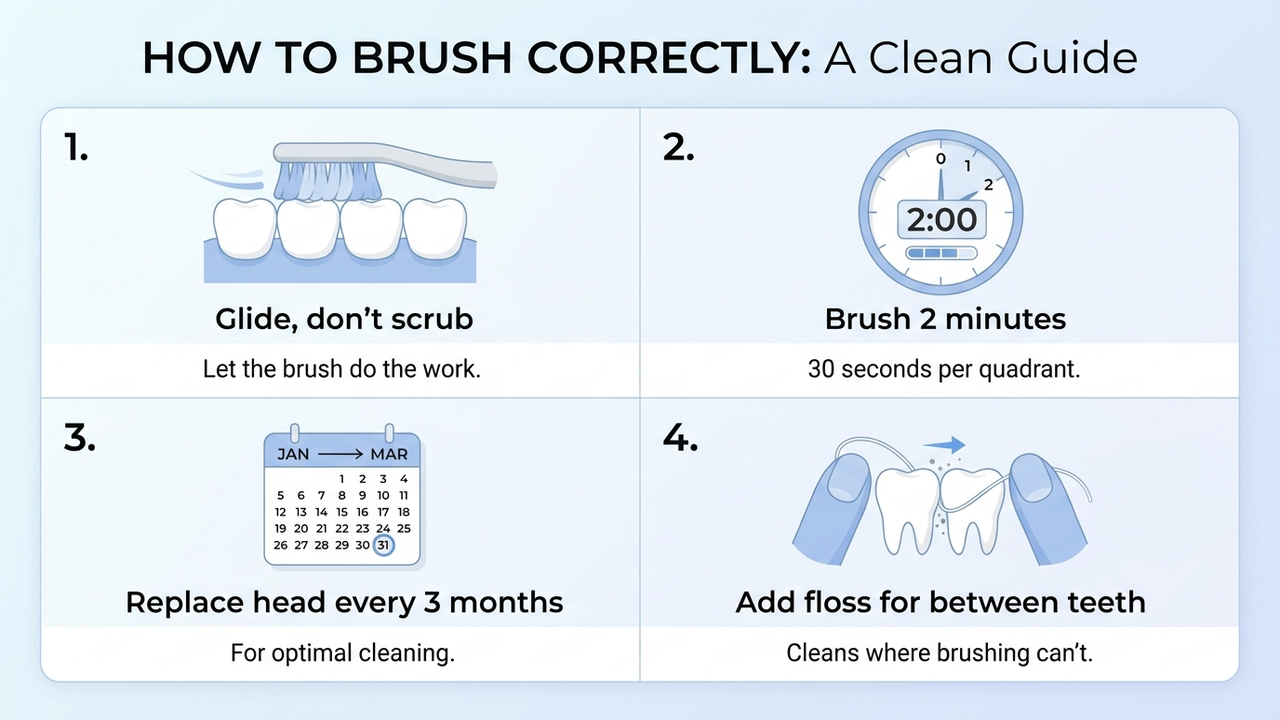
The Cochrane evidence describes what powered brushes can do when used correctly. Used poorly, even a $200 brush underperforms. Four habits matter most.
7-1. Four common mistakes
| Mistake | Correct technique |
|---|---|
| Scrubbing back and forth by hand | Just glide and hold — let the brush do the work |
| Finishing in under a minute | Brush the full two minutes (about 30 seconds per quadrant) |
| Using a head for six months or more | Replace every three months, sooner if bristles splay |
| Relying on the brush alone | Add floss or interdental brushes between teeth |
The two-minute target is the globally recommended brushing time, and every model above includes a timer to enforce it. That is the strongest practical argument that you do not need the most expensive brush — a timer and a pressure sensor, both present on sub-$50 models, cover most of the benefit.
7-2. Count the replacement-head cost, not just the handle
The true three-year cost is “handle price + three years of replacement heads.” Approximate per-head US prices at time of writing:
| Brand | Approx. price per genuine head | Approx. yearly cost (4 heads) |
|---|---|---|
| Philips Sonicare | ~$8–12 | ~$32–48 |
| Oral-B | ~$6–11 | ~$24–44 |
| Burst (subscription) | ~$6 | ~$24 |
Over several years, refills can quietly exceed the handle’s price. Burst’s subscription model and Oral-B’s widely available heads are the running-cost winners; genuine Sonicare heads tend to run highest.
8. Don’t get fooled by inflated review scores
Electric toothbrushes span roughly $40 to $250, and a high star rating alone is a poor guide. A recurring failure pattern in customer reviews: someone with sensitive gums buys a 4.7-star oscillating-rotating brush, finds the rotation too harsh, and returns it — a mismatch the average star score never revealed. Before buying, do three things:
- Read the 1- and 2-star reviews first — they reveal the real weaknesses.
- Search the review text for words like “sensitive,” “gums,” or “battery” to see whether your specific concern appears.
- Favor products on the market for a year or more, so early-unit defects have surfaced.
If checking all of that yourself sounds tedious, there is a faster way.
9. Verify any product in about five minutes with Arekore
Arekore is an AI shopping assistant: paste a product URL and it analyzes review authenticity, summarizes the negative reviews, and compares prices automatically.
- “4.8 stars — but is it real?” → fake-review screening
- “What do the low ratings actually say?” → a summary of the genuine complaints
- “Which retailer is actually cheaper?” → automatic price comparison
- “Will it suit my mouth?” → use-case guidance from the assistant
For a long-lived, higher-priced purchase like an electric toothbrush, a few minutes of verification before buying is time well spent. When you find a brush you are considering, paste its URL into Arekore and try it.
Summary: match the technology to your mouth
Once you understand the three lanes, choosing gets simple:
- Sensitive gums, between-teeth care, long battery, app coaching → Philips Sonicare
- Surface stains, the most clinically studied mechanism, healthy gums → Oral-B
- Gentle sonic clean at the lowest upfront and ongoing cost → Burst
Found an electric toothbrush you are considering? Verify it with Arekore first.
Limitations
This analysis relies on publicly available customer reviews, independent third-party tests, and manufacturer specifications; we did not personally test the products covered here. Manufacturer performance figures (strokes per minute, “10x more plaque,” “300% more plaque removal”) are claims by the makers, generally measured against manual brushing rather than against rival electric brushes, and are presented as such. Clinical figures from the Cochrane review describe pooled averages across many studies and do not predict any individual’s result. Prices and replacement-head costs are approximate, captured in June 2026, and change frequently — confirm current pricing and ASIN availability on the linked product pages before purchasing. Individual experience varies with technique, oral health, and unit-to-unit variance.