Portable Power Stations 2026: 3 Households to Skip

As an Amazon Associate, Arekore earns from qualifying purchases. The Amazon product links in this article may include our affiliate tracking ID and may earn us a commission if you buy through them, at no additional cost to you. See our Links Policy for details on how we select products and how commissions do not influence our recommendations.
Portable power stations are having a moment. Search interest climbs every hurricane season and every heat wave, and the pitch is easy to buy into: a quiet, fume-free battery that keeps the fridge cold and the phones charged when the grid fails. We covered how to pick one in our hurricane-season buyer’s guide. But the category’s marketing rarely mentions the households for whom a $500–$1,500 battery is the wrong purchase. This analysis looks at three common profiles where the math does not favor a portable power station, based on aggregated outage data, customer reviews, and independent reporting.
TL;DR / Quick Verdict
- Reliable-grid renters with no medical need: a typical US customer experiences roughly 2 hours of cumulative outage per year outside major storms. A $60 UPS for the router covers most of that.
- Homeowners who already installed a whole-home standby generator: automatic, whole-house coverage makes a portable unit redundant for anything beyond pure portability.
- Occasional travelers whose real need is charging phones and a laptop, not a fridge: a $100–$150 power bank does that job at a fraction of the size, weight, and cost.
- This is not an anti-power-station article. For frequent, multi-hour outages, medical equipment, or a fridge/freezer to protect, the category earns its price — see our companion buying guide.
How We Reached These Conclusions (Methodology)
This is an editorial analysis, not a hands-on review; we did not personally test the products mentioned here. We synthesized (a) US grid-reliability data reported by utilities and the Energy Information Administration, (b) the top few dozen aggregated amazon.com customer reviews for the alternative products discussed (UPS units, power banks), captured in August 2026 — Amazon does not publish an exact count of reviews analyzed per listing, so we do not report a precise N here and treat this input as directional rather than statistically representative, and (c) independent reporting from Consumer Reports and manufacturer generator guides. Where a figure comes from a manufacturer or a single utility, we label it as such rather than as an industry-wide fact. Prices are amazon.com figures at the time of writing and change frequently.
The Case Everyone Skips: Most Outages Are Short
The portable-power-station pitch assumes long, frequent outages. National data tells a more mixed story. The US grid’s average annual outage duration per customer — the industry’s SAIDI metric — was about 335.5 minutes (roughly 5.6 hours) in 2022 when major storm events are included, and closer to 2 hours per year in a typical year without them, according to Energy Information Administration reporting. Individual utilities vary widely: some report SAIDI figures near 270–280 minutes a year, others far less. The pattern matters more than any single number — for a large share of US households, in a typical year, the grid stays up almost all the time, and the outages that do happen are measured in minutes, not days.
That does not mean backup power is a bad idea everywhere. It means the decision should start with your own outage history and household risk, not with marketing copy built around hurricane season.
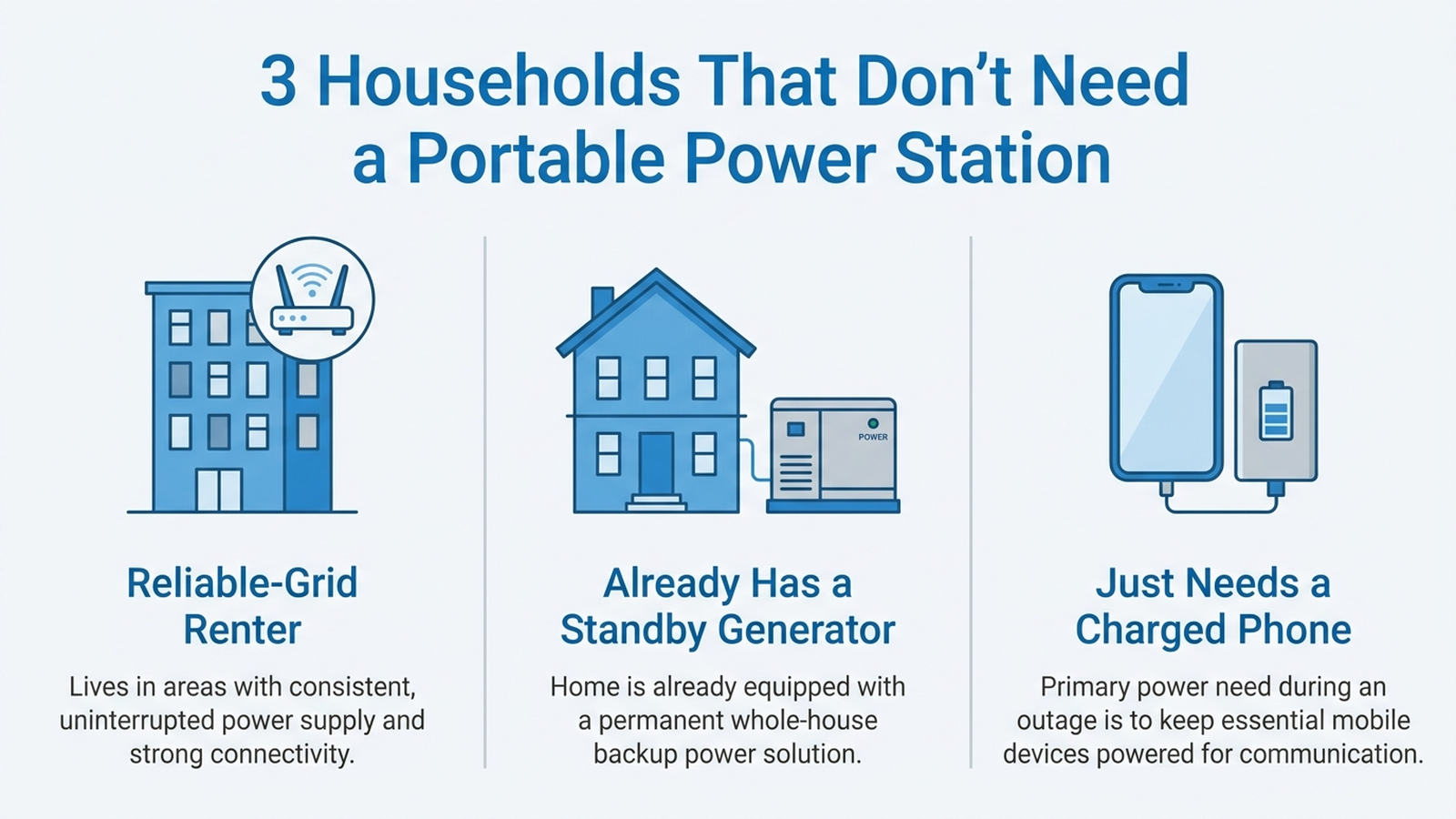
Household 1: The Reliable-Grid Renter With No Medical Need
Profile: Apartment or rental home, no CPAP or other powered medical equipment, no chest freezer of food to protect, and a utility service area with a track record of short, infrequent outages (well under the ~2-hour national typical-year figure).
For this household, the realistic failure mode during an outage is a dead phone and a router that needs to reboot when power returns — not spoiled food or a life-safety device going dark. A portable power station’s core selling points (running a fridge for hours, powering a CPAP overnight, surviving a multi-day event) simply do not apply.
What solves the actual problem: A basic UPS (uninterruptible power supply), the same category IT departments use to protect servers, keeps a router, modem, and a lamp running through short blips and gives a controlled shutdown window for anything longer. The APC Back-UPS BE600M1 (amazon.com/dp/B01MXD2FL4/) is rated by APC to deliver about 23 minutes of runtime at a 100-watt load — enough to ride out the short blips that make up most outages, at roughly one-tenth the price of an entry-level portable power station.
Household 2: Homeowners Who Already Have a Whole-Home Standby Generator
Profile: Single-family homeowner who has already installed a natural-gas or propane standby generator wired through an automatic transfer switch.
A standby generator starts itself within seconds of an outage and powers the whole house — HVAC, hard-wired lighting, and large appliances — without anyone lifting a finger. Consumer Reports’ generator buying guidance frames standby units as the right call specifically for households expecting common, multi-day outages, precisely the profile portable-power-station marketing also targets. Once that investment is made, a portable power station adds little beyond true portability (camping, tailgating, a job site) — it is not filling a gap the standby generator leaves open at home. Homeowners in this position are better served putting the next few hundred dollars toward generator maintenance (annual service, a fuel supply plan) than toward a second, overlapping backup system.
Household 3: The “I Just Need My Phone Charged” Traveler
Profile: Someone whose actual pain point is a dead phone or laptop on a long flight, a commute, or a day away from outlets — not a home power outage at all.
Portable power stations are sometimes marketed as travel gear, but at 8–20+ pounds even the smallest “grab-and-go” tier is overkill for keeping a phone and laptop charged. A high-capacity USB power bank does the same job in a jacket pocket. The Anker 737 Power Bank, 24,000mAh (amazon.com/dp/B09VPHVT2Z/) is rated by Anker for up to 140W output and, per Anker’s spec sheet, can recharge a phone roughly five times or a laptop close to a full charge. At roughly 89Wh, it also falls under the FAA’s 100Wh carry-on battery limit, so it is airline-friendly in a way a portable power station is not — larger units can trigger battery-capacity questions at security.
Comparison at a Glance
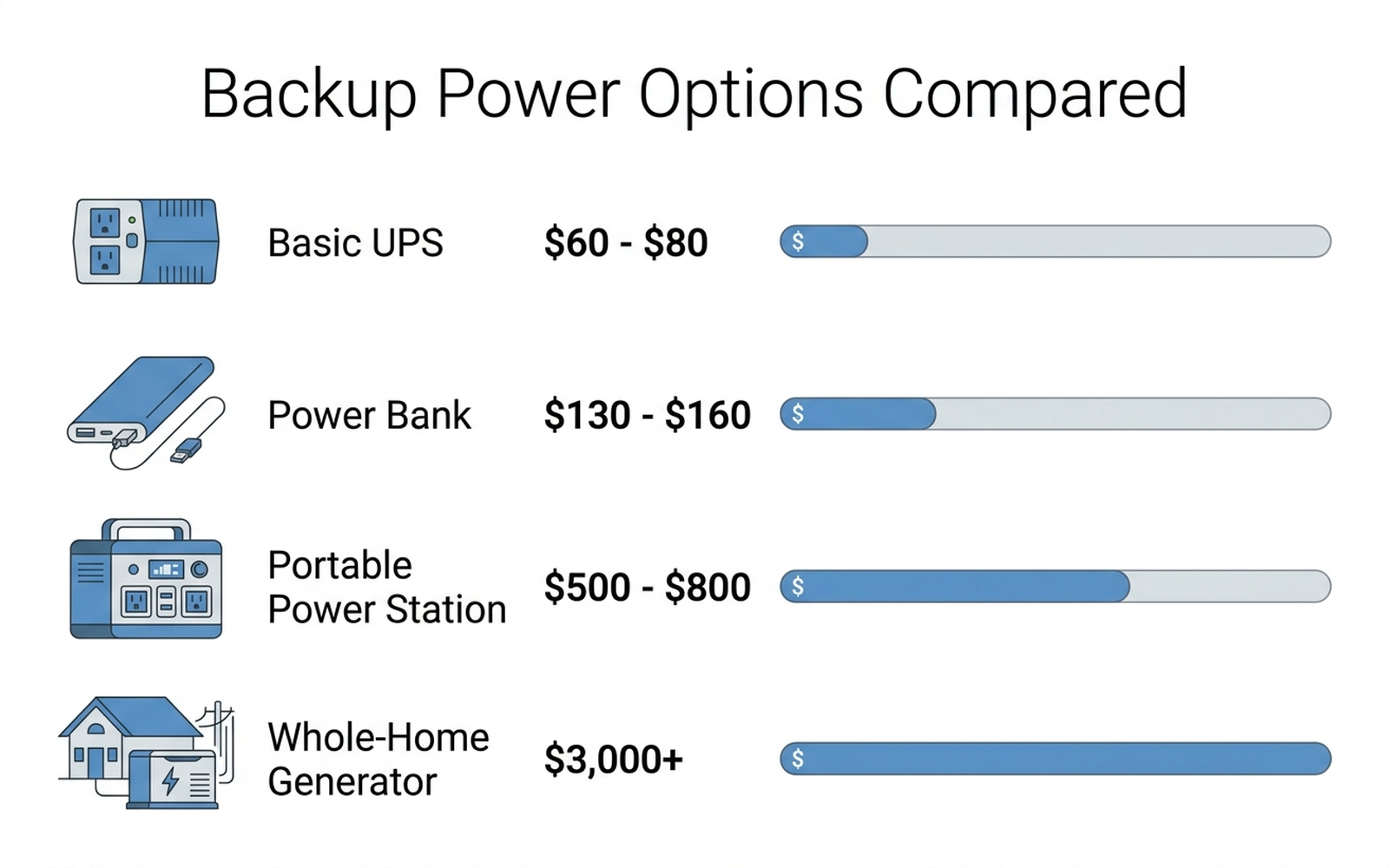
| Device type | Typical price (at writing) | What it protects | Runtime for its job | Best fit |
|---|---|---|---|---|
| Basic UPS (e.g., APC BE600M1) | $60–$80 | Router, modem, single lamp | ~23 min @ 100W (manufacturer spec) | Short, infrequent blips |
| High-capacity power bank (e.g., Anker 737) | $130–$160 | Phone, laptop, small electronics | ~5 phone charges (manufacturer spec) | Travel, commuting, no fridge need |
| Portable power station, ~1,000Wh tier | $500–$800 | Fridge (hours), electronics, CPAP | Several hours to ~1 day | Frequent/multi-hour outages, medical equipment |
| Whole-home standby generator | $3,000–$10,000+ installed | Entire house, automatically | Days, continuous with fuel supply | Homeowners expecting long, recurring outages |
Customer Sentiment Synthesis
Reviewers of small UPS units like the BE600M1 consistently describe the same use case: protecting a home-office setup or networking gear during brief blips, not running major appliances — which lines up with its 23-minute manufacturer-rated runtime at modest load. Power bank reviewers for high-capacity models like the Anker 737 focus on travel convenience, TSA compliance, and the ability to recharge a laptop, not home-backup scenarios. Neither product’s review base frames these devices as fridge or medical-equipment backup, reinforcing that they solve a different, smaller problem than a portable power station does.
Editorial Recommendation by Use Case
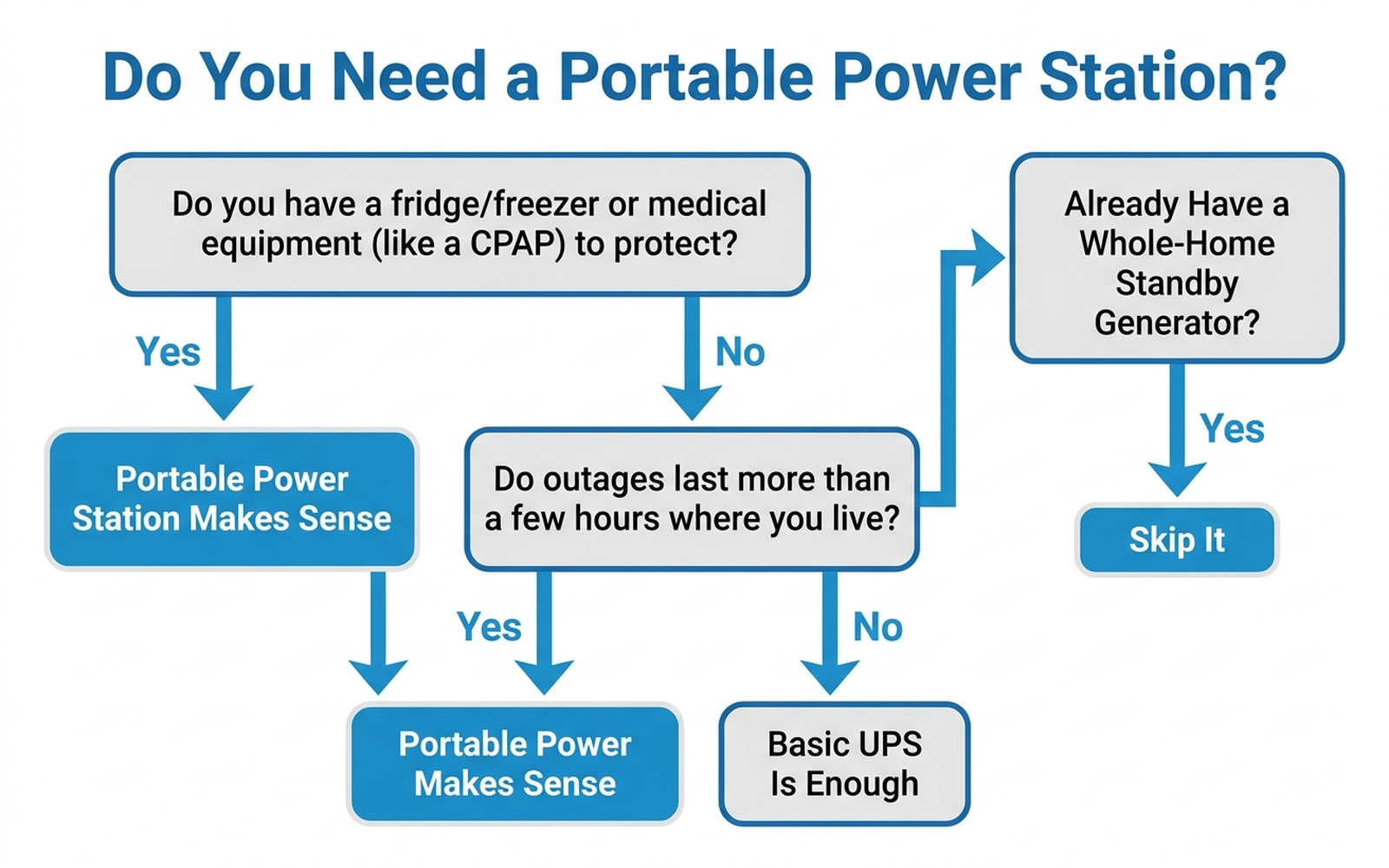
- Short, infrequent outages, no medical equipment, no food to protect: skip the power station; buy a basic UPS for the router and call it done.
- Already have a whole-home standby generator: skip the power station unless you specifically need a portable unit for camping, tailgating, or a job site — you are not filling a gap at home.
- Your problem is a dead phone on the go, not a home outage: buy a power bank, not a power station.
- Frequent multi-hour outages, a fridge/freezer to protect, or medical equipment like a CPAP: a portable power station does earn its price — see our portable power station buying guide for how to size one.
Limitations
This analysis relies on publicly available utility reliability data, manufacturer specifications, and aggregated customer reviews; we did not personally test the products mentioned here. National SAIDI averages mask significant regional and utility-level variation — a household on an above-average-outage utility circuit, or in a wildfire-prone or hurricane-exposed region, may face a very different calculation than the national figures suggest. Individual risk tolerance and the cost of a single ruined refrigerator of food also vary and are not fully captured by cost-per-minute-of-backup math.
Visit Arekore Before You Buy
Before buying any backup power device, paste the product URL into Arekore to check review authenticity and see what aggregated low-star feedback actually says about a specific unit’s real-world runtime.