Best Portable Power Stations in 2026: Jackery vs EcoFlow vs Anker vs Bluetti, a Hurricane-Season Buyer's Guide
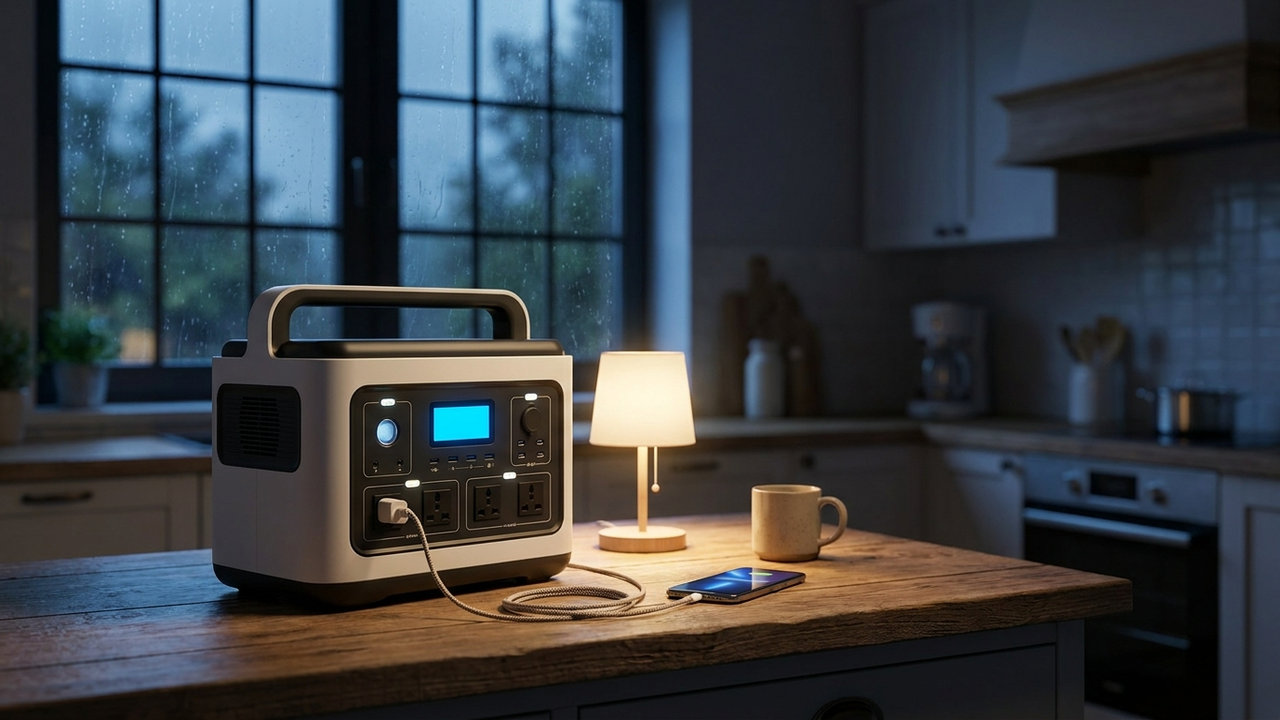
Atlantic hurricane season opened on June 1, and across the storm-prone South and the wildfire-and-heat belt of the West, the question is the same every summer: when the grid goes down, what keeps the refrigerator cold and the phones charged? Portable power stations — large lithium batteries with built-in outlets and inverters — have become the default answer for people who do not want the noise, fuel, and carbon-monoxide risk of a gas generator. But the category is confusing. Capacities run from under 300 watt-hours to over 4,000, prices from about $150 to past $3,000, and four big brands all claim to be the best. This guide breaks down how to match a unit to your actual outage needs, using aggregated review data, independent lab testing, and manufacturer specifications.
As an Amazon Associate, Arekore earns from qualifying purchases. The Amazon product links in this article may include our affiliate tracking ID and may earn us a commission if you buy through them, at no additional cost to you. See our Links Policy for details on how we select products and how commissions do not influence our recommendations.
TL;DR / Quick Verdict
- Best for most households (mid-size outage): the ~1,000Wh class — Anker SOLIX C1000 Gen 2, EcoFlow DELTA 3 Plus, and Jackery Explorer 1000 v2 — runs a fridge plus phones and lights for a short outage and recharges fast.
- Best whole-essentials backup: the EcoFlow DELTA Pro 3 offers the largest capacity and 120/240V output for multi-day coverage and well-pump or large-appliance loads.
- Best balance of capacity and price: the Bluetti Elite 200 V2 and Jackery Explorer 2000 v2 sit around 2,000Wh, enough to ride out an overnight-to-day outage for the core essentials.
- Best grab-and-go / CPAP and devices: the Jackery Explorer 300 Plus at roughly 288Wh covers phones, laptops, and a CPAP overnight.
- Battery chemistry to insist on: LiFePO4 (LFP). Every unit recommended here uses it.
How We Reached These Conclusions (Methodology)
This is an editorial analysis, not a hands-on review. We did not personally test the products covered here. Instead, this guide synthesizes three kinds of public information: (a) aggregated amazon.com customer ratings and the substance of low-star reviews, captured in June 2026; (b) independent third-party testing and reporting from Consumer Reports, Tom’s Guide, TechRadar, GearJunkie, and Outdoor Life; and (c) manufacturer specifications and user manuals. Where we cite a manufacturer figure — charge times, cycle-life claims, surge ratings — we label it as a manufacturer claim rather than an independently verified result. Prices are amazon.com figures at the time of writing and will change, especially around Prime Day.
The US Power-Station Market in 2026
Demand for home battery backup keeps climbing. The US portable power station market was valued near $1.38 billion in 2025 and is projected to reach roughly $2.08 billion by 2035, a compound annual growth rate of about 4.19% (Precedence Research); a separate estimate puts the US market on a faster 7.21% CAGR through 2030 (Arizton). The growth is driven by more frequent grid disruptions, outdoor recreation, and the steady fall in battery costs.
Seasonality sharpens the timing. Colorado State University’s June 2026 update forecasts 11 named storms, 5 hurricanes, and 2 major hurricanes, and places the odds of at least one major hurricane making US landfall at 24%; NOAA’s outlook is similar, calling for 8–14 named storms and a 55% chance of a below-normal season. A quieter forecast is not a reason to skip preparation. Even a single landfalling storm, or a summer heat wave that strains the grid, can knock out power for days in the affected area. That is the use case this guide is built around.
1. First, Size the Battery to the Outage
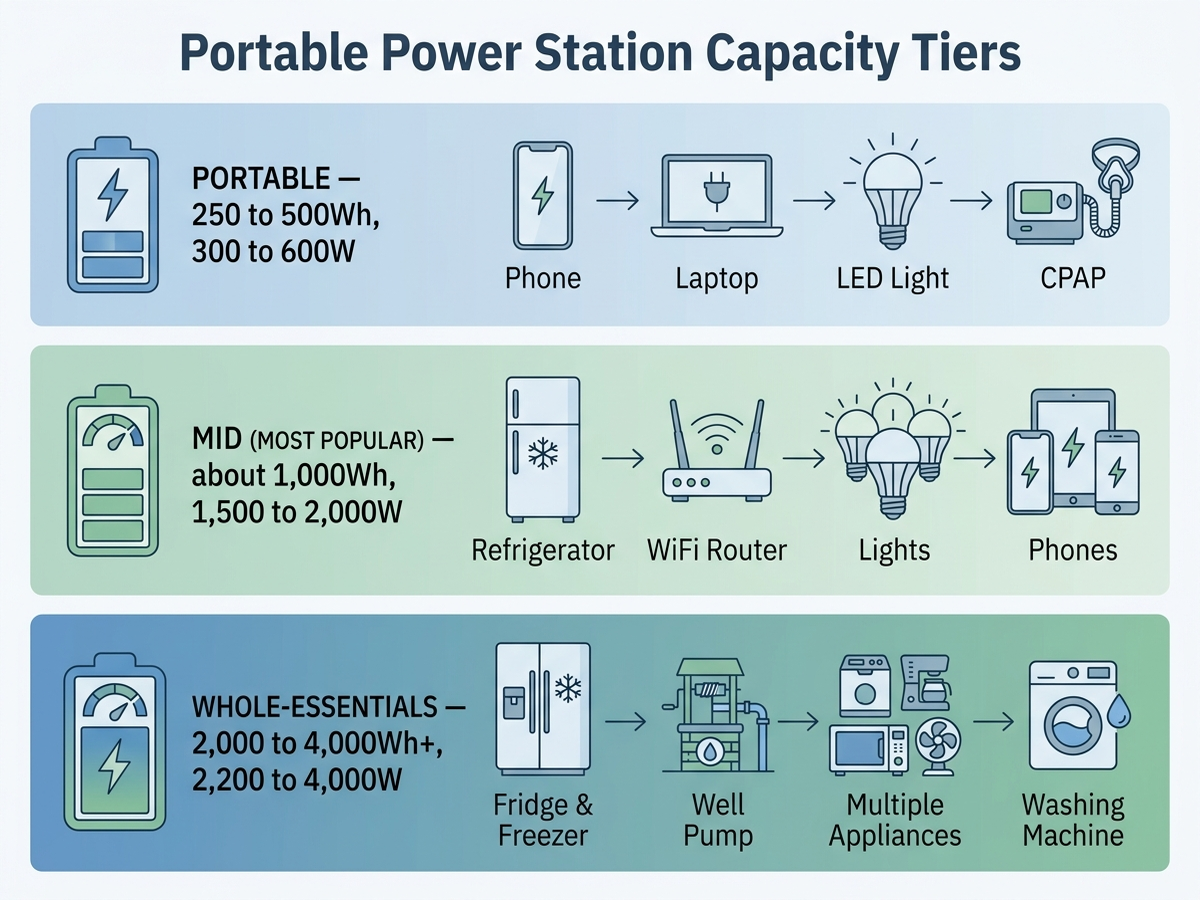
The single most important spec is watt-hours (Wh) — total energy storage. The second is watts (W) — how much the inverter can deliver at once. A unit needs enough watts to start your devices and enough watt-hours to keep them running. Here is the rough math, using the three capacity tiers most buyers choose between.
| Tier | Capacity | Inverter output | What it realistically runs | Typical price (at writing) |
|---|---|---|---|---|
| Portable | 250–500Wh | 300–600W | Phones, laptops, lights, a CPAP overnight, small fan | $150–$300 |
| Mid (most popular) | ~1,000Wh | 1,500–2,000W | Refrigerator for several hours, electronics, lights, modem | $500–$800 |
| Whole-essentials | 2,000–4,000Wh+ | 2,200–4,000W | Fridge + freezer + lights + electronics for a day or more; 240V models add well pumps | $1,000–$3,200 |
To estimate runtime, divide usable watt-hours by your average load. Consumer Reports tests each unit on a constant 300-watt load (a TV and a few lights), and in its refrigerator test the best model it measured ran a side-by-side fridge for 44 hours on a charge while the weakest managed only 13 hours — a reminder that capacity and efficiency vary widely between units. A modern refrigerator averages roughly 100–200 watts over time (it cycles on and off), so a 1,000Wh unit covers a fridge for the better part of a day, while a 2,000Wh+ unit stretches toward a full day or more for the core essentials.
2. Insist on LiFePO4 (LFP) Battery Chemistry
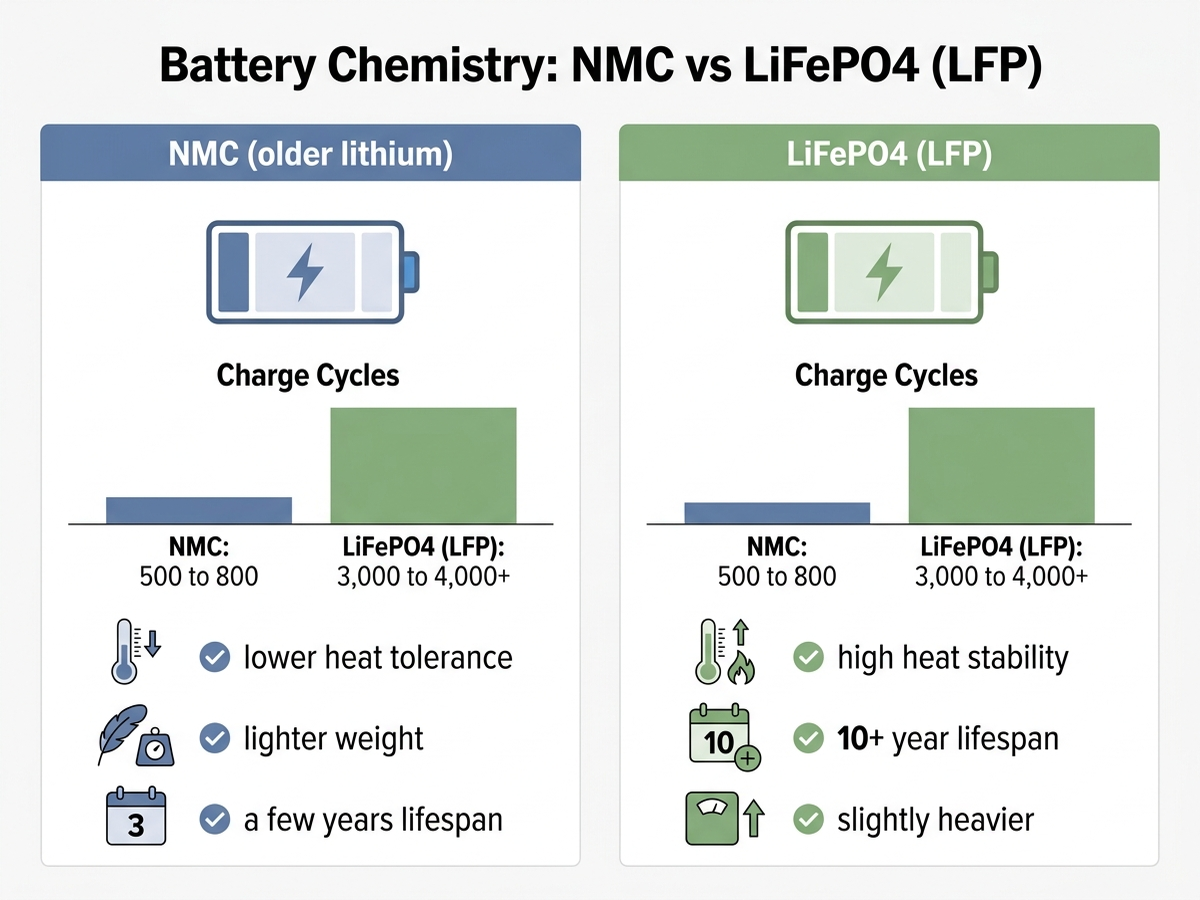
The biggest technical shift in this category is the move from older NMC (nickel-manganese-cobalt) lithium cells to LiFePO4 (LFP). By 2026 LFP is standard across the recommended class, and for good reason.
| Attribute | Older NMC lithium | LiFePO4 (LFP) |
|---|---|---|
| Charge cycles to ~80% | ~500–800 | 3,000–4,000+ |
| Thermal stability | Lower; more heat-sensitive | High; resists thermal runaway |
| Calendar lifespan | A few years of heavy use | 10+ years typical |
| Energy density | Higher (lighter per Wh) | Lower (slightly heavier) |
LFP’s longer cycle life and better heat tolerance matter most for backup gear that may sit charged through a hot summer and then cycle hard during an outage. Jackery, for example, states its LFP units retain over 70% of capacity after 4,000 cycles (a manufacturer claim). The trade-off is weight: LFP is slightly heavier per watt-hour than NMC, which is why grab-and-go units stay small while whole-home units get heavy. Tom’s Guide notes the NMC-to-LFP transition is now mainstream across the roughly $999–$1,499 class, citing 3,000+ cycle life versus 500–800 for NMC.
3. The Four Brands at a Glance
Four brands dominate US power-station shopping. Their reputations differ in useful ways.
| Brand | Reputation | Signature strength |
|---|---|---|
| Jackery | The category’s best-known name; camping heritage | Simple, approachable units; strong portable line |
| EcoFlow | Fast charging and modular expansion | Largest expansion ecosystems; 240V flagship |
| Anker (SOLIX) | Electronics-brand polish and value | Compact, fast-charging mid units |
| Bluetti | Capacity-per-dollar value | Big batteries at competitive prices |
4. Tier 1 — Portable (Grab-and-Go, CPAP, Devices)
If your goal is keeping phones, a laptop, a few lights, and a CPAP machine going through an overnight outage — or powering a campsite — you do not need a heavy unit.
Jackery Explorer 300 Plus — 288Wh LFP, 300W AC output. A compact, roughly 8-pound unit that covers small electronics and a CPAP overnight. Reviewers consistently flag its portability and simplicity as the draw. It will not run a refrigerator or anything with a motor; that is not its job.
Check the Jackery Explorer 300 Plus on Amazon
5. Tier 2 — Mid (~1,000Wh, the Sweet Spot for Most Homes)
This is where most home-backup buyers land. Around 1,000Wh with a ~1,800–2,000W inverter covers a refrigerator plus electronics for a short outage, and these units recharge fast. The three below are closely matched; they are frequently cross-shopped and trade the top spot across review outlets.
Anker SOLIX C1000 Gen 2 — 1,024Wh LFP, 2,000W output (3,000W peak), full charge in a claimed 49 minutes. GearJunkie named the C1000 line a top “one-and-done” pick that won’t feel obsolete next year. Its fast wall charging and compact footprint are the standout points in aggregated reviews.
Check the Anker SOLIX C1000 Gen 2 on Amazon
EcoFlow DELTA 3 Plus — 1,024Wh LFP, 1,800W AC output, expandable to 2,048Wh with a smart extra battery. TechRadar rated the DELTA 3 Plus its best unit for most people, highlighting strong solar input (up to a claimed 1,000W) for fast off-grid recharging and a deep port selection. The expansion path is the reason to pick it over the Anker if you think your needs will grow.
Check the EcoFlow DELTA 3 Plus on Amazon
Jackery Explorer 1000 v2 — 1,070Wh LFP, 1,500W AC output, claimed 1-hour fast charge. The most approachable of the three, with Jackery’s familiar interface and a slightly lower inverter ceiling. A good choice for buyers who value brand familiarity and a simple experience over maximum output or expandability.
Check the Jackery Explorer 1000 v2 on Amazon
6. Tier 3 — Whole-Essentials (2,000Wh and Up)
For multi-day outages, running a fridge and a freezer together, or anyone who wants headroom, step up to the 2,000Wh-plus class. Expect real weight (40–80+ pounds) and consider wheels.
Bluetti Elite 200 V2 — 2,073.6Wh LFP, 2,600W output (3,900W power-lifting peak), claimed 0–80% in 50 minutes. A strong capacity-per-dollar pick that handles essential household devices through an extended outage. Reviewers cite its fast wall charging and relatively compact size for the capacity.
Check the Bluetti Elite 200 V2 on Amazon
Jackery Explorer 2000 v2 — 2,042Wh LFP, 2,200W output. Tom’s Guide called the Jackery 2000-class the “value inflection point” in the market — above roughly $999 you are mostly paying for capacity headroom many home users never fully use. A sensible whole-essentials default.
Check the Jackery Explorer 2000 v2 on Amazon
EcoFlow DELTA Pro 3 — 4,096Wh LFP, 4,000W output (some reviewers cite the 3,600W pure-sine-wave figure), 120/240V, expandable to a manufacturer-claimed 48kWh with extra batteries. Tom’s Guide rated it the top home-backup unit for 2026, noting the 240V output handles virtually any household circuit and the expansion ecosystem scales from one unit to a near-whole-home system. This is the pick if you need to run a well pump, a 240V appliance, or want a foundation you can grow into. It is also the heaviest and most expensive option here.
Check the EcoFlow DELTA Pro 3 on Amazon
7. Side-by-Side Comparison
| Model | ASIN | Capacity | AC output | Chemistry | Tier | Approx. price (at writing) |
|---|---|---|---|---|---|---|
| Jackery Explorer 300 Plus | B0CFV93GZM | 288Wh | 300W | LFP | Portable | $150–$250 |
| Anker SOLIX C1000 Gen 2 | B0FN7MSY4L | 1,024Wh | 2,000W (3,000W peak) | LFP | Mid | $500–$700 |
| EcoFlow DELTA 3 Plus | B0DCC2BVFW | 1,024Wh | 1,800W | LFP | Mid | $500–$700 |
| Jackery Explorer 1000 v2 | B0D7PPG25F | 1,070Wh | 1,500W | LFP | Mid | $500–$800 |
| Bluetti Elite 200 V2 | B0DCJV9LTB | 2,073.6Wh | 2,600W (3,900W peak) | LFP | Whole-essentials | $900–$1,400 |
| Jackery Explorer 2000 v2 | B0DFG2WDQH | 2,042Wh | 2,200W | LFP | Whole-essentials | $1,000–$1,500 |
| EcoFlow DELTA Pro 3 | B0D14FMFZD | 4,096Wh | 4,000W (120/240V) | LFP | Whole-home | $2,400–$3,200 |
Capacities and outputs are from manufacturer specifications. Prices fluctuate; verify the current amazon.com price and any strikethrough deal before buying.
8. How to Use a Power Station for Outage Backup
A power station only helps if it is ready when the lights go out. A few practical points, drawn from manufacturer guidance and reviewer consensus:
- Keep it charged. LFP units self-discharge slowly, but check the charge every couple of months and top off before storm season.
- Know your loads. Add up the wattage of what you must run (fridge label, CPAP, modem, lights) and confirm it is below the inverter’s continuous output, with headroom for motor startup surge.
- Never run it like a gas generator. Power stations are safe indoors — no fumes — but do not exceed the rated output, and keep them in a ventilated, dry spot.
- Plan recharging. During a multi-day outage, a solar panel or charging from a running car (via the appropriate accessory) extends runtime. Check what your unit supports.
- Refrigerator strategy. Open it as little as possible and the same charge lasts far longer, since the compressor cycles less.
9. Warranty and Support
Warranty length tracks the shift to LFP. Across this class, manufacturers commonly offer 5-year warranties on the recommended units (manufacturer terms; confirm at purchase). Bluetti markets a 17-year lifespan figure for the Elite 200 V2 based on cycle life — that is a projected-lifespan claim, not a 17-year warranty, and the two should not be confused. Register your unit after purchase, keep the receipt, and note that warranty coverage generally requires use within rated limits.
10. Editorial Recommendation by Use Case
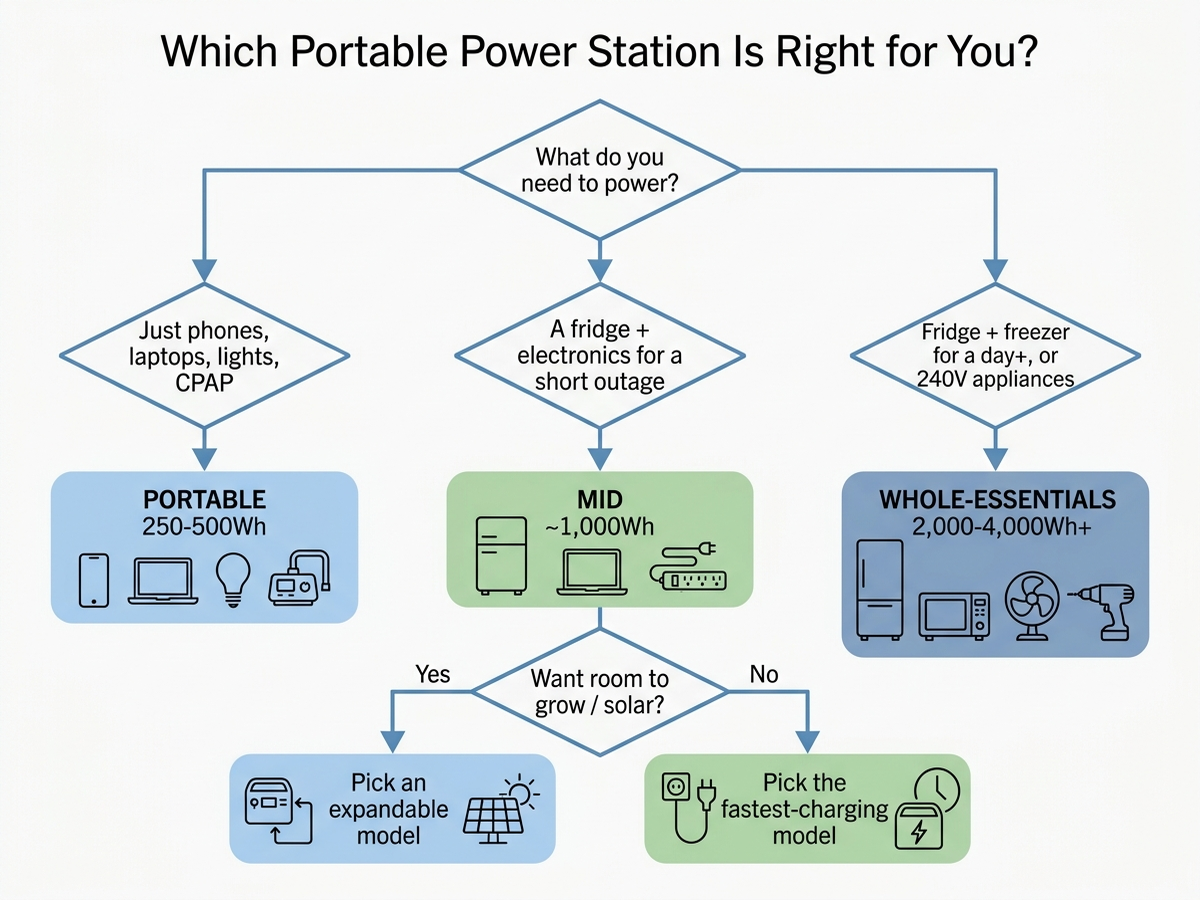
- Most households preparing for a short outage: a ~1,000Wh mid unit. Choose the Anker SOLIX C1000 Gen 2 for the fastest charging and highest output, the EcoFlow DELTA 3 Plus if you want a future expansion path, or the Jackery Explorer 1000 v2 for the simplest experience.
- Whole-essentials, multi-day, or 240V loads: the EcoFlow DELTA Pro 3, or the Bluetti Elite 200 V2 / Jackery Explorer 2000 v2 for a lighter, lower-cost 2,000Wh option.
- Devices, CPAP, and grab-and-go: the Jackery Explorer 300 Plus.
- Everyone: insist on LFP chemistry and buy before peak storm season, when popular models sell out.
Limitations
This analysis relies on publicly available reviews, third-party reporting, and manufacturer specifications; we did not independently lab-test these units. Charge times, surge ratings, cycle-life, and runtime figures are manufacturer claims or come from cited third parties, and real-world results vary with load, temperature, and unit-to-unit variance. Capacities and prices were accurate to our research at the time of writing and change frequently — verify current specs and pricing on the product page before purchasing. Hurricane forecasts describe probabilities, not certainties, and should not be read as a guarantee of either an active or a quiet season in any specific location.
Before you buy any of these, it pays to check that the listing’s reviews are genuine and the price is actually a deal. That is exactly what Arekore does: paste the Amazon URL and our AI analyzes review authenticity, surfaces the most useful low-star feedback, and compares pricing in about five minutes — so you head into storm season with the right unit, not just the most heavily advertised one.