Hair Dryer Grinding Noise 2026: Repair or Replace It?
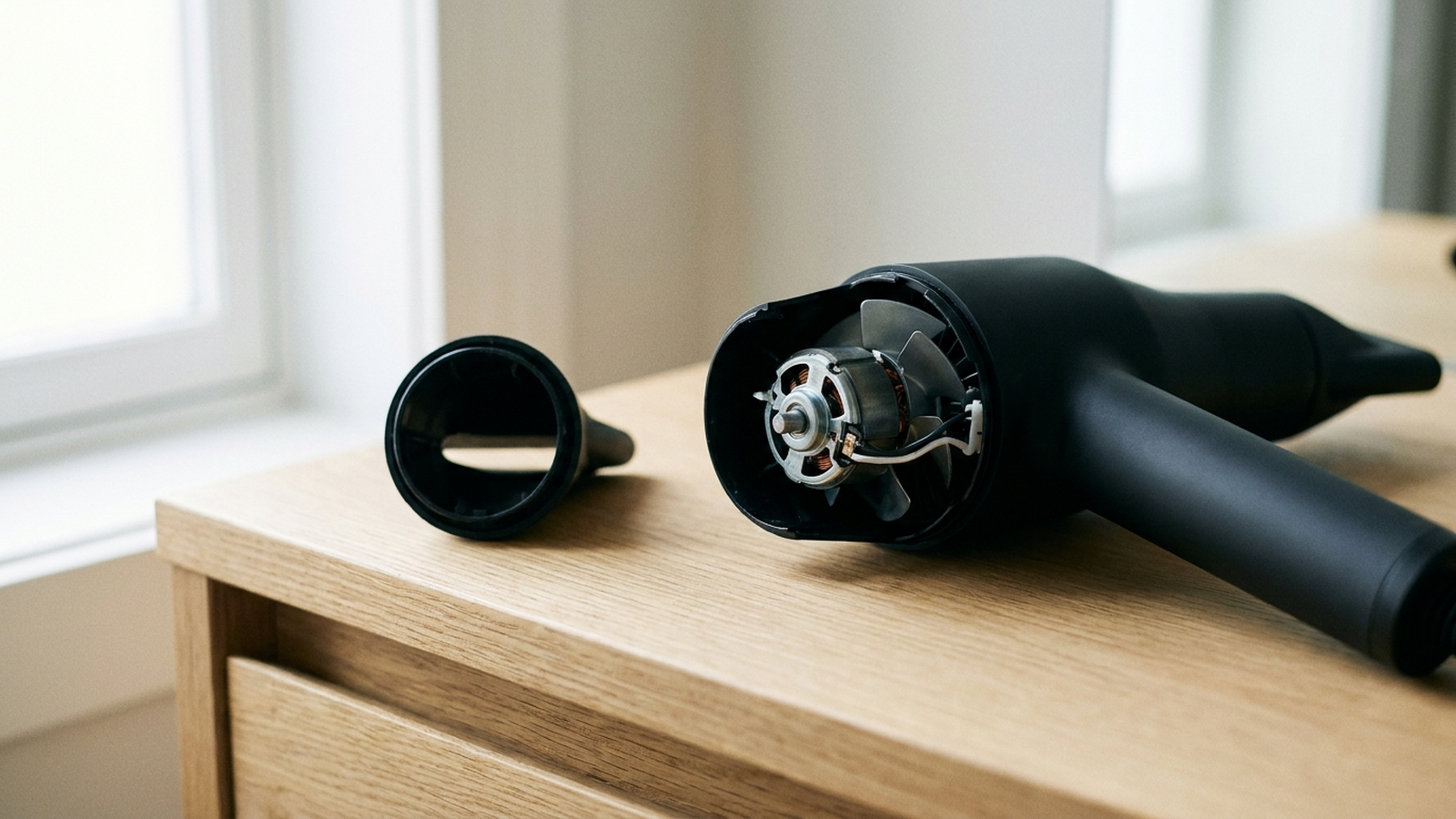
TL;DR. A grinding noise from a hair dryer usually means one of four things: a worn motor bearing, debris jammed in the intake grille, a loosened motor mount, or a failing heating element. The first two are often fixable in minutes at home; the last is a genuine fire-risk signal that means “unplug now, do not keep using it.” Whether repair makes financial sense mostly comes down to a simple industry rule of thumb — if the repair costs more than half the price of a comparable new unit, replace it.
A note on links and methodology
The product links in this article go to amazon.com without any affiliate tracking — we have not yet been accepted to the Amazon Associates US program (application is pending). See our Links Policy for the long version.
We also did not personally test the replacement products recommended below. Every diagnostic and product claim in this article is an editorial synthesis of public data, cited inline.
Methodology
This is an editorial analysis based on publicly available data collected in July 2026. We did not run controlled failure tests on hair dryer motors ourselves; instead we synthesized:
- Independent appliance-repair documentation — iFixit’s Hair Dryer Fan/Motor Assembly Replacement guide, iFixit’s Hairdryer Troubleshooting wiki, and the Revlon 1875W hair dryer teardown, which physically documents how the motor, fan, and heating coil are assembled.
- US federal safety records — the Consumer Product Safety Commission (CPSC) recall database, specifically hair-dryer-related recalls for overheating and fire risk.
- Appliance-repair industry cost guidance — repair-service publications describing the “50% rule” used across the appliance-repair trade to decide repair versus replacement, corroborated by multiple independent repair businesses.
- Manufacturer warranty pages for Dyson, Shark (SharkNinja), Revlon, and Conair.
- Aggregated Amazon customer review sentiment on amazon.com for the specific replacement products recommended in this article, read via each product’s “Top reviews” and “Customers say” summary panels in July 2026. We do not report a precise review-count N because Amazon’s review panels do not expose a stable, verifiable count; a fabricated number would be misleading.
- European independent test context — Stiftung Warentest’s hair dryer testing program, cited for its noise/handling evaluation methodology.
We deliberately do not simulate a specific personal repair experience, invent a fake reviewer persona, or claim we personally opened up a broken unit. The advice below is a synthesis of documented repair procedures, safety records, and warranty terms — treat it as a starting framework, not a substitute for a qualified appliance technician’s inspection.
1. Four things that sound like “grinding” — and how to tell them apart
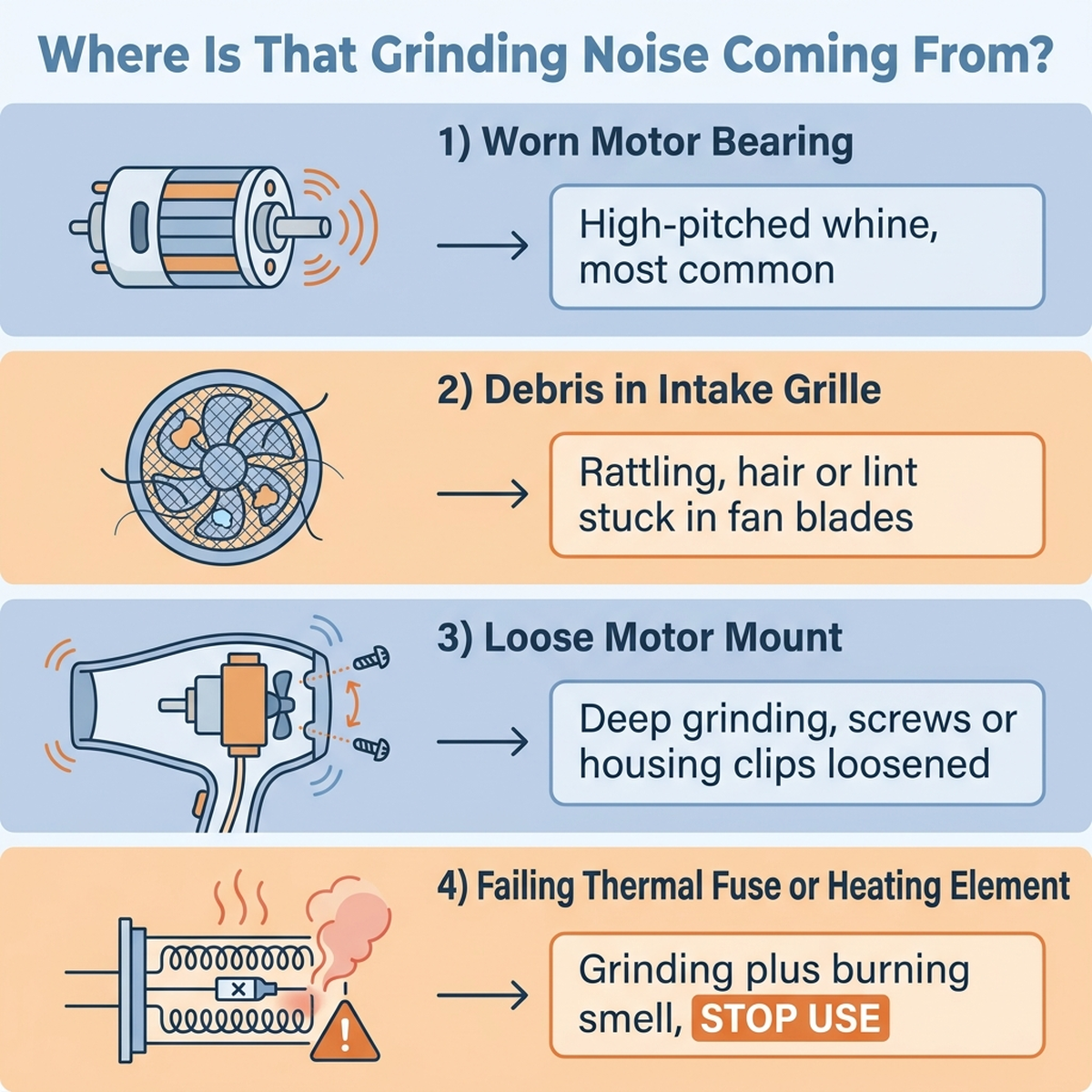
“Grinding” is a catch-all term. In appliance-repair documentation, the sound your dryer makes usually maps to one of four distinct mechanical causes:
| Cause | What it sounds like | Fixable at home? | Urgency |
|---|---|---|---|
| Worn motor bearing | A steady, high-pitched whine that gets louder as the motor spins up | Sometimes — depends on whether the motor housing is user-serviceable | Low (not a safety issue, but will worsen) |
| Debris in the intake grille | Rattling or a scraping sound that changes when you tilt the dryer | Yes — this is the most common false alarm | Low |
| Loose motor mount or housing clip | A deeper, rattling grind, often worse when the dryer is held at certain angles | Sometimes, with a screwdriver | Low-medium |
| Failing heating element or thermal fuse | Grinding combined with a burning smell, discoloration, or the dryer cycling on and off | No — stop using it | High: fire and shock hazard |
The distinction that matters most is between the first three (annoying, usually not dangerous) and the fourth (a genuine safety signal). The CPSC’s hair-dryer recall history exists specifically because of this last category: the 2018 Xtava Allure recall covered roughly 235,000 units after the manufacturer received 193 reports of the dryers or their power cords overheating, melting, or catching fire, including 18 burn injuries. Earlier CPSC actions — the 1997 Pomair recall (thermostat malfunction, overheating) and the 1994 Model PRO1600 recall (flammable motor-mount material) — followed the same pattern: a heat-related fault that a user could have noticed early as unusual noise, smell, or a hot housing.
The practical rule: if the grinding is accompanied by any burning smell, visible smoke, discoloration around the vents, or the dryer getting hot to the touch on the outer housing, unplug it immediately and do not attempt a repair. If it’s just noise with no smell or heat change, it’s very likely one of the first three causes.
Worth noting: how repairable a hair dryer is by design varies a lot, and it isn’t only a US question. iFixit — the same organization whose teardown documentation informs this section — is also a lead advocate for Right to Repair legislation on both sides of the Atlantic, including the EU’s Ecodesign for Sustainable Products framework, which is gradually pushing small-appliance manufacturers toward more serviceable designs (removable batteries, published spare-part lists). Stiftung Warentest, the German institute widely regarded as Europe’s benchmark for independent appliance testing, runs hair dryers through roughly two weeks of lab evaluation that includes a dedicated noise/handling assessment (rating how the perceived sound compares across models, not just raw decibels) — the same “how it actually sounds and feels to use” angle that matters when deciding whether a noise is normal wear or a fault. US small appliances, including most hair dryers, are not yet covered by an equivalent repairability mandate, which is part of why a $79 dryer with a failed motor mount is usually cheaper to replace than to fix.
2. Manufacturer- and brand-specific patterns
Because dryer construction varies meaningfully by brand and price tier, what’s “normal” to inspect differs across the products US shoppers actually own.
Dyson Supersonic. Dyson states its V9 digital motor is a sealed, high-RPM (Dyson publishes a figure of up to 110,000 RPM) assembly mounted in the handle, not the head — a fundamentally different layout from conventional dryers. Dyson does not publish a user-serviceable motor-bearing repair procedure; if a Supersonic starts grinding, Dyson’s own repair-and-servicing page directs owners to book an inspection through an authorized Dyson Service Center rather than attempt a DIY teardown. Out-of-warranty repairs are quoted after inspection — Dyson does not publish a flat fee, and the owner is responsible for return shipping if they decline the quoted repair.
Shark FlexStyle (SharkNinja). SharkNinja support routes noise complaints through standard customer service and warranty channels; because the FlexStyle is a multi-styler with more moving attachments (auto-wrap barrels, brush heads) than a simple dryer, a grinding sound is more often traced to an attachment not seating correctly than to the core motor — worth checking before assuming a motor fault.
Revlon One-Step / Conair. These sit in the more traditional, less sealed construction category. iFixit’s teardown of a Revlon 1875W dryer documents a straightforward layout: motor, fan, and heating coil accessible after removing a handful of screws — but the same teardown also notes that on some models the fan and motor are integrated tightly enough that removing the fan without damaging it is not realistic for a home repair. In practice, this means a grinding noise on a sub-$100 hot-air brush or basic dryer is usually not worth repairing even when the parts are technically accessible — the labor cost of a technician exceeds the price of a new unit.
3. The repair-or-replace decision: the 50% rule
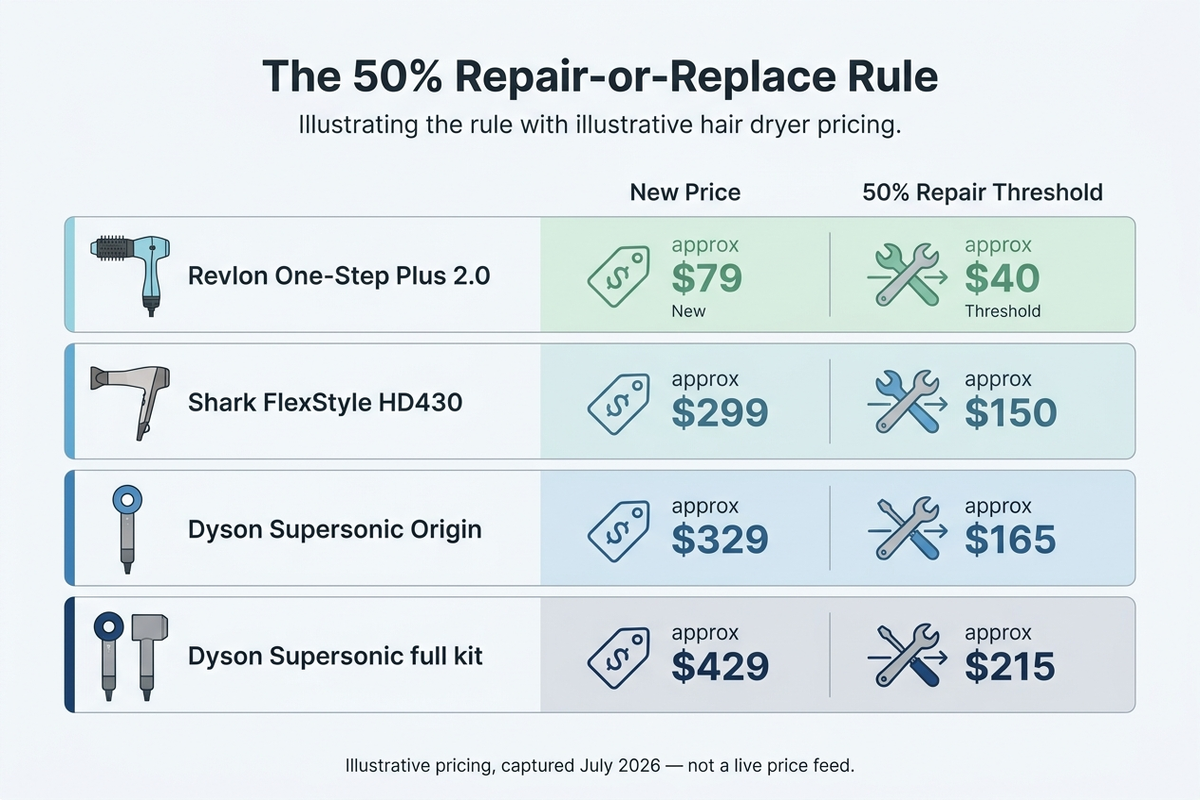
The appliance-repair trade has a widely used shorthand for this decision, sometimes called the “50% rule”: if a repair quote exceeds roughly half the cost of a comparable new unit, replacement is the better financial move. Independent repair-service publications consistently describe the same threshold, while also noting an important caveat: the rule is a starting heuristic, not an absolute — appliance age and remaining warranty coverage matter just as much as the raw percentage.
Applied to hair dryers at 2026 US Amazon pricing (captured at time of writing):
| Product | Price new (USD) | 50% repair threshold | Practical read |
|---|---|---|---|
| Revlon One-Step Plus 2.0 | ~$79 | ~$40 | Almost never worth a paid repair — replace |
| Shark FlexStyle HD430 | ~$299 | ~$150 | Worth a repair quote if it’s a simple fix (attachment, debris) |
| Dyson Supersonic Origin | ~$329 | ~$165 | Worth requesting Dyson’s official quote before replacing |
| Dyson Supersonic, full kit | ~$429 | ~$215 | Worth requesting Dyson’s official quote, especially with attachments included |
The lower a dryer’s original price, the less sense a paid repair makes — this is simple arithmetic, not a brand judgment. A $79 Revlon hot-air brush that needs a $45 motor-mount repair is a bad trade; a $429 Dyson with a $180 quoted fix is a reasonable one, especially since it retains the diffuser and attachment set that a brand-new equivalent would also cost you.
Age matters as much as price. A dryer under roughly 2 years old is almost always worth repairing (or getting fixed for free under warranty) regardless of the 50% math, because most of its useful life remains. A dryer past the 3-4 year mark that beauty-industry publications cite as a typical hair-dryer lifespan is a weaker repair candidate even if the quote looks favorable on paper, simply because other components (heating coil, switch contacts) are statistically closer to failing too.
4. What to actually do, step by step
- Unplug the dryer immediately if you smell burning, see smoke, or notice discoloration around the vents. Do not attempt any further troubleshooting on a unit showing these signs — replace it.
- If there’s no smell or heat issue, check the intake grille first. Most dryers have a removable rear grille; lint, hair, and dust accumulation there is, per iFixit’s troubleshooting documentation, one of the most common causes of both rattling and reduced airflow that can eventually strain the motor. Clean it with a dry brush or compressed air, unplugged.
- Check whether the dryer is still under manufacturer warranty. Dyson (2 years), Shark (2 years on the FlexStyle line), and Revlon (4 years if product-registered) all offer warranty repair or replacement for manufacturing defects — a grinding motor at 14 months old on a Dyson should go straight to Dyson’s service center, not a personal repair attempt.
- Get an actual repair quote before assuming cost. Whether through the manufacturer (Dyson, SharkNinja) or a local small-appliance repair shop, get a number, then apply the 50% rule from the table above.
- If it fails the 50% rule, or it’s outside warranty and old enough that other parts are also due to wear out, replace it — the products below are current, size-appropriate replacements at different budget points.
5. If you’re replacing it: budget-tier recommendations
Editorial recommendation, not personal testing. These follow the same brand-tier logic used in our hair dryer comparison article, adapted for someone replacing a broken unit rather than upgrading from scratch.
- Budget replacement, under $30: Conair INFINITIPRO Advanced Ceramic Hair Dryer with Heat-Sense Technology — 1875W AC motor, ceramic technology. Conair and Revlon together are described as commanding a dominant share of unit volume in the US hair-dryer category (IndexBox brand analysis, 2025), making a Conair-tier dryer one of the most-purchased entry-level replacement categories in the US. At this price, if it ever grinds again in 2-3 years, replacing rather than repairing is close to automatic under the 50% rule.
- Mid-tier, ~$79: Revlon One-Step Volumizer Plus 2.0 if you want a hot-air brush rather than a pure dryer.
- Premium, ~$299: Shark FlexStyle HD430 if the failing unit was also doing double duty as a styler.
- Premium, ~$329-$429: Dyson Supersonic Origin or the full kit if your previous dryer was a Dyson and you were satisfied with dry time and heat control before it failed — and especially if your old unit’s warranty had already lapsed, since Dyson’s out-of-warranty repair quotes can approach the cost of the Origin anyway.
6. Warranty and after-sales comparison
| Brand | Warranty length | Covers noise/motor defects? | How to claim |
|---|---|---|---|
| Dyson | 2 years | Yes, defects in materials/workmanship | Dyson repair-and-servicing portal; free if in-warranty, quoted if not |
| Shark (SharkNinja) | 1-2 years depending on SKU | Yes | SharkNinja customer service; registration extends some claims |
| Revlon | 4 years if registered | Yes | Revlon customer service; unregistered units get a shorter default term |
| Conair | Varies by line, typically 1 year | Yes | Conair customer service |
If your dryer is inside its warranty window, a grinding noise almost always belongs to the manufacturer’s service channel first — before you spend money on an independent repair shop or buy a replacement outright.
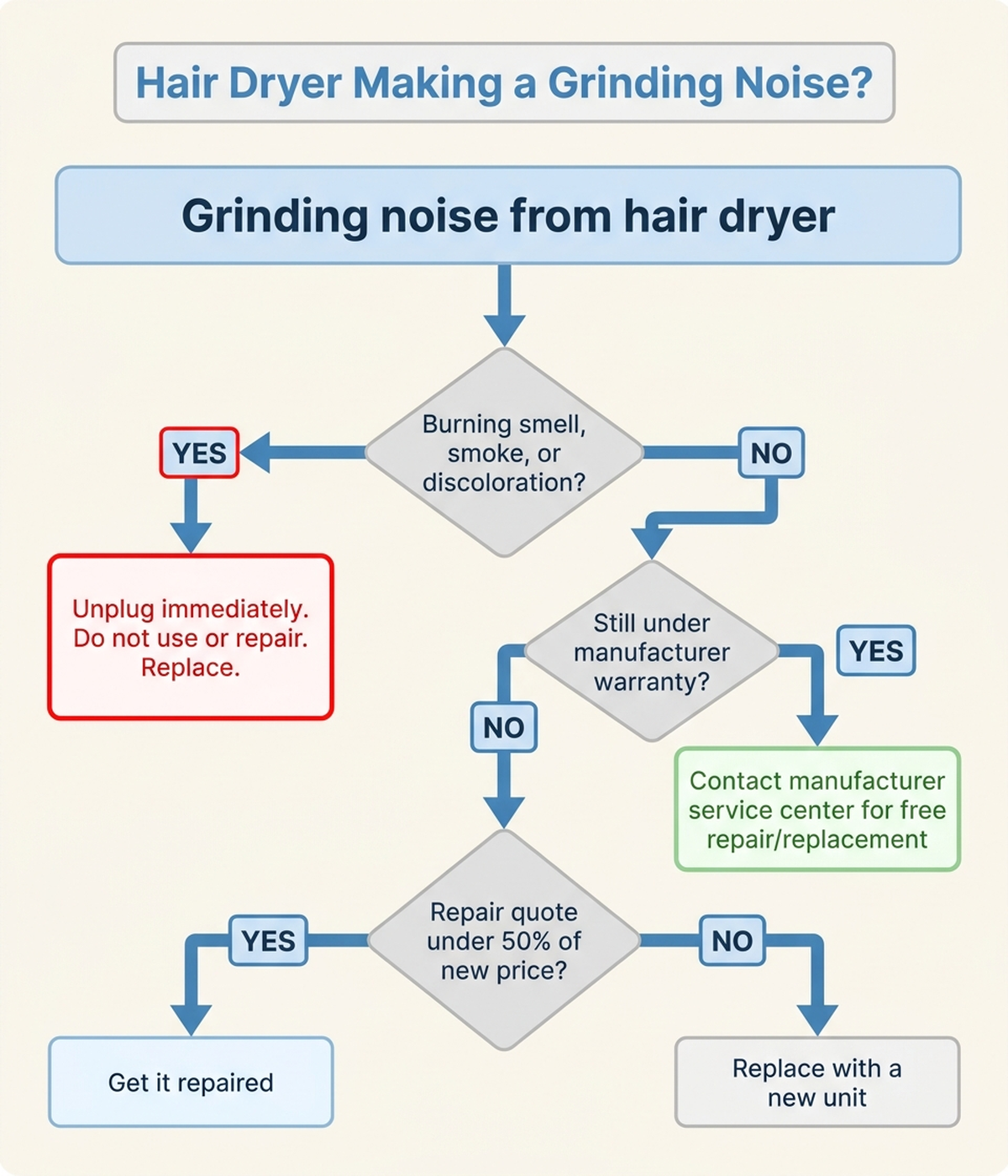
7. The decision flowchart
8. Still not sure whether to trust a replacement listing?
If you’ve found a specific replacement dryer on Amazon and want a second opinion before buying — paste the product link into the Arekore app. The app reads the aggregated customer reviews, flags review-integrity red flags, and checks whether the current price is reasonable against the historical range. It takes about 5 minutes per product, is free, and does not require an account.
9. The bottom line
A grinding hair dryer is rarely an emergency — unless it comes with a burning smell, in which case it always is. For everything else: clean the grille first, check the warranty second, get a real repair quote third, and apply the 50% rule fourth. Below $100, replacing almost always wins on pure economics. Above $300, a warranty claim or a real repair quote is worth the 10 minutes it takes to request one before you buy anything new.
Limitations of this analysis
To be explicit about what this article does not establish:
- We did not personally disassemble or repair any of the specific units named here. The mechanical causes described (bearing wear, debris, motor mount, thermal fuse) are drawn from published appliance-repair documentation and iFixit teardowns of hair dryers, not from a controlled test we ran ourselves.
- The “50% rule” is an industry heuristic, not a universal law. Multiple independent repair-service sources describe it consistently, but they also note it fails to be the right call in a meaningful share of individual cases — age, remaining warranty, and part availability can override the pure cost math.
- Repair costs cited here are illustrative thresholds, not real quotes. Actual repair pricing depends on your region, the specific technician, and whether the fault is diagnosed correctly on the first visit.
- CPSC recall examples cited are historical (1994-2020) and describe specific defective models, not a claim that any currently sold Dyson, Shark, Revlon, or Conair product has an active safety issue. We found no active recall for the specific ASINs recommended in this article at the time of writing.
- Pricing for replacement products fluctuates with promotions; confirm current pricing on the linked page before purchase.
- Amazon review sentiment was read from each ASIN’s public review panels in July 2026 and reflects aggregated impressions, not a scientific sample.
Want a 5-minute check on a specific replacement you’re considering? Try the free Arekore app — paste any Amazon link and we’ll read the reviews and check the pricing for you.