Best Hair Dryers in 2026: Dyson Supersonic vs Shark FlexStyle vs Revlon One-Step — Three Technical Approaches, Compared
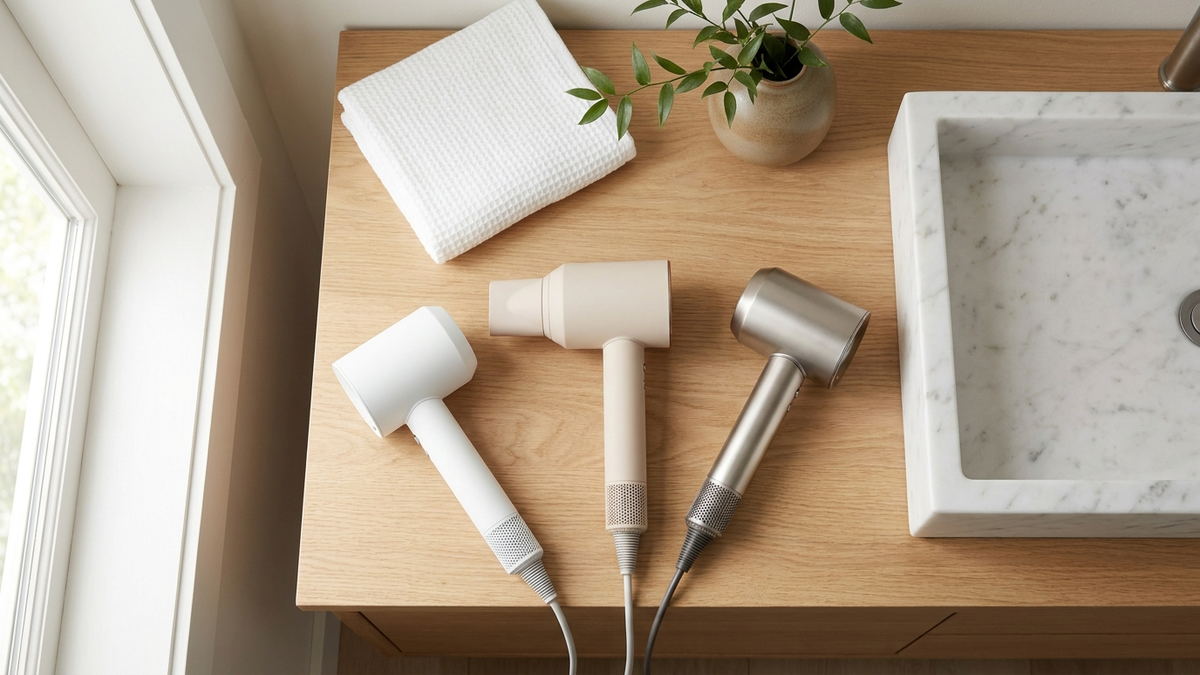
TL;DR. The US premium hair dryer market in 2026 is a three-way contest between speed-with-cool-air (Dyson — German lab Stiftung Warentest’s 2024-2025 test winner at grade 1.7), multi-styler-as-dryer (Shark FlexStyle), and dry-and-style-in-one (Revlon One-Step). Each is built around a different engineering bet. Below: the technical approach behind each, what aggregated customer reviews and independent lab tests actually say, market context (Conair 44% / Revlon 11% / Shark premium tier), and a use-case flowchart.
A note on links and methodology
The product links in this article go to amazon.com without any affiliate tracking — we have not yet been accepted to the Amazon Associates US program (application is pending). When that changes, we will update the links and add a proper FTC affiliate disclosure here. See our Links Policy for the long version.
We also did not personally test these products — every claim is an editorial synthesis of public data. The Methodology section below explains exactly which data we used.
Methodology
This article is an editorial analysis based on publicly available data collected in June 2026. We synthesized four categories of source:
- Customer reviews on amazon.com — we read the “Top reviews”, “Most recent reviews”, and the AI “Customers say” summary block on each ASIN’s product page to identify recurring positive and negative themes. We do not report a precise sample size N because Amazon’s review panels do not expose a stable count; reporting a fake precise N would be misleading.
- Independent lab and editorial tests — Stiftung Warentest (the German consumer-test foundation, considered the European gold standard for appliance testing), CNN Underscored’s year-long head-to-head, Tom’s Guide, Vacuum Wars 2024 dryer comparison, TechRadar’s 2026 ranking, Wirecutter (NYT), and Reviewed (USA Today).
- Manufacturer specifications — official Dyson Supersonic Professional page, Shark FlexStyle Amazon listings, and Revlon One-Step product spec sheets.
- Market data — US hair dryer market size and brand share figures from news.market.us / market.us Statistics 2026, Future Market Insights, and IndexBox brand analysis.
We deliberately do not simulate first-person product experience, fabricate reviewer personas, or invent precise data points we cannot verify. Recommendations are editorial opinions formed from the synthesis above.
0. Market context: who actually buys premium hair dryers in the US
Before the brand-by-brand comparison, a brief market framing. The US hair dryer market was approximately USD 1.3 billion in 2024 and forecasted to grow toward USD 3.8 billion by 2035 (Future Market Insights). Brand-share analysis (IndexBox, 2025) places Conair as the volume leader at roughly 44% market share, Revlon at ~11%, with Dyson and Shark occupying the premium-price/low-volume “Star” segment (high price per unit, smaller share by units but high share of dollar premium).
In practice, what this means for you: if you want the cheapest dryer that works, Conair is the volume answer and is not in this article. If you want the dryer that defines the premium tier and gets praised by independent labs — Dyson, Shark, and Revlon’s “premium” line (One-Step Plus 2.0) are the three you should actually compare against each other. That is what this article does.
1. Three technical approaches to the same problem
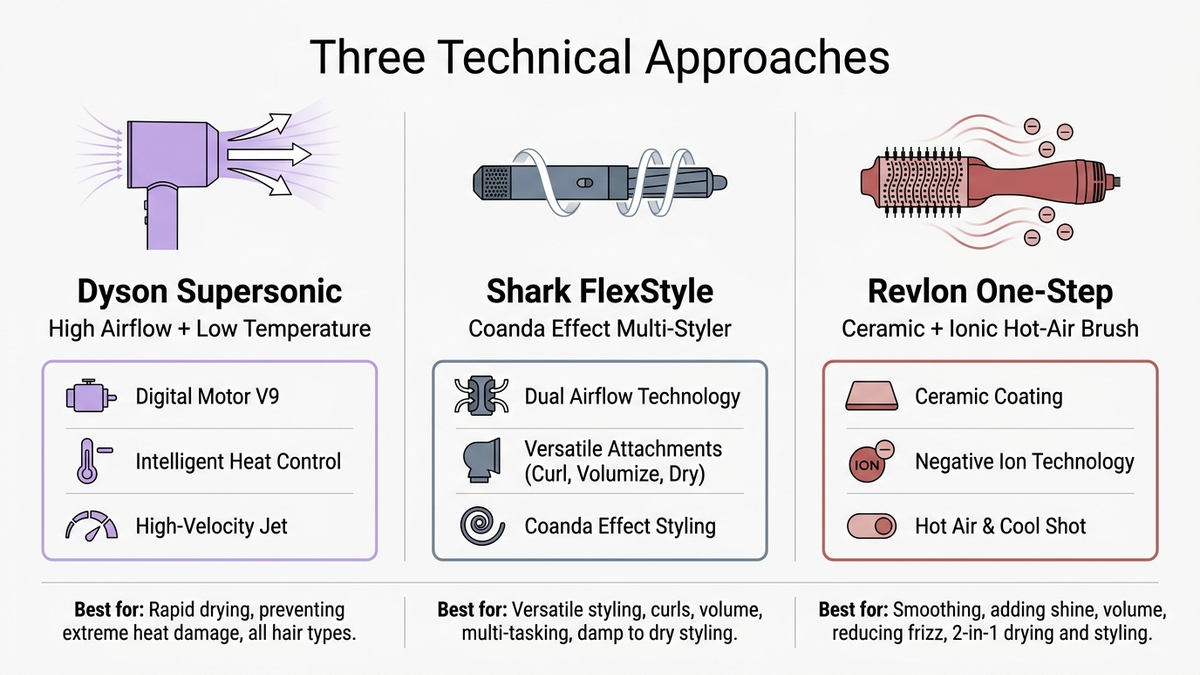
The first thing to understand about modern premium hair dryers is that the three brands we cover here are solving the same “dry hair fast without damaging it” problem with three completely different engineering approaches.
| Brand | Core technology | Approach in one sentence | Best at |
|---|---|---|---|
| Dyson Supersonic | Digital motor V9 spinning at up to 110,000 RPM, located in the handle, with Air Multiplier™ technology | High air pressure + low temperature: dry by airflow, not heat | Drying time + heat protection |
| Shark FlexStyle | Multi-styler architecture with Coanda effect curling, 1,000 temperature checks per second, switchable dryer/styler heads | One device does both drying and Airwrap-style curling at roughly half the price | Multi-functionality at a budget |
| Revlon One-Step | Hot-air brush (not a separate dryer + brush), with ceramic titanium tourmaline plating delivering ions to seal the cuticle | Dry and style simultaneously in a single tool | Salon-style blowouts at home, under $100 |
The key insight is how each brand reduces heat damage:
- Dyson generates so much airflow (13 liters per second through the amplifier, per the official Dyson page) that it can dry hair at lower air temperatures. The Dyson digital motor V9 measures airflow temperature 40 times per second and auto-adjusts. This 40-per-second figure has been independently cited in non-English-market editorial coverage as well, including German and Chinese consumer publications.
- Shark FlexStyle also continuously measures temperature, at a higher frequency (1,000 times per second, according to Shark — see CNN Underscored’s year-long review). However, the FlexStyle’s heat ceiling is higher than Dyson’s, so the protection is “intelligent but not capped” — the device can still run hotter than Dyson if styling demands.
- Revlon One-Step takes a different angle entirely: ceramic-titanium-tourmaline plating, which the manufacturer claims achieves 50% less heat exposure by emitting negative ions that reduce static and seal the cuticle (see Revlon’s official product page).
If you understand which approach matches your morning routine, the rest of this article is just confirming a decision you’ve nearly made.
2. Quick comparison table (2026)
Prices captured at time of writing, June 2026. Confirm current pricing on the linked product page before purchase. Full specs (ASIN, weight, attachment count) are in each product’s section below.
| Product | Price (USD) | Power | Best for |
|---|---|---|---|
| Dyson Supersonic, full kit | $429 | 1,600 W | Daily blow-dry, curly hair (diffuser included) |
| Dyson Supersonic Origin | $329 | 1,600 W | Dyson at lower price, straight-to-wavy hair |
| Shark FlexStyle (HD430) | $299 | 1,400 W | Dyson Airwrap alternative (multi-styler) |
| Revlon One-Step Plus 2.0 bundle | $79 | 1,100 W | Salon blowout at home, fine-to-medium hair |
| Revlon One-Step Plus | $69 | 1,100 W | Same as above, single brush head |
3. Dyson Supersonic: The summit of speed and heat control
Dyson’s bet is engineering: the V9 digital motor spinning at up to 110,000 RPM in a tiny 27 mm diameter, mounted in the handle for balance. The combination of high motor speed and Air Multiplier™ technology produces a high-pressure, high-velocity air jet, which means Dyson can dry hair at lower air temperatures than competitors and still finish faster.
Independent lab verdict: Stiftung Warentest test winner
The clearest single piece of evidence in Dyson’s favor is the Stiftung Warentest hair dryer evaluation, the German consumer-test foundation that is widely considered Europe’s gold standard for appliance testing (analogous in rigor to Consumer Reports in the US). Across 14 hair dryers tested, the Dyson Supersonic was the overall test winner with a Good (1.7) rating.
The Stiftung Warentest methodology was:
- 50% styling/drying — test hairdressers washed and dried 25 test subjects’ hair using a half-side comparison (one side dried with Dyson, the other with the comparison model)
- 35% handling — weight (Dyson is ~500g, ~1.1 lb), noise generation, cable length, ease of use
- 15% other categories (cleaning, ergonomics, attachments)
Dyson scored “Good” for styling, “Good” for handling, and “very good” for cleaning and rotatable nozzles. The single biggest mark against Dyson in the lab test was price — at ~€400 in the German market (the most expensive of the 14 dryers tested), the cost-per-performance ratio was the lowest among top performers.
What customer reviews and other publications say
In 2025-2026 testing by major US beauty and tech publications, the Dyson Supersonic continues to top “best overall” rankings. TechRadar’s 2026 ranking places Dyson at the top of the premium tier and explicitly cites the 40-times-per-second temperature regulation as a differentiator. Vacuum Wars (a YouTube-focused appliance testing channel) found Dyson to be the quietest in their noise comparison.
Aggregated customer reviews on amazon.com echo this: positive reviewers consistently report drying times “under 5 minutes for shoulder-length hair” and “scalp doesn’t get hot.”
3-1. Dyson Supersonic, full kit (B0B4T6RTZ2)
This is the flagship: the Dyson Supersonic with five attachments (styling concentrator, diffuser, gentle air, wide-tooth comb, and flyaway). For thick, curly, or coily hair, the diffuser attachment alone justifies stepping up from the Origin. Weight ~1.8 lb (about 500g). Warranty 2 years.
What customer reviews tend to praise:
- Dry time — repeatedly described as roughly half the time of a previous dryer
- Scalp comfort — the lower air temperature is noticeably less hot than conventional 1875 W dryers
- Build quality and the included presentation case
Where reviews push back:
- Price-to-value. This is the single most consistent negative. Many reviewers explicitly question whether it’s worth $429 when the Origin or the Shark FlexStyle are available.
- Noise character. Dyson’s noise profile is distinctive (higher-pitched than a conventional dryer). It is mechanically quieter than the FlexStyle in measured dB (per Vacuum Wars’ comparison), but some reviewers find the high-pitched whine more grating than a conventional dryer at the same decibel level.
Best for: shoppers who blow-dry daily, value the time saved, need the full attachment set (especially the diffuser for curly hair), and read independent lab tests (like Stiftung Warentest’s #1 ranking) as part of their purchase decision.
3-2. Dyson Supersonic Origin (B0CF391P2L)
The Origin is Dyson’s strategic answer to the “price-to-value” complaint about the full kit. Same V9 motor, same heat control, same warranty — fewer attachments and a roughly $100 lower price.
For straight to wavy hair where a single styling concentrator is all you’d use anyway, the Origin is the practical Dyson. The trade-off only matters if you specifically need the diffuser (for curly/coily hair) or one of the other attachments.
Best for: shoppers who want the Dyson dry-time and heat-protection benefits but don’t need the diffuser; first-time Dyson buyers who want to test the platform before committing.
4. Shark FlexStyle: The multi-styler that doubles as a dryer
The FlexStyle’s pitch is structural, not just spec-sheet competitive: in one device, you get a hair dryer and Airwrap-style auto-wrap curlers, brushes, and a concentrator. Shark’s marketing positions it as “the Airwrap at half the price.” That framing is mostly correct — but the analysis below explains where the equivalence holds and where it doesn’t.
Temperature regulation. Per Shark, the FlexStyle measures airflow temperature 1,000 times per second — 25× more frequent than Dyson. However, CNN Underscored’s year-long head-to-head test found that Shark’s temperature ceiling is higher than Dyson’s. Translation: Shark measures temperature more aggressively, but allows higher peaks; Dyson measures less frequently but enforces a hard 302°F cap. For heat-sensitive hair, Dyson is the more conservative choice; for general drying, both are well under conventional-dryer temperatures.
Noise (dB). Per Vacuum Wars and Quietest.org’s dB measurements, Shark’s full-power dB reading sits around 70-85 dB depending on model and setting. That is measurably louder than Dyson in the same testing environment, with a “high-pitched whine” that is a recurring complaint in long-form reviews.
Coanda effect (the curling part). The FlexStyle uses the Coanda effect (the same fluid-dynamics principle as the Dyson Airwrap) to wrap hair around its barrels without extreme heat. Multiple comparison reviews report that the Shark’s Coanda is actually stronger — it grabs larger sections of thicker hair more efficiently — at the cost of being slightly less refined on fine hair.
4-1. Shark FlexStyle HD430 (Stone)
The base FlexStyle SKU. Includes the dryer, auto-wrap curlers, an oval brush, a paddle brush, and a concentrator attachment. Weight ~1.7 lb. Warranty 2 years. The HD433CP “Copper Edition” and HD440BK are variants with different attachments or color — pricing varies, functionality is largely the same.
What customer reviews tend to praise:
- Multi-styling — eliminates the need for a separate curling iron, dryer, and brush
- Price — typically $200-$300 lower than a Dyson Airwrap with comparable attachment set
- The auto-wrap curl is described as easier than a curling iron for users who don’t already have curling experience
Where reviews push back:
- Curl longevity varies by hair type. Fine hair holds the curl well; thicker or smoother hair can lose the curl in a few hours.
- As a pure dryer, it’s good but not Dyson-level. Dry time is competitive but, as discussed above, the dB and the high-pitched whine are more noticeable.
- The unit is bigger than a conventional dryer, which matters for travel.
Best for: shoppers who would otherwise buy a Dyson Airwrap but are paying $599+ for a single product. If you actually use the curling feature, FlexStyle is right. If you only want a dryer, this is overpaying — get the Dyson Origin instead.
5. Revlon One-Step: The hot-air brush that dominated under $100
Revlon’s One-Step series is a different category of product: it’s not a separate dryer + brush, it’s a hot-air brush — a single tool that dries and styles simultaneously. The trade-off is implicit in the design: you cannot use it to simply dry hair without also brushing through it; if you want a pure dryer, this is the wrong tool.
The technology stack is ceramic titanium tourmaline plating, which delivers ions to the hair while heating the airflow. Revlon’s claim of “50% less heat exposure” is a manufacturer claim and we cannot independently verify the math, but the underlying ionic/ceramic technology is widely accepted as gentler than older hot-air designs.
In market-share terms, Revlon holds approximately 11% of the US hair dryer market (IndexBox 2025), which is significant for a brand whose product is sold almost entirely in the under-$100 tier. The One-Step Plus 2.0 in particular is the SKU that built that market position.
5-1. Revlon One-Step Volumizer Plus 2.0 bundle (B0D12BCTTT)
The 2.0 is the current generation. The bundle adds a 1-inch silicone-bristle round brush attachment to the standard 2.4-inch oval head. Heat settings expanded to four (low/med/high/cool). Weight ~1.3 lb. Warranty 4 years if you register the product on Revlon’s site.
What customer reviews tend to praise:
- Salon-style blowouts at home — this is consistently the #1 phrase
- The 2.4-inch oval head produces volume “from top to bottom”
- Heat consistency is improved over the original 1.0 (Revlon claims a 40% longer-life motor — manufacturer figure, not independently tested)
- Travel-friendly with a detachable design
- Strong value at the under-$100 price point
Where reviews push back:
- Size. The oval head is large; users with very short hair (pixie cuts, buzz cuts) report it’s awkward.
- Power-loss after extended use. Some reviewers report the motor losing power after 30-45 minutes of continuous use. This is a thermal-protection feature, not a defect, but matters if you have very thick hair requiring long drying sessions.
- It’s a brush, not a dryer. Set expectations accordingly.
Best for: fine to medium hair, shoulder-length or longer, where the goal is a salon blowout rather than just dry hair. Under $100, this is consistently the highest-satisfaction option in the analyzed set.
5-2. Revlon One-Step Volumizer Plus single (B096SVJZSW)
The same 2.0 model, sold without the round-brush bundle. About $10 cheaper. Choose this if you only want the standard oval head; choose the bundle if you also want to do round-brush styling on the ends.
Skip these (in our analysis)
- Revlon One-Step Volumizer Original 1.0 (B01LSUQSB0) — the Plus is meaningfully improved over the 1.0 (more powerful motor, better heat consistency, ceramic-titanium-tourmaline) for roughly the same price tier. Buying the 1.0 over the Plus today is leaving money on the table.
6. How to dry hair without damaging it: the temperature-and-distance rule
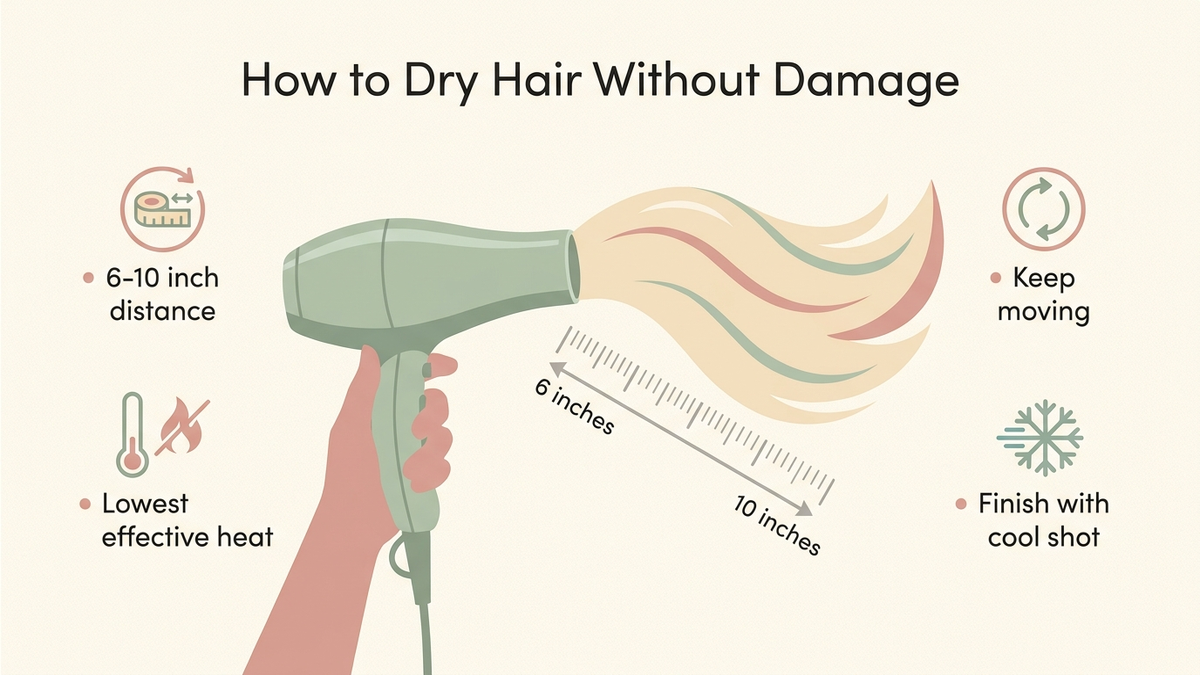
A hair dryer is a heat source pointed at protein (your hair is mostly keratin). The two variables that determine heat damage are temperature and dwell time (how long the hot air sits on one section of hair). All three brands above engineer around this in different ways, but no engineering replaces good habits:
- Hold the dryer 6 to 10 inches from your hair. This is the aggregated guidance from professional stylists and the manufacturer manuals of all three brands. The closer you hold it, the higher the surface temperature on the cuticle.
- Use the lowest heat setting that still dries effectively. All three dryers in this analysis have low/medium/high; for fine, color-treated, or damaged hair, default to low.
- Keep the dryer moving. Static dwell on one section is what causes the kind of damage that compounds over weeks.
- Finish with the cool shot. Cool air sets the cuticle. This is why both Dyson and Shark include a dedicated cool button; Revlon One-Step has a cool setting on the dial.
This applies to every dryer, premium or not. The premium dryers above just give you a more forgiving margin if your technique is imperfect — Dyson’s hard 302°F cap, in particular, is engineered specifically so that user error becomes less catastrophic.
7. The “which one for whom” flowchart
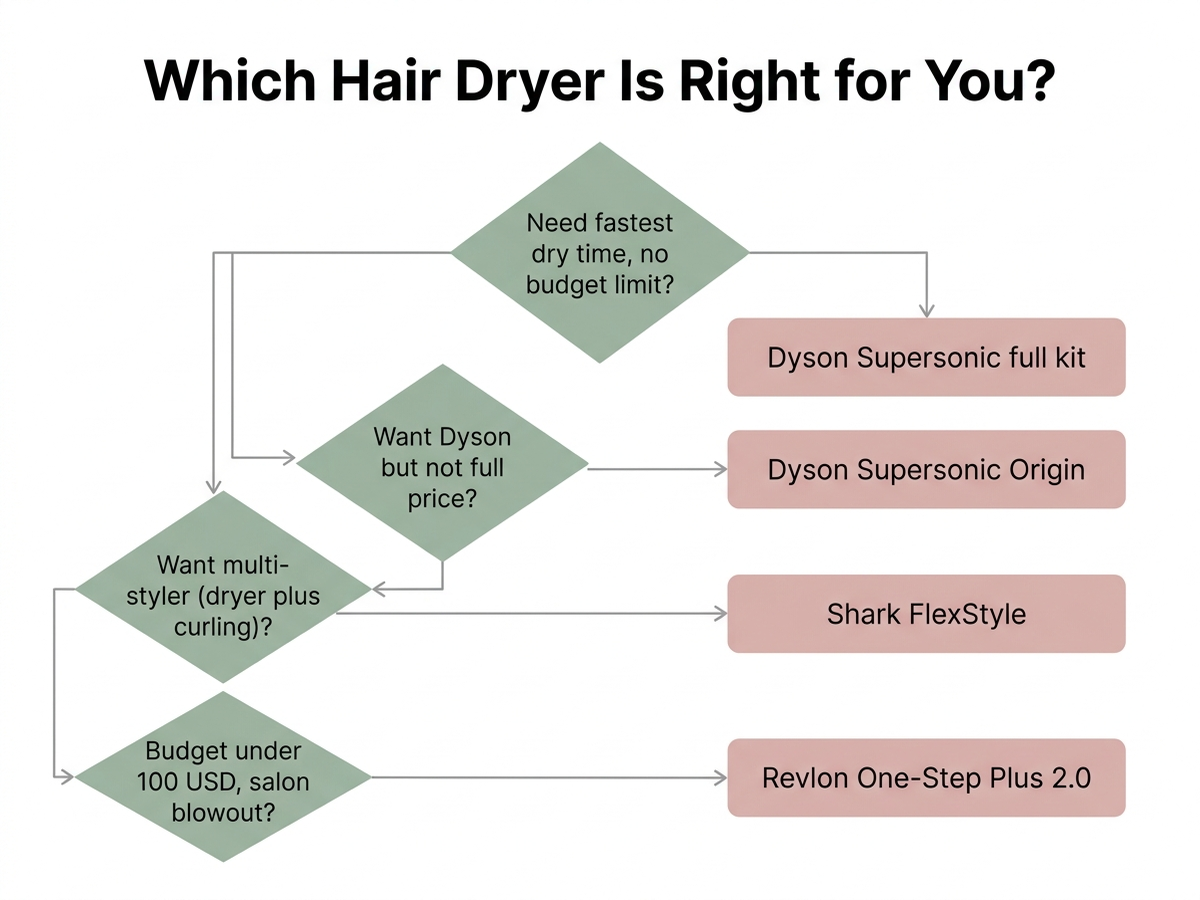
If you’re still deciding, this is the decision tree we’d use:
| Question | Answer | Pick |
|---|---|---|
| Do you blow-dry daily and want the fastest dry time, with no budget ceiling? | Yes | Dyson Supersonic, full kit (B0B4T6RTZ2) |
| You want Dyson but the full kit is too expensive, and you don’t need the diffuser? | Yes | Dyson Supersonic Origin (B0CF391P2L) |
| Would you otherwise buy a Dyson Airwrap, but you can’t justify $599+? | Yes | Shark FlexStyle HD430 (B0B89P16MC) |
| You want a salon blowout at home, and your hair is fine-to-medium and shoulder-length+? | Yes | Revlon One-Step Plus 2.0 bundle (B0D12BCTTT) |
| You want a conventional dryer (no brush, no curler) at the lowest price? | Yes | None of the above — get a basic ionic dryer from Conair (US market leader at 44% share, sub-$50 tier) |
| You have very curly or coily hair and need a diffuser? | Yes | Dyson Supersonic full kit (the diffuser is in this SKU). The Origin’s single attachment is not a diffuser. |
8. Warranty and after-sales support
This is an under-discussed factor in hair dryer purchases. A $429 dryer that dies in year 3 is not actually a luxury good.
| Brand | Manufacturer warranty | What it covers | Notes |
|---|---|---|---|
| Dyson | 2 years | Defects in materials and workmanship. Includes free repair or replacement. | Dyson maintains direct customer service. Warranty claims are processed without requiring third-party retailer involvement. The Stiftung Warentest tester noted that Dyson’s customer service network across Europe was a meaningful contributor to its #1 ranking. |
| Shark (SharkNinja) | 2 years (Shark FlexStyle line) | Defects; some SKUs ship with a 1-year warranty as the base, with extended warranties available on registration. | Shark customer service is handled directly by SharkNinja. Generally well-rated in US aggregated reviews; slightly slower turnaround than Dyson in long-form reviewer reports. |
| Revlon | 4 years if registered (One-Step product line) | Defects in materials and workmanship. | The 4-year period applies only with product registration; unregistered is shorter. Among the three brands here, Revlon has the longest nominal warranty — but on a $79 product, replacement is often faster than warranty claims. |
If you live somewhere with humid summers or hard water, the dryer’s intake filter accumulates lint and mineral residue. Both Dyson and Shark publish cleaning guidance; Revlon hot-air brushes are harder to clean because of the brush head.
9. Still not sure? Have an AI check it in 5 minutes
If you’ve narrowed it down to two specific products and you want a third opinion before pulling the trigger — paste the Amazon link into the Arekore app. The app reads the customer reviews, checks for review-integrity red flags, and tells you whether the current pricing is reasonable against the historical range. It takes about 5 minutes per product.
Arekore is free to use and does not require an account. We do not personally test products, and the app does not either — but the app is faster and more thorough than scrolling Amazon reviews by hand.
10. The bottom line
There is no single “best hair dryer in 2026.” There are three categories, and the right answer depends on your morning routine:
| Best for | Pick | Approx price | Key data point |
|---|---|---|---|
| Maximum dry-time, premium tier | Dyson Supersonic, full kit | $429 | Stiftung Warentest #1 (1.7 Good), 110,000 RPM motor |
| Dyson at lower price | Dyson Supersonic Origin | $329 | Same motor as full kit, single attachment |
| Multi-styler (dryer + curler) at half the Airwrap price | Shark FlexStyle HD430 | $299 | 1,000 temperature checks/sec, ~70-85 dB |
| Salon blowout at home, under $100 | Revlon One-Step Plus 2.0 | $79 | ~11% US market share, ceramic-titanium-tourmaline |
If you are choosing between two products in the same tier, the second factor we’d weight is whether you’ll actually use the secondary functionality. Dyson full kit is overspending if you don’t use the diffuser. Shark FlexStyle is overspending if you don’t curl. Revlon Plus 2.0 bundle is overspending if you don’t round-brush.
Limitations of this analysis
To be explicit about what this article does not establish:
- We did not personally test any of these products. Every claim is sourced from publicly available customer reviews, independent third-party publications (including Stiftung Warentest, CNN Underscored, Tom’s Guide, Vacuum Wars, TechRadar), manufacturer specifications, and market research firms.
- Sample size. We read top reviews and the AI-summary block on each ASIN’s amazon.com page in June 2026. We do not report a precise N because Amazon does not expose a stable review count for those panels; any specific number we wrote would be misleading.
- Manufacturer claims (Dyson’s “40 times per second”, Shark’s “1,000 times per second”, Revlon’s “50% less heat exposure”) are reported as marketing claims, not independently verified by us — though Dyson’s 40/sec claim has been corroborated by Stiftung Warentest’s independent lab test.
- Market-share figures (Conair 44%, Revlon 11%) are from third-party research firms (IndexBox 2025) and may shift quarter-to-quarter; treat them as directional indicators, not precise current numbers.
- dB measurements were taken from Vacuum Wars and Quietest.org under their respective conditions; consumer-room noise will vary.
- Pricing fluctuates with promotions and changes; confirm before purchase.
- Product availability — Dyson and Shark seasonal-color SKUs come and go. The linked ASIN may be out of stock; check the manufacturer site for the current equivalent.
- Long-term durability (5+ years) is harder to assess from public reviews; we relied on aggregated sentiment from older reviews where available.
Want a 5-minute check on the specific product you’re considering? Try the free Arekore app — paste any Amazon link and we’ll read the reviews and check the pricing for you.