Do Air Fryers Really Save Electricity? We Checked the Data
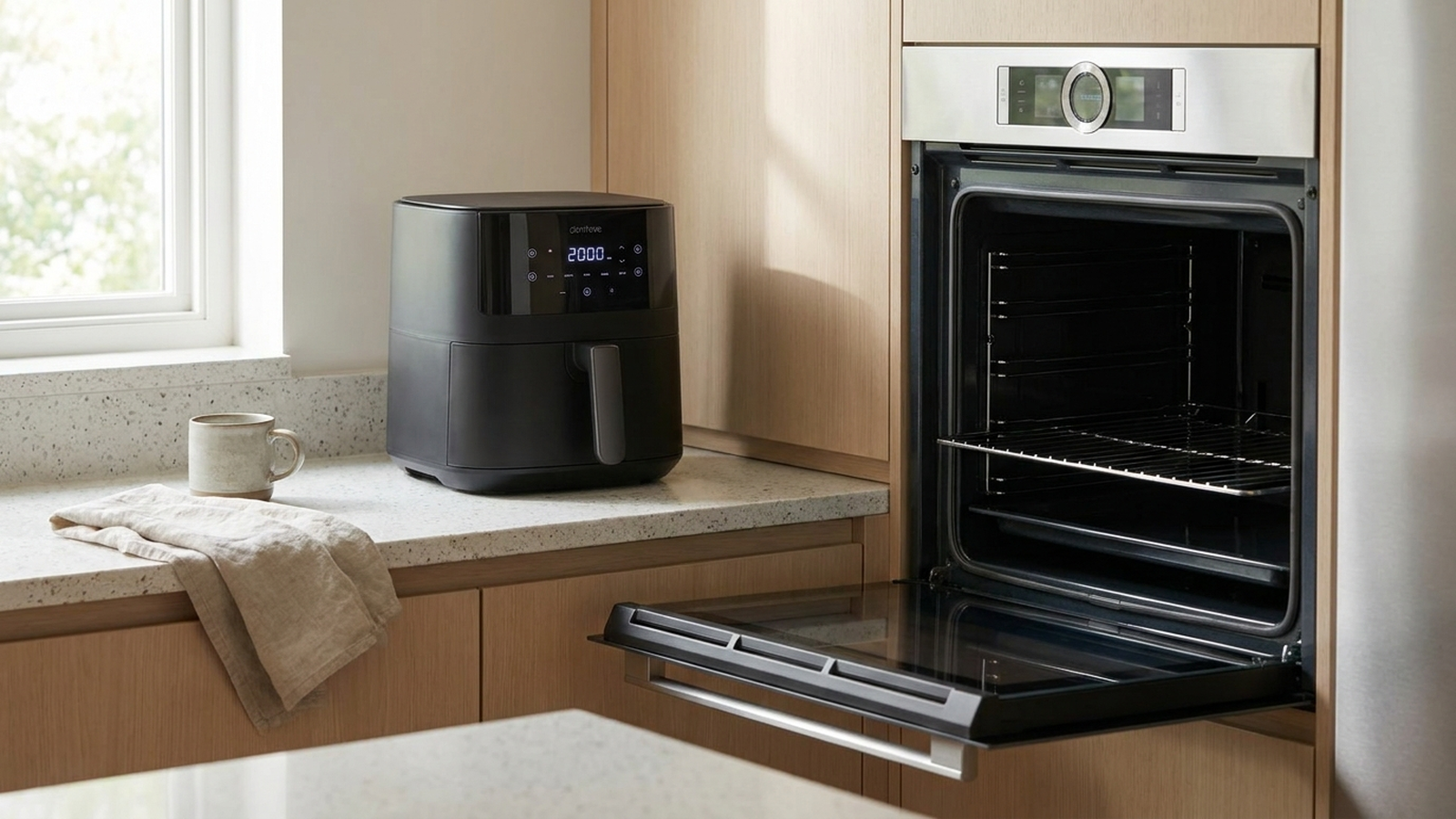
“Air fryers use up to 70% less energy than your oven” is one of the most repeated claims in kitchen-appliance marketing, and it has real momentum behind it: the U.S. air fryer market is on track to hit roughly $1.32 billion in 2026, with household penetration estimates ranging from 45% to as high as 60–70% depending on the survey. With the average U.S. residential electricity rate sitting at about 18 cents per kWh as of September 2026 — up from the low-teens just a few years ago — “will this appliance actually lower my bill” is no longer an idle question.
So we did the wattage math against public data from the U.S. Energy Information Administration (EIA), Department of Energy (DOE) appliance-power guidance, and manufacturer specifications for best-selling models, plus an independent test from the UK’s Which? consumer-testing organization. The short answer: yes, an air fryer genuinely uses less electricity per meal than a full-size oven — but the gap is smaller than the boldest marketing claims, and for some households it nearly disappears.
As an Amazon Associate, Arekore earns from qualifying purchases. The Amazon product links in this article may include our affiliate tracking ID and may earn us a commission if you buy through them, at no additional cost to you. See our Links Policy for details on how we select products and how commissions do not influence our recommendations.
TL;DR / Quick Verdict
- Air fryers really do use less power per meal. A typical air fryer draws 1,200–1,800 watts and needs no preheat, using roughly 0.3–0.9 kWh for a single-batch meal. A full-size electric oven draws 2,000–5,000 watts, needs a 10–15 minute preheat, and typically uses 1.0–2.5 kWh for a comparable meal.
- The realistic savings are single digits to low double digits in dollars per meal, not the dramatic bill cuts implied by some marketing. Our editorial estimate, built from EIA’s rate data and DOE’s wattage ranges: about $0.05–$0.15 per air-fryer meal versus $0.15–$0.45 per oven meal.
- Batch size flips the math. An independent test by the UK consumer group Which? found an air fryer used about 53% less energy than an oven to cook the same single roast chicken. That advantage shrinks fast once you need two or three air-fryer batches to feed a family — at that point a single oven load can use less energy per serving.
- There is no ENERGY STAR rating for air fryers yet. Unlike ovens and refrigerators, air fryers have no DOE-mandated test procedure, so every wattage figure you see (including ours) comes from manufacturer nameplate ratings, not independently verified lab tests.
How We Reached These Conclusions (Methodology)
This is an editorial analysis, not a hands-on test. We did not personally test the products covered here. This guide synthesizes three kinds of public information: (a) EIA Residential Energy Consumption Survey (RECS) data and EIA’s published residential electricity price statistics; (b) DOE/ENERGY STAR guidance on electric cooking-product wattage ranges; and (c) manufacturer nameplate power ratings for best-selling air fryer models on amazon.com, cross-checked against an independent wattmeter-based cooking test published by Which?, the UK’s non-profit consumer-testing organization (comparable in methodology to Consumer Reports, though it tests under UK electricity pricing). Dollar estimates are our own arithmetic applied to these public figures, not a measurement of any specific unit in a specific kitchen. Prices are amazon.com figures as of this writing and fluctuate.
The Wattage Math, Side by Side
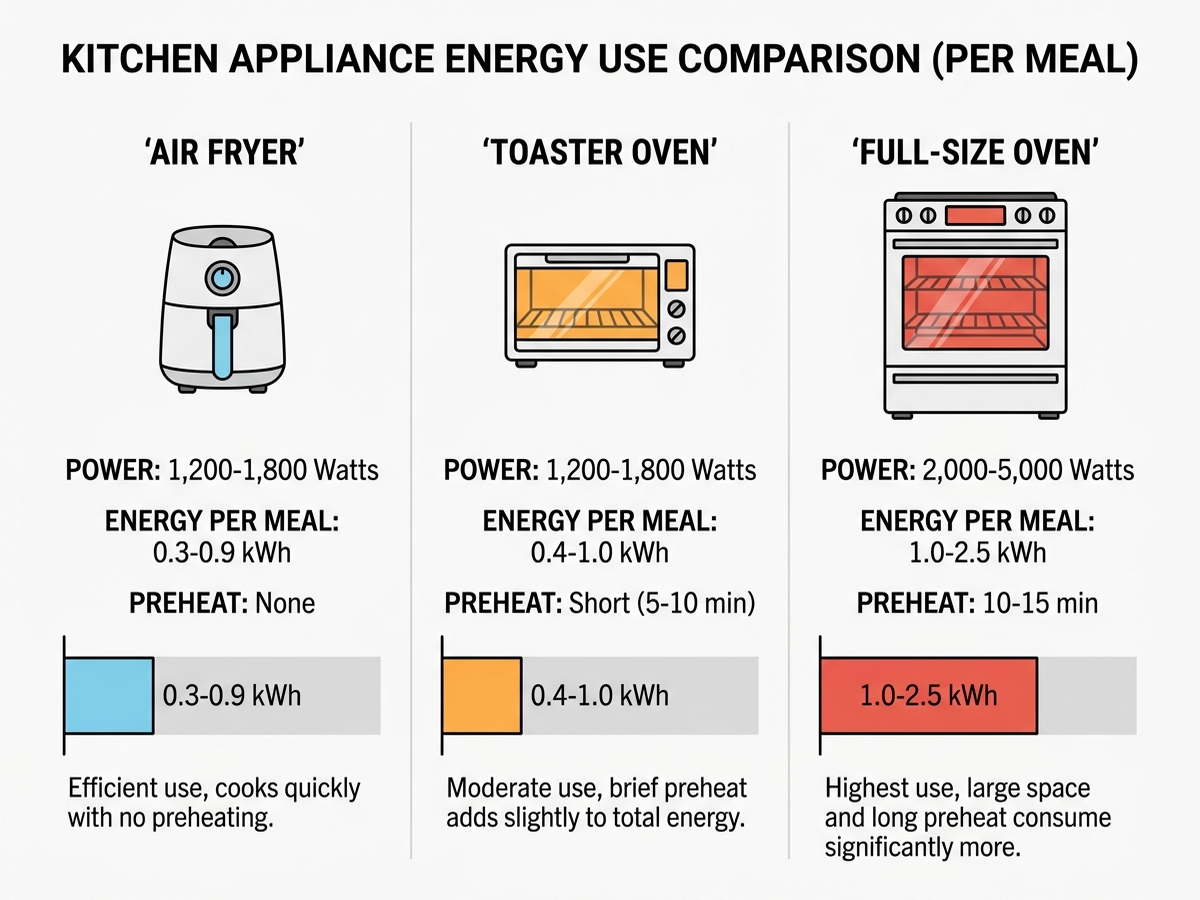
Three appliances typically compete for the same task — crisping a chicken thigh, roasting vegetables, reheating leftovers — and their published wattage ranges tell most of the story before you even factor in cooking time:
- Air fryer: 1,200–1,800 watts, no preheat required. A 20–30 minute cook session uses roughly 0.3–0.9 kWh.
- Toaster oven: 1,200–1,800 watts, similar nameplate power to an air fryer, but a short 5–10 minute preheat pushes typical use to 0.4–1.0 kWh per meal.
- Full-size electric oven: 2,000–5,000 watts. A 10–15 minute preheat followed by 25–40 minutes of cooking (the oven’s heating element cycles on and off to hold temperature rather than running at full power the whole time) typically lands around 1.0–2.5 kWh for one meal.
The gap between an air fryer and a full-size oven is driven less by the wattage on the nameplate and more by two things ovens can’t avoid: preheating a large, poorly insulated cavity, and heating far more air and metal mass than a 4–6 quart air fryer basket needs to. An air fryer’s small, enclosed chamber and rapid air circulation reach cooking temperature in 2–5 minutes or skip preheating altogether, per manufacturer instructions for the models below.
What an Independent Test Actually Measured
Manufacturer wattage specs tell you the appliance’s capacity to draw power, not what it actually consumes cooking real food — that requires a wattmeter and a stopwatch. Which?, the UK’s independent consumer-testing nonprofit, ran exactly that experiment: it cooked the same roast chicken in a conventional oven and in an air fryer, metering actual electricity draw for each. The air fryer used about 53% less energy than the oven for the identical meal. That is a relative reduction, not a currency figure, and it is directly comparable to the U.S. context because it is driven by physics (chamber size and preheat time), not by the price of electricity in either country.
That 53% figure sits inside the range implied by DOE’s wattage bands above, which is reassuring — an independently metered result lines up with what nameplate physics would predict, rather than the higher “up to 70%” figures common in appliance-brand marketing copy.
The Dollar Math, Honestly
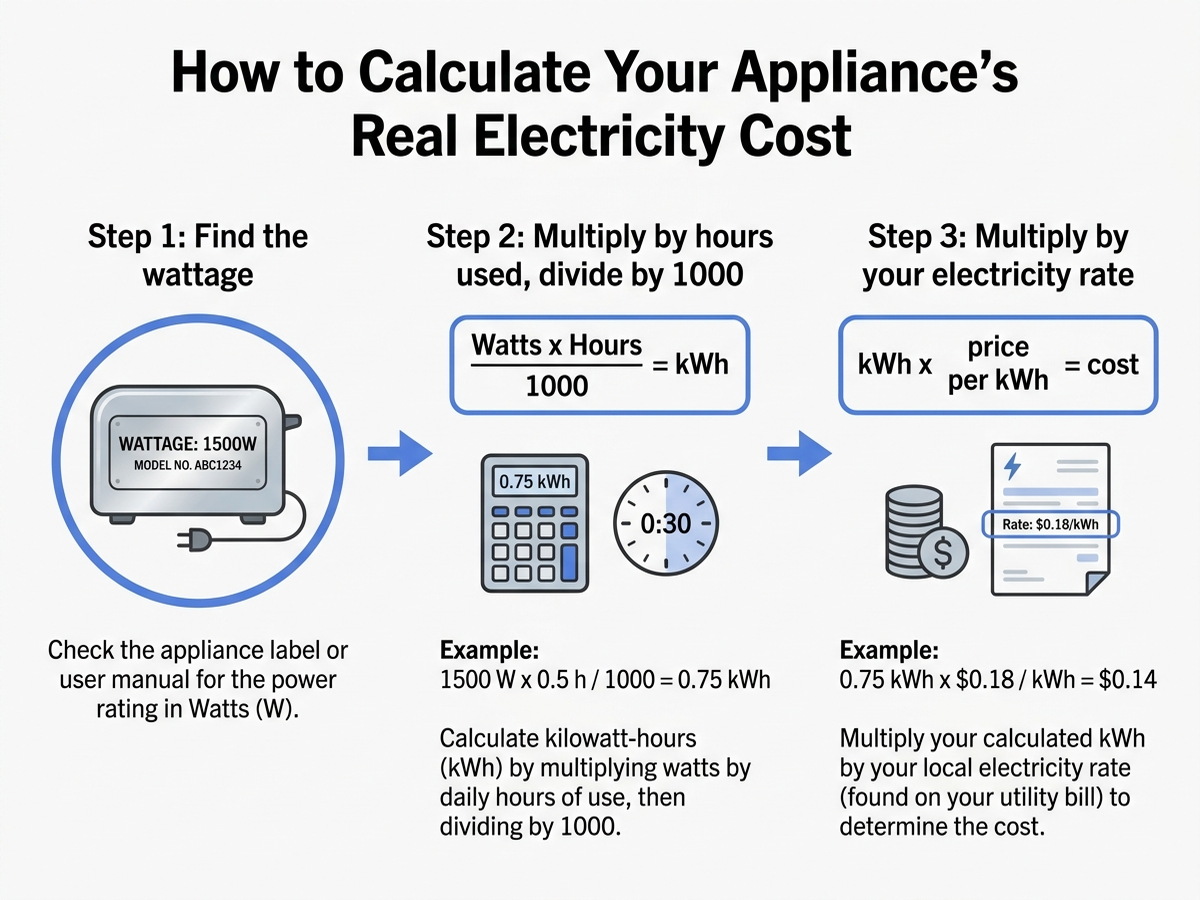
EIA’s Residential Energy Consumption Survey puts electricity as the most common cooking fuel, used in 63% of U.S. households (74.9 million homes), and pegs average household electricity spending on cooking at roughly $31 per year across stovetop and oven combined — a small slice of the typical electric bill to begin with, which is the first reality check on any “cut your bill” pitch. Layer in EIA’s national average residential rate of about 18 cents per kWh (September 2026), and the formula in the diagram above (watts × hours ÷ 1,000 × rate per kWh) gives:
- Air fryer meal: 0.3–0.9 kWh × $0.18 ≈ $0.05–$0.16
- Full-size oven meal: 1.0–2.5 kWh × $0.18 ≈ $0.18–$0.45
Swapping three oven meals a week for the air fryer saves roughly $0.10–$0.30 per meal, which works out to an editorial estimate of $15–$45 per year for a single-person or two-person household cooking that way consistently — well short of the “$50-$100 or more” figures floated in some appliance-marketing content, though not nothing. This is our own arithmetic from the cited public data, not a measurement of any specific product or kitchen; your actual meter reading depends on your model’s real wattage, your local electricity rate, and how long you actually run it.
Where the Math Breaks Down: Batch Size
The single biggest variable none of the marketing copy accounts for is how many batches you need. An air fryer’s small basket (typically 4–6 quarts on the best-selling models) fits a single layer of food. Cooking for four people often means two or three consecutive air-fryer batches, each restarting near-room-temperature and running its own 15–20 minute cycle — while an oven does the whole tray in one load. At that point, the per-serving energy comparison can flip toward the oven, especially for a large sheet-pan meal the oven was already going to cook regardless.
The same logic applies if you’re already running the oven for something else — a side dish, bread, dessert. An air fryer sitting alongside a preheated oven you’re using anyway saves little to nothing, because the oven’s marginal energy cost per additional dish (once it’s already hot) is lower than a fresh air-fryer cycle from cold.
Who Actually Sees the Savings
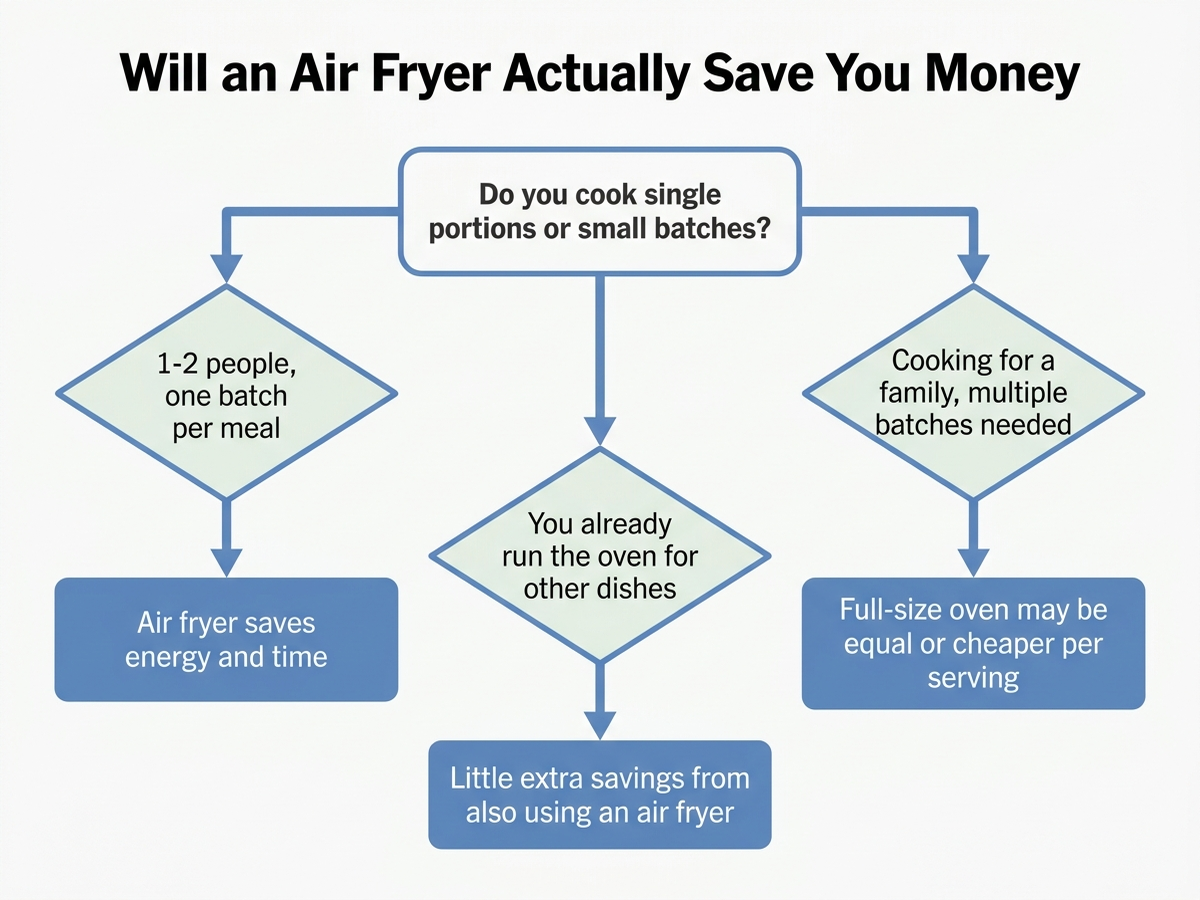
- Single-person and two-person households cooking one batch at a time see the clearest wins: no preheat, no wasted capacity, and the air fryer’s short cook time compounds the wattage advantage.
- Anyone reheating or crisping small portions — leftovers, frozen snacks, a few vegetables — is the use case an air fryer was built for; running a 3,000-watt oven for 15 minutes to reheat two slices of pizza is the least efficient way to do it.
- Families cooking large single-tray meals get a smaller advantage, or none, once multiple air-fryer batches are required to match one oven load.
- Households that already run the oven daily for other dishes gain the least by adding an air fryer purely for energy reasons — the oven’s fixed preheat cost is being paid either way.
If You Want to Know for Certain: Measure Your Own Kitchen
Every figure above is a published range, not a measurement of your specific appliance on your specific utility rate. The only way to know exactly what your air fryer or oven draws is a plug-in electricity usage monitor — plug the appliance into the monitor, run your normal cook cycle, and read the kWh directly.
P3 P4400 Kill A Watt Electricity Usage Monitor
The long-running standard in this category, widely used for exactly this kind of appliance-by-appliance energy audit. It reads live watts, cumulative kWh, and — if you enter your utility’s rate — an estimated cost, which lets you plug the exact numbers from the diagram above into your own kitchen instead of a published range. About $20–$30 at the time of writing.
Check the P3 P4400 Kill A Watt Monitor on Amazon
Ninja AF101 Air Fryer, 4-Quart, 1,550W
One of the best-selling air fryers on amazon.com and a useful reference point because Ninja publishes its wattage plainly: 1,550 watts, in the middle of the typical range, with a 4-quart basket suited to single-batch cooking for one or two people — the scenario where this analysis shows the clearest energy edge over an oven. About $70–$100 at the time of writing.
Check the Ninja AF101 Air Fryer on Amazon
COSORI Pro LE Air Fryer, 5-Quart, 1,500W
A slightly larger 5-quart basket at a comparable 1,500 watts, aimed at the same single-batch use case with a bit more headroom for a family-of-two dinner without a second batch. About $90–$110 at the time of writing.
Check the COSORI Pro LE Air Fryer on Amazon
Instant Vortex Plus Air Fryer, 6-Quart, 1,700W
The higher-wattage, higher-capacity option in this comparison — drawing more power per hour, but with enough basket space to fit what would otherwise require two smaller-basket batches. For a household straddling the “batch size” tipping point described above, the larger single-basket capacity can matter more to total energy use than the higher nameplate wattage. About $90–$120 at the time of writing.
Check the Instant Vortex Plus 6-Quart Air Fryer on Amazon
Comparison Table
Prices are approximate amazon.com figures as of this writing (September 2026) and fluctuate.
| Product | ASIN | Approx. price | Wattage | Best for |
|---|---|---|---|---|
| Ninja AF101 (4 qt) | B07FDJMC9Q | ~$70–$100 | 1,550W | Single/two-person, one-batch cooking |
| COSORI Pro LE (5 qt) | B0936FGLQS | ~$90–$110 | 1,500W | Slightly larger single-batch meals |
| Instant Vortex Plus (6 qt) | B096N28SZP | ~$90–$120 | 1,700W | Fewer batches for a family, more capacity per cycle |
| P3 P4400 Kill A Watt Monitor | B00009MDBU | ~$20–$30 | N/A (measures other appliances) | Verifying your own kitchen’s real numbers |
Warranty and Practical Notes
Most air fryers in this price range carry a 1-year manufacturer warranty covering defects, which is standard for small kitchen appliances at this price point; extending it further rarely pays off (see our analysis of extended warranties for the general math). Basket non-stick coatings are the most common wear point across brands in aggregated review sentiment — hand-washing rather than dishwasher cycles is the usual recommendation to extend coating life, even on baskets marketed as dishwasher-safe.
Limitations
This analysis relies on manufacturer nameplate wattage ratings, EIA and DOE published statistics, and one independently metered UK test, rather than our own instrumented measurement of any specific unit. Air fryers have no DOE-mandated efficiency test procedure or ENERGY STAR certification program, unlike ovens, so there is no standardized U.S. lab dataset to check nameplate claims against. Actual energy use varies by cook time, temperature setting, how full the basket is, ambient kitchen temperature, and your local electricity rate, which ranges well above and below the 18-cent national average depending on your state and utility. The dollar estimates above are editorial arithmetic applied to cited public data, not a measurement of any specific product; individual results will vary.
Bottom Line
Do air fryers actually save electricity? Yes, for the use case they were built for — single-batch, no-preheat cooking for one or two people — where the physics and an independent metered test both point to real, if modest, savings of roughly $15–$45 a year for consistent use, not the dramatic bill cuts implied by some marketing claims. That advantage narrows or disappears once you need multiple batches to feed a family, or you’re already running the oven anyway. If you want the real number for your kitchen rather than a published range, a $20 plug-in wattmeter will tell you more than any manufacturer spec sheet.
Before you buy, paste the product link into Arekore — our AI assistant checks review authenticity, surfaces what the one-star reviews actually complain about, and compares prices, free, in about five minutes.