Extended Warranties 2026: Skip Them, With 4 Exceptions
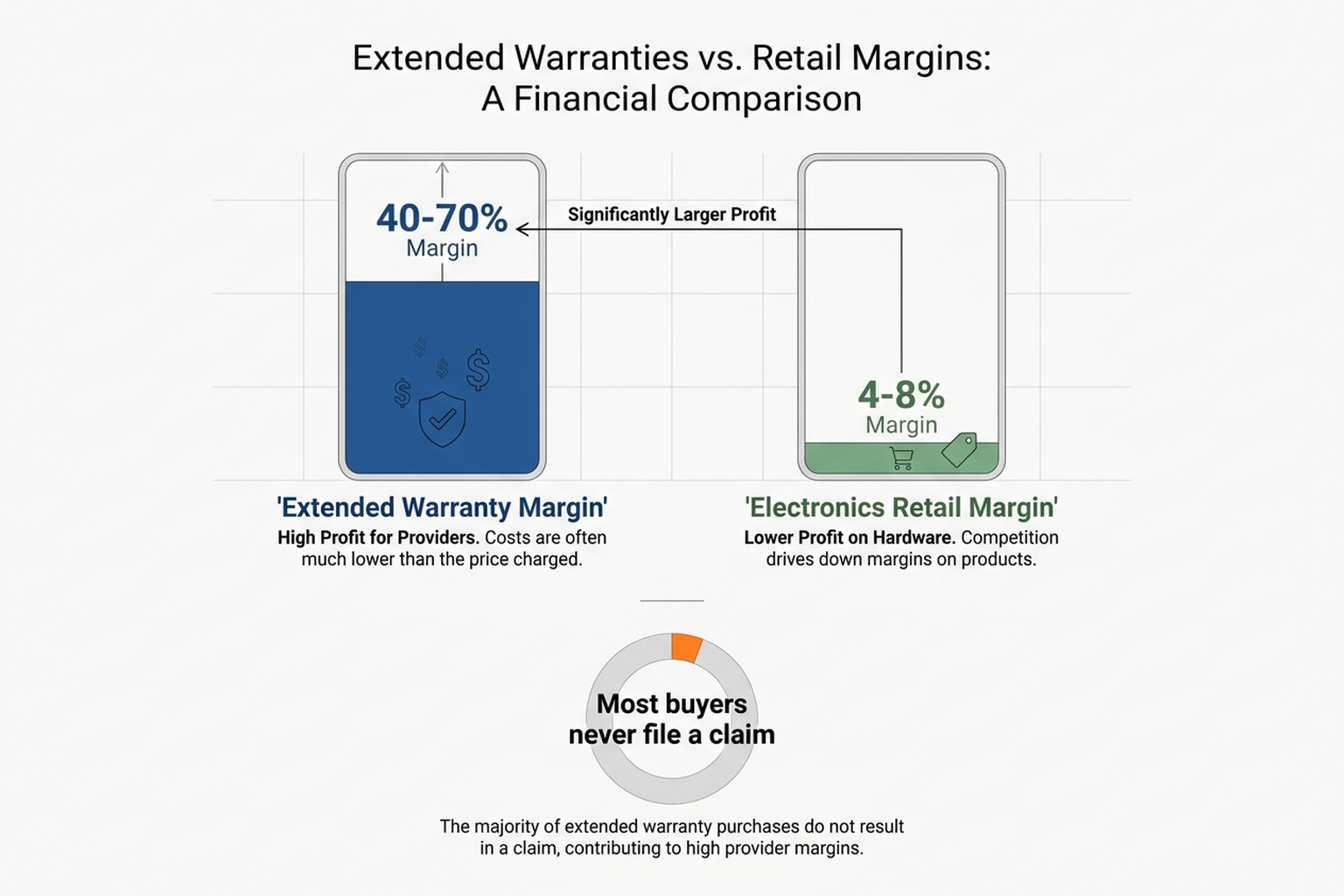
The pitch arrives at the worst possible moment — right after you have decided to buy, card already out, cashier or checkout screen asking one more question: “Would you like to add protection?” It sounds like insurance. It is priced like a rounding error next to the purchase. And retailers push it harder than almost anything else they sell, for a simple reason: service contracts carry gross margins that routinely run 40% to 70%, several times the 4–8% margin on the consumer electronics they are attached to. At Best Buy specifically, extended warranties and related services have historically supplied a share of profit large enough that analysts flag the company’s warranty attach rate as a closely watched line item every earnings call.
None of that means every extended warranty is a bad deal. It means the sales incentive and your actual financial interest point in different directions most of the time — and the four situations where they genuinely align are specific enough to name.
As an Amazon Associate, Arekore earns from qualifying purchases. The Amazon product links in this article may include our affiliate tracking ID and may earn us a commission if you buy through them, at no additional cost to you. See our Links Policy for details on how we select products and how commissions do not influence our recommendations.
TL;DR / Quick Verdict
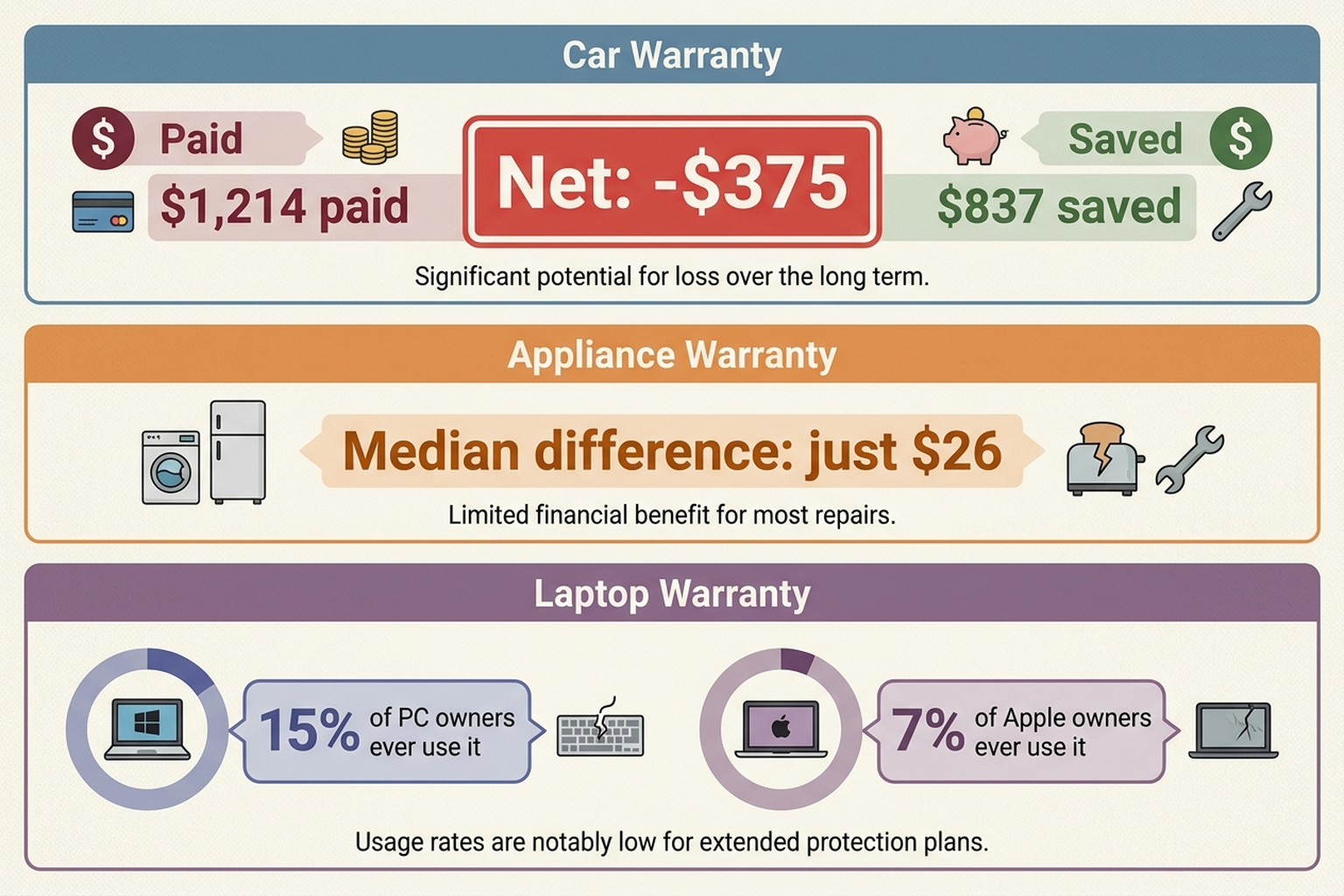
- Most buyers never use the plan. Consumer Reports’ member survey found 55% of extended-car-warranty buyers never filed a claim over the life of the policy; among laptop buyers, only 15% of PC owners and just 7% of Apple owners with extended coverage ever used it for a repair.
- When people do use it, the math is often still a loss. Among car owners who did file a claim, the median repair savings was $837 against a median $1,214 purchase price — a net loss of roughly $375, per Consumer Reports’ analysis.
- For appliances, the gap is smaller but the conclusion is similar. Consumer Reports’ Repair and Replace Appliance Survey found the median cost difference between an extended warranty and the eventual repair itself was just $26 — meaning the warranty rarely pays for itself, let alone profits you.
- Four situations flip the math: pricey built-in appliances with expensive sealed-system repairs, accident-prone owners of screens and drop-risk electronics, unreliable-brand purchases you can’t avoid, and used cars bought without a manufacturer-backed certified program.
How We Reached These Conclusions (Methodology)
This is an editorial analysis, not a hands-on test. We did not personally test the protection plans covered here. This guide synthesizes: (a) Consumer Reports’ member survey data on extended-warranty claim rates and cost outcomes for cars, laptops, and appliances; (b) FTC consumer-protection guidance and enforcement actions on service-contract sales tactics; (c) J.D. Power’s U.S. Appliance Reliability & Service Study on first-year and multi-year failure rates by category; (d) independent repair-cost data aggregated from HomeGuide, Angi, and manufacturer repair-cost disclosures; (e) Reviewed (USA Today)‘s testing and cost analysis of Amazon-sold third-party protection plans; and (f) aggregated amazon.com customer-review sentiment on best-selling Asurion and Allstate/SquareTrade protection-plan listings, sampled in July 2026. Figures are attributed to their source; where a number is a provider’s own marketing claim rather than an independently measured result, it is labeled as such. Prices are amazon.com figures at the time of writing and fluctuate.
Why the Math Favors the Seller, Not You
Three structural facts explain why extended warranties are pitched so aggressively, and why the aggressive pitch is itself a signal:
- The margin is the point. Consumer electronics retail on thin margins — commonly cited at 4–8% — while attached service contracts carry gross margins in the 40–70% range, and appliance retailers have reported protection plans contributing 2–5 times the profit rate of the hardware sale itself, per industry warranty-program analyses. A product with poor margin economics for the seller is exactly the product where the warranty pitch gets most insistent.
- Manufacturer warranties already cover the period when most defects surface. The standard one-year manufacturer warranty catches most true manufacturing-defect failures, which cluster early. Extended plans mostly cover the second and third year, when the failure curve for a well-made product has already flattened.
- The FTC has repeatedly had to intervene on sales tactics in this category. The FTC has taken action against multiple operators for deceptively marketing “extended auto warranty” programs via robocalls that falsely imply dealer or manufacturer affiliation, and its consumer guidance warns that legitimate sellers do not need pressure tactics like “your warranty is about to expire” to close a sale. That enforcement pattern is a reasonable proxy for how aggressively this category is marketed industry-wide, even for legitimate in-store add-ons.
The Numbers, Category by Category
Cars: the worst-documented case
Consumer Reports’ long-standing member survey on extended auto warranties — still the most detailed public dataset on this category and still cited by Consumer Reports itself as its baseline reference — found that 55% of extended-warranty buyers never filed a single claim over the policy’s lifetime, despite a median purchase price just over $1,200. Among the owners who did use their coverage, the median out-of-pocket savings on covered repairs was $837 — against that $1,214 median cost, a net loss of roughly $375 even in the “it worked” cases. Separately, more recent (2025–2026) ConsumerAffairs-aggregated survey data puts extended-warranty ownership at 47% of vehicle owners, while only about 1 in 10 have ever used it — a newer survey converging on the same shape of result as the older baseline.
Laptops: usage rates even lower
Among PC owners who purchased extended coverage, only 15% ever used it to pay for a repair; among Apple laptop owners with extended coverage, just 7% did, according to Consumer Reports. The gap between PC and Apple usage rates tracks with what people are actually protecting against: accidental damage (a cracked screen, a spill) rather than manufacturing defects, and Apple’s own reliability data shows why fewer Apple owners end up filing — Consumer Reports’ member survey puts Apple’s laptop failure rate at roughly 10% by year three, versus 16–19% for the Windows brands it tracks.
Appliances: closer, but rarely a win
J.D. Power’s U.S. Appliance Reliability & Service Study finds the average appliance logs about 69 problems per 100 units (PP100) in its tracked ownership window, and refrigerators specifically see a service rate near 13.5% within the first year — numbers high enough that the category feels like it should reward coverage. But Consumer Reports’ Repair and Replace Appliance Survey found the median difference between what people paid for an extended warranty and what they would have paid for the eventual repair was just $26 — essentially a wash, before accounting for the years the warranty produced nothing at all.
Smartphones: the accident category, not the defect category
A cracked iPhone screen costs $129–$379 to repair out of warranty depending on model, per Apple’s own published repair pricing, while AppleCare+ caps a screen-repair incident at $29 on top of a $149–$199 two-year plan cost. That math only works in your favor if you are the kind of owner who actually drops phones — which is precisely why this is one of the four exceptions below, not a blanket “buy AppleCare” recommendation.
The 4 Exceptions Where Coverage Pays
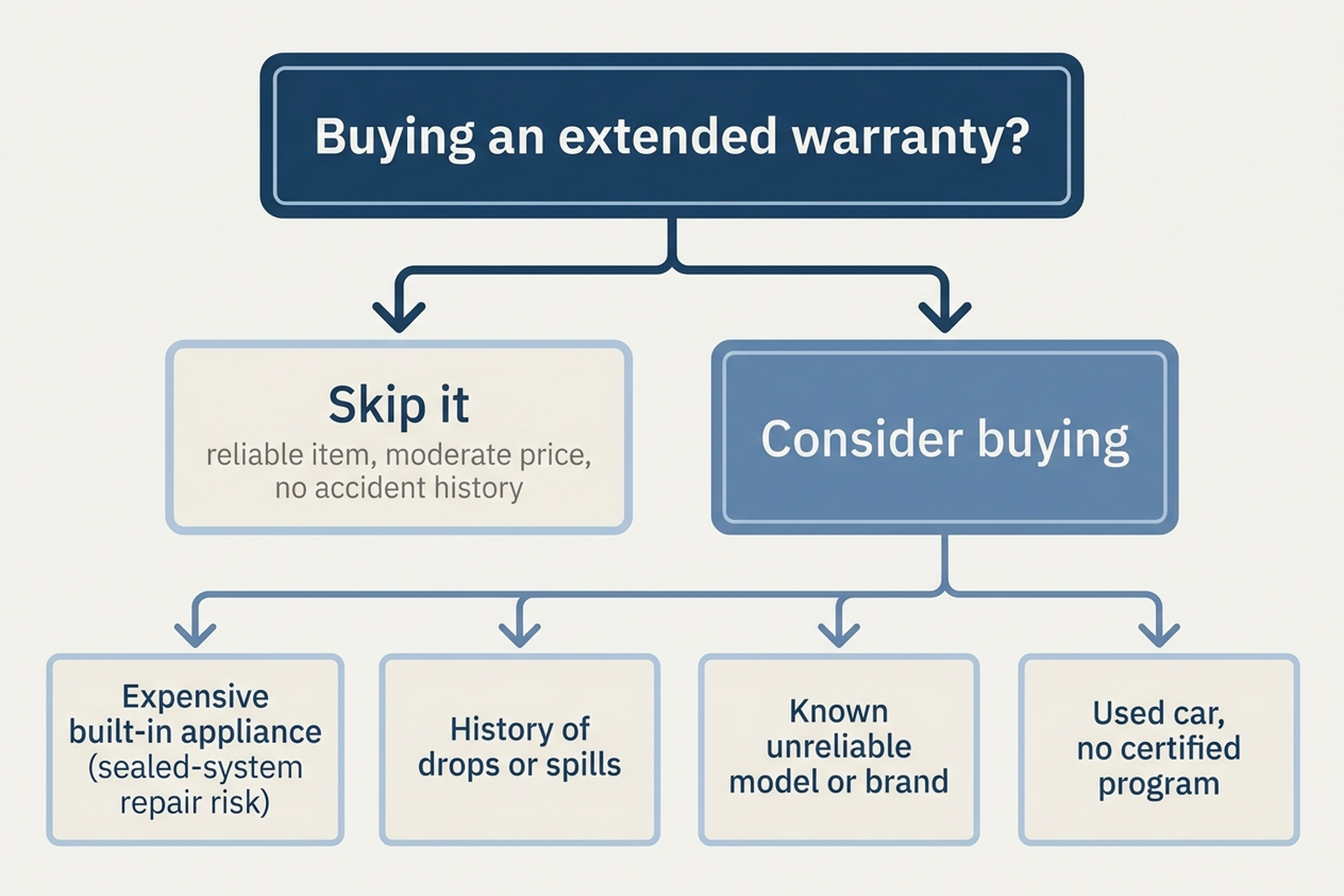
1. Built-in and premium appliances, where the worst-case repair is genuinely large. A refrigerator’s sealed-system repair — the compressor, evaporator, and refrigerant lines — runs $600–$1,400 on average and can reach $1,400–$2,800 for the most involved cases, per aggregated repair-cost data from HomeGuide and Angi. About 33% of refrigerators need a repair within the first five years, per industry service-call data. On a $2,500 built-in unit, a single sealed-system failure can approach half the replacement cost — the point at which most repair-vs-replace guidance says repair barely still makes sense, and where warranty coverage genuinely offsets a plausible worst case rather than an unlikely one.
2. A documented personal history of drops, spills, and screen damage. Extended warranties on laptops and phones almost never cover accidental damage by default — separate accidental-damage protection (ADP) does, and of the 98 two-year plans one industry survey examined, 74 included accidental-damage coverage as an add-on. If your last three phones each cracked a screen, or your household is genuinely rough on electronics, that observed rate — not a hypothetical one — is the right input for the decision, and ADP is priced for exactly your risk category.
3. A specific unreliable model or brand you cannot avoid. J.D. Power’s category data shows real spread between brands — refrigerator PP100 scores that differ by double digits between the best and worst performers it tracks. If the specific model you are buying (for space, budget, or feature reasons) sits on the unreliable end of independently published reliability data, that is a data-backed reason to hedge, distinct from buying a plan reflexively on a model with a strong reliability record.
4. A used car bought outside a manufacturer-backed certified program. Consumer Reports finds certified pre-owned (CPO) vehicles have about 14% fewer problems than non-certified used cars, and recommends buying CPO through the manufacturer’s own program rather than a third-party “certification.” If you are instead buying a non-certified used vehicle — especially from a private seller with no inspection history — a mechanically focused extended warranty is closing a real information gap, not just adding margin for the seller.
What the Data Says to Skip
Outside those four situations, the aggregated evidence points toward self-insuring: put the premium you would have spent — often 10–20% of the item’s price for consumer electronics — into a standing emergency-repair fund instead, and let manufacturer warranties handle the first year, when true defects mostly surface. Reviewed (USA Today)‘s testing of Amazon-sold third-party plans found some priced almost trivially low (a four-year plan on a $200 TV for around $9), but also found user reviews reporting denied claims and coverage gaps even at that price — a reminder that “cheap enough not to matter” and “reliable enough to pay out” are two different claims, and only one of them shows up in the checkout-page pitch.
If You Decide Coverage Fits Your Situation
For readers who match one of the four exceptions above, these amazon.com-listed plans are among the most-reviewed in their categories:
Allstate 3-Year Major Appliance Protection Plan ($900–$999.99)
Backed by Allstate (through SquareTrade), this plan covers mechanical and electrical failure on major appliances priced in the $900–$999.99 range after the manufacturer’s warranty ends — the window where sealed-system and compressor failures in Exception #1 typically surface. Aggregated Amazon sentiment favors the no-deductible repair-or-replace structure; the recurring critique across similar tiers is claim-processing speed for less common appliance types. About $130–$170 at the time of writing.
Check the Allstate 3-Year Major Appliance Protection Plan on Amazon
Asurion 4-Year Television Protection Plan ($1,000–$1,249.99)
Covers mechanical and electrical failure starting on the purchase date, with power-surge protection from day one — relevant given how often surge damage shows up in aggregated low-star TV reviews after storms. No deductible on covered repairs. Best suited to Exception #3 (a specific model with below-average reliability data) rather than a blanket add-on for every TV purchase. About $60–$90 at the time of writing.
Check the Asurion 4-Year Television Protection Plan on Amazon
Asurion Complete Protect (whole-home electronics plan)
A broader plan covering eligible past and future Amazon electronics purchases under one subscription, rather than a single item. This fits households that recognize themselves in Exception #2 — a general pattern of accidental damage across multiple devices — better than a single-item plan does, since it does not require predicting which device breaks first. Aggregated sentiment is mixed on claim turnaround time relative to single-item plans; read current reviews before choosing this over an item-specific plan.
Check Asurion Complete Protect on Amazon
Comparison Table
Prices are approximate amazon.com figures at the time of writing (July 2026) and fluctuate.
| Situation | Plan type | Typical cost | Best exception match |
|---|---|---|---|
| Built-in/premium appliance | Allstate/SquareTrade 3-Year Major Appliance | ~$130–$170 | Exception #1 (expensive sealed-system repair risk) |
| Single TV, known reliability concern | Asurion 4-Year TV Protection | ~$60–$90 | Exception #3 (unreliable specific model) |
| Multiple electronics, drop/spill history | Asurion Complete Protect | Subscription, varies | Exception #2 (documented accident-prone use) |
| New phone, no drop history | Manufacturer warranty only | $0 (included) | None — skip per the data above |
| Used car, no certified program | Mechanical breakdown warranty | Varies widely | Exception #4 (no manufacturer inspection history) |
Limitations
This analysis relies on Consumer Reports member surveys, J.D. Power’s industry study, FTC public guidance, independent repair-cost aggregators, and amazon.com review sentiment, rather than our own claims-filing test of any specific plan. Consumer Reports’ underlying claim-rate and cost-savings figures come from member-survey windows that may not match current-year pricing or claim terms exactly, and individual plan terms (deductibles, exclusions, transferability) vary by provider and change over time — always read the specific contract before buying. Reliability and failure-rate percentages describe surveyed populations, not a guarantee for any individual unit. Individual experience may vary based on brand, usage, and unit-to-unit variance.
Bottom Line
Extended warranties are not a scam, but they are priced and sold like the seller’s best profit center, not your best financial move — because for most of the products people are offered coverage on, that is exactly what they are. The data says skip it by default and put the money toward an emergency-repair fund. Buy it specifically when you are covering an expensive built-in appliance’s worst-case repair, insuring against your own documented accident history, hedging a below-average-reliability model you cannot avoid, or filling the inspection gap on a non-certified used car. Everywhere else, the checkout-counter pitch is optimized for the store’s margin, not your $26 median outcome.
Before you buy, paste the product link into Arekore — our AI assistant checks review authenticity, surfaces what the one-star reviews actually complain about, and compares prices, free, in about five minutes.