Black Friday TV Deals 2026: Which Discounts Are Real

TL;DR
Some Black Friday TV discounts are real; a meaningful share are not. Independent price-tracking research on the 2025 Black Friday season found that 36% of items marked down for Black Friday showed no actual savings compared with their price in the weeks right before the sale, and the discounts that were genuine averaged about 24% off. The fix isn’t guesswork — Amazon now publishes its own 365-day price-history graph and a “Typical Price” reference on most product pages, and free third-party trackers like CamelCamelCamel independently confirm the same data. Checking the three TVs this analysis tracked (the LG C5 OLED, Samsung S90F OLED, and TCL QM7L Mini-LED) against their own price history shows the same split: one model’s current price matches its lowest point of the year, one is a real but modest discount, and one is still well above a price it has already hit earlier in 2026 — meaning “Black Friday” isn’t automatically this year’s best price on that set.
Methodology
This analysis synthesizes (a) Amazon’s own published price-history and Typical Price documentation for the policy changes rolled out through May 2026, (b) independent retail-pricing research on Black Friday discount authenticity from WalletHub, (c) price-history data for three specific 2026 TV models (the LG C5, Samsung S90F, and TCL QM7L) gathered via CamelCamelCamel and cross-referenced against pricing reported by RTINGS, Tom’s Guide, and Consumer Reports between June and October 2026, and (d) Consumer Technology Association holiday-purchasing research on TV seasonality. We did not personally test the TVs covered here, and we did not independently audit every retailer’s pricing algorithm.
The Problem: Not Every “Was $X, Now $Y” Is True
Retail pricing research has quantified something shoppers have long suspected. A WalletHub analysis of the 2025 Black Friday shopping season found that 36% of discounted items showed the same price — or a higher one — compared with how they were priced in the three weeks leading up to the sale, meaning the “discount” was measured against a price that had been quietly raised just before the markdown was applied. Among items that genuinely were cheaper, the average real markdown came out to roughly 24% — a solid discount, but far short of the 50–70% banners common in Black Friday marketing.
TVs are a heavily promoted category for exactly this reason. Historically, close to 65% of all 4K UHD TVs sold in the U.S. move in the October-to-December window, according to Consumer Technology Association holiday-purchasing data, which gives retailers a strong incentive to make every TV look like a once-a-year price. Industry discount forecasting for the 2026 holiday season puts the TV category’s typical markdown around 23%, broadly in line with WalletHub’s genuine-discount average — which is also a useful number to keep in mind: a “Black Friday” TV deal advertising much more than roughly a quarter off its recent price is the kind of outlier worth double-checking before buying.
Three Ways to Check If a Price Is Real
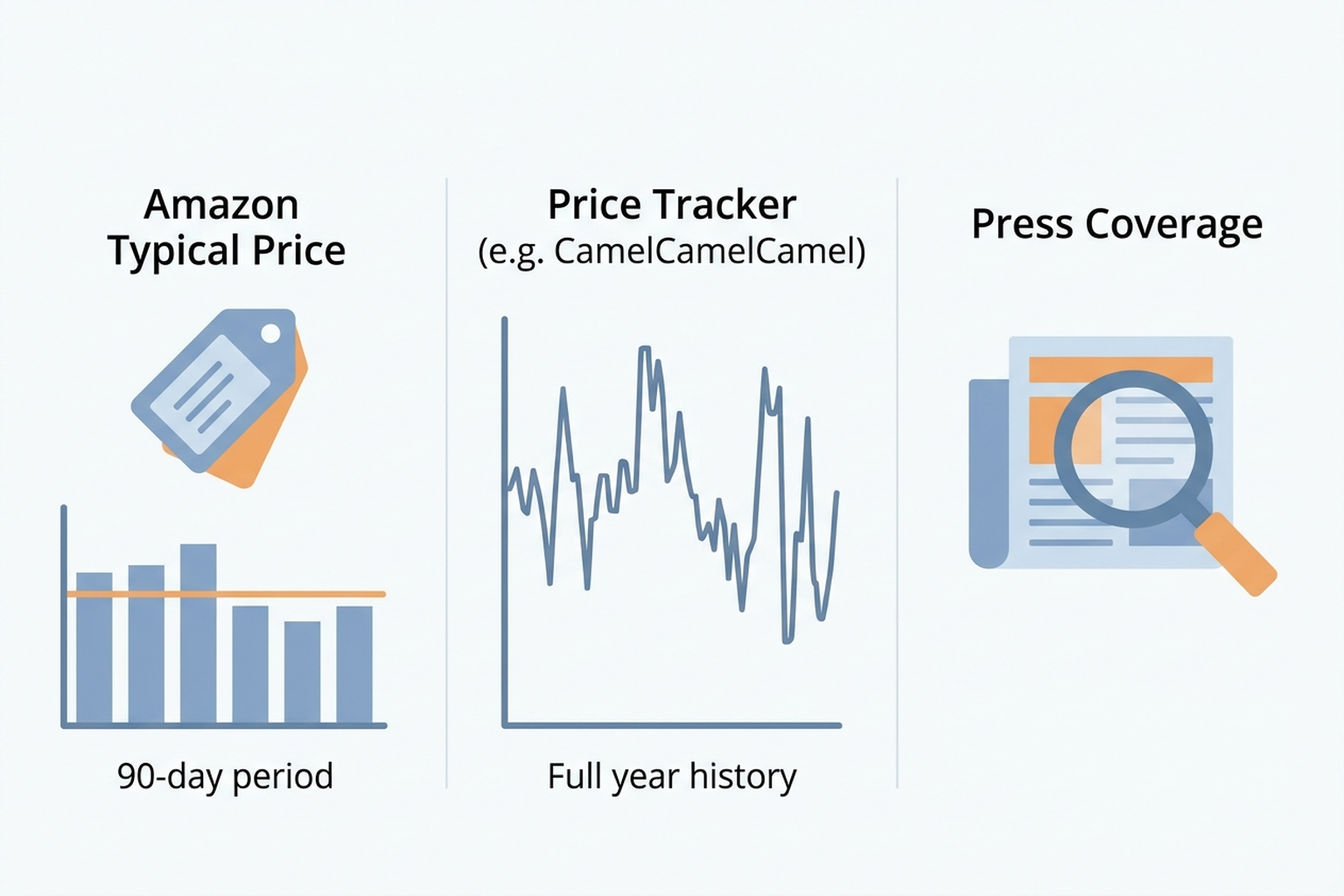
- Amazon’s own Typical Price badge. As of a policy update effective May 18, 2026, Amazon calculates a “Typical Price” as the median price customers actually paid over the trailing 90 days; if a seller’s listed “was” price isn’t judged credible against that median, Amazon replaces it with the Typical Price as the strikethrough reference shown to shoppers. Amazon also now shows up to 365 days of daily price history directly on eligible product pages — a first-party, built-in check that didn’t exist before 2026.
- Independent price trackers. Free tools like CamelCamelCamel pull Amazon’s own pricing data into a chart of the all-time high, low, and average price for a specific ASIN, independent of how Amazon or the seller labels the current discount. This is the fastest way to answer “has this TV actually been cheaper before, and when.”
- Manual cross-referencing against press coverage. Outlets that cover TV deals year-round — RTINGS, Tom’s Guide, Consumer Reports — regularly report the specific price a given model hit during Prime Day, back-to-school sales, and other mid-year promotions. If a Black Friday price doesn’t beat a number already reported earlier in the year, it’s not actually the year’s best deal on that set, whatever the percentage-off badge says.
None of these three methods requires paying for anything — the point is that verifying a TV discount now takes under a minute, using tools that didn’t exist in this combination before 2026.
Case Studies: What Three 2026 TVs’ Price Histories Actually Show
Applying that checking process to the three TVs most frequently recommended by reviewers in 2026 — the same three models covered in our Best TVs 2026 buying guide — produces three different outcomes.
LG C5 (65-inch OLED, OLED65C5PUA): Amazon’s list price is $1,296.99, and the lowest price ever recorded on Amazon was $1,099.99, set on June 26, 2026 — months before Black Friday. Tom’s Guide separately reported the 65-inch C5’s predecessor pattern last cycle: a Best Buy price of $1,699 in late September fell to $1,399 by Black Friday, a real but modest seasonal drop. If this year’s Black Friday price lands anywhere above $1,100, it is not actually the model’s lowest point of 2026, even if the percentage-off badge looks large next to the $1,296.99 list price.
Samsung S90F (65-inch QD-OLED, QN65S90F): Amazon’s current listing shows roughly $1,399.99 against a “was” price as high as $2,499.99 in some retailer listings — a discount that looks dramatic on paper. But the model’s own price history shows an all-time Amazon low of $999.99, set August 19, 2026, roughly two months before Black Friday even began. A Black Friday price in the $1,300–$1,400 range is a real discount off list, but it is not the model’s best 2026 price, and the $2,499.99 “was” figure referenced by some retailers does not reflect what the TV has actually sold for on Amazon this year.
TCL QM7L (Mini-LED): This is the case where Black Friday timing appears to genuinely matter. Tom’s Guide reported the 65-inch QM7L hitting $897.99 — described explicitly as its lowest price to date on Amazon — and the 55-inch size separately dropped to $697.99, each against roughly 40% list-price markdowns. Unlike the two OLED sets above, TCL’s price history doesn’t show an earlier 2026 dip below the levels reported heading into the holiday season, which lines up with Mini-LED/QLED sets generally following a more traditional back-loaded discount pattern than premium OLEDs, which retailers tend to promote more evenly across the year’s sales events.
Comparison Table
| Model | List Price | Lowest 2026 Amazon Price (and when) | Typical Black Friday Discount Depth | Verdict |
|---|---|---|---|---|
| LG C5 65” OLED | $1,296.99 | $1,099.99 (June 26, 2026) | ~$150–200 off list | Check current price against the June low — Black Friday is not guaranteed to beat it |
| Samsung S90F 65” QD-OLED | Up to $2,499.99 (retailer-reported “was” price) | $999.99 (Aug 19, 2026) | ~$200–300 off actual list | Real discount off list, but the August low has likely already beaten it |
| TCL QM7L 65” Mini-LED | ~$1,499.99 | $897.99 (reported as all-time low, Oct 2026) | ~40% off list | Black Friday timing appears to be this model’s actual best window in 2026 |
Prices shown are a snapshot sampled as of 2026-10-23 and change frequently with lightning deals and regional variation; always check the live Amazon listing and its price-history graph before buying.
How to Check Before You Buy
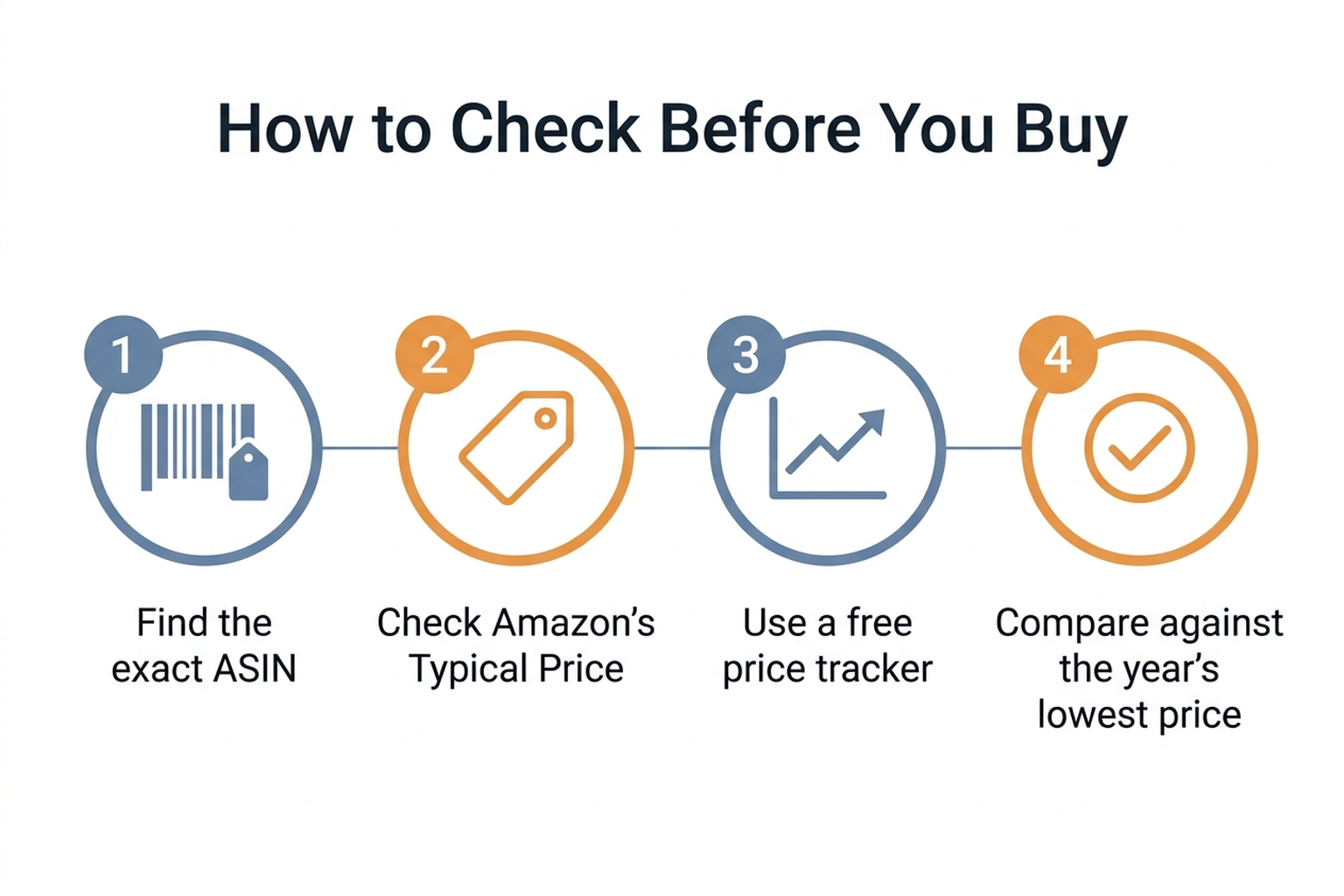
- Find the exact ASIN, not just the model name — TVs are sold under dozens of nearly identical SKUs (different sizes, bundle configurations, retailer-exclusive variants), and price history is only meaningful for the specific ASIN you’re about to buy.
- Check Amazon’s own Typical Price and price-history graph on the product page — this is now built into the listing itself for most electronics and takes seconds.
- Paste the ASIN or product URL into a free tracker like CamelCamelCamel to see the full 2026 price curve, including any price hikes shortly before the “sale” began.
- Search the model name plus “lowest price” or “Black Friday” on a review outlet’s site (RTINGS, Tom’s Guide, Consumer Reports) to see whether this exact TV already hit a lower price earlier in the year — if it did, Black Friday’s badge is measuring against the wrong baseline.
Decision Guide: Buy Now, Wait, or Check Again Later
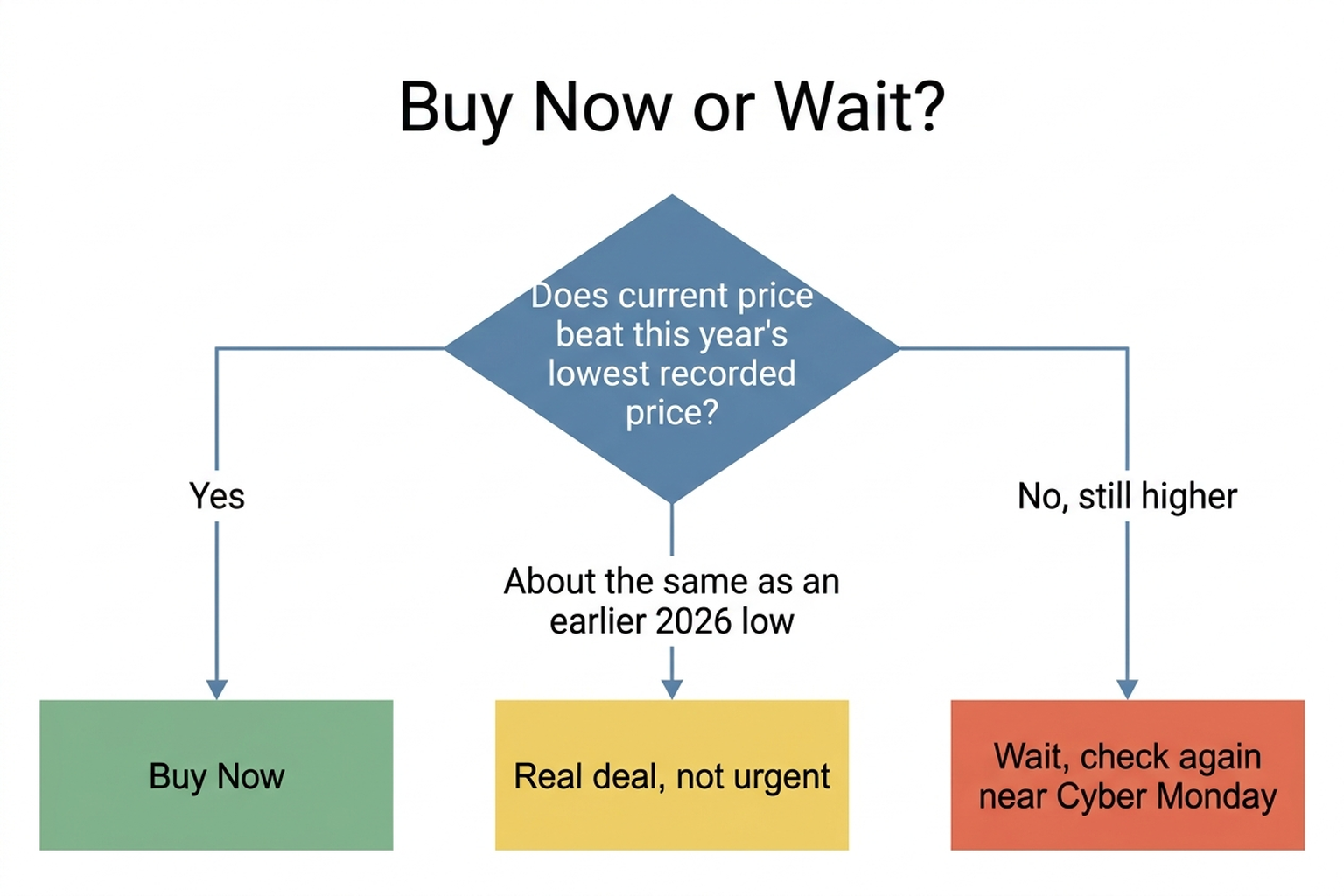
- Current price beats the lowest price recorded anywhere in 2026: Buy — this is a genuinely exceptional window, not just a seasonal label.
- Current price matches (within a few dollars of) an earlier 2026 low: It’s a real discount, but not a reason to buy today specifically — the same price has already been available, and Cyber Monday or a later sale could match it again.
- Current price is meaningfully above a price already reported earlier in the year: Wait, and recheck closer to Cyber Monday — retailers sometimes hold their deepest discounts for the following week rather than Black Friday itself.
- No price history exists yet (a brand-new 2026 model): Treat the discount claim with more caution by default, since there’s no earlier price to verify it against — lean on review-outlet coverage of the specific launch price instead.
Limitations
The specific price points cited here (the LG C5’s $1,099.99 low, the Samsung S90F’s $999.99 low, the TCL QM7L’s $897.99 low) reflect price-tracking snapshots and press reporting gathered through October 2026; Amazon prices change multiple times a day during the Black Friday window itself, so a given reader’s actual checkout price may differ from any number in this article by the time they look. The WalletHub 36%-fake-discount and 24%-average-markdown figures describe Black Friday retail listings broadly, not TVs specifically, and may not generalize precisely to every retailer or every TV model. Amazon’s Typical Price methodology has changed more than once in 2026 and may change again before Black Friday; the version described here reflects the rules Amazon documented as of its May 2026 update.
As an Amazon Associate, Arekore earns from qualifying purchases. The Amazon product links in this article include our affiliate tracking ID and may earn us a commission if you buy through them, at no additional cost to you. See our Links Policy for details on how we select products and how commissions do not influence our recommendations.
Products Mentioned
- LG 65-Inch Class C5 Series OLED evo AI 4K Smart TV, OLED65C5PUA
- Samsung 65-Inch Class QN65S90F OLED 4K Vision AI Smart TV
- TCL 65-Inch Class QM7L Series SQD-Mini LED QLED 4K Smart Google TV
Verify current pricing, availability, and the live price-history graph on the Amazon product page before purchasing — prices shown in this article are a snapshot and do not update in real time.