Best TVs 2026: OLED vs Mini-LED Buying Guide
TL;DR
For a dedicated home-theater room that’s kept dark for movies, the LG C5 OLED remains the set most reviewers recommend first, with perfect per-pixel black levels and the best gaming response time of the three. If color volume and shelf-life matter more than saving a few hundred dollars, the Samsung S90F OLED uses QD-OLED technology to push brighter, more saturated color than the LG without sacrificing OLED’s black levels. For a brighter living room where sunlight hits the screen during the day, the TCL QM7L Mini-LED trades OLED’s perfect blacks for roughly 20% more peak brightness and zero organic burn-in risk, at close to half the price of the two OLED sets.
Methodology
This analysis synthesizes (a) aggregated Amazon US customer reviews for the LG C5, Samsung S90F, and TCL QM7L, sampled in October 2026 — Amazon does not expose a fixed review count per product, so we cannot report a precise N, but each listing had several hundred to several thousand ratings visible at the time of sampling — (b) independent lab test data and editorial rankings from RTINGS, Tom’s Guide, Consumer Reports, and Digital Trends, (c) manufacturer specification sheets and warranty documentation, and (d) global TV market-share data from Counterpoint Research and TrendForce. We did not personally test the products covered here.
Technical Approach: Three Different Display Bets
Modern TVs split into two fundamentally different ways of making a picture, and the three models here represent the leading version of each. OLED panels light each pixel individually and turn pixels fully off for black; Mini-LED/QLED panels keep a conventional LCD layer but use thousands of small LED zones behind it for localized dimming.
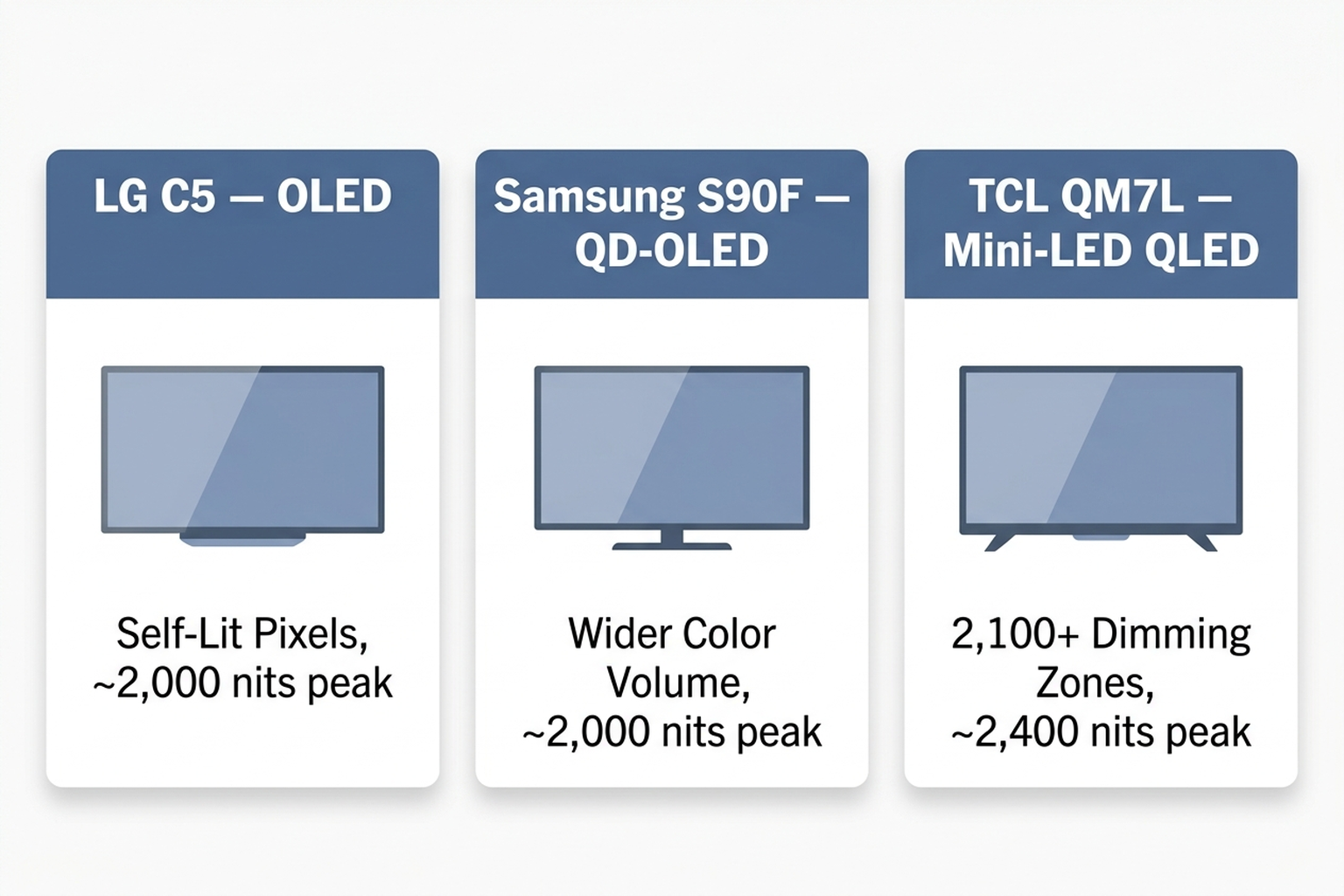
- LG C5 (OLED, self-lit pixels): LG’s mainstream OLED panel for 2026, built around self-emissive pixels that can switch off individually for true black. RTINGS’ testing credits the C5 generation with among the fastest response times of any TV tested, which is why it’s frequently singled out as the pick for competitive gaming alongside movie watching.
- Samsung S90F (QD-OLED, wider color volume): Samsung’s QD-OLED panel adds a quantum-dot color layer on top of an OLED backplane, which independent testing shows produces a noticeably wider and more saturated color gamut than traditional white-OLED panels like LG’s, at a similar peak brightness. Consumer Reports names a 65-inch S90F its top-rated TV for 2026, scoring at or near the top of every picture-quality category it tests.
- TCL QM7L (Mini-LED QLED, backlit with zoned dimming): TCL’s Mini-LED sets use more than 2,100 local dimming zones behind a QLED panel. TCL advertises up to 3,000 nits of peak brightness; independent measurement in Filmmaker Mode comes in lower, around 2,400 nits, which is still brighter than either OLED here. Tom’s Guide named the QM7L its top mid-range Mini-LED TV of the year.
Manufacturer Details
LG markets the C5 (model OLED65C5PUA at 65 inches) with its “OLED evo AI” processing, a 144Hz native refresh rate, four HDMI 2.1 ports, and support for Dolby Vision, Dolby Atmos, and HDR10 — manufacturer-branded processing names rather than independently verified performance claims. LG’s standard limited warranty runs 1 year on parts and labor.
Samsung positions the S90F (model QN65S90F at 65 inches) around its “NQ4 AI Gen3” processor and “4K AI Upscaling Pro,” along with a 144Hz panel and Samsung’s Vision AI smart-TV platform — again, manufacturer naming for internal processing rather than a third-party benchmark. Samsung’s standard warranty is 1 year of parts and labor; like LG, it does not cover burn-in or image retention on OLED models as a standard inclusion.
TCL advertises the QM7L (model 55QM7L at 55 inches) with its “SQD-Mini LED” backlight, more than 2,100 local dimming zones, a 144Hz panel, Google TV, and Dolby Vision IQ plus Dolby Atmos support. TCL’s standard limited warranty covers 12 months of parts and labor; its warranty documentation explicitly excludes “markings or images on the product’s LCD/LED panel resulting from viewing fixed images,” the same category of exclusion OLED brands apply to burn-in.
Customer Sentiment Synthesis
Aggregated Amazon customer reviews and cross-referenced retail and press reviews point to a few consistent patterns:
- LG C5: Reviewers consistently praise picture quality and gaming responsiveness, and several outlets explicitly rank it as the OLED most people should buy. The recurring complaint cluster involves hardware reliability on a subset of units — reports of panels failing within months, intermittent volume dropouts, and in a smaller number of cases, visible banding near the top edge of the screen after a panel replacement.
- Samsung S90F: Reviewers highlight color vibrancy and HDR highlight detail as standout strengths, consistent with QD-OLED’s wider color volume. The most common friction point in aggregated reviews is Samsung’s Tizen smart-TV interface, which some reviewers find more ad-heavy and less intuitive to navigate than LG’s webOS or Google TV on the TCL.
- TCL QM7L: Reviewers frequently describe it as “almost premium at mid-range prices,” citing strong HDR highlight brightness and a genuinely usable 144Hz gaming mode for the cost. The main critique is visible blooming — faint halos around bright objects on a dark background — which is an inherent tradeoff of backlit Mini-LED rather than a defect, and shows up to some degree on every Mini-LED set tested at this price.
Comparison Table
| Model | Size Tested | Price (as of 2026-10-18) | Panel Type | Peak Brightness (independently measured) | Refresh Rate |
|---|---|---|---|---|---|
| LG C5 OLED | 65” | $1,246.99 | OLED (WOLED) | ~1,900–2,000 nits | 144Hz |
| Samsung S90F OLED | 65” | $1,399.99 | QD-OLED | ~1,900–2,100 nits | 144Hz |
| TCL QM7L Mini-LED | 55” | $697.99 | Mini-LED QLED | ~2,400 nits | 144Hz |
Prices shown are Amazon US prices sampled as of the stated date and fluctuate frequently with lightning deals and seasonal sales — the TCL QM7L’s $1,199.99 list price, for example, has been discounted to as low as $697.99 at various points in October 2026, so the checkout price may differ from what’s shown here. Note the TCL is a smaller 55-inch size class at this price point; a 65-inch QM7L typically costs several hundred dollars more.
How to Use: Weighing OLED’s Tradeoffs Against Mini-LED’s
Choosing between these two display families comes down to how and where the TV will actually be used, not just which one wins more spec comparisons.
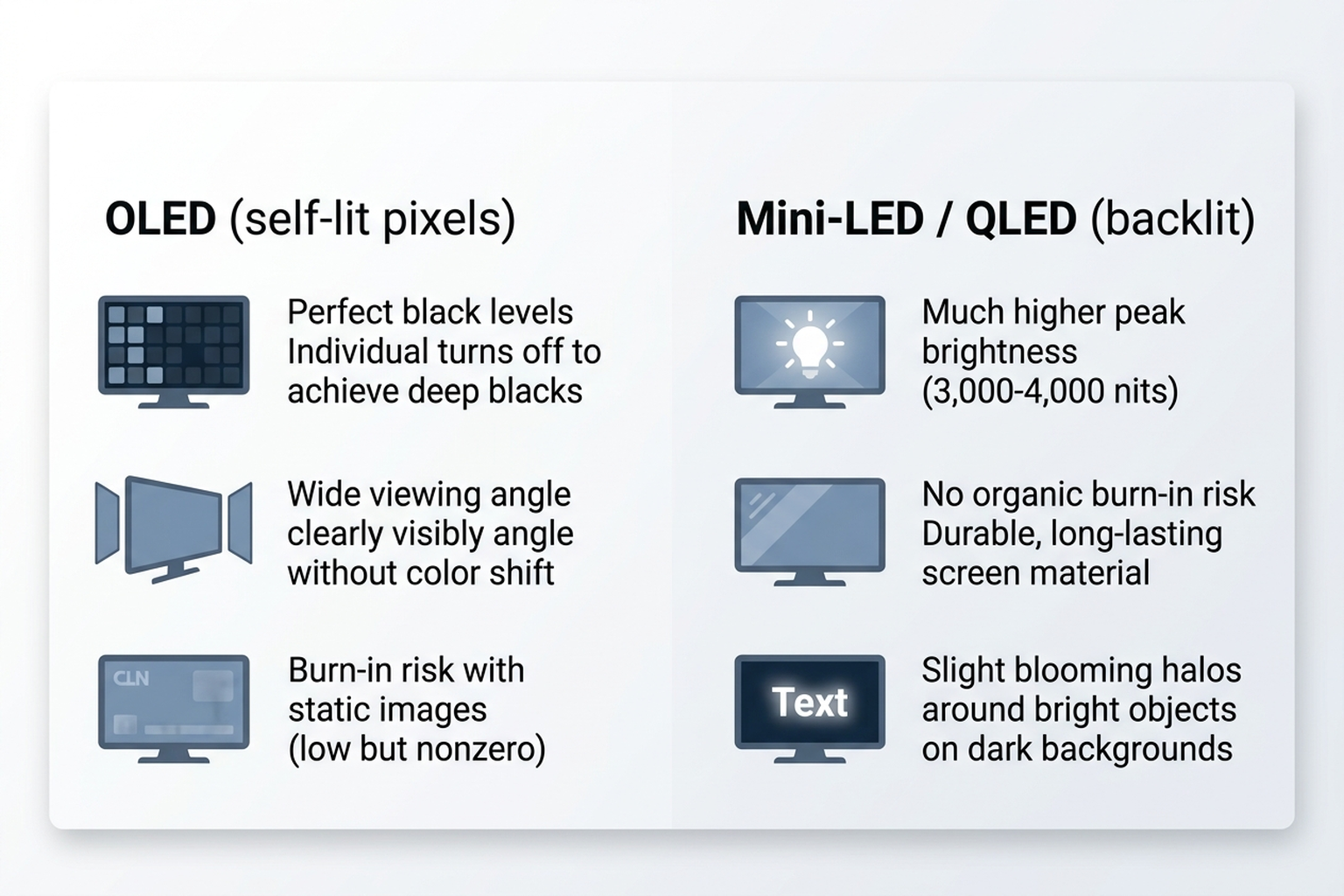
Industry reporting and manufacturer documentation converge on the same picture: OLED burn-in in 2026 is real but far less common than it was on early panels, thanks to pixel-shift, logo-dimming, and panel-refresh routines running in the background — producing visible burn-in now typically requires hours of the same static image (a channel logo, a game HUD) every day for months. Mini-LED sidesteps that risk entirely because its LED backlight and LCD pixel layer are physically separate from anything organic, but it introduces blooming instead, where a bright object on a dark background produces a visible glow in the surrounding dimming zone. The diagram above shows the brightness range across Mini-LED TVs as a category (some flagship models do reach 3,000-4,000 nits); the TCL QM7L specifically lands lower in that range, at roughly 2,400 nits independently measured. Rooms that stay dark for movie nights favor OLED’s black levels; rooms with daytime glare or households that leave the same channel or app on screen for hours favor Mini-LED’s brightness and zero burn-in risk.
Which One Should You Buy?
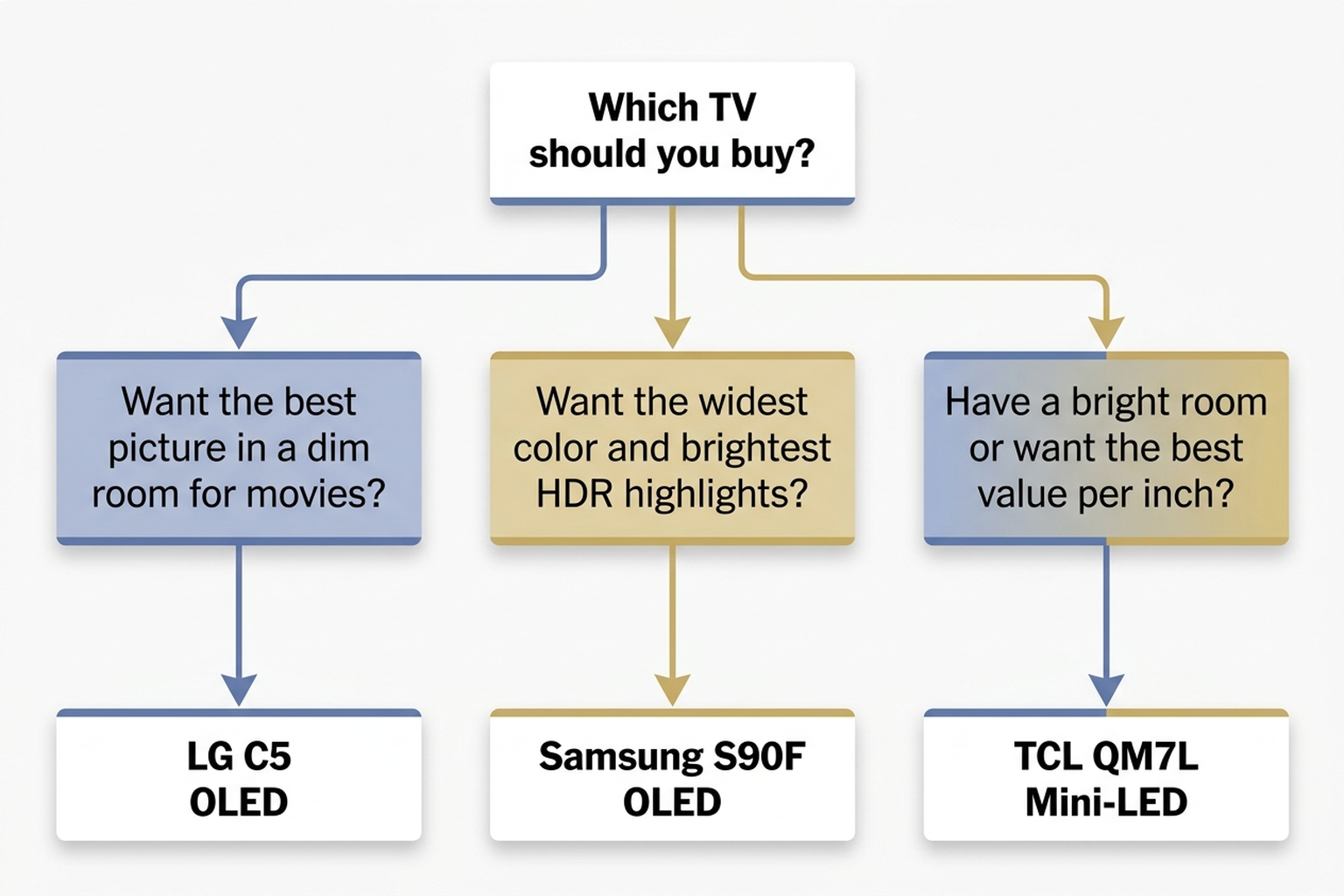
- Best for a dark home theater and gaming: LG C5 OLED — among the fastest response times tested and the pick most frequently named “best for most people” in a light-controlled room.
- Best for color accuracy and HDR highlights: Samsung S90F OLED — QD-OLED’s wider color volume gives it an edge in vibrant HDR content, at a similar price to the LG.
- Best value and brightest room performance: TCL QM7L Mini-LED — roughly $500–$700 cheaper than the OLEDs at a comparable size class, with no organic burn-in risk, at the cost of some black-level depth and visible blooming in high-contrast scenes.
Warranty and Support
LG publishes a 1-year limited warranty covering parts and labor on the C5, and its documentation does not explicitly list burn-in as a covered defect — independent reporting describes LG’s language here as ambiguous enough that claims are evaluated case by case. Samsung’s 1-year limited warranty on the S90F similarly covers parts and labor but, per Samsung’s own warranty terms and third-party warranty trackers, standard coverage excludes burn-in and image retention; Samsung has occasionally run separate promotional burn-in coverage offers on specific models in specific years, which do not apply by default. TCL’s 12-month limited warranty on the QM7L covers manufacturing defects in parts and labor but explicitly excludes “markings or images on the product’s LCD/LED panel resulting from viewing fixed images” — language TCL uses for both burn-in and conceptually similar Mini-LED image-retention cases, even though the underlying failure mode differs by panel type.
Limitations
This analysis relies on publicly available reviews, manufacturer specifications, and independent lab test data, including RTINGS’ TV testing program, Consumer Reports’ picture-quality scoring, and Tom’s Guide’s and Digital Trends’ hands-on reviews. Individual experience may vary based on room lighting, viewing distance, content mix, and unit-to-unit manufacturing variance — the reliability complaints noted for the LG C5, in particular, describe a subset of units rather than the model as a whole. Prices shown are Amazon listing prices as of the stated date and change frequently with promotions; check the current Amazon listing before buying.
As an Amazon Associate, Arekore earns from qualifying purchases. The Amazon product links in this article include our affiliate tracking ID and may earn us a commission if you buy through them, at no additional cost to you. See our Links Policy for details on how we select products and how commissions do not influence our recommendations.
Products Mentioned
- LG 65-Inch Class C5 Series OLED evo AI 4K Smart TV, OLED65C5PUA
- Samsung 65-Inch Class QN65S90F OLED 4K Vision AI Smart TV
- TCL 55-Inch Class QM7L Series SQD-Mini LED QLED 4K Smart Google TV
Verify current pricing, availability, and specifications on the Amazon product page before purchasing — we do not guarantee prices stay current after publication.