How to Winterize an Outdoor Security Camera in 2026
TL;DR
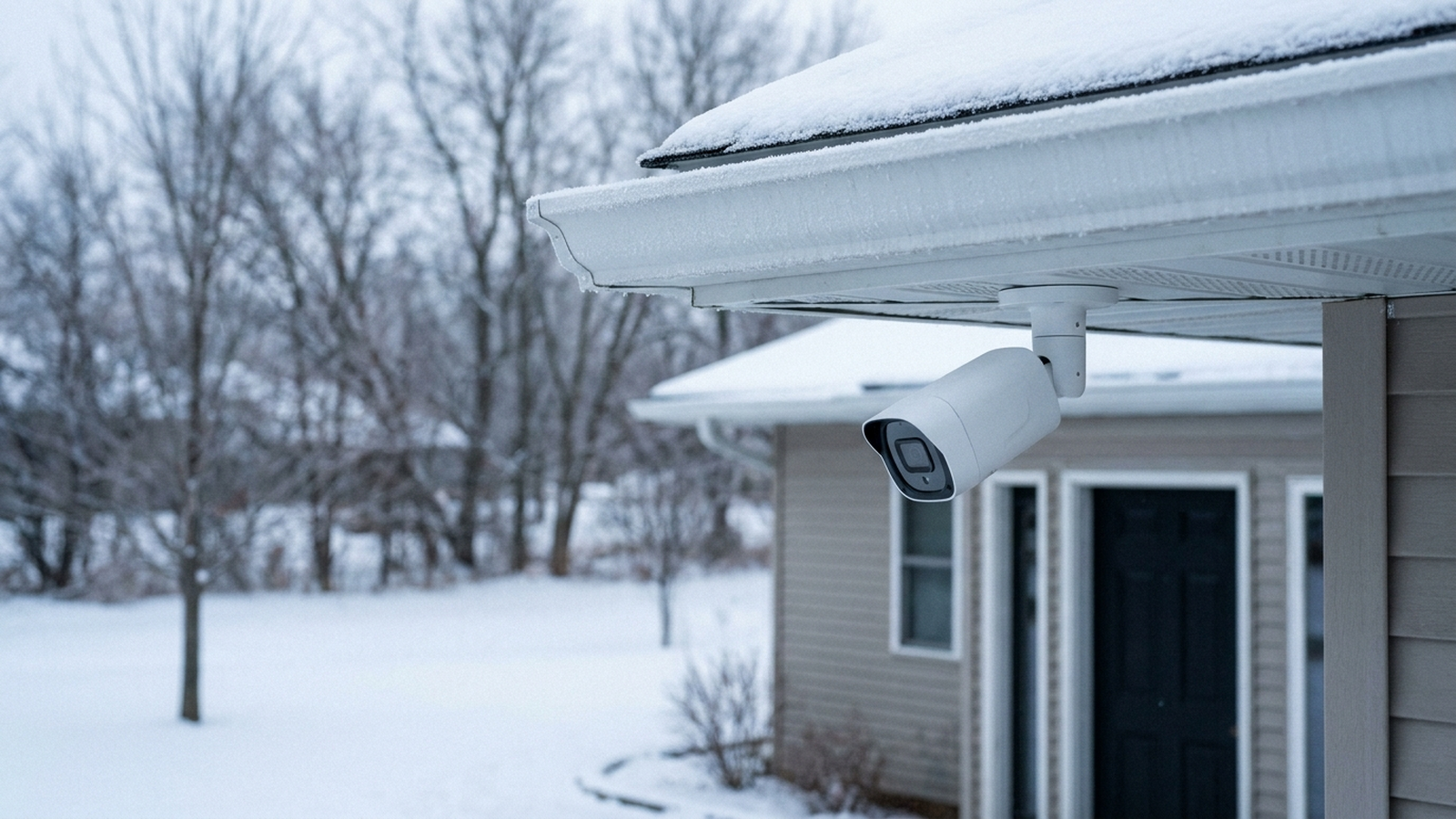
Cold weather doesn’t usually kill an outdoor security camera outright — it quietly drains the battery, fogs the lens, and weakens the Wi-Fi link until the camera starts missing clips. Every major battery-powered camera (Ring, Arlo, eufy, Wyze) is rated to survive well below freezing on paper, but real-world battery runtime still drops 20–50% once temperatures fall below 32°F. The fix is mostly about power and placement, not the camera itself: add a wired or solar supplement before the first hard freeze, mount so warm air can’t condense on the lens, and check Wi-Fi signal strength now, while it’s still easy to move things.
Methodology
This analysis synthesizes (a) manufacturer-published operating-temperature specifications and support documentation for Ring, Arlo, eufy, and Wyze outdoor cameras, (b) a 2025–2026 Stiftung Warentest outdoor-camera test (issue 10/2025) covering 22 models, (c) recurring themes from official Ring, Arlo, and Wyze community-forum threads about cold-weather and condensation problems, and (d) third-party lithium-battery performance data on cold-temperature capacity loss. We did not personally test the products covered here; all specifications were cross-checked against current manufacturer datasheets as of October 2026.
Why Cold Weather Actually Breaks Outdoor Cameras
Outdoor security cameras rarely fail from cold in the way people expect — the plastic housing and sensor are fine. Three specific mechanisms cause the complaints that show up every winter:
- Battery chemistry. Every battery-powered outdoor camera on the market uses a lithium-ion or lithium-polymer cell. Independent battery-performance data shows that standard lithium-ion cells lose roughly 20% of usable capacity between 0°F and 14°F, and 40–50% below -4°F, because the internal chemical reaction that delivers current slows down in the cold. A camera rated for a 6-month charge in summer can need a recharge every 6–8 weeks once overnight lows drop into the 20s.
- Lens condensation. When a cold camera housing is exposed to a sudden rise in humidity — rain followed by a cold snap, or a warm, moist day after a freeze — moisture condenses on the inside of the lens cover faster than it can evaporate. Wyze’s own support documentation and forum threads describe this as a known issue on the Wyze Cam v3, with some users reporting it recurs after essentially every heavy rain or fog event until the unit is resealed or replaced.
- Wi-Fi signal attenuation. Cold, dense winter air carries radio signals slightly differently than summer air, but the bigger factor is leafless trees and closed storm windows changing the physical signal path between camera and router. A camera that worked fine on a marginal signal in July can start dropping clips in December for reasons that have nothing to do with the camera itself.
None of these is something a thermostat fixes. They’re solved with power strategy, physical placement, and a five-minute signal check — covered below.
As an Amazon Associate, Arekore earns from qualifying purchases. The Amazon product links in this article include our affiliate tracking ID and may earn us a commission if you buy through them, at no additional cost to you. See our Links Policy for details on how we select products and how commissions do not influence our recommendations.
Brand-by-Brand Cold-Weather Specs
Manufacturer-published operating-temperature ranges are a reasonable floor, not a guarantee of good battery life at the edge of that range. The table below uses each brand’s current official datasheet or support article.
| Camera | Power type | Official operating range | Cold-weather note | Price (as of 2026-10-02) |
|---|---|---|---|---|
| Ring Outdoor Cam (Stick Up Cam), Battery | Removable Li-ion battery | -5°F to 120°F | Ring’s own support channel recommends a wired model if cold is a primary concern | $79.99 |
| Arlo Pro 5S, 2-camera kit | Removable Li-ion battery | -4°F to 113°F (per official datasheet) | Several users in Arlo’s own community forum report faster-than-expected battery drain near the low end of this range | $149.99 |
| eufyCam 3 (S330) Add-on Camera | Li-ion battery + integrated solar panel | -4°F to 122°F | Manufacturer claims the integrated solar panel needs only ~2 hours of direct sun per day to offset battery drain — a manufacturer claim, not independently verified | $123.48 |
| Wyze Cam v3 | Li-ion battery (wired USB power standard) | -5°F to 113°F (per official spec sheet) | Forum reports describe internal lens-moisture buildup after heavy rain or freeze-thaw cycles more often than on Ring or Arlo models | ~$36 |
A pattern worth noting: all four brands cluster within a few degrees of each other on paper (roughly -4°F to -5°F on the low end). The real difference between a camera that survives a Midwest or Northeast winter and one that doesn’t comes down to how it’s powered and mounted, not which brand’s logo is on the housing.
What Forums and Reviews Actually Say
Reading through Ring, Arlo, and Wyze’s own community support forums rather than marketing pages surfaces a consistent pattern: complaints cluster around battery drain and condensation, not catastrophic hardware failure. Threads about “camera died overnight in the cold” are almost always resolved by a support rep pointing to battery capacity loss, not a defect. Threads about foggy or “milky” footage after rain or snow are more often attributed to a failed internal seal — a hardware issue, but one some users report recurring on replacement units of the same model, suggesting a design tolerance issue rather than a one-off defect. Stiftung Warentest’s October 2025 outdoor-camera test (22 models, 19 rated “good,” none failed outright) did not isolate cold-weather performance as a specific test category, which is itself a gap in available third-party data — most lab tests evaluate image quality and app usability, not multi-week cold-weather battery behavior.
The Winterizing Checklist
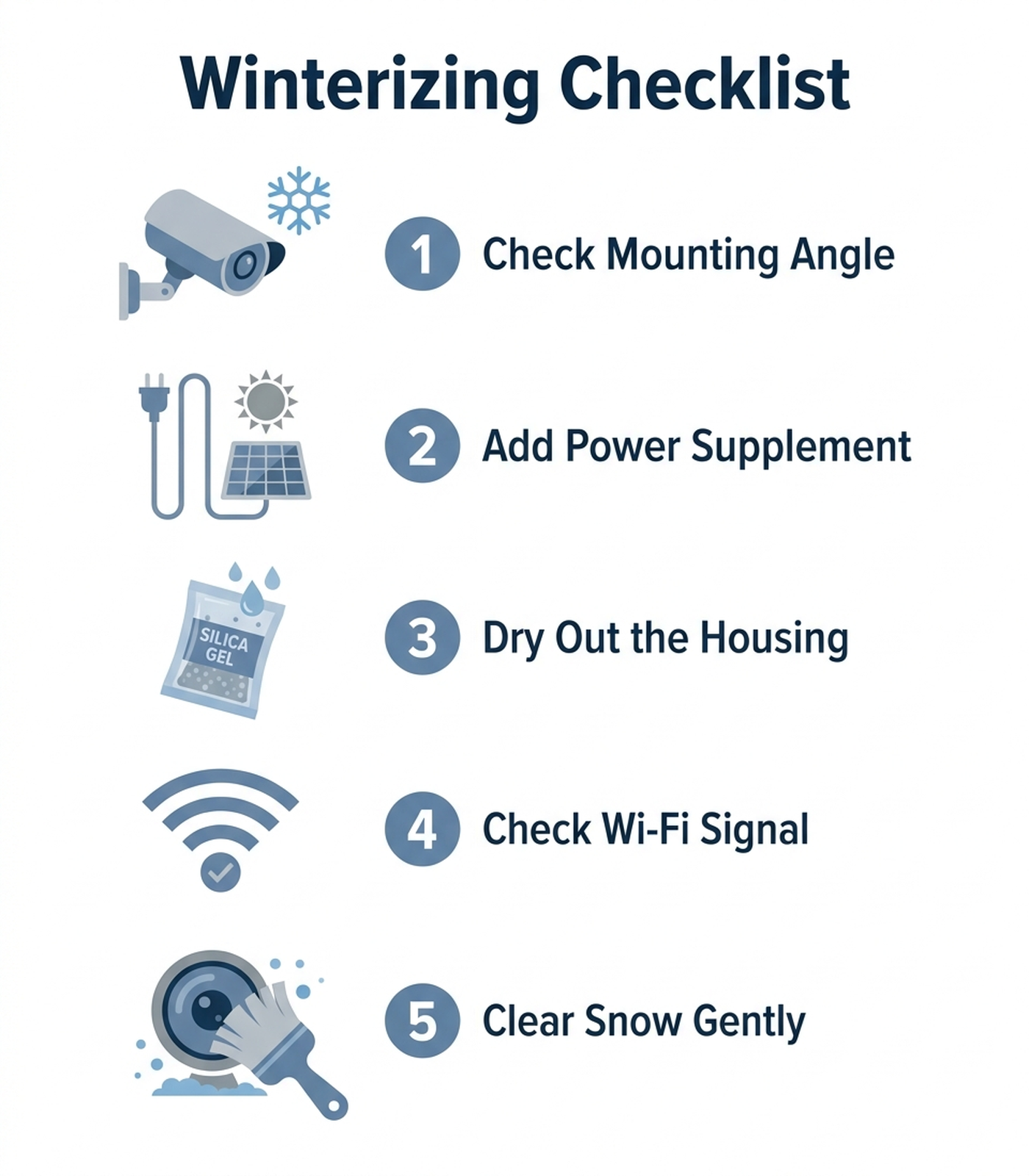
Do this before the first hard freeze, not after a camera has already gone dark:
- Check the mounting angle. A camera mounted flat against a wall or pointed slightly upward collects snow and ice directly on the lens. Angling the camera a few degrees downward, or adding a universal sun/rain shade cover over the housing, keeps falling snow off the glass without blocking the field of view.
- Add a power supplement before you need it. A wired power adapter (most outdoor cameras accept a weatherproof USB or barrel-connector cable) keeps the camera charged continuously, which sidesteps the cold-battery-capacity problem entirely. For solar-equipped cameras like the eufyCam 3, an additional solar panel helps offset the shorter, lower-angle winter sun.
- Dry out the housing before the first freeze. If a camera has shown any condensation during fall rain, open the battery compartment on a dry day and let it air out, or add a small reusable silica-gel pack inside the compartment (where the camera design allows it) to absorb residual moisture before it has a chance to freeze.
- Re-check Wi-Fi signal strength in the app. Most camera apps show a signal-strength indicator. If it was marginal in summer, it’s worth testing again now — bare trees, closed storm windows, and added holiday lighting can all change the signal path between camera and router.
- Clear snow buildup, don’t scrape it. Brushing snow off a lens with a glove or soft brush is safe; using a scraper or anything abrasive can permanently scratch the lens coating, which no amount of winterizing then fixes.
Which Approach Fits Your Setup
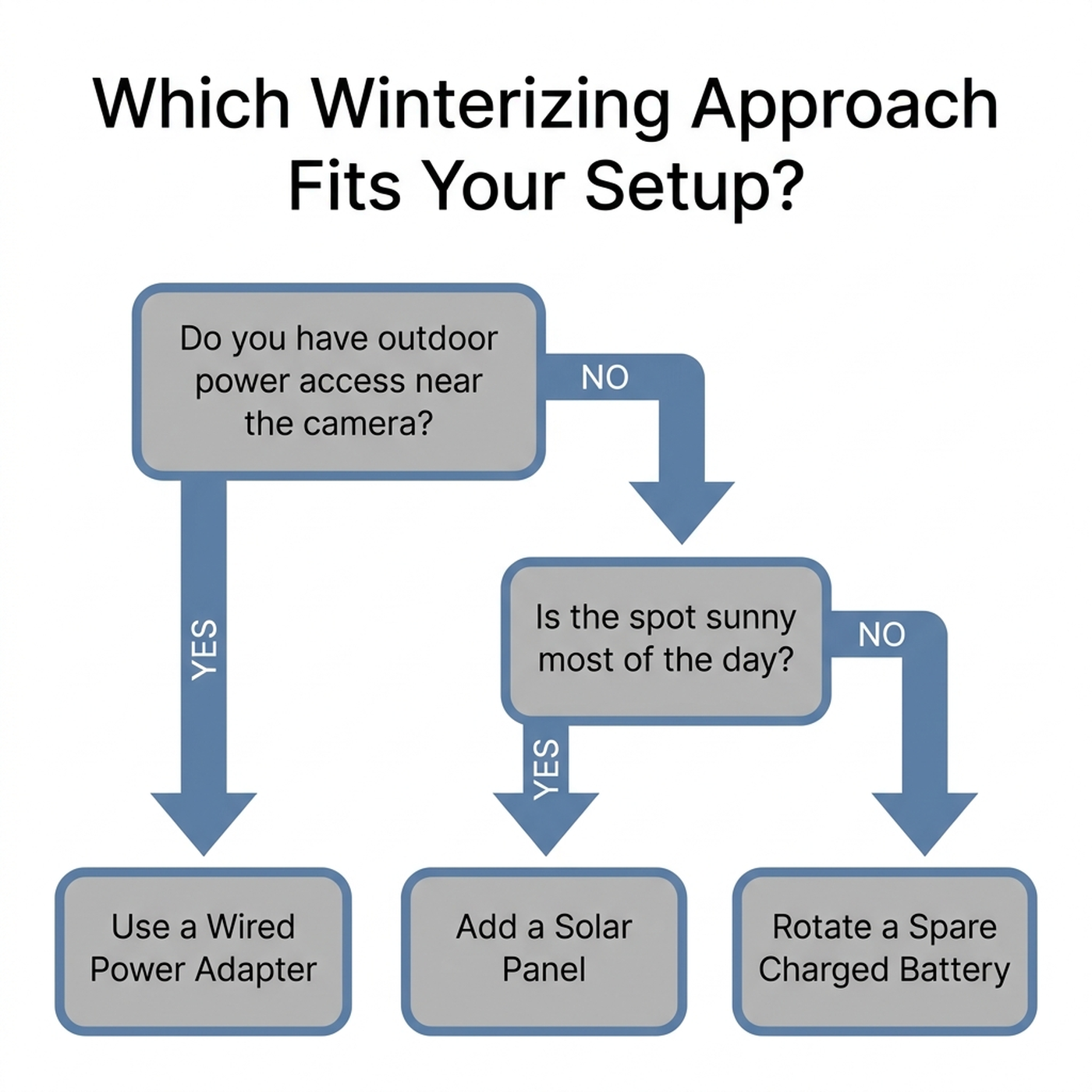
- Camera near an outdoor outlet or easy cable run: A weatherproof power adapter is the simplest fix — it removes the cold-battery problem entirely and costs less than a replacement camera.
- Camera in a sunny, south-facing spot with no outlet nearby: A supplemental solar panel (compatible with eufy, and widely available third-party for Ring and Arlo) is the next-best option, though it depends on winter daylight hours in your region.
- Camera in a shaded or north-facing spot with no outlet: Plan on a battery swap rotation — keep a charged spare battery indoors and swap it every few weeks through the coldest months, since neither wired power nor solar is practical here.
Editorial Recommendation
- Best for renters or anyone who can’t run a cable: The eufyCam 3’s integrated solar panel is the only one of these four that doesn’t require buying a separate accessory, which matters if drilling or running cable isn’t an option.
- Best for a known-cold climate (regular nights below 10°F): Prioritize the wired-power option regardless of brand. At that temperature, every lithium battery in this comparison loses enough capacity that a battery-only setup becomes high-maintenance.
- Best if the lens has fogged before: Start with the physical fix (mounting angle, lens hood, silica gel) before assuming the unit is defective — forum reports suggest this resolves the majority of condensation complaints without a replacement.
Limitations
This analysis relies on publicly available manufacturer specifications, one third-party lab test, and forum/community-reported experiences rather than controlled side-by-side cold-weather testing. Operating-temperature ranges are manufacturer-published figures; actual battery performance at the edge of those ranges varies by individual unit, battery age, and local humidity. Individual experience may differ based on climate, mounting location, and Wi-Fi setup.
Recommended Winterizing Accessories
| Accessory | Use case | Price (as of 2026-10-02) |
|---|---|---|
| Weatherproof power adapter for Ring Stick Up Cam | Converts a battery Ring camera to continuous wired power | $19.99 |
| eufy Security Solar Panel (3W) | Supplemental charging for eufyCam models in sunny spots | $29.99 |
| HYDROSORBENT Silica Gel Moisture Absorber, 40g | Reusable desiccant for drying out a battery compartment before a freeze | $14.99 |
| Universal sun/rain shade cover for dome and bullet cameras | Fits Ring, Arlo, eufy, Nest, and Wyze outdoor cameras; keeps falling snow off the lens without blocking the field of view | $12.99 |
Before You Buy
Specs and prices change, and the right winterizing approach depends on your specific mounting location and climate. Visit Arekore to check current Amazon pricing and verify any product mentioned here before you buy.