How to Store a Cordless Vacuum Battery Over Winter (2026)
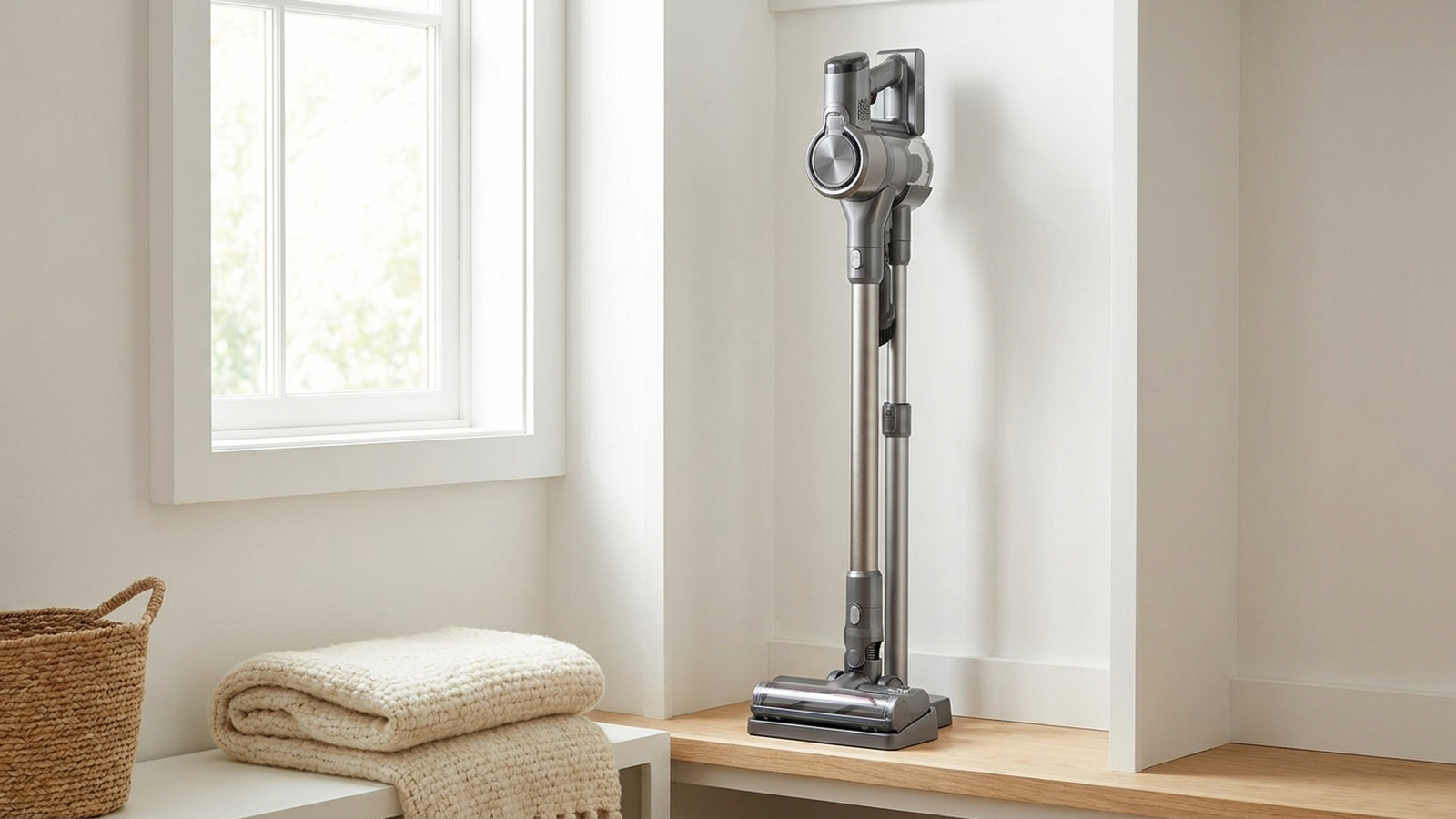
TL;DR. Cordless vacuum batteries are lithium-ion, and the two things that damage them fastest are cold and a full or empty charge sitting untouched for months. Manufacturer guidance converges on the same three rules: keep the battery somewhere between roughly 60–75°F (15–24°C), leave it at about a 50% charge rather than 0% or 100% for long-term storage, and top it back up every 1–2 months so it never sits in a deep-discharge state. An unheated garage or shed in winter is the single most common mistake — Shark’s own manual says not to store the unit below 37.4°F, and Dyson gives the same floor.
A note on links and methodology
As an Amazon Associate, Arekore earns from qualifying purchases. The Amazon product links in this article include our affiliate tracking ID and may earn us a commission if you buy through them, at no additional cost to you. See our Links Policy for details on how we select products and how commissions do not influence our recommendations.
We did not personally run a controlled cold-storage test on any specific vacuum this winter. Every recommendation below is an editorial synthesis of manufacturer documentation, peer-reviewed battery degradation research, and aggregated public troubleshooting reports, cited inline.
Methodology
This is an editorial analysis based on publicly available data collected in September 2026. We synthesized:
- Manufacturer support documentation — Dyson’s official “Vacuum Battery Care” page (storage temperature range and cold-weather operation guidance) and Shark’s published cordless handvac and stick-vacuum user manuals, which specify exact storage and charging temperature floors.
- Peer-reviewed battery science — a 2026 meta-analysis on lithium-ion battery degradation (ScienceDirect) and a multi-scale study of low-temperature exposure effects on lithium-ion cells (ScienceDirect, 2024), both of which quantify how cold accelerates capacity loss through mechanisms like lithium plating and SEI-layer growth.
- Power-tool and outdoor-equipment manufacturer guidance — STIHL’s and Flymo’s published winter battery-storage advice, which covers the same lithium-ion chemistry used in cordless vacuums and gives concrete charge-level and check-in-interval recommendations.
- Aggregated owner troubleshooting reports — JustAnswer and appliance-repair guide threads describing batteries that stopped holding a charge after a season in a garage or unheated basement, read in September 2026. We do not report a precise review-count N because these are scattered support threads, not a single reviewed panel; a fabricated sample size would be misleading.
- Replacement-cost data — current retail listings for genuine Dyson replacement batteries (V6/V8/V11-generation), used to quantify what a preventable cold-storage failure actually costs to fix.
We deliberately do not simulate a specific personal battery failure or invent a fake reviewer persona. Treat the guidance below as a synthesis of manufacturer documentation and battery science, not a substitute for your specific model’s manual — always check the manual for your exact machine before assuming these numbers apply.
Why cold is worse for a vacuum battery than most people assume
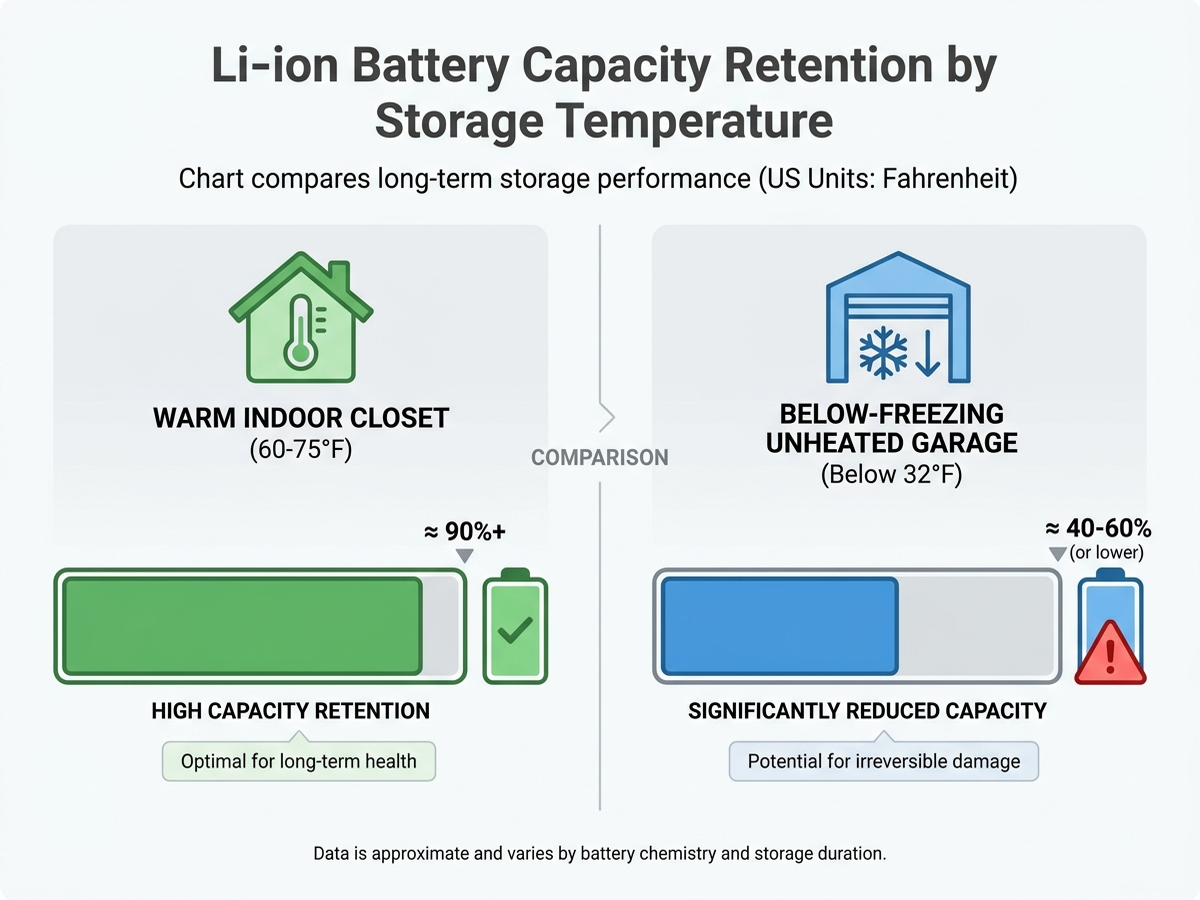
Every cordless stick vacuum on the market — Dyson, Shark, Tineco, Bissell, the handheld units built into Roomba-adjacent brands — runs on lithium-ion cells, and lithium-ion chemistry does not fail gracefully in the cold. Research on low-temperature exposure describes cracking in the cathode material and a buildup of “dead lithium” on the electrode surface, both of which permanently reduce how much charge the cell can hold — this is separate from the temporary, reversible power drop you see when you just try to run a cold vacuum for a few minutes. In lab testing of exposed cells, a bare cell held onto only about 2% of its capacity at −60°C, while an insulated cell retained roughly 81% — an extreme case, but it illustrates that insulation and ambient temperature matter far more for lithium-ion cells than most owners assume.
That’s the science behind why “just leave it in the garage over winter” is the single most common way a cordless vacuum battery gets quietly ruined before spring.
What the manufacturers actually specify
Manufacturers publish exact numbers for this, and they’re stricter than most owners expect. The table below compares the two brands with the clearest published specs, plus the general range that most cordless-vacuum manuals converge on.
| Brand | Storage temperature floor | Charging temperature range | Source |
|---|---|---|---|
| Dyson | Do not store below 37.4°F (3°C); ideal range 64–82°F (18–28°C) | Room temperature; let the machine warm up before charging if it’s been cold | Dyson official battery care page |
| Shark | Do not use or store below 37.4°F (3°C) | Do not charge below 50°F (10°C) or above 104°F (40°F) | Shark cordless handvac / stick vacuum manual |
| General lithium-ion (most brands) | Below freezing accelerates permanent capacity loss | Manufacturers commonly restrict charging below roughly 50°F | STIHL / Flymo winter battery-storage guidance (same chemistry, power-tool category) |
Specs as reported in each manufacturer’s published documentation as of September 2026; confirm against your own unit’s manual, since firmware and battery-management thresholds can vary by model year.
The three-part winter storage rule
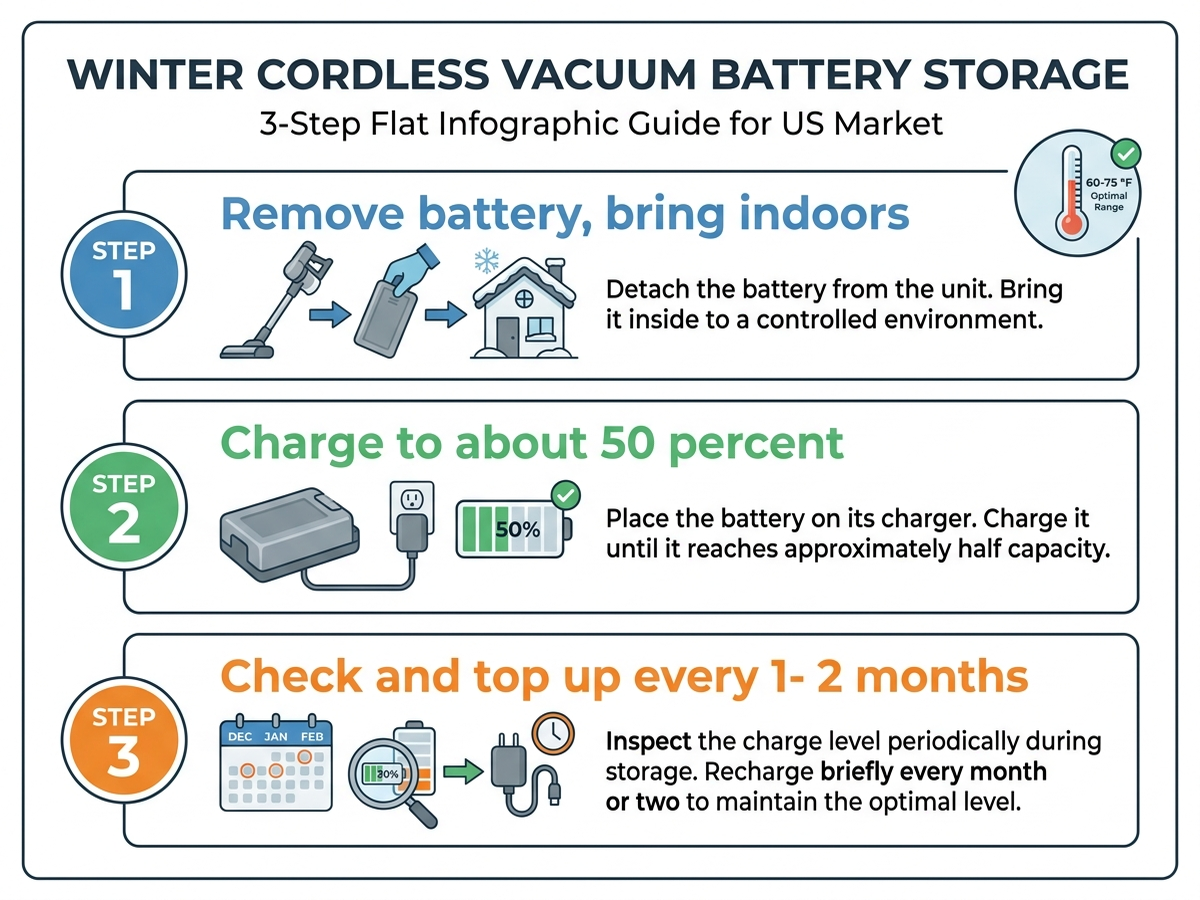
- Bring the battery — not just the vacuum — indoors. Even if the vacuum body lives in a garage or mudroom closet the rest of the year, the battery itself should move somewhere in the 60–75°F range for winter. If the battery is removable, storing it separately from the vacuum body is the single easiest fix.
- Charge to roughly 50% before long-term storage, not 0% or 100%. Lithium-ion cells age fastest at a full charge held for months, and a battery left to sit near 0% risks dropping into a deep-discharge state that can permanently damage the cells. A partial charge splits the difference.
- Check in every 1–2 months and top up if needed. A battery left completely untouched for an entire winter can self-discharge low enough to enter that same deep-discharge state. A quick top-up charge every 4–8 weeks is enough to keep it in a safe range until spring.
Where should you actually store it this winter?
Not every household has a spare climate-controlled closet, so the right answer depends on what storage space is actually available. About two-thirds of U.S. housing units have a garage or carport, and the winter temperature inside an unheated one tracks closely with outdoor temperature — which is exactly the scenario manufacturer specs warn against.
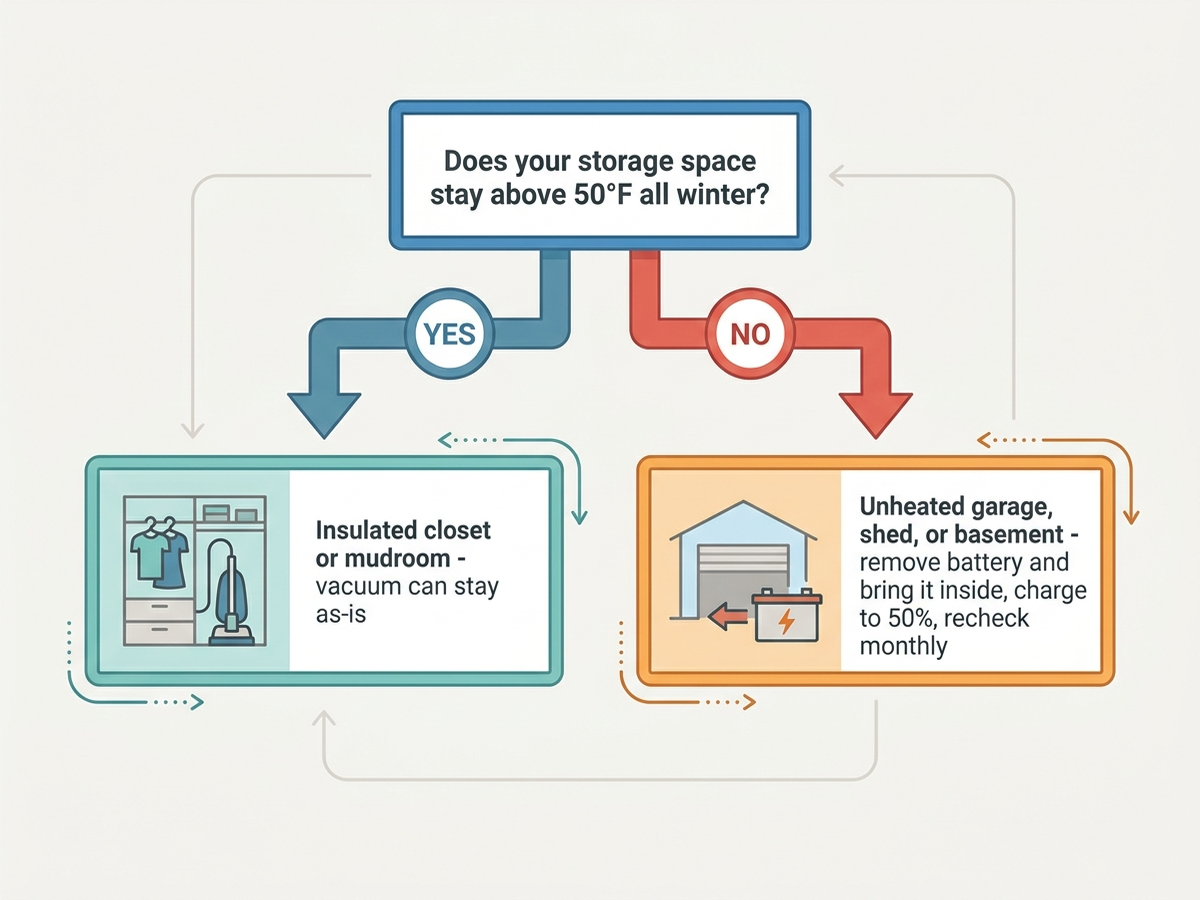
- Insulated closet, mudroom, or interior utility room that stays above 50°F all winter: the vacuum and battery can stay put as-is. Just avoid leaving it right against an exterior wall or a drafty window.
- Attached garage in a cold-winter climate: bring the battery inside for the season, even if the vacuum body stays in the garage. A cheap wireless thermometer in the garage (see below) tells you in a week or two whether it’s actually dropping below the manufacturer’s floor.
- Unheated shed, detached garage, or unheated basement: always bring the battery inside. These spaces routinely track outdoor temperature and are the scenario every manufacturer manual explicitly warns against.
- Vacation home or RV left unoccupied for the season: remove the battery and store it at the primary residence if possible; a battery left at 0% or 100% in an unmonitored, unheated space over a full winter is the highest-risk combination in this article.
A cheap way to know for sure
Aggregated troubleshooting threads on JustAnswer and appliance-repair sites repeatedly describe the same pattern: a battery that charged fine in fall stops holding a charge by spring, traced back to a garage or basement that got colder than the owner realized. A small wireless indoor thermometer placed near the storage spot removes the guesswork — instead of assuming a space is “probably fine,” you get an actual reading and, with app-connected models, an alert if it drops near freezing.
The Govee H5075 is a widely stocked Bluetooth indoor thermometer/hygrometer that fits this use case: it logs temperature history so you can check whether a garage or closet dipped below the storage floor at 2 a.m. during a cold snap, not just what it reads when you happen to walk by.
Govee H5075 Bluetooth Indoor Thermometer/Hygrometer
If you want extra insurance while charging
Lithium-ion cells that have been degraded by cold exposure are also the cells most likely to behave unpredictably during a subsequent charge. Hobbyist fireproof charging bags — originally sold for drone and RC-hobby lithium-polymer packs — are inexpensive and give a small extra margin of safety if you’re topping up a battery you suspect has already been through a bad winter, by containing heat and any venting gas if a damaged cell does start to fail during charging. They are not a substitute for storing the battery correctly in the first place, and they are not manufacturer-endorsed accessories for vacuum batteries specifically — treat this as a general lithium-ion safety habit, not a fix for a battery that’s already failing.
HOBBYMATE Fireproof Lithium Battery Storage & Charging Bag
What it costs if you get this wrong
A battery that’s been permanently degraded by a winter in the cold doesn’t fail dramatically — it just runs for a fraction of its original time per charge, or stops holding a charge at all by the following season. Aggregated troubleshooting reports describe this as one of the most common post-winter complaints for cordless stick vacuums. Genuine Dyson replacement batteries for the V6/V8/V11 generation of machines are commonly priced in the $79–$150 range depending on model, which puts a real dollar figure on what a $10 wireless thermometer and a five-minute fall habit are meant to prevent.
Editorial recommendation
For most households with an attached, occasionally-heated garage, the fix costs nothing: pull the battery out, set it on a shelf in a closet at roughly half charge, and set a recurring monthly reminder to top it up. Households with an unheated detached garage, shed, or unfinished basement should treat this as a mandatory step rather than an optional one, since those spaces are exactly the ones manufacturer manuals call out by name. A cheap indoor thermometer is worth adding specifically for anyone who has been assuming a storage space “doesn’t really get that cold” without having checked.
Limitations
This analysis relies on publicly available manufacturer documentation, peer-reviewed battery-degradation research, and aggregated troubleshooting reports rather than a controlled experiment we ran ourselves. Exact storage-temperature and charging-temperature thresholds vary by brand and by model year — always confirm against your specific unit’s manual before relying on the numbers cited here. Individual battery lifespan also depends on age, charge-cycle history, and manufacturing variance that this article cannot account for.
Prices as of 2026-09-27.