Window AC Installation Mistakes 2026: 5 Errors Renters Make
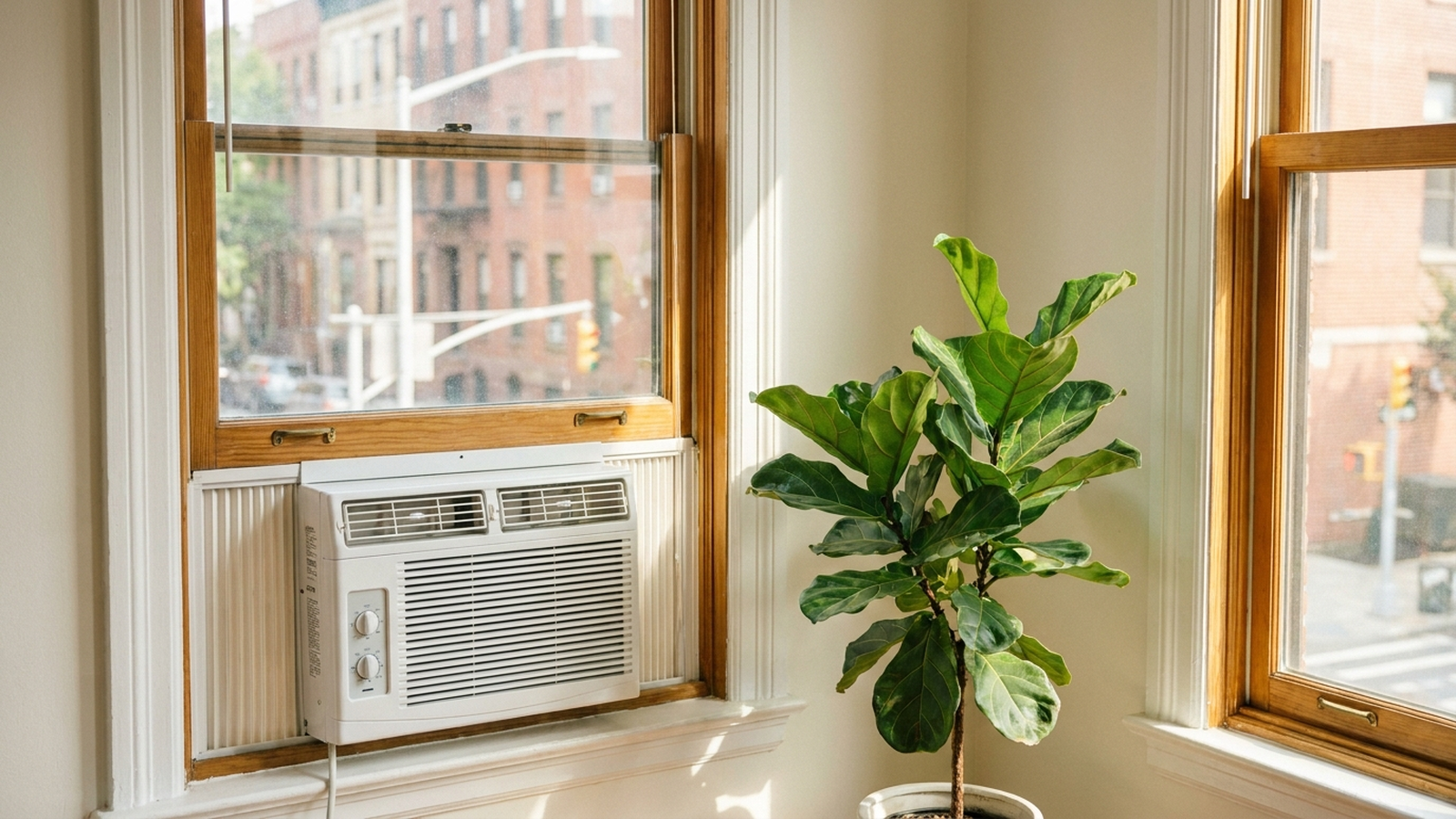
Americans bought roughly 9.6 million window and wall air conditioners in 2024 — a $1.7 billion market, up 6.3% in value over the prior year, according to trade-data firm IndexBox. A large share of those boxes went to the country’s 45.3 million renter households (Redfin’s analysis of Census data), because a window unit is the one form of air conditioning a tenant can own, install, and take to the next apartment. It is also the only major appliance most people will ever install themselves, sixty pounds of it, in an open window, often several stories up.
The low-star reviews on best-selling window AC listings tell a remarkably consistent story, and it is usually not about the machine. Water dripping onto the floor, hot air pouring through gaps, breakers tripping, units shifting in the sash — the same handful of installation errors appears across brands and price points. This analysis walks through the five mistakes that come up again and again, why each one happens, and the fixes — most of them under $50, none of them requiring a drill or a landlord’s signature.
As an Amazon Associate, Arekore earns from qualifying purchases. The Amazon product links in this article may include our affiliate tracking ID and may earn us a commission if you buy through them, at no additional cost to you. See our Links Policy for details on how we select products and how commissions do not influence our recommendations.
TL;DR / Quick Verdict
- Most dangerous mistake: letting the window sash carry the unit’s full weight. Consumer Reports warns the worst case is the unit falling out of the window; a no-drill support bracket (~$30–$45 at the time of writing) removes that risk without violating a lease.
- Most common mistake in reviews: trusting the accordion side panels to seal the window. They are draft curtains, not insulation. The Department of Energy attributes 25–40% of a typical home’s heating and cooling energy to air leakage — foam weatherseal costs about $10.
- Most misunderstood mistake: the tilt. Older units drain outward and need a slight backward slope; many newer units (including Midea’s U-shaped line) are designed to sit level per the manual. Guessing instead of reading caused enough pooled-water problems that the CPSC recalled about 1.7 million Midea U and U+ units in June 2025 over mold risk — since remedied in current models.
- Most expensive mistake to ignore: extension cords. The National Fire Protection Association has counted roughly 2,800 home fires a year involving air conditioning equipment (2011–2015 average, its most recent category baseline); wall outlet only, ideally on a circuit that is not already loaded.
How We Reached These Conclusions (Methodology)
This is an editorial analysis, not a hands-on review. We did not personally install or test the products covered here. This guide synthesizes three kinds of public information: (a) recurring installation-failure themes in aggregated amazon.com customer reviews — especially one- and two-star reviews — across best-selling window AC and AC-accessory listings, sampled in July 2026; (b) installation guidance and reporting from Consumer Reports, Wirecutter (The New York Times), CNN Underscored, and Bob Vila, plus safety data from the CPSC, the U.S. Fire Administration, and the Department of Energy; and (c) manufacturer installation manuals and specifications from Midea, Frost King, and others. Figures such as noise levels, energy savings, and load ratings are manufacturer claims unless attributed to an independent source. Prices are amazon.com figures at the time of writing and move frequently during the summer season.
Why This Keeps Happening: The Renter’s Dilemma
Window AC installation sits in an awkward gap. It is treated as too simple for a professional (and most renters would not pay for one), yet the consequences of doing it wrong range from a moldy sill to a unit on the sidewalk. Renters face three extra constraints homeowners do not: they usually cannot drill into the building exterior, they inherit whatever window and wiring the apartment has, and they reinstall the unit every summer — which means every mistake gets a fresh chance annually. Consumer Reports notes that support brackets may even be required by a landlord or local building code, something many tenants discover only after buying the wrong hardware.
The five mistakes below are ordered by where they occur in the process, from the store to the outlet.
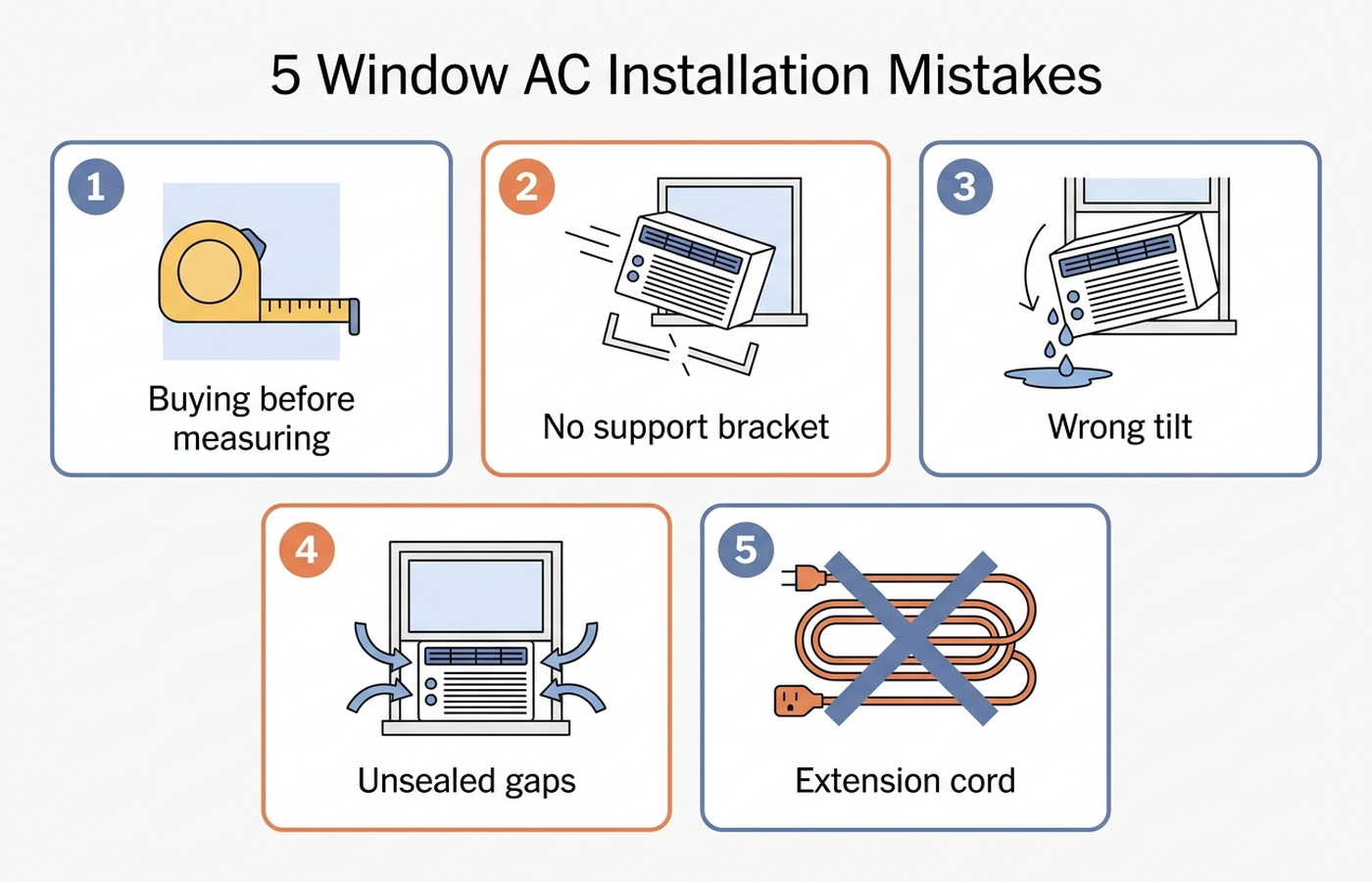
Mistake 1: Buying Before Measuring
A surprising share of “does not fit” and “returned it” reviews trace back to ten missing minutes with a tape measure. Standard window ACs are designed for double-hung windows (the kind where the bottom sash slides up). Sliding and casement windows need entirely different units, and no amount of foam fixes a fundamental mismatch. Beyond window type, three numbers matter: the width of the window opening (units specify a minimum and maximum), the height the sash actually opens (U-shaped units in particular need clearance for the saddle), and the distance to the nearest outlet — because, as covered in Mistake 5, an extension cord is not an acceptable answer.
Sizing by cooling capacity matters too. Reviewers who report a unit that “runs constantly and never cools” usually bought too few BTUs for the space; an oversized unit short-cycles and dehumidifies poorly. As a reference point, an 8,000 BTU unit is rated for roughly 350 square feet — a typical one-bedroom living room.
The renter-friendly fix is a unit designed around easy installation. The Midea 8,000 BTU U-Shaped Smart Inverter (~$330–$380 at the time of writing) is the model Wirecutter has repeatedly named a top pick, and CNN Underscored’s 2026 testing again rated it the best window air conditioner the outlet has tested. Its U-shape lets the window sash close into the gap between the fan and the compressor, which blocks outdoor noise — Midea claims operation as low as 32 dBA and over 35% energy savings compared to traditional non-inverter units, with a CEER of 15 (manufacturer claims; it was the first window AC to earn ENERGY STAR Most Efficient status). One transparency note: the CPSC announced a recall of about 1.7 million earlier U and U+ units in June 2025 over a drainage design that could pool water and grow mold. Midea remedied the design; per CNN Underscored’s reporting, units sold in 2026 do not have the issue and carry a three-year warranty. Aggregated review sentiment on the current listing praises the quiet and the open-window flexibility, while the persistent critiques are price and a bulkier, more involved first-time bracket assembly — read the manual, which is the theme of this entire article.
Check the Midea U-Shaped 8,000 BTU on Amazon
Mistake 2: Making the Window Sash Carry the Weight
This is the mistake with a body count attached. An 8,000 BTU unit weighs roughly 55–60 lbs, and the factory installation method — resting it on the sill, closing the sash on top, adding an L-bracket screw — asks a piece of wood or vinyl to hold that weight all summer. Consumer Reports is blunt about the failure mode: forcing the sash to bear the load can tilt the unit, stop it from draining properly, and in the worst case the unit falls out of the window. Falling-unit incidents are rare but documented, including fatalities from units dropped from upper-story windows, and the CPSC’s broader window-safety data (5,600 children treated in ERs for window falls in 2024 alone) explains why some cities and many landlords mandate additional support.
The renters’ version of this mistake is understandable: traditional support brackets bolt into the exterior wall, which is exactly what a lease forbids. Reviewers describe skipping the bracket entirely rather than risking the security deposit.
The fix costs about $35 and drills nothing. The Jeacent no-drill support bracket (~$30–$45 at the time of writing) clamps against the inside of the wall below the window and the sill, supports up to 200 lbs (manufacturer claim), and installs without tools. Wirecutter’s accessory coverage specifically flags this style as suited to renters, since it removes and reinstalls in minutes when the unit comes out for winter or the lease ends. Aggregated review sentiment across its large amazon.com review base is strongly positive on stability and lease-friendliness; the recurring critiques are that it will not work on every wall profile (bay windows, very deep sills) and that the instructions reward a careful first read. Consumer Reports prices conventional brackets at $30–$100, so the no-drill version sits at the cheap end while solving the renter’s core problem.
Check the Jeacent No-Drill AC Bracket on Amazon
Mistake 3: Getting the Tilt Wrong — in Either Direction
Window ACs make water. Condensate has to go somewhere, and where it goes is decided by a few degrees of tilt at installation. Reviews describing “water dripping down my wall” or “puddle on the floor every morning” are almost always this mistake, and it comes in two opposite flavors.
The classic error is installing the unit dead level, or tilted slightly into the room. Traditional units drain out the back and need a slight backward slope — Bob Vila and Consumer Reports both cite roughly a half inch — so gravity moves water toward the outside drain holes rather than onto your baseboards.
The newer error is the reverse: applying that folk wisdom to a unit engineered to sit level, with an internal slanted drain pan doing the work. Consumer Reports specifically warns that some newer models require perfect leveling, and the Midea U’s own support documentation addresses tilt-related dripping. The consequences of getting this wrong at scale are on the record: pooled water that never drained properly was central to the CPSC’s June 2025 recall of about 1.7 million Midea U-series units for mold exposure risk. The design has since been corrected — but the lesson generalizes to every brand.
The fix is free: read the installation manual for your specific unit and use a bubble level (or a phone’s level app) instead of eyeballing. Thirty seconds of checking beats a summer of mopping. While you are at it, clear the drain holes at the rear base of the unit each spring — blocked drains produce identical symptoms to bad tilt.
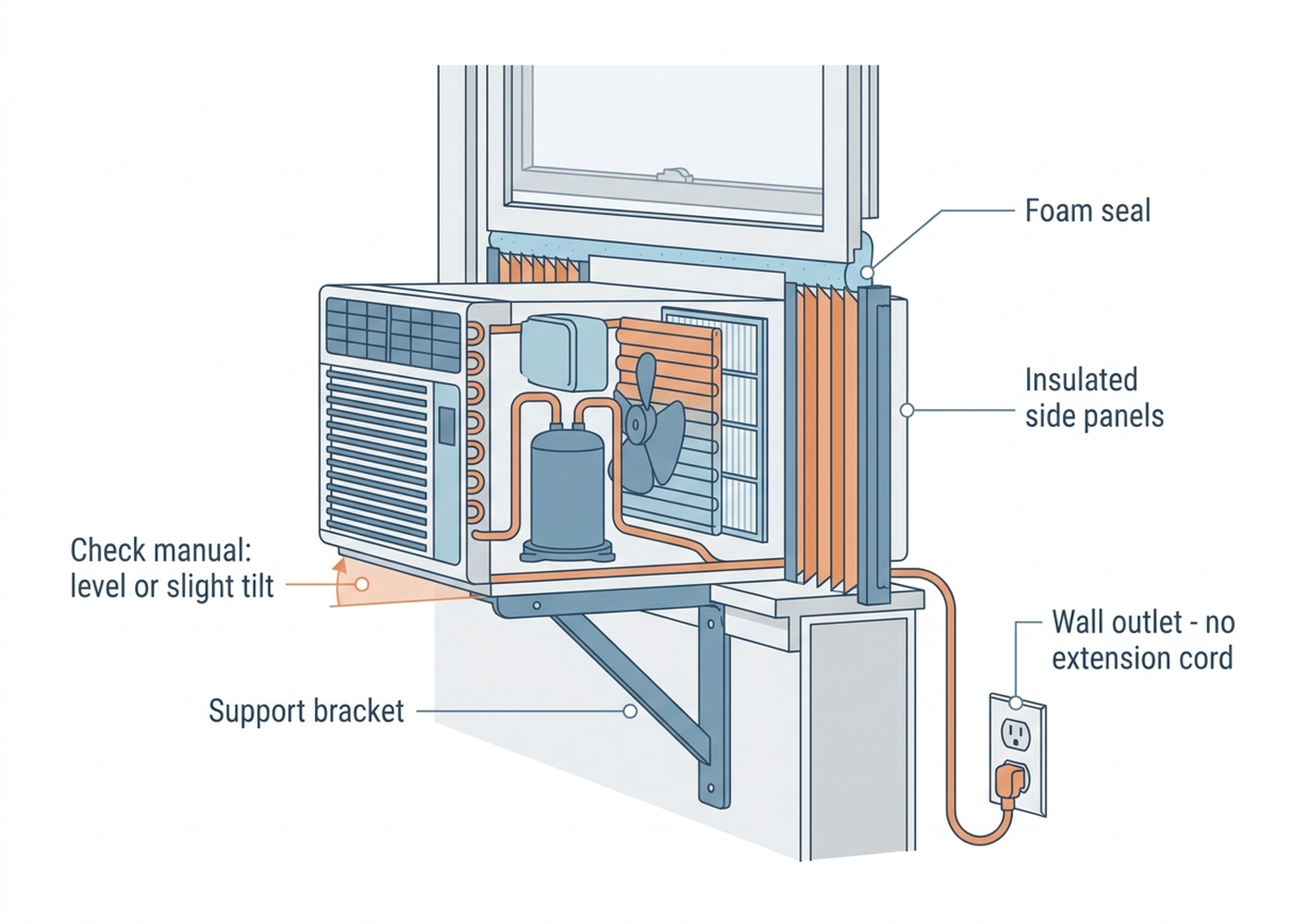
Mistake 4: Trusting the Accordion Panels to Seal the Window
Extend the plastic accordion panels, screw them to the sash, done — that is where most installations stop, and it is where most efficiency dies. Those panels are single-layer vinyl draft curtains. Aggregated reviews of aftermarket sealing products repeat the same discovery: the stock panels flex in wind, let hot air stream through, admit light (and mosquitoes) at the corners, and transmit street noise. There is also a second gap almost everyone misses: the horizontal slot between the upper and lower sash created when the window closes on the unit, which is an open channel to the outdoors.
The stakes are larger than comfort. The Department of Energy attributes 25–40% of the energy used for heating and cooling in a typical residence to air leakage, and the EPA estimates air sealing plus insulation saves an average of 15% on heating and cooling costs. Sealing a window unit is the single highest-leverage version of that work a renter can do, because the leaks are all in one place — and every one of them is reversible at move-out.
Two products cover it for about $40 combined. The Frost King AC43H weatherseal ($8–$12 at the time of writing) is the standard answer to the sash gap: a compressible open-cell foam strip, 2¼ inches square by 42 inches, that stuffs into the gap between sashes and around small perimeter openings; aggregated sentiment praises the price-to-draft-reduction ratio, with the caveat that the foam degrades in UV and is best replaced each season. For the accordion panels themselves, the Wintcomfort insulated side panel kit ($30–$45 at the time of writing) replaces or covers the stock fillers with framed foam-insulation panels sized for 5,000–14,000 BTU units; reviewers consistently cite reduced drafts, light, and noise versus the factory vinyl, with fit on unusual window widths as the main complaint to check against your measurements.
Check the Frost King AC43H Weatherseal on Amazon
Check the Wintcomfort Insulated Side Panels on Amazon
Mistake 5: Plugging It Into an Extension Cord
The outlet is part of the installation, and it is the part reviewers mention only after something went wrong. A window AC compressor pulls a startup surge of two to three times its running load, which is why electricians consistently recommend a dedicated or lightly loaded circuit — on a shared circuit, that surge is the classic cause of “brand new AC trips the breaker” reviews. The unit is fine; the wiring is busy.
The dangerous version of this mistake is the extension cord or power strip. Ordinary cords are not rated for continuous compressor loads; undersized cords overheat at the connections, and the National Fire Protection Association has counted roughly 2,800 home fires a year involving air conditioning equipment (2011–2015 average baseline), with poor wiring setups a recurring factor. Nearly every manufacturer’s manual, including Midea’s, prohibits extension cord use outright — which also matters for warranty claims and, for a renter, for liability.
The fix costs nothing but planning. Choose the window nearest an outlet (Mistake 1’s measuring step), plug directly into the wall, and note what else shares the circuit — a microwave or space heater on the same breaker is the usual culprit behind nuisance trips. If the apartment’s wiring genuinely cannot support the unit, that is a conversation with the landlord, not a job for a power strip. Warm outlet plates or repeated trips are red flags worth reporting in writing.
The Renter’s Fix-It Kit: Comparison Table
Prices are approximate amazon.com figures at the time of writing (July 2026) and fluctuate. Load and insulation figures are manufacturer claims.
| Item | ASIN | Approx. price | Fixes mistake | Lease-safe? |
|---|---|---|---|---|
| Midea U-Shaped 8,000 BTU Smart Inverter | B0FDQGPCG7 | ~$330–$380 | #1 (fit, sizing), quieter install | Yes — no exterior drilling |
| Jeacent No-Drill Support Bracket (200 lbs) | B07QHXT1PX | ~$30–$45 | #2 (sash bearing weight) | Yes — clamps, no tools |
| Frost King AC43H Weatherseal Foam | B0000DH4JL | ~$8–$12 | #4 (sash gap) | Yes — removable foam |
| Wintcomfort Insulated Side Panels | B0D1CHBV31 | ~$30–$45 | #4 (accordion gaps) | Yes — swaps at move-out |
Which Fixes Do You Actually Need? A Decision Flowchart
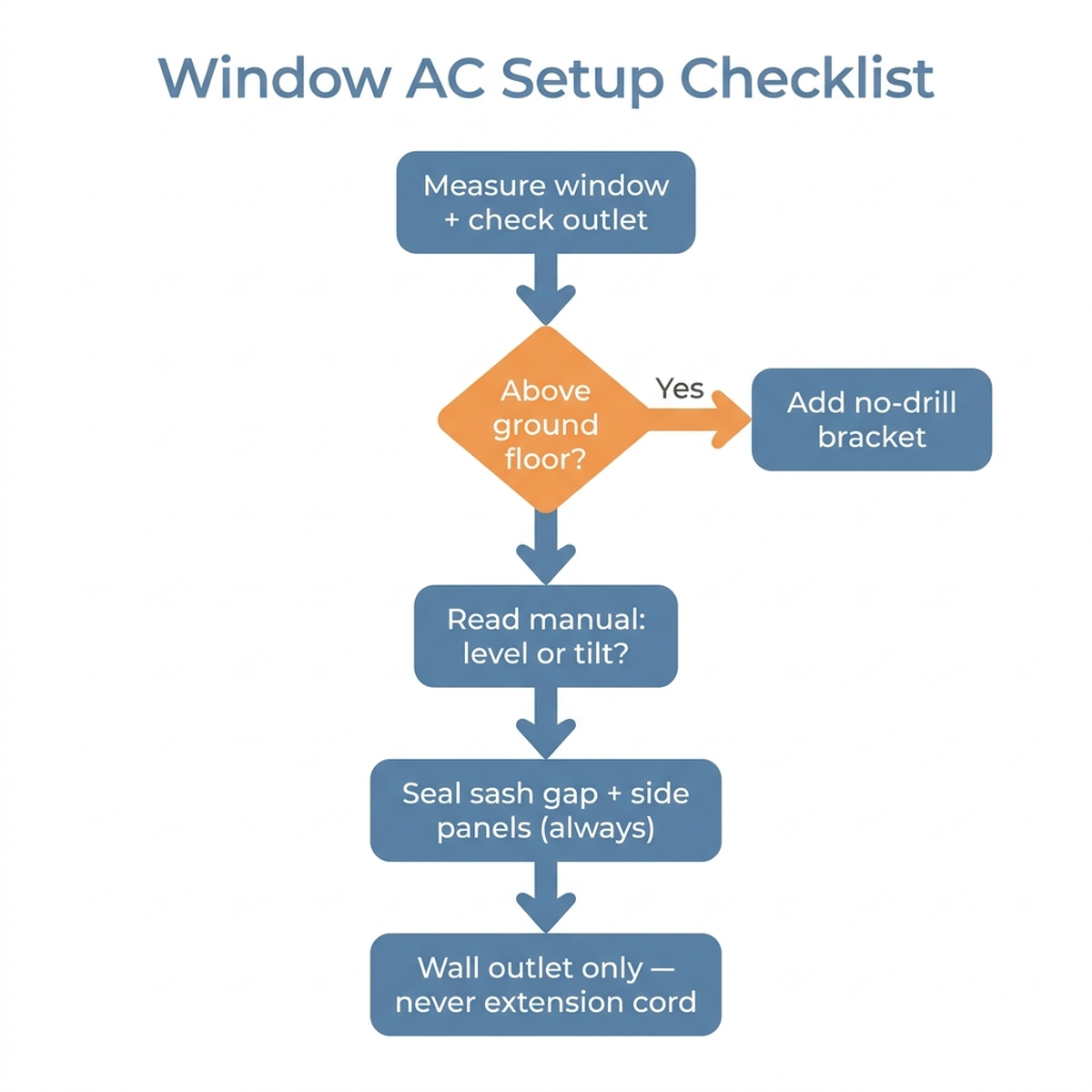
- Buying new? Measure window type, opening width, sash clearance, and outlet distance first. For most renters in the 350 sq ft range, the Midea U is the data-backed default.
- Unit above the ground floor, or a landlord who asked about support? Add the no-drill bracket. At ~$35 against a falling 60 lb appliance, the asymmetry argues for it even where nobody requires it.
- Every installation, regardless of unit: seal the sash gap with foam and upgrade or cover the accordion panels. This is the cheapest cooling-bill reduction available to a tenant.
- Every installation, regardless of unit: wall outlet, no extension cord, know your circuit.
- Each spring reinstall: re-check the tilt against the manual, clear the drain holes, replace UV-degraded foam.
Warranty and Lease Considerations
Installation mistakes are also paperwork mistakes. Manufacturer warranties routinely exclude damage from improper installation — extension cord use and missing support are the standard exclusions — so a $10 foam strip and a correct plug protect a $350 warranty claim. Current Midea U units carry a three-year warranty, notably long for the category (manufacturer claim; register the unit). For renters, the same logic runs toward the security deposit: sash damage from an unsupported unit, water stains from bad tilt, and screw holes in the frame are all deductible damage, and all five fixes in this article are chosen to be fully reversible. Photograph the window before installation and after removal; it is the cheapest insurance in this entire guide.
Editorial Recommendations by Situation
- First window AC, one-bedroom apartment: the Midea U-Shaped 8,000 BTU plus the Jeacent bracket and Frost King foam. Roughly $400 all-in at the time of writing for the quietest mainstream unit installed the safe way.
- Already own a unit that works fine: skip the new AC; spend ~$40 on the bracket-and-seal pair. Most of the comfort gain in reviews comes from the sealing, not the machine.
- Ground-floor unit, tight budget: at minimum the Frost King foam and a manual-check of the tilt. Under $12, and it addresses the two most common review complaints (drafts and drips).
- Upper-story unit, any budget: the no-drill bracket is not optional in our reading of the safety data. Sixty pounds over a sidewalk is not a place to economize.
Limitations of This Analysis
This analysis relies on publicly available customer reviews, third-party reporting, government safety data, and manufacturer documentation; we did not personally install or test these products, and individual results vary with window construction, wall profile, and unit condition. Review themes are qualitative patterns drawn from aggregated amazon.com feedback, not a controlled survey with a fixed sample size. Government figures (DOE air-leakage share, U.S. Fire Administration fire counts, CPSC recall and injury data) describe broad categories — whole-home leakage, all AC equipment types — not window units in isolation; treat them as directional context. Building codes and landlord requirements vary by city and lease, and nothing here is structural-engineering or electrical advice: when in doubt about a wall, a bracket fit, or a circuit, ask a professional or your building manager. Prices, ASIN availability, and product revisions change frequently — Amazon rotates listing variants — so confirm the current price, size variant, and specs on the product page before buying.
The Bottom Line
Window AC failure stories are rarely about the air conditioner. The same five decisions — measure first, support the weight, follow the manual on tilt, seal the gaps, respect the outlet — separate the one-star install from the five-star one, and four of the five fixes cost less than $50 combined while remaining fully reversible at move-out. The pattern in the review data is clear: the machine works; the installation is the product. Whichever unit ends up in your window, verify the exact variant and current price before checkout — and if you want a second opinion on a specific listing, paste the URL into Arekore and let the AI scan the reviews and price history for you in about five minutes.