Weighted Blankets 2026: 3 Sleepers Who Should Skip One
Weighted blankets have grown from a niche occupational-therapy tool into a mainstream sleep category valued at roughly $1.1 billion in 2026 and expanding at a 14.1% compound annual growth rate, according to market researcher Verified Market Reports. Nearly every buying guide online treats that growth as proof the product works for almost anyone chasing better sleep. The safety and customer-experience data behind that growth tells a narrower story: three specific sleeper profiles consistently report a worse night’s sleep with a weighted blanket than without one, independent of which brand or fill type they buy.
This isn’t an argument that weighted blankets are a bad product. Independent testers and peer-reviewed occupational-therapy research both find real benefits for the right user. It’s an argument that “10% of your body weight” — the industry’s near-universal sizing guideline — answers the wrong question for some sleepers, because their problem isn’t picking the right weight, it’s that a fixed-weight blanket doesn’t fit how they sleep at all.
One safety note applies to everyone before the rest of this article, and it isn’t optional: weighted blankets and weighted swaddles should never be used with infants or toddlers under 3. The Consumer Product Safety Commission and the American Academy of Pediatrics have both issued warnings on this point. CPSC has publicly confirmed “multiple” infant deaths linked to weighted infant sleep products, and its own August 2024 review identified five fatalities tied to weighted infant sleep sacks and swaddles between 2011 and 2024; independent press analysis of CPSC data (InvestigateTV) has put the count at eight or more. Multiple major retailers stopped selling weighted infant sleep products in response. That rule sits outside the “which adult sleeper should skip one” question this article answers.
As an Amazon Associate, Arekore earns from qualifying purchases. The Amazon product links in this article include our affiliate tracking ID and may earn us a commission if you buy through them, at no additional cost to you. See our Links Policy for details on how we select products and how commissions do not influence our recommendations.
TL;DR / Quick Verdict
- Hot sleepers are the most common mismatch. Sleep Foundation testing and aggregated Amazon reviews consistently flag standard glass-bead weighted blankets as running warmer than a regular blanket, and “too hot to use” is one of the most repeated complaint themes across brands.
- People with respiratory, cardiac/circulatory conditions, or who are pregnant should check with a doctor first, not buy on impulse. Added chest pressure can matter for asthma, COPD, sleep apnea, and circulatory conditions — occupational-therapy guidance and safety literature flag this consistently, though the risk level varies by individual and severity.
- Frequent repositioners and mismatched-weight couples get less benefit than the marketing implies. A weighted blanket sized to one person’s body weight is harder to fling off or reposition mid-night, and couples with a large weight difference are advised by manufacturers themselves to buy two blankets rather than share one.
- Infants and toddlers under 3 should never use one — full stop. This is a CPSC/AAP safety rule, not a comfort trade-off; CPSC has confirmed multiple infant deaths linked to weighted infant sleep products, with its own review identifying five fatalities and independent press analysis putting the count at eight or more.
- The category still works well for its core use case: adults without the conditions above, using deep pressure for anxiety or sleep-onset difficulty, sized correctly and not sharing with a very different-weight partner.
How We Reached These Conclusions (Methodology)
This is an editorial analysis, not a hands-on test. We did not personally test the products covered here. This guide synthesizes: (a) safety and contraindication guidance from occupational-therapy sources (OT Dude) and the Oxford Health NHS Foundation Trust’s published sensory-weighted-product advice; (b) CPSC and American Academy of Pediatrics public statements and reporting on weighted infant sleep products — CPSC has publicly confirmed “multiple” infant deaths and its own August 2024 review identified five fatalities (2011–2024), while independent press analysis of CPSC data (InvestigateTV) has put the count at eight or more; (c) Sleep Foundation’s published testing and buying guidance on weighted blanket heat retention, including its “Best Cooling Weighted Blankets” testing category; (d) aggregated amazon.com customer review sentiment for weighted blankets across multiple brands, sampled in August 2026; (e) manufacturer guidance on couples’ sizing from Bearaby, Mosaic, and Layla; and (f) Verified Market Reports’ 2026 market-sizing and growth data for the weighted blanket category. Where a figure is a manufacturer’s own claim or a third party’s estimate rather than an independently controlled study, it is labeled as such. Prices are amazon.com figures at the time of writing and fluctuate.
Why Category Growth Doesn’t Mean Universal Fit
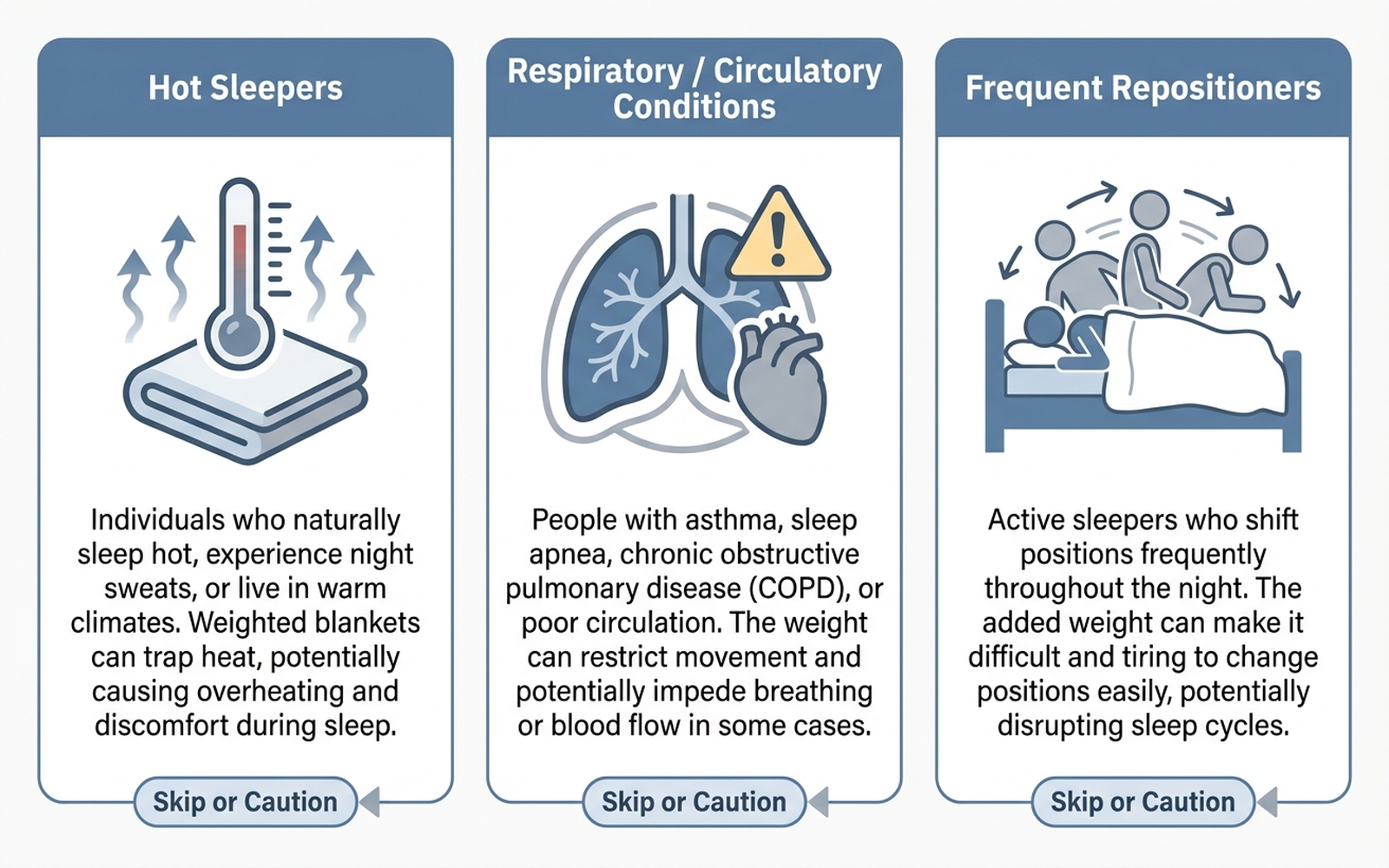
A weighted blanket does one thing: it applies steady, even pressure across the body, which peer-reviewed occupational-therapy research links to a calming, “deep pressure” effect for a meaningful share of users. That single mechanism is also exactly why it’s a poor fit for some sleepers — the same pressure that feels calming to one person restricts airflow, traps heat, or interferes with the freedom to move for another. The category’s own safety literature and aggregated review data point to three separate reasons this happens, independent of brand or fill type:
- Heat has nowhere to go. Glass-bead fill, the dominant construction method across the category, holds more heat against the body than an unweighted blanket of comparable thickness, and Sleep Foundation’s own testing treats “runs hot” as common enough to warrant a dedicated cooling-blanket testing category.
- Added chest pressure interacts with certain medical conditions. Occupational-therapy contraindication guidance consistently lists respiratory conditions (asthma, COPD, sleep apnea), cardiac or circulatory problems, and pregnancy as situations warranting caution or a doctor’s sign-off before use — not because every person in these groups will have a problem, but because the risk profile is different enough to skip guessing.
- A fixed weight assumes a still sleeper. The entire sizing model — roughly 10% of body weight — assumes the blanket stays put and applies even pressure all night. Reviewers who reposition often, and couples with a meaningfully different body weight, both run into the same practical issue: the blanket’s benefit depends on staying under it in roughly the same position, which isn’t how everyone sleeps.
The Three Sleepers Where the Data Says Skip It
1. Hot sleepers, unless choosing a cooling-specific line
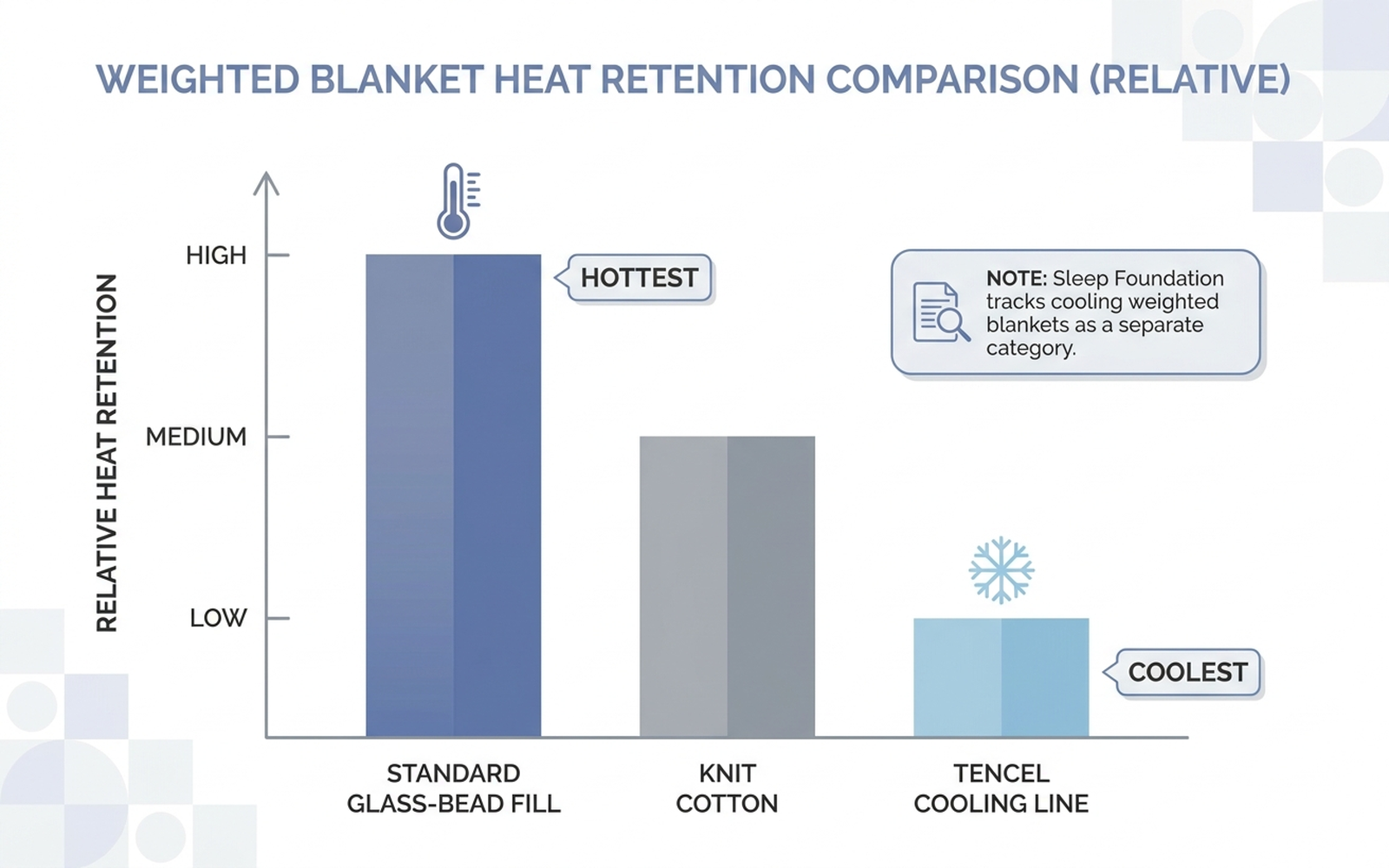
“Too hot to sleep under” is one of the most consistently repeated complaints in aggregated Amazon reviews for standard weighted blankets, and it isn’t specific to one brand — it shows up across bead-filled models regardless of price tier. Sleep Foundation’s own testing takes the problem seriously enough to maintain a separate “Best Cooling Weighted Blankets” category, which is itself evidence that the standard product runs warm enough for a meaningful share of testers and reviewers to need a dedicated cooler alternative.
If you already run warm at night, sleep with a fan on, or kick off blankets mid-sleep, a standard glass-bead-filled weighted blanket is likely to make that worse, not better — the added mass traps body heat regardless of how breathable the cover fabric is. The exception is a cooling-specific construction built around moisture-wicking fabric, such as the Bearaby Tree Napper (ASIN B0H66C9Z6M), which uses TENCEL lyocell and organic cotton specifically because Bearaby’s own standard Cotton Napper line runs too warm for hot sleepers — an acknowledgment from the manufacturer itself that the base product has this limitation.
Check the Bearaby Tree Napper cooling weighted blanket on Amazon
2. Sleepers with respiratory, cardiac, or circulatory conditions, or who are pregnant
There is no independently controlled clinical trial establishing exactly how much added chest pressure is safe for every respiratory or cardiac condition, and that gap is precisely why occupational-therapy contraindication guidance treats this as a “check with a doctor” category rather than a flat yes-or-no. Guidance from OT Dude and the Oxford Health NHS Foundation Trust’s published sensory-weighted-product advice both list asthma, COPD, sleep apnea, cardiac or circulatory problems, and pregnancy as conditions warranting a doctor’s input before use, on the reasoning that a blanket’s steady chest and torso pressure could plausibly worsen breathing effort or circulation in these situations. This is caution based on plausible mechanism and clinical guidance, not a documented pattern of harm at the consumer level — but it’s exactly the kind of judgment call that belongs to a doctor who knows the individual’s condition, not a product review.
For this group, there’s no brand or fill type that resolves the underlying concern — a lighter blanket weight reduces but does not eliminate the added pressure. If any of these conditions apply, the responsible move is a conversation with a physician before buying, not a lighter-weight product as a workaround.
3. Frequent repositioners and couples with a large weight difference
A weighted blanket’s entire value proposition depends on the pressure staying roughly constant across the night, which assumes a sleeper who doesn’t move much. Reviewers who toss and turn frequently report a common frustration: repositioning a 15–25 lb blanket takes real effort compared with flipping a normal duvet, which for some sleepers turns a comfort product into a nightly annoyance rather than a calming one. Manufacturer sizing guidance reinforces the same limitation from a different angle: brands including Bearaby, Mosaic, and Layla explicitly advise couples with a meaningfully different body weight to buy two separate blankets rather than share one oversized blanket, because a single blanket sized for the average of two very different body weights ends up under-weighted for one partner and over-weighted for the other.
If you still want to try one despite moving around a lot at night, choosing the lowest available weight option in a line reduces how much effort repositioning takes, without eliminating it. YnM sells its 7-layer, glass-bead construction down to a 15 lb option (ASIN B073429DV2), lighter than the 22 lb version covered in our full weighted-blanket comparison. Couples who want the deep-pressure effect but have a large weight gap are better served by two individually sized blankets than one shared compromise blanket.
Check the YnM 15 lb weighted blanket on Amazon
When a Weighted Blanket Still Makes Sense
None of this is a case against the category broadly. Peer-reviewed occupational-therapy research on weighted blanket use for sleep-onset difficulty and anxiety shows real benefit for a meaningful share of the adults it studies, and aggregated reviews for correctly sized blankets skew strongly positive outside the three groups above. The data supports buying one if you sleep at a normal or cool body temperature, have none of the respiratory, cardiac, circulatory, or pregnancy considerations above (or have already checked with a doctor), sleep in a relatively stable position most of the night, and either sleep alone or share a bed with a partner close in body weight. That’s a large share of adult sleepers — it just isn’t every sleeper the category’s growth numbers imply.
Comparison Table
Prices are approximate amazon.com figures at the time of writing (September 2026) and fluctuate.
| Sleeper profile | What the data suggests | Alternative | Typical cost |
|---|---|---|---|
| Hot sleeper | Standard glass-bead fill runs warm; needs a cooling-specific line | Bearaby Tree Napper (TENCEL) | ~$220–$300 |
| Respiratory, cardiac, circulatory condition, or pregnant | Check with a doctor before buying; no product workaround | Consult a physician first | N/A |
| Frequent repositioner or mismatched-weight couple | Lowest available weight reduces effort; couples need two blankets | YnM (15 lb option) | ~$40–$60 |
| Normal temperature, no flagged condition, stable sleeper | Weighted blanket fits as intended | Any correctly sized model | ~$50–$280 |
Decision Flowchart
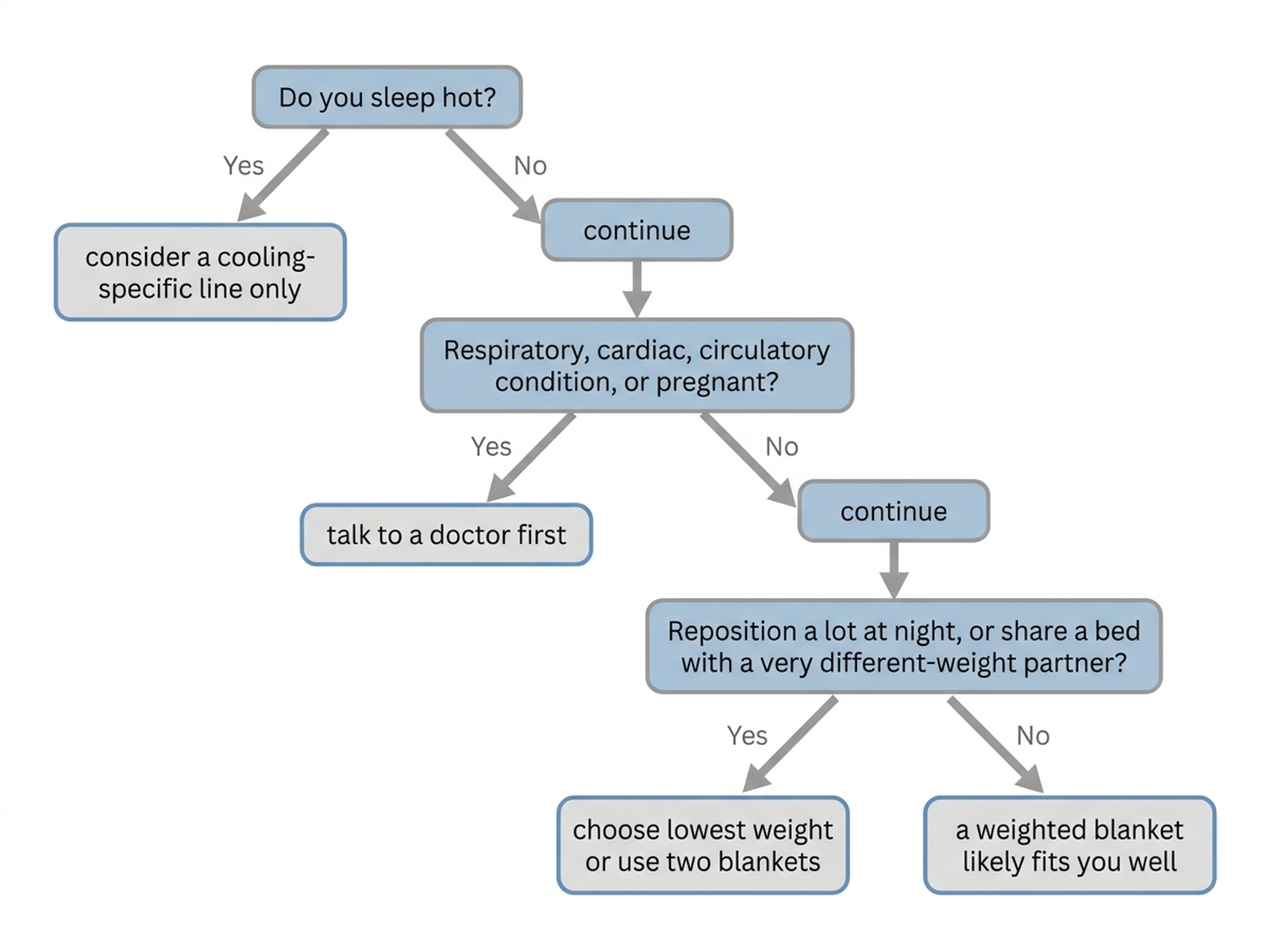
Start with temperature: if you already run warm at night, a standard weighted blanket will likely make that worse, and only a cooling-specific TENCEL or knit construction is worth considering. Next, check for respiratory, cardiac, or circulatory conditions, or pregnancy — if any apply, talk to a doctor before buying rather than guessing at a “safe” weight. If neither of those rules you out, consider how much you move at night: frequent repositioners and couples with a large weight difference get less benefit from a single fixed-weight blanket and should either choose the lowest available weight or buy two individually sized blankets. Only sleepers who clear all three checks get the full benefit the category’s marketing describes.
Limitations
This analysis relies on published occupational-therapy contraindication guidance, CPSC and AAP public statements on infant safety, Sleep Foundation’s published testing conclusions, aggregated amazon.com customer review sentiment, and manufacturer sizing guidance, rather than our own side-by-side test of any specific model. The medical-caution guidance for respiratory, cardiac, circulatory, and pregnancy-related conditions reflects general occupational-therapy and clinical caution based on plausible mechanism, not a large-scale controlled study quantifying actual risk for each condition — individuals in these groups should get personalized medical advice rather than relying on this article. Heat-retention and repositioning-effort complaints are drawn from aggregated reviewer reports rather than a controlled comparative test, and individual results vary with room temperature, bedding layers, sleep position, and unit-to-unit manufacturing variance. Prices fluctuate on amazon.com and should be verified on the current product page before buying.
Bottom Line
Weighted blankets earned their growth honestly — for the right sleeper, the deep-pressure effect is a real, research-backed benefit. But the same safety and review data that explains the category’s rise also identifies three groups who consistently get a worse night’s sleep from one: hot sleepers stuck with heat-trapping glass-bead fill, sleepers with respiratory or circulatory conditions (or who are pregnant) who need a doctor’s input rather than a product recommendation, and frequent repositioners or mismatched-weight couples fighting a fixed-weight design built for a still sleeper. And regardless of any of that, infants and toddlers under 3 should never use one. If you fit one of the first three profiles, the data points toward skipping the purchase or choosing a specific workaround — not assuming “10% of body weight” solves it for everyone.
Before you buy, paste the product link into Arekore — our AI assistant checks review authenticity, surfaces what the one-star reviews actually complain about, and compares prices, free, in about five minutes.