Robot Mops 2026: 3 Homes Where You Don't Need One

Robot mops are one of the fastest-growing categories in home cleaning, expanding at roughly a 16.6% CAGR as hybrid vacuum-mop models take share from vacuum-only robots, according to market researcher Mordor Intelligence. But growth in a category is not the same as a universal fit, and the maintenance, flooring, and household-size data behind that growth points at three specific home types where a robot mop is the wrong purchase — not because the technology is bad, but because the setup doesn’t match what the machine is built to solve.
This isn’t an argument against robot mops. It’s an argument that the fit depends on your flooring mix, your square footage, and how much dock upkeep you’re actually willing to do — and the data on all three is more specific than “everyone with hard floors needs one.”
As an Amazon Associate, Arekore earns from qualifying purchases. The Amazon product links in this article may include our affiliate tracking ID and may earn us a commission if you buy through them, at no additional cost to you. See our Links Policy for details on how we select products and how commissions do not influence our recommendations.
TL;DR / Quick Verdict
- Homes that are mostly or entirely carpet don’t benefit. Carpet and rugs still account for roughly 43.8% of US flooring by volume, per Floor Covering News’ 2024 industry survey, and combo units generally trade off some carpet suction to fit a mopping mechanism — a real cost for homes with substantial carpet and no matching mopping benefit.
- Small apartments (roughly 500–800 sq ft) rarely need the automation. A manual spin mop covers that footprint in about the time it takes a robot to map and clean the same space, at a fraction of the cost and with no permanent dock footprint.
- Households unwilling to do weekly dock upkeep end up worse off than with a manual mop. One independent smart-home ownership tracker (Robovations) estimates owners spend roughly 15–20 minutes a week on tank refills, pad swapping, and rinsing, plus $100–$500 a year in consumables — and Amazon reviewers have flatly said they spend more time “babysitting the thing” than a manual mop would take.
- Three setups where the data favors skipping it: majority-carpet homes, small apartments where a manual mop is genuinely faster end-to-end, and households that dislike appliance maintenance routines.
How We Reached These Conclusions (Methodology)
This is an editorial analysis, not a hands-on test. We did not personally test the products covered here. This guide synthesizes: (a) flooring-industry volume statistics from Floor Covering News’ 2024/2025 industry surveys; (b) independent testing and reporting from Vacuum Wars and The Smart Home Hookup on how combo vacuum-mop robots handle carpet compared with vacuum-only models; (c) Consumer Reports’ 2024–2026 Winter Survey data on robotic vacuum reliability (13,624 units tracked) and its stated position that it does not yet have equivalent multi-year reliability data for combo vacuum-mop units; (d) dock-maintenance time-and-cost estimates from independent smart-home ownership tracker Robovations and aggregated Reddit/Amazon owner accounts, sampled in August 2026 — these are third-party estimates, not a controlled study, and are presented as such; and (e) Mordor Intelligence’s market-growth data on the robot vacuum-mop category. Where a figure is a manufacturer’s own claim rather than an independently measured result, it is labeled as such. Prices are amazon.com figures at the time of writing and change frequently.
Why Robot Mop Adoption Doesn’t Mean Universal Fit
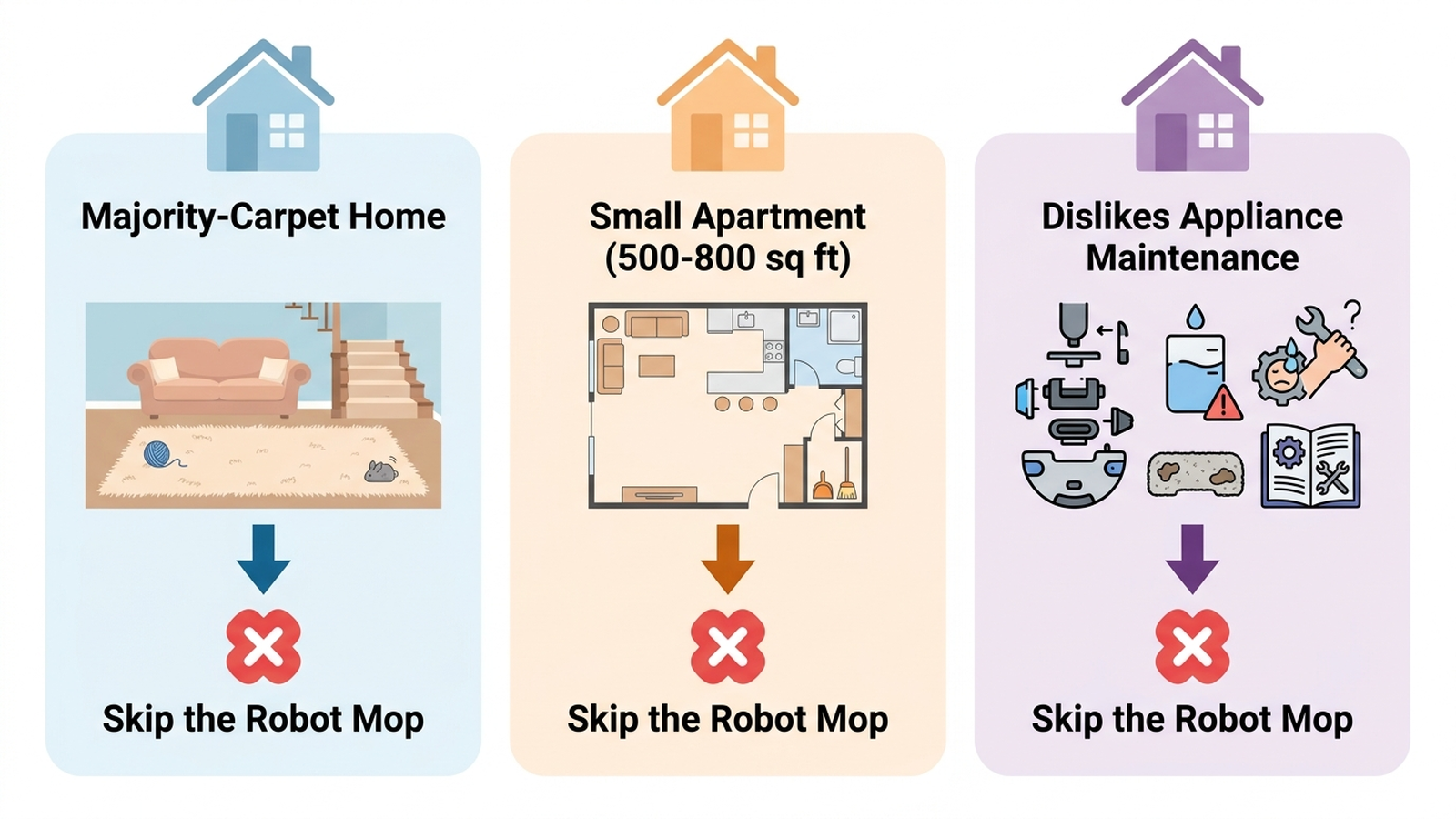
Robot mops are marketed as a single answer to “clean floors without thinking about it,” but the category’s own testing data shows three separate constraints that don’t apply evenly to every home:
- They trade off carpet performance for mopping ability. Combo units generally reduce brush clearance height and add a raised or auto-lifting mop assembly to keep the pad off carpet, and independent testers at Vacuum Wars and The Smart Home Hookup have repeatedly flagged reduced carpet suction and pickup on combo units relative to a comparable vacuum-only robot — a real cost for homes with substantial carpet.
- The automation advantage shrinks as square footage shrinks. In the roughly 500–800 sq ft range, most current robot models — vacuum-only or combo — complete a single-level apartment on one charge without needing to return to the dock mid-run, per manufacturer runtime specs for entry-to-mid-tier models. That means the main selling point (unattended coverage of a floor plan too large to mop by hand) barely applies at that scale.
- The maintenance burden is heavier than the marketing implies. Independent smart-home ownership tracker Robovations estimates owners spend 15 to 20 minutes weekly on tank refills, pad swaps, and tank rinsing, plus $100 to $500 annually in consumables — a workload that offsets much of the “hands-off” appeal for households not prepared for it.
The Three Homes Where the Data Says Skip It
1. Majority-carpet homes
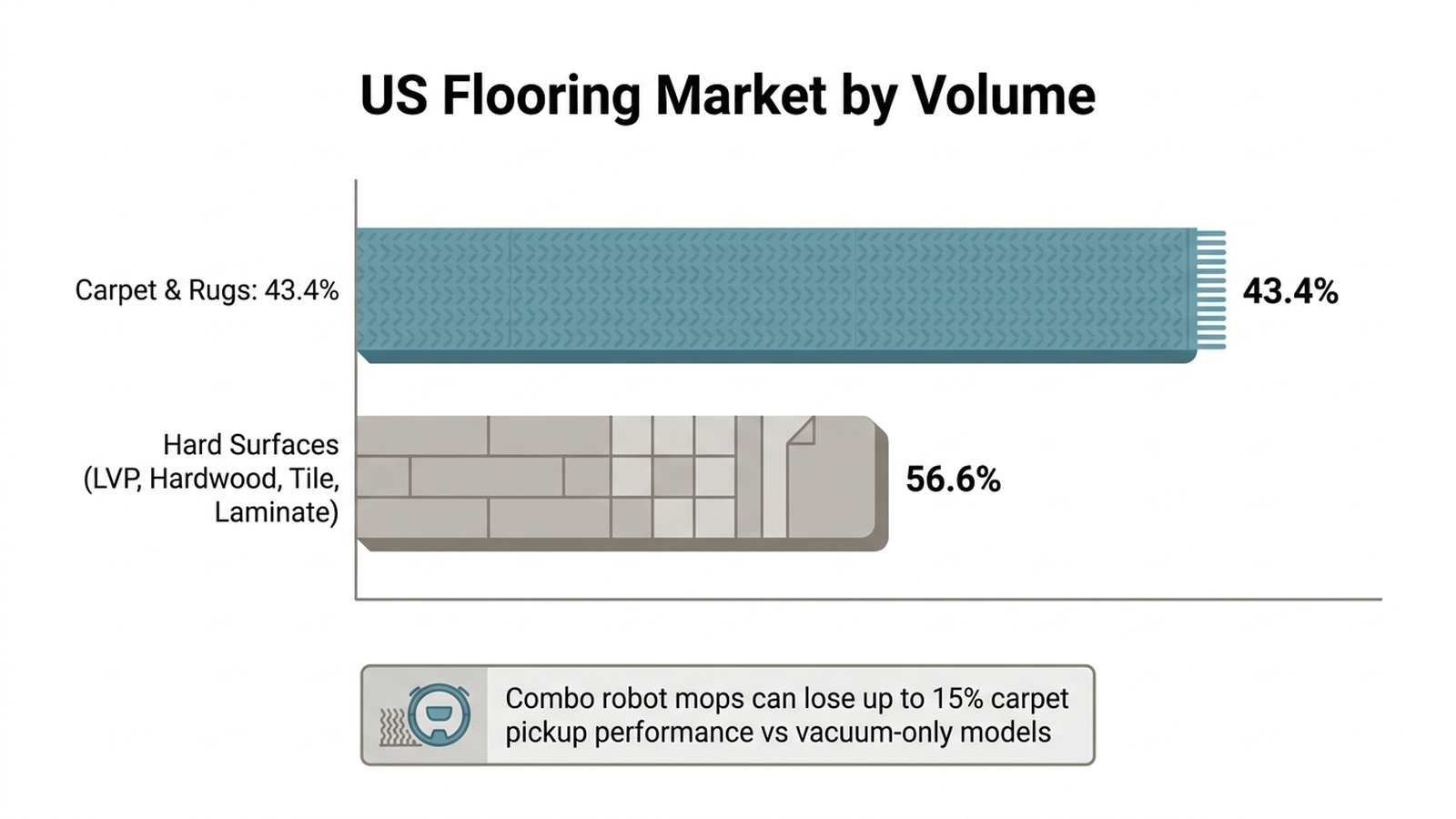
Carpet and rugs still make up roughly 43.8% of the US flooring market by volume, per Floor Covering News’ 2024 industry survey — down from a majority share a decade earlier, but still the single largest flooring category nationwide, and heavily concentrated in bedrooms and living rooms in many homes. For a household where hard flooring is limited to a kitchen or entryway, a robot mop’s core feature is mostly wasted square footage.
Worse, the mopping hardware itself is a liability on the carpet you do have. Reviewers and testers at Vacuum Wars and The Smart Home Hookup have documented that combo vacuum-mop robots generally use a raised or auto-lifting mop assembly to keep pads off carpet, and have flagged measurably reduced carpet suction and pickup on several combo models compared with an equivalent vacuum-only model in the same product line — a real trade-off for a majority-carpet home getting no mopping benefit in return.
For this setup, a dedicated vacuum-only robot avoids the trade-off entirely: no mop pads to wash, no water tank to fill or drain, and no compromised carpet performance. The eufy RoboVac 25C (ASIN B081N1PN3G) is a widely reviewed vacuum-only model with Wi-Fi app control and automatic suction boost on carpet, at roughly a third of the price of a flagship combo unit.
Check the eufy RoboVac 25C on Amazon
2. Small apartments where a manual mop is genuinely faster
If your home is in the roughly 500–800 sq ft range, manufacturer runtime specs and independent reviewer testing for most current robot models — regardless of navigation type — show they can finish the entire space in a single run without needing to return to the dock mid-cycle. That means the core promise of a robot mop, unattended coverage of a floor plan too large to mop in one manual pass, doesn’t apply: a manual pass of that same footprint takes a comparable amount of time to a robot’s mapping-and-cleaning cycle, without the cost of a $400–$1,000+ machine or the permanent 12″ × 16″ dock footprint that competes for counter or floor space in an already-small unit.
For this setup, a manual spin mop delivers equivalent hard-floor results at a fraction of the cost and with zero ongoing dock maintenance. The O-Cedar EasyWring Microfiber Spin Mop and Bucket System (ASIN B01D7K595A) is one of the most-reviewed manual mop systems on amazon.com, with aggregated sentiment favoring the foot-pedal wringing mechanism and washable microfiber head over the disposable-pad systems it competes with.
Check the O-Cedar EasyWring Spin Mop System on Amazon
3. Households that dislike appliance maintenance routines
Robot mop marketing leans heavily on “set it and forget it,” but the maintenance data tells a more mixed story. Robovations, an independent smart-home ownership tracker, estimates owners spend 15 to 20 minutes a week refilling clean-water tanks, swapping pads or bags, and rinsing dirty-water tanks, on top of $100 to $500 a year in consumables. Odor complaints are common enough to be a recurring theme in owner reports: posts from robot-mop owner communities in 2026 describe visible sludge or a musty smell developing in the water tank within two to four weeks of regular use if the dock isn’t rinsed on schedule.
Consumer Reports itself has noted that it does not yet have the multi-year reliability data for combo vacuum-mop units that it has built up for vacuum-only robots (13,624 units tracked across its 2024–2026 Winter Surveys) — meaning long-term reliability for the mopping half of these machines is still an open question, not a settled one. Aggregated Amazon reviews echo the maintenance fatigue directly: reviewers of several dock-based systems have written that they “spend more time babysitting the thing” than the manual mopping routine it was supposed to replace.
For a household that finds appliance upkeep tedious rather than satisfying, that weekly maintenance loop can turn into the exact chore the robot was bought to eliminate.
When a Robot Mop Still Makes Sense
None of this is a blanket case against the category. The data supports buying one specifically when: your home has substantial hard flooring (not just a kitchen), your floor plan is large enough that manual mopping is a genuine time burden, and you’re prepared to do the weekly dock upkeep the category actually requires rather than the “zero effort” version implied by marketing. That is a real and common household profile — it just isn’t every household with a hard floor.
Comparison Table
Prices are approximate amazon.com figures at the time of writing (August 2026) and fluctuate.
| Your setup | What the data suggests | Alternative product | Typical cost |
|---|---|---|---|
| Majority-carpet home | Skip the mop function — get vacuum-only | eufy RoboVac 25C | ~$150–$200 |
| Small apartment (500–800 sq ft) | Manual mop is comparably fast, far cheaper | O-Cedar EasyWring Spin Mop System | ~$30–$40 |
| Dislikes weekly appliance maintenance | Dock upkeep offsets the “hands-off” benefit | O-Cedar EasyWring Spin Mop System | ~$30–$40 |
| Large home with mostly hard floors, wants automation, will do weekly upkeep | Robot mop still fits | Combo robot mop | ~$400–$1,600 |
Decision Flowchart
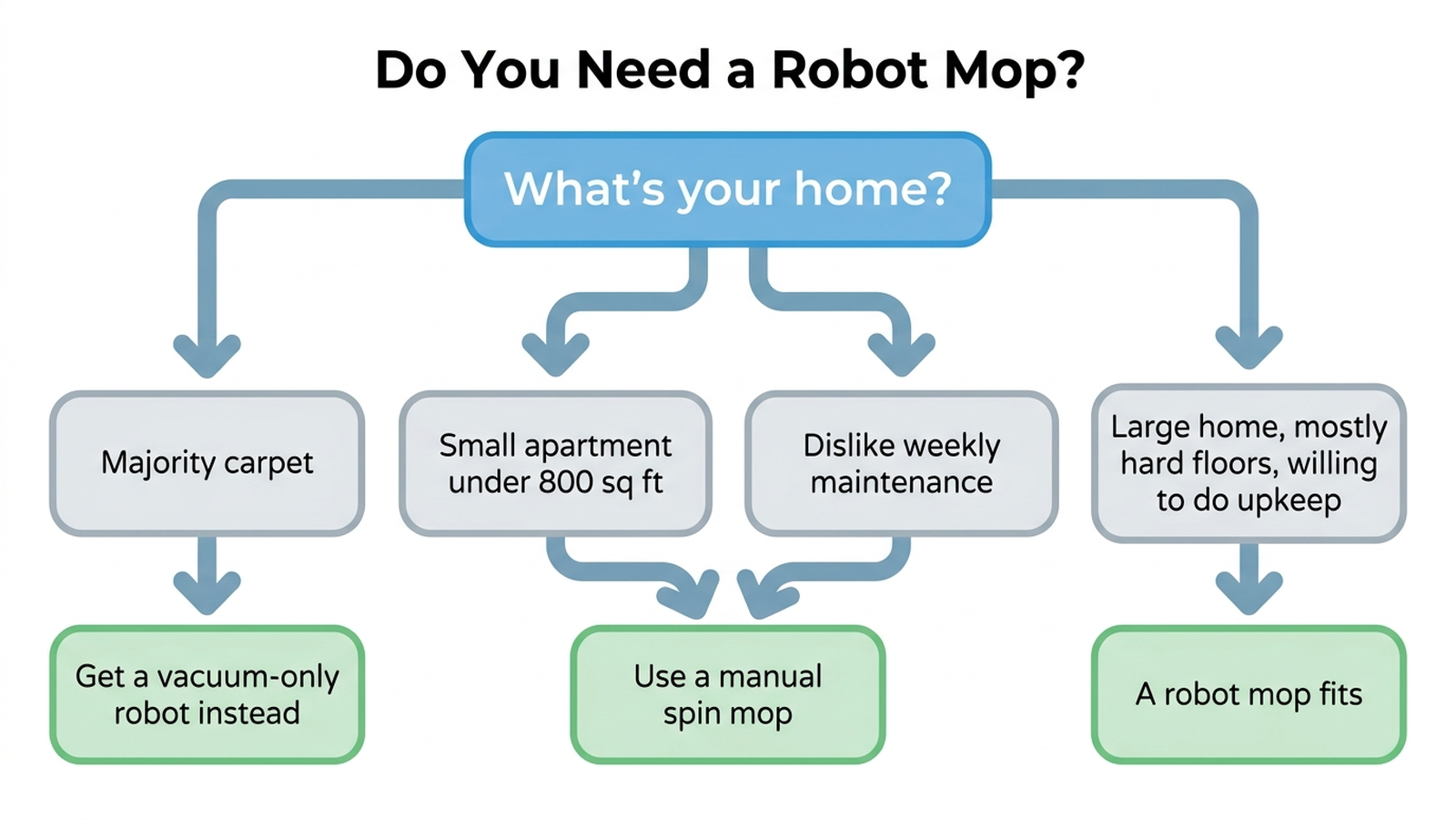
Start with your flooring: if your home is majority carpet, skip the mop function and consider a vacuum-only robot instead. If your hard-floor footprint is small enough to mop by hand in about the time a robot would take to map and clean it, a manual spin mop gets you the same result for a fraction of the cost. If neither of those applies but you know you won’t keep up with weekly tank refills and pad rinsing, a robot mop will likely underperform its own marketing in your hands. Only when you have substantial hard flooring, a floor plan too large to comfortably mop manually, and genuine willingness to do the weekly upkeep does the category deliver on its promise.
Limitations
This analysis relies on flooring-industry volume statistics, independent testing and reporting from Vacuum Wars and The Smart Home Hookup, Consumer Reports’ survey data, and third-party estimates (Robovations, aggregated owner reports) on dock maintenance, rather than our own side-by-side test of any specific model. The maintenance-time and consumables-cost figures are estimates from a single independent tracker, not a controlled study, and may not generalize to every model or household. Carpet-pickup performance differences are described qualitatively based on cited testers’ reporting rather than a single precise percentage, since no controlled head-to-head figure could be independently confirmed. Consumer Reports’ reliability data cited here covers vacuum-only robots; it explicitly does not yet cover combo vacuum-mop units with the same multi-year depth. Individual results vary with home layout, flooring condition, and how closely an owner follows a manufacturer’s maintenance schedule.
Bottom Line
Robot mops earned their growth honestly — for the right home, they solve a real chore. But the same testing and ownership data that explains the category’s rise also explains why it’s the wrong purchase for a documented set of households: heavily carpeted homes lose carpet performance for no mopping benefit, small apartments rarely need the automation a manual mop can match in the same time, and anyone who dislikes appliance upkeep will find the weekly dock routine offsets the “hands-off” pitch. If any of those describe your home, the data points toward skipping the purchase and using what already works.
Before you buy, paste the product link into Arekore — our AI assistant checks review authenticity, surfaces what the one-star reviews actually complain about, and compares prices, free, in about five minutes.