Massage Guns 2026: 3 Buyers Who Should Skip One
Percussion massage guns have grown from a niche physical-therapy tool into a mainstream recovery product. The global market is projected to reach $1.1 billion in 2026 and grow to $1.9 billion by 2033, a compound annual growth rate of roughly 8.3%, according to market researcher Persistence Market Research, with North America accounting for close to 38% of that global share. Most buying guides treat that growth as proof the category belongs in everyone’s gym bag. The safety and performance research behind it tells a narrower story: three specific buyer profiles are likely to get little benefit, or real risk, from a percussion massage gun — independent of which $100–$600 model they choose.
This isn’t an argument that massage guns don’t work. A meaningful body of research supports percussive therapy for reducing delayed-onset muscle soreness (DOMS) in the right context. It’s an argument that owning one doesn’t automatically mean you should use one the way marketing implies, and that for some buyers the honest answer is a doctor’s clearance, a cheaper tool, or no purchase at all.
One safety rule applies to everyone, regardless of which group below you fall into: never use a massage gun directly on the neck, throat, spine, joints, bones, bruises, varicose veins, or any area of numbness or broken skin. Physical therapy sources (NYDNRehab, CoachAmyPT) are consistent on this point, and it sits outside the “who should skip buying one entirely” question this article answers.
As an Amazon Associate, Arekore earns from qualifying purchases. The Amazon product links in this article include our affiliate tracking ID and may earn us a commission if you buy through them, at no additional cost to you. See our Links Policy for details on how we select products and how commissions do not influence our recommendations.
TL;DR / Quick Verdict
- Anyone on blood thinners, with a clotting disorder, DVT history, osteoporosis, a recent injury or surgery, or varicose veins should check with a doctor first, not buy on impulse. Percussive force can increase bruising and bleeding risk on anticoagulants, and in rare cases vibration near an existing clot carries a theoretical risk of dislodging it — a doctor who knows the individual case needs to make that call, not a product review.
- Athletes buying a massage gun specifically to improve strength, power, or explosive performance are solving the wrong problem. A 2023 systematic review found no clear benefit — and sometimes a small decline — for strength, balance, acceleration, agility, and explosive movements.
- Casual or infrequent exercisers without existing soreness get limited marginal value from a $300 premium model. The research-backed benefit concentrates in post-exercise DOMS reduction with a modest effect size, and many commercial gyms already make percussion devices available in their recovery areas — duplicating that purchase at home only pays off with regular use.
- The category still works well for its core use case: people without the conditions above who train regularly, want modest, research-supported help with muscle soreness, and apply the device correctly (short sessions, away from joints and bone).
How We Reached These Conclusions (Methodology)
This is an editorial analysis, not a hands-on test. We did not personally test the products covered here. This guide synthesizes: (a) contraindication and safety guidance from physical-therapy and sports-medicine sources, including NYDNRehab, CoachAmyPT, and Healthline’s clinically reviewed massage-gun safety guide; (b) a 2023 peer-reviewed systematic review of massage-gun effects on athletic performance and recovery, published in the Journal of Functional Morphology and Kinesiology (JFMK); (c) aggregated manufacturer specifications for amplitude and stall force across Theragun, Hyperice, and Renpho product lines; (d) Persistence Market Research’s published 2026 global market-sizing data for the percussion massage gun category; and (e) general guidance on anticoagulant medication and soft-tissue pressure devices from massage-therapy industry publications. Where a figure is a manufacturer’s own claim rather than an independently verified measurement, it is labeled as such. We did not find a verifiable, sourced figure for what share of U.S. athletes personally own a massage gun, how many home units sit unused after purchase, or how commonly commercial gyms stock them — those points are presented as general observations rather than cited statistics, and are noted as such where relevant. Prices are amazon.com figures at the time of writing (October 2026) and fluctuate.
Why Category Growth Doesn’t Mean Universal Fit
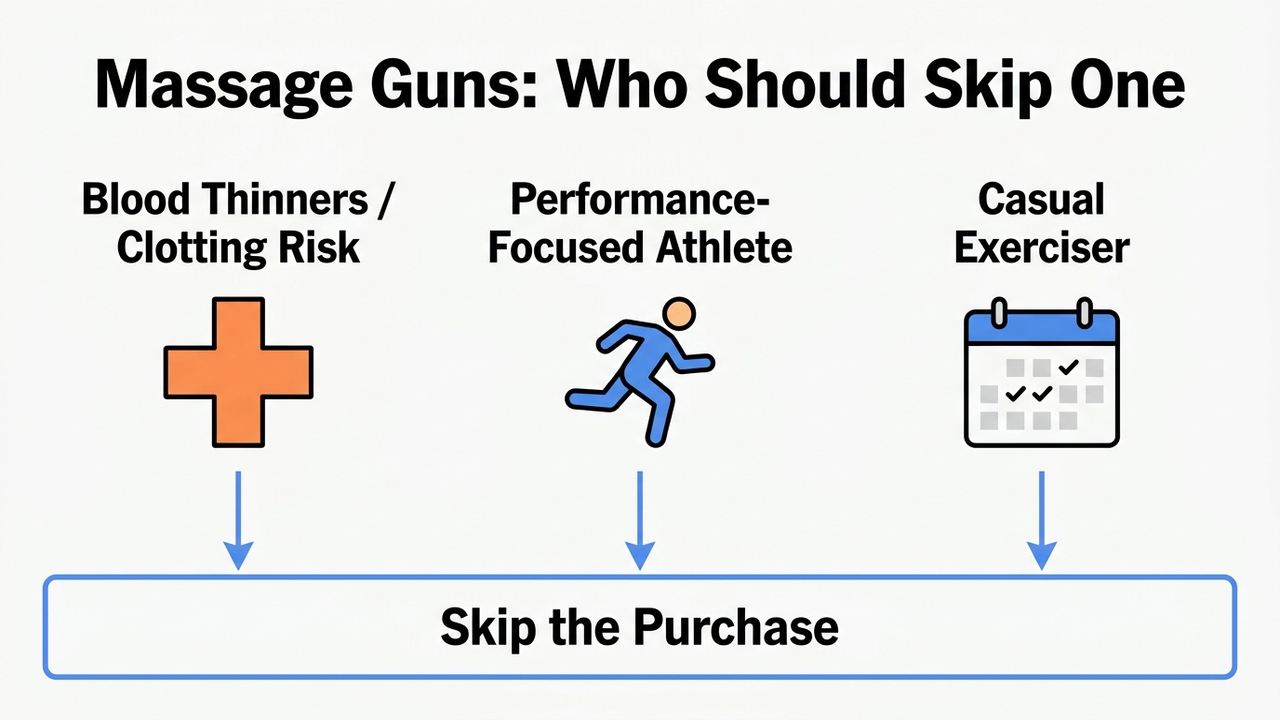
A percussion massage gun does one thing well: it delivers rapid, repeated mechanical pressure into soft tissue, which a meaningful body of research links to modest short-term reductions in perceived muscle soreness after exercise. That narrow mechanism is also exactly why it’s a mismatch for some buyers. The same force that helps a regularly training athlete recover faster is a medical risk for someone on blood thinners, is aimed at the wrong outcome for someone chasing strength gains, and is overkill for someone who exercises occasionally and could get similar soreness relief from a $20 foam roller. The research points to three distinct reasons this happens, independent of brand or price tier:
- Percussive force interacts with bleeding and clotting risk. Massage-therapy industry guidance consistently flags anticoagulant medications, clotting disorders, deep vein thrombosis history, recent fractures or surgery, osteoporosis, and varicose veins as reasons to get medical clearance before using any percussive device, because the mechanism of harm (increased bruising, or in rare cases dislodging a clot) is plausible even without a large documented pattern of consumer injuries.
- The performance-gain claim isn’t supported by the research most buyers are relying on. Massage gun marketing frequently implies improved workout performance, but a 2023 systematic review of the available studies found no clear benefit for strength, balance, acceleration, agility, or explosive power — and in some measures, a small decline. The genuinely supported use case is soreness reduction, not performance enhancement.
- The benefit scales with how often you actually use it, and most research tests regular users. Studies showing reduced DOMS largely used the device around planned training sessions — before exercise or during rest, not as an occasional emergency fix after a rare hard workout. A device that only gets used a few times a year delivers a small fraction of the researched benefit, no matter how premium the model.
The Three Buyers Where the Data Says Skip It
1. Anyone on blood thinners, with a clotting disorder, or recovering from injury or surgery
Percussive pressure increases the mechanical force applied to soft tissue well beyond what a hand massage delivers, and that force interacts directly with how blood thinners, clotting disorders, and recent injuries behave. People on anticoagulants such as warfarin, apixaban (Eliquis), or rivaroxaban (Xarelto) bruise more easily, and the repeated impact from a massage gun can increase the risk of deeper bruising or bleeding under the skin. For anyone with a history of deep vein thrombosis, the concern is more specific: physical-therapy sources note a theoretical risk that vibration near an existing clot could dislodge it, with the clot potentially traveling to the lungs or brain. The same caution extends to recent fractures, surgical sites, osteoporosis, and varicose veins, where added mechanical force over a weakened or already-compromised area can make an existing problem worse rather than aid recovery.
None of this means every person in these categories must avoid percussion therapy forever — it means the decision belongs to a physician who knows the individual’s diagnosis, medication, and healing timeline, not to a product description. If you fall into this group, the responsible move is a conversation with your prescribing doctor or surgeon before you add a massage gun to your routine, not a lower-intensity model as a workaround.
2. Athletes buying one specifically to improve strength, power, or explosive performance
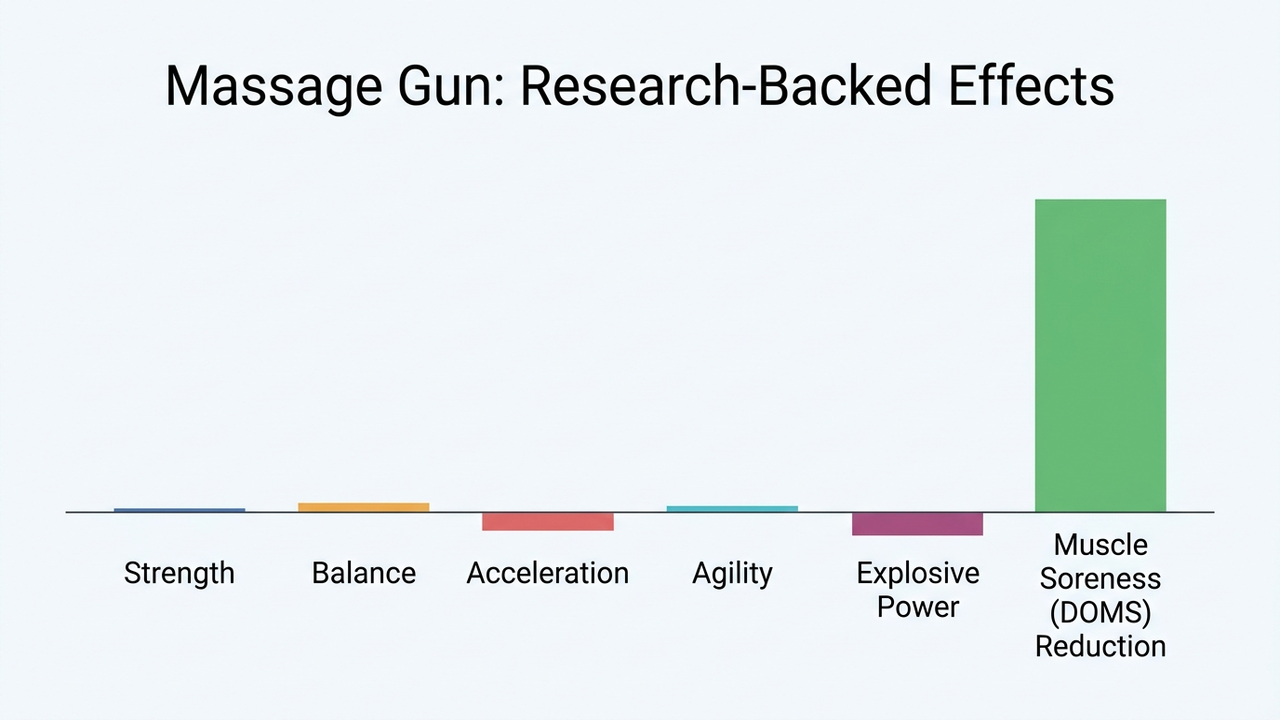
Massage gun marketing often leans on language like “warm up faster” and “train harder,” which implies a performance benefit distinct from recovery. The research doesn’t back that framing. A 2023 systematic review of massage-gun studies found no clear benefit — and in some measured categories, a slight decline — for strength output, balance, acceleration, agility, and explosive movements like jumping or sprinting. The device’s supported benefit is a modest reduction in perceived delayed-onset muscle soreness, which is a recovery outcome, not a performance one; one study specifically found vibration therapy improved pain tolerance and accelerated the decline of muscle-damage blood markers (creatine kinase and LDH) after exercise, which is a different claim than “it makes you stronger or faster.”
If the goal is genuinely better strength, speed, or power output, the research-supported paths remain a structured dynamic warm-up before training and progressive overload in the training program itself — not a percussion device applied beforehand. Athletes who want a massage gun for its actual supported use case (soreness management between sessions) should buy one with that expectation, rather than as a substitute for warm-up or programming work that the device isn’t designed to replace.
3. Casual or infrequent exercisers without an existing soreness problem
Massage gun studies showing a meaningful soreness-reduction effect generally test people training regularly enough to accumulate the kind of muscle damage the device is designed to address — the research applies to someone working out several times a week, not someone exercising occasionally. Many commercial gyms also stock percussion massage devices in their recovery or stretching areas, meaning a casual gym-goer who trains inconsistently can often access the same tool at the facility they already pay for, without buying one of their own. Buying a $250–$300 premium model like the Theragun Prime or Hyperice Hypervolt 2 to use a few times a month delivers a small fraction of the device’s researched value relative to its cost.
We did not find a large-scale survey quantifying what share of home massage guns go unused after the first few weeks, so we’re not claiming a specific abandonment rate — but the mismatch between “benefit concentrates with regular use” and “buying one casually” is well supported by the research itself. For an occasional exerciser who still wants to try percussive therapy without the premium price, a compact budget option such as the RENPHO Extend 2 Massage Gun (ASIN B0DZ68JZGJ, around $119.99) is a lower-cost way to test fit before committing to a $300 device, and a basic foam roller (under $30) delivers comparable DOMS-reduction research support for a fraction of the price for anyone unsure they’ll use a massage gun consistently.
Check the RENPHO Extend 2 Massage Gun on Amazon
When a Massage Gun Still Makes Sense
None of this is a case against the category broadly. The research-supported use case — modest, short-term reduction in post-exercise muscle soreness — is real for people who train consistently enough to need it, and aggregated customer sentiment for correctly used devices skews positive outside the groups above. The data supports buying one if you have none of the bleeding, clotting, injury, or surgical-recovery considerations above (or have already cleared it with a doctor), train regularly enough that DOMS is a recurring issue, and want the device for soreness management rather than as a substitute for warm-up or performance training. That’s a meaningful share of regular exercisers — it just isn’t the “everyone with sore muscles” audience the category’s marketing and growth numbers suggest.
Comparison Table
Prices are approximate amazon.com figures at the time of writing (October 2026) and fluctuate.
| Buyer profile | What the data suggests | Alternative | Typical cost |
|---|---|---|---|
| On blood thinners, clotting disorder, DVT history, recent injury/surgery, osteoporosis, or varicose veins | Get medical clearance first; no product workaround | Consult a physician first | N/A |
| Chasing strength, power, or explosive performance gains | No clear benefit shown (sometimes a slight decline); wrong tool for the goal | Structured dynamic warm-up + progressive training | Free–$20 |
| Casual or infrequent exerciser without existing soreness | Benefit concentrates with regular use; many gyms already stock one | RENPHO Extend 2 (budget) or a foam roller | ~$25–$120 |
| Regular exerciser, no flagged condition, wants soreness relief | Massage gun fits the researched use case | Theragun Prime (B0FKCJNHWB) or Hyperice Hypervolt 2 (B0BDS9D4SB) | ~$230–$300 |
Check the Theragun Prime on Amazon · Check the Hyperice Hypervolt 2 on Amazon
Decision Flowchart
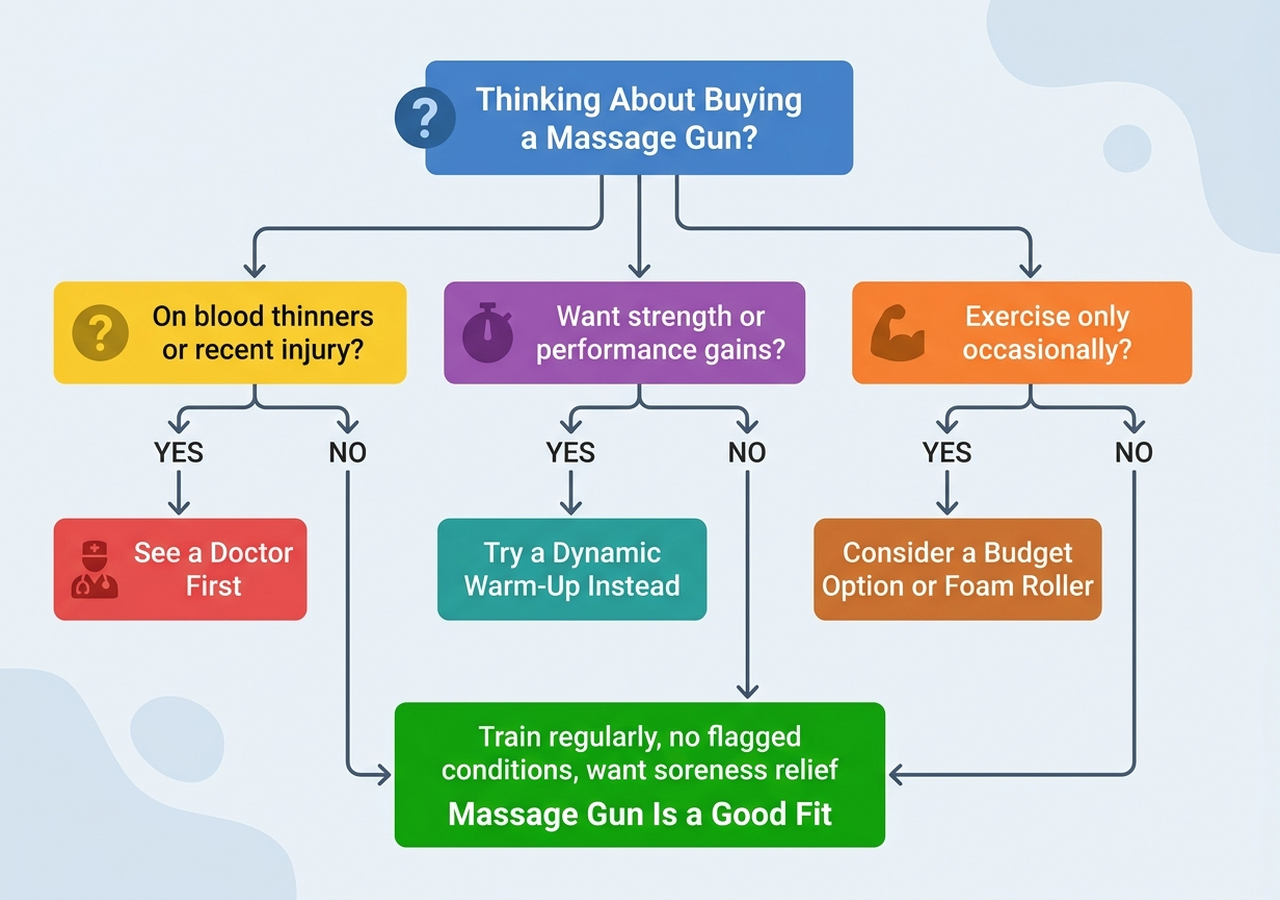
Start with medical history: if you’re on blood thinners, have a clotting disorder, a DVT history, osteoporosis, varicose veins, or a recent injury or surgery, talk to a doctor before buying anything — no device or lower intensity setting resolves that concern on its own. If none of those apply, check your goal: if you specifically want strength, speed, or power improvements, redirect that budget toward a dynamic warm-up routine and training program instead, since the research doesn’t support a massage gun for that outcome. If your goal is soreness relief, check your training frequency: occasional exercisers get limited value from a premium model and should consider a budget option, a foam roller, or their gym’s existing equipment first. Only buyers who train regularly, have no flagged medical conditions, and want soreness relief specifically get the full benefit the research actually supports.
Limitations
This analysis relies on published physical-therapy and sports-medicine contraindication guidance, a single 2023 systematic review of massage-gun performance research, aggregated manufacturer specifications, and a published global market-sizing report, rather than our own side-by-side test of any specific model. The medical-caution guidance for blood thinners, clotting disorders, and injury recovery reflects general clinical caution based on plausible mechanism of harm, not a large-scale controlled study quantifying actual injury rates among massage-gun users with these conditions — individuals in these groups should get personalized medical advice rather than relying on this article. The “no performance benefit” finding reflects one systematic review’s synthesis of available studies at the time it was conducted; sports-science research in this area is still developing and future studies could refine or update that conclusion. We did not find sourced, verifiable figures for what share of U.S. athletes own a massage gun, how many home units go unused, or how commonly gyms stock them, so those points are presented as general observations rather than statistics. Prices fluctuate on amazon.com and should be verified on the current product page before buying.
Bottom Line
Massage guns earned their growth honestly — for a regularly training person without the conditions above, the research-backed soreness-reduction benefit is real, if modest. But the same safety and performance research that explains the category’s popularity also identifies three groups who are unlikely to see that benefit or who carry real risk from buying one: anyone on blood thinners or with a clotting, injury, or surgical-recovery concern who needs a doctor’s input rather than a product recommendation; athletes expecting strength or performance gains the research doesn’t support; and casual exercisers whose infrequent use captures only a fraction of a benefit that’s concentrated among regular users. If you fit one of the first two profiles, the data points toward skipping the purchase entirely or redirecting the budget — not choosing a different model as a workaround.
Before you buy, paste the product link into Arekore — our AI assistant checks review authenticity, surfaces what the one-star reviews actually complain about, and compares prices, free, in about five minutes.