Multi-Cookers 2026: When a $25 Pot Beats the Instant Pot
Electric pressure cookers now account for over 41% of pressure cooker usage in the United States, up from 29% in 2017, with an estimated 58 million-plus units actively in use in American homes, according to industry market-research tracking of the category. Instant Pot turned “multi-cooker” into a household verb, and Consumer Reports’ own 2026 testing of 29 multi-cookers confirms the category has genuinely improved — the Instant Pot 8-quart remains one of the strongest all-around performers CR has tested, and a newer entrant, Zavor, edged out Crock-Pot, Breville, and Instant Pot for the top overall score.
None of that means every kitchen needs one. The same appliance-usage research that explains why air fryers and blenders end up unused applies just as directly to multi-cookers, and a closer look at what pressure cooking is actually good at — versus what a stripped-down stockpot, slow cooker, or rice cooker already does just as well — points to three specific setups where the data favors skipping the $80–$150 multi-cooker and buying the $25 alternative instead.
As an Amazon Associate, Arekore earns from qualifying purchases. The Amazon product links in this article may include our affiliate tracking ID and may earn us a commission if you buy through them, at no additional cost to you. See our Links Policy for details on how we select products and how commissions do not influence our recommendations.
TL;DR / Quick Verdict
- Small-appliance abandonment is well-documented and multi-cookers are not exempt. An NPD Group survey of 1,200 US households found 57% own at least three under-used small appliances, and only 29% actively use more than half of what they own.
- Pressure cooking’s core advantage — speed — is specific to certain foods. Independent testing shows it excels at dried beans, tough cuts of meat, and stock, but offers little to no time savings for rice, pasta, soup reheating, or anything that already cooks fast on a stovetop.
- Slow cooking uses less electricity than pressure cooking for long-simmer meals. One published comparison of energy use across cook methods found a basic slow cooker drawing roughly 18% less electricity per meal than an equivalent multi-cooker cycle for hands-off, all-day recipes — an editorial estimate, not a government or lab-certified figure.
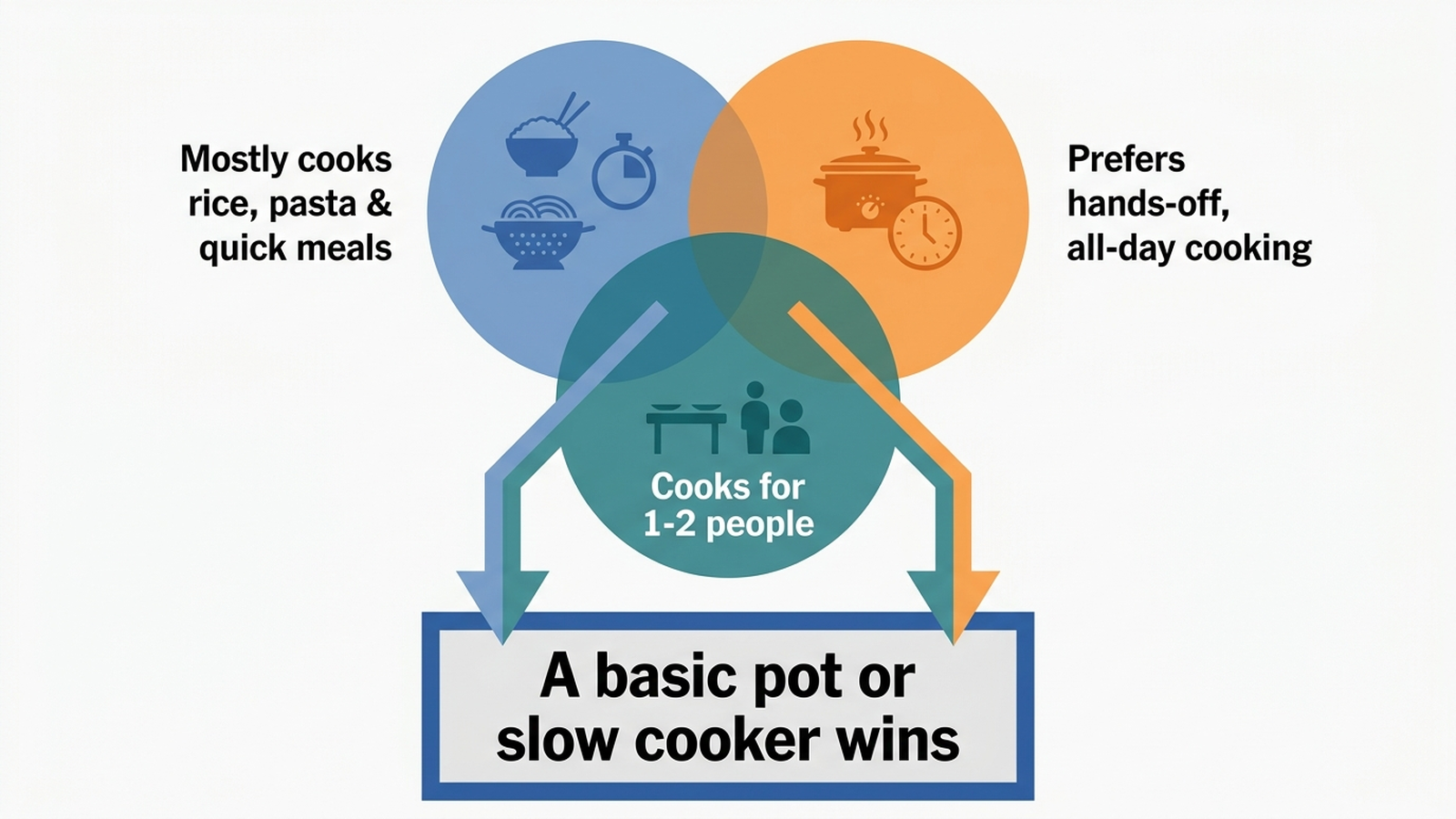
- Three setups where the data favors the simpler tool: households whose usual meals are rice, pasta, and quick sautés rather than dried beans or tough braises; households that prefer genuinely hands-off, all-day cooking over active pressure-release steps; and single-person or two-person households where a multi-cooker’s minimum-liquid requirement makes small portions impractical.
How We Reached These Conclusions (Methodology)
This is an editorial analysis, not a hands-on test. We did not personally test the appliances covered here. This guide synthesizes: (a) NPD Group’s small-kitchen-appliance usage survey data on ownership and under-use rates; (b) Consumer Reports’ 2026 lab testing of 29 multi-cookers, comparing pressure-cook and slow-cook performance across brands including Instant Pot, Crock-Pot, Breville, and Zavor; (c) America’s Test Kitchen’s published comparison of slow-cooker versus pressure-cooker results by recipe type; (d) energy-use comparisons between pressure cooking and slow cooking for equivalent long-cook recipes; (e) US electric-pressure-cooker household-penetration and unit-count estimates from industry market research; and (f) aggregated amazon.com customer-review sentiment on best-selling multi-cookers, basic stockpots, and manual slow cookers, sampled in September 2026. Figures are attributed to their source; where a number is a manufacturer’s own marketing claim rather than an independently measured result, it is labeled as such. Prices are amazon.com figures at the time of writing (September 2026) and fluctuate.
Why the Multi-Cooker Isn’t the Universal Answer
Multi-cookers earned their reputation honestly: pressure cooking genuinely shrinks cook time for a specific category of food. America’s Test Kitchen’s own comparison of slow cookers against pressure cookers is explicit that “which one’s better… depends on what you plan to cook” — pressure cooking wins decisively on dried beans, pot roast, and stock. Instant Pot’s own marketing materials put the time savings at up to 70% versus conventional stovetop cooking for these foods; independent kitchen testing does not dispute the direction of that claim but has not published its own matching percentage, so treat the specific figure as a manufacturer claim rather than an independently measured one. That same independent testing notes a tradeoff: because pressure cooking happens in a sealed environment with minimal evaporation, broths and braises can come out tasting more diluted than a slow-cooked version, where liquid reduces naturally over hours.
The category-wide abandonment pattern documented by NPD Group — 57% of US households own at least three under-used small appliances, with only 29% actively using more than half — applies to multi-cookers for three overlapping, data-backed reasons:
- The speed advantage only shows up for specific foods. Rice, pasta, eggs, sautéed vegetables, and reheated leftovers — the bulk of a typical week’s cooking for most households — cook in roughly the same time on a stovetop or in a basic pot as in a multi-cooker, once you account for the multi-cooker’s own pressurization and depressurization time.
- The sealing ring and locking lid create a maintenance step a basic pot doesn’t have. The silicone sealing ring is a widely reported source of complaints in aggregated amazon.com reviews — it absorbs food odors over repeated use, and owners commonly report needing a dedicated vinegar-and-steam cleaning cycle or a second ring to keep sweet and savory smells from mixing.
- Minimum-liquid requirements work against small households. Electric pressure cookers generally need a minimum volume of liquid to build pressure safely, which makes cooking a single portion of rice or a small batch of vegetables less practical than in a pot sized to the actual meal.
The Three Setups Where the Data Says Skip It
1. Households whose weekly cooking is mostly rice, pasta, and quick meals
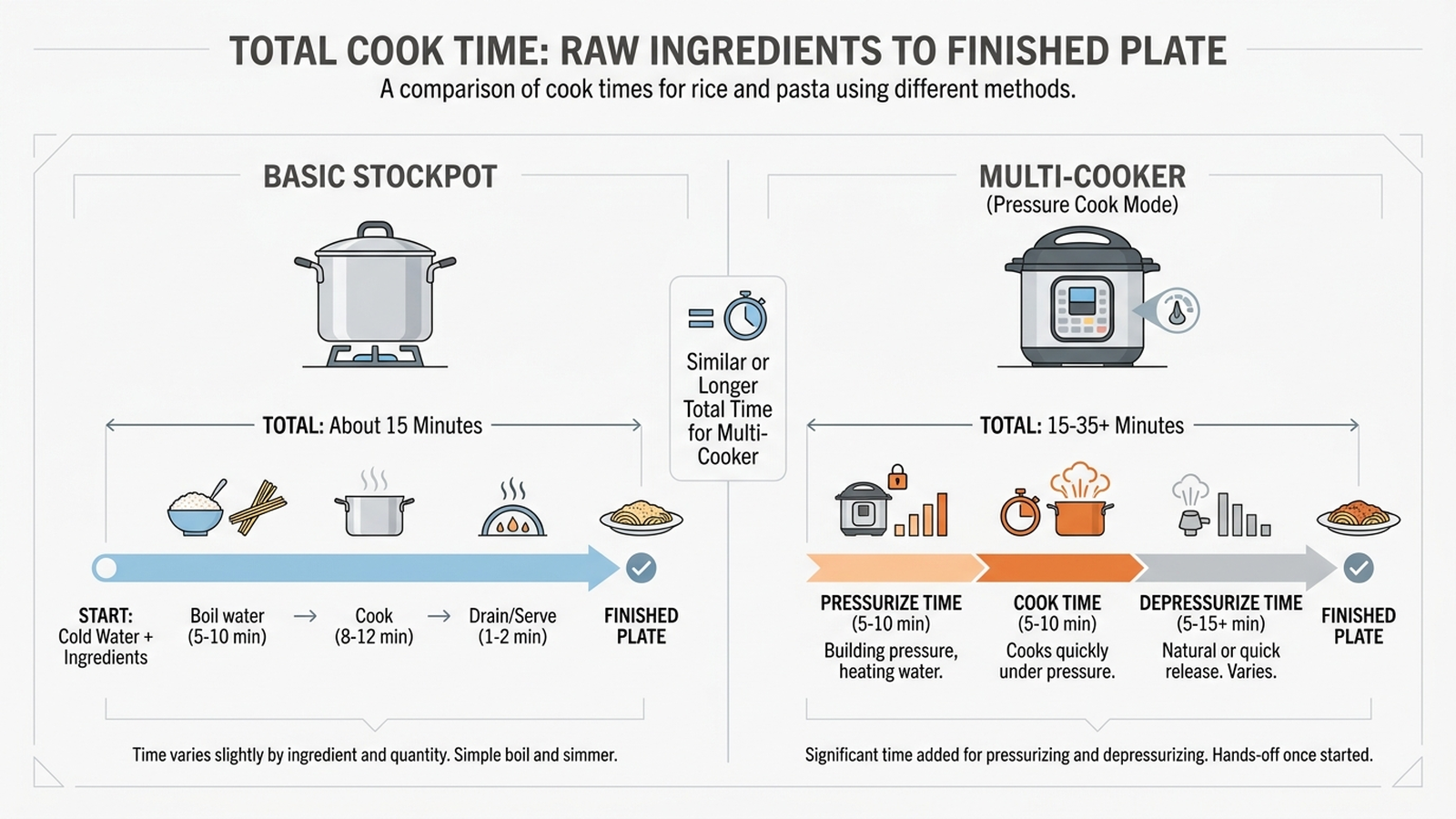
If dried beans, pot roast, and homemade stock are rare in your kitchen and rice, pasta, eggs, and quick sautés make up most weeknight cooking, a multi-cooker’s headline advantage barely applies. Independent testing consistently frames pressure cooking’s time savings around foods that are slow by nature — a multi-cooker’s own pressurize-then-depressurize cycle adds several minutes on either end of the cook, which can erase or exceed the time savings for something that already boils in ten minutes on the stove.
For this setup, a basic stockpot with a lid does the same job with one less appliance to store, clean, and maintain. The Amazon Basics 8-Quart Stainless Steel Stock Pot with Glass Lid (amazon.com) is dishwasher-safe, induction-compatible, and oven-safe; aggregated Amazon sentiment favors its even heating and simple design, with the main critique being that it lacks the pressure or slow-cook modes a multi-cooker offers — modes this household profile doesn’t use often enough to justify the extra $60–$100.
Check the Amazon Basics 8-Quart Stock Pot on Amazon
2. Households that prefer genuinely hands-off, all-day cooking
For recipes built around a long, slow simmer — chili, pulled pork, stews — a basic manual slow cooker matches a multi-cooker’s slow-cook mode on results while using an estimated 18% less electricity per meal for long-cook recipes, per a published editorial energy-use comparison between the two cooking methods (not a government-certified measurement). A slow cooker also removes the active step a pressure cooker requires: releasing pressure, whether via a quick-release valve or a longer natural-release wait, before the lid can be opened. For a household that wants to load ingredients in the morning and return to a finished meal with zero mid-cook attention, that is one less step, not a missing feature.
The Crock-Pot Cook & Carry 6-Quart Manual Portable Slow Cooker (amazon.com) is one of the most-reviewed basic manual slow cookers in this category; aggregated sentiment favors its simple high/low/warm dial and locking travel lid, with the recurring note that it has no digital timer or app — a tradeoff this household profile doesn’t need, since the appeal here is starting it and leaving it alone.
Check the Crock-Pot Cook & Carry 6-Quart Slow Cooker on Amazon
3. Single-person and two-person households cooking small portions
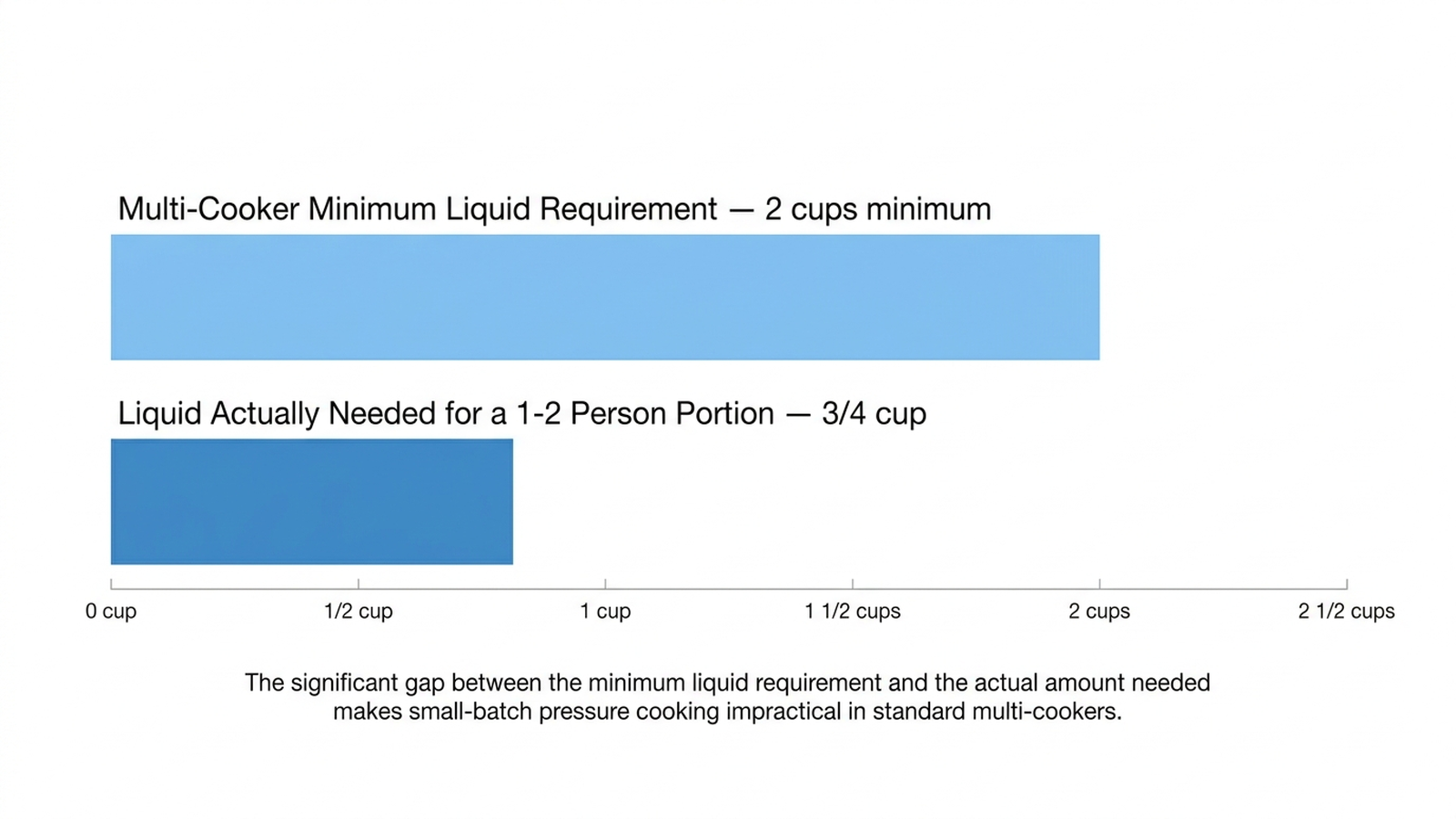
Electric pressure cookers need a minimum amount of liquid in the pot to safely build and hold pressure, regardless of how much food is actually being cooked. For a household of one or two, that minimum is often more liquid than the actual recipe calls for, which pushes owners toward batch-cooking more food than they need just to make the appliance work correctly — the opposite of what a small household wants. Aggregated reviews of compact and mini multi-cooker models reflect this indirectly: buyers of 3-quart “mini” versions frequently cite portion size, not price, as the reason for downsizing from a standard 6-quart unit.
A basic saucepan or small rice cooker sized to an actual one- or two-person portion sidesteps the minimum-liquid constraint entirely, and costs a fraction of even a mini multi-cooker. For rice specifically, a simple non-programmable rice cooker in the 3-cup range handles the single task most small households actually use a multi-cooker’s rice setting for, without the pressure hardware, sealing ring, or cleaning steps that go unused the rest of the week.
When a Multi-Cooker Still Makes Sense
None of this is a case against the category broadly. The data supports buying one specifically when: dried beans, tough cuts of meat, or homemade stock are a regular part of your cooking, you value one appliance replacing several single-function tools, or you cook for a household large enough that the standard 6- to 8-quart capacity gets used weekly rather than occasionally. That is a real and common household profile — Consumer Reports’ own testing confirms today’s best multi-cookers, including the Instant Pot 8-quart, perform well on exactly those tasks.
Comparison Table
Prices are approximate amazon.com figures at the time of writing (September 2026) and fluctuate.
| Your setup | What the data suggests | Alternative product | Typical cost |
|---|---|---|---|
| Mostly rice, pasta, quick meals | Skip a dedicated multi-cooker | Amazon Basics 8-Quart Stock Pot | ~$20–$30 |
| Prefers hands-off, all-day cooking | Manual slow cooker matches results, less electricity | Crock-Pot Cook & Carry 6-Quart Slow Cooker | ~$30–$45 |
| Cooking for 1–2 people | Minimum-liquid requirement wastes food and effort | Basic saucepan or small rice cooker | ~$15–$30 |
| Regular dried beans, tough cuts, stock, cooking for 4+ | Multi-cooker’s speed and capacity still fits | 6- to 8-quart electric multi-cooker | ~$80–$150 |
Limitations
This analysis relies on NPD Group’s household-appliance usage survey, Consumer Reports’ 2026 multi-cooker testing, America’s Test Kitchen’s published slow-cooker-versus-pressure-cooker comparisons, published energy-use comparisons between cooking methods, and aggregated amazon.com review sentiment, rather than our own side-by-side test of any specific model. Household ownership and under-use percentages describe surveyed populations at a point in time and vary by survey methodology; an individual household’s actual usage may differ. Energy-use and cook-time figures depend on the specific recipe, model, and settings used and should be treated as approximate. Individual cooking needs vary by recipe type, portion size, and how a household weighs speed against simplicity.
Bottom Line
Multi-cookers earned their popularity honestly — for the right kitchen, they genuinely shrink cook time on foods that are slow by nature and replace several single-function appliances with one. But the same usage data that explains their adoption also explains why a documented majority of small-appliance owners have units gathering dust: the fit depends on what you actually cook and how many people you’re cooking for, not on how popular the appliance is. If your kitchen mostly needs rice and pasta, wants genuinely hands-off cooking, or feeds one or two people, the data points toward the simpler, cheaper pot already doing the job.
Before you buy, paste the product link into Arekore — our AI assistant checks review authenticity, surfaces what the one-star reviews actually complain about, and compares prices, free, in about five minutes.