Garment Steamers 2026: 3 Closets That Don't Need One

Garment steamers have quietly become one of the default “upgrade your laundry routine” purchases pushed in home gift guides. The global market is estimated at roughly $2.4–2.7 billion in 2026, growing at a 5.5–6.6% compound annual rate through the early 2030s, according to multiple industry research firms, with handheld portable models now accounting for an estimated 58% of unit sales. That growth gets framed as evidence everyone should own one. A closer look at dry-cleaning pricing, the wrinkle-resistant fabric already in most closets, and Consumer Reports’ own 2026 steamer testing tells a narrower story: for at least three specific closets, a $30–$130 steamer adds little that a dry cleaner, a $20 bottle of spray, or an iron already already sitting in a drawer doesn’t cover.
This isn’t an argument that steamers are a bad product. Consumer Reports’ 2026 testing found real performance gains over older models — one unit heated in 10 seconds and erased stubborn linen wrinkles, and the category genuinely does some things an iron can’t, like touching up a hanging blazer without setting up a board. It’s an argument that “the category is growing fast” and “your specific wardrobe needs one” are different claims, and that for a few closet types, the honest answer is to keep using what’s already there.
As an Amazon Associate, Arekore earns from qualifying purchases. The Amazon product links in this article include our affiliate tracking ID and may earn us a commission if you buy through them, at no additional cost to you. See our Links Policy for details on how we select products and how commissions do not influence our recommendations.
TL;DR / Quick Verdict
- Closets dominated by performance and wrinkle-resistant fabric (athleisure, travel knits, synthetic blends) get limited marginal benefit from a steamer — the global wrinkle-resistant fabric market is valued near $1.38 billion and growing specifically because these textiles are engineered not to wrinkle in the first place.
- Closets where the only wrinkle-prone pieces are suits, blazers, and silk already in the dry-cleaning rotation have less to gain, since a professional press is typically bundled into the $4–$11 per-garment dry-cleaning charge most people are already paying.
- Occasional-wear closets that just need a quick touch-up a few times a month can get most of the benefit from a wrinkle-release spray — Consumer Reports found Downy Wrinkle Releaser Plus was the one spray, of seven tested, that left shirts “looking truly wearable,” at roughly $0.60 per use from a $19.99 twin pack.
- None of this beats a steamer for the “truly pressed” look. Consumer Reports’ own testing found that fabric steamers reduce wrinkles but don’t create the crisp, pressed finish a hot iron does — so closets that need that specific look still need an iron or a steamer-and-iron combo, not a steamer alone.
- The category still earns its growth for a real audience: anyone who wears delicate or steam-friendly fabric often (silk, linen, wool), doesn’t have convenient dry-cleaner access, or needs fast between-wears touch-ups a spray and an iron can’t match on speed.
How We Reached These Conclusions (Methodology)
This is an editorial analysis, not a hands-on test. We did not personally test the products covered here. This guide synthesizes: (a) Consumer Reports’ October 2026 testing of 10 handheld steamers plus wrinkle-release sprays and steam-mop attachments, including heat-up time, steam output in grams per minute, and fabric-finish comparisons against an iron; (b) Wirecutter’s 2026 garment steamer buying guide and its top picks across handheld, upright, and travel categories; (c) published 2026 industry market-sizing reports on the global garment steamer market (GMI, Persistence Market Research, Straits Research) and the wrinkle-resistant/performance fabric market (Coherent Market Insights, Future Market Insights); (d) 2026 US dry-cleaning price surveys reporting per-garment shirt pricing; and (e) manufacturer product listings on amazon.com for pricing and specifications. Where a figure is a manufacturer’s own claim (for example, steam temperature or bacteria-reduction claims from manufacturer or retailer blog sources) rather than an independently verified measurement, it is labeled as such and not treated as a tested fact. We did not find a sourced, verifiable figure for what share of steamer buyers fall into the three closet types discussed below, so that proportion is not claimed as a statistic. Prices are amazon.com figures at the time of writing (November 2026) and fluctuate.
Why Market Growth Doesn’t Mean Universal Fit
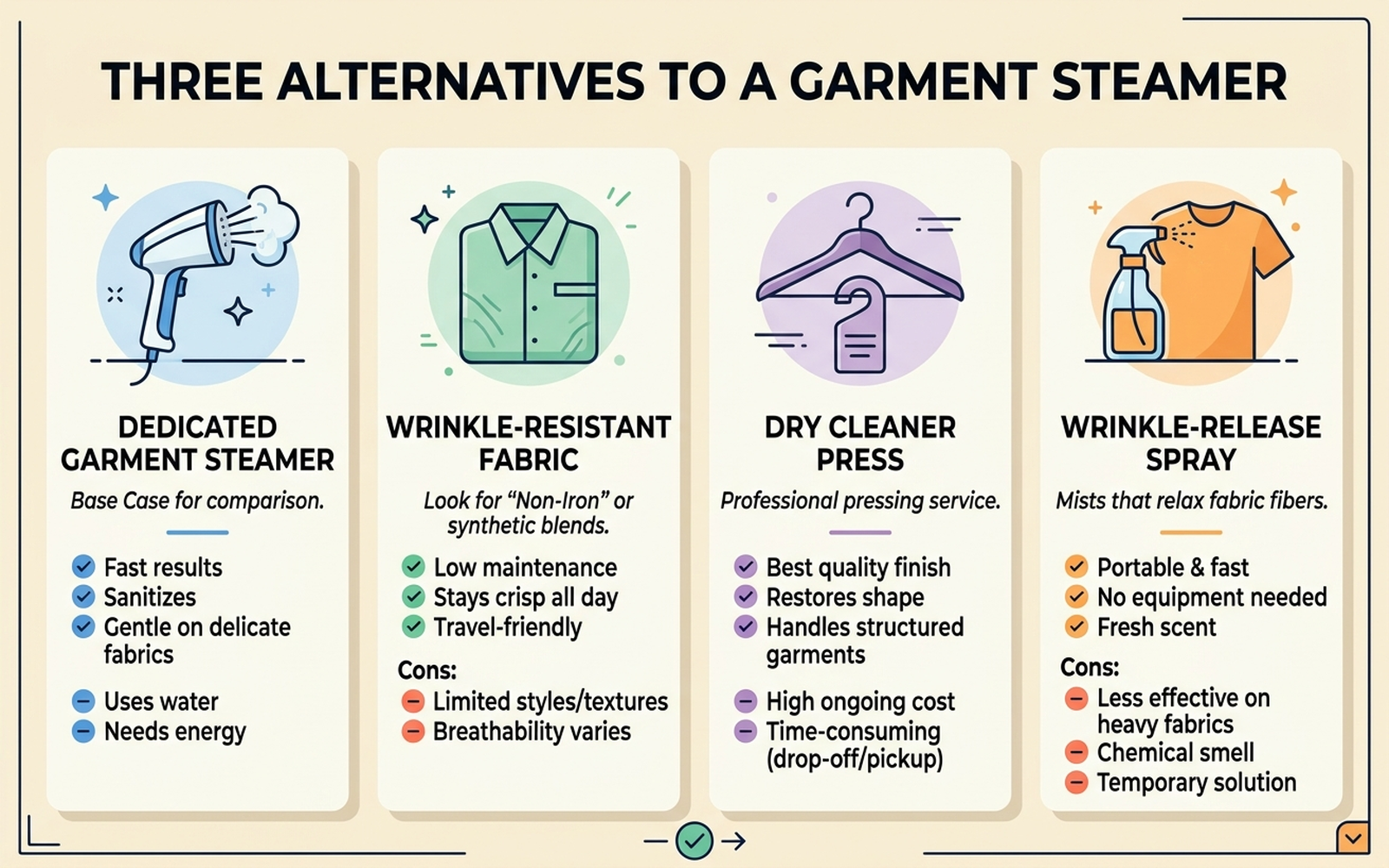
A garment steamer does one job well: it relaxes fabric fibers with steam to reduce wrinkles without the board-and-plug setup of an iron, and it’s genuinely useful on hanging garments, delicates, and curtains an iron can’t easily reach. That value is real, but it isn’t unique to purpose-built hardware. The same underlying outcome — clothes that look presentable without visible creasing — is already delivered, to varying degrees, by things many closets already have:
- Modern fabric is already engineered to resist wrinkling. The performance and wrinkle-resistant fabric market has grown specifically because synthetic blends, travel knits, and treated cotton are designed to shed creases without any heat treatment at all. A closet built around athleisure, travel-friendly knits, or wrinkle-treated dress shirts has fewer garments that need de-wrinkling in the first place.
- A dry cleaner already presses the garments most likely to wrinkle badly. Suits, structured blazers, and silk blouses are the fabrics steamers are most often marketed for — and they’re also the fabrics most people already send to a dry cleaner, where a professional press is typically included in the $4–$11 per-garment charge. Buying a steamer to do a job you’re already paying someone else to do is a duplicated cost, not a new one.
- A spray bottle covers the occasional touch-up. Consumer Reports tested seven wrinkle-release sprays and found only one, Downy Wrinkle Releaser Plus, left shirts looking truly wearable. At roughly $19.99 for a two-bottle pack, that’s well under a cent-per-use cost for someone who only needs a quick fix a few times a month — far below the $30–$130 upfront cost of a dedicated steamer.
None of these alternatives match a dedicated steamer on the specific finish it produces, and none of them handle high-volume or frequent steaming as well — wrinkle-resistant fabric still creases under enough wear, a dry cleaner’s turnaround is measured in days rather than minutes, and spray only works on light wrinkles, not deep creases. But “not a perfect substitute” and “worth buying something else to replace it” are different conclusions, and for the three closets below, the gap doesn’t justify the purchase.
The Three Closets Where the Data Says Skip It
1. Closets built around performance and wrinkle-resistant fabric
If the majority of what’s hanging up is athleisure, travel knits, merino-blend layers, or wrinkle-treated dress shirts, the core problem a steamer solves — visible creasing — rarely shows up in the first place. The wrinkle-resistant fabric market, valued at roughly $1.38 billion and projected to grow at a 5.5% compound annual rate through the early 2030s according to Coherent Market Insights, exists precisely because manufacturers have engineered fibers that resist creasing through folding, packing, and regular wear. A steamer still has a role for the handful of cotton or linen pieces in a mostly-performance-fabric closet, but buying one specifically to maintain a wardrobe that’s already resistant to the problem is solving for a need that mostly doesn’t exist.
The calculation changes the moment real wrinkle-prone fabric enters the rotation — untreated cotton dress shirts, linen, or silk — since those fibers crease visibly and performance fabric doesn’t substitute for them. For that mixed-closet case, a compact handheld like the Conair Turbo ExtremeSteam 2-in-1 (ASIN B0FMLDB3ZQ, roughly $35–$45) covers occasional cotton and linen pieces without the cost or counter space of an upright unit.
Check the Conair Turbo ExtremeSteam on Amazon
2. Closets where the wrinkle-prone pieces are already in the dry-cleaning rotation
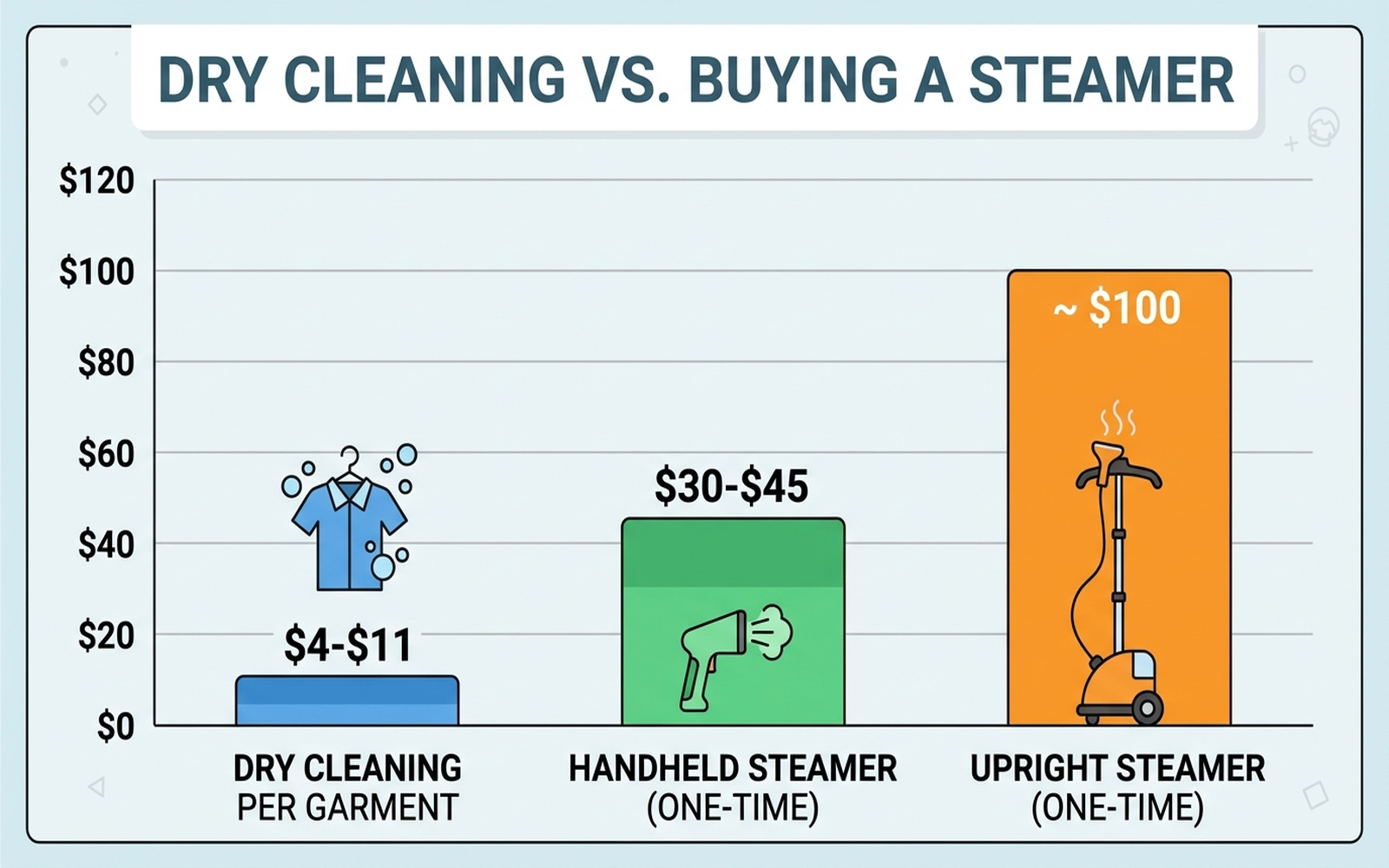
Suits, structured blazers, and silk blouses are the exact garments most steamer marketing targets — and they’re also the garments most likely to already be going to a dry cleaner, where a press is part of the standard service. US dry-cleaning prices for a dress shirt run roughly $4 to $11 per garment depending on region, with the federal price index for laundry and dry-cleaning services up 5.1% year over year as of August 2026. For someone who’s already paying that charge regularly on their suits and silk pieces, a steamer duplicates a service already bundled into a bill they’re paying — the marginal use case shrinks to between-cleaning touch-ups, which a $20 bottle of spray or a hotel-room-style five-minute steam from a handheld can handle without the upfront cost.
This doesn’t mean the math works the same for everyone in this group. Someone dry-cleaning six or more garments a month might find an upright steamer pays for itself quickly if it lets them stretch the interval between professional cleanings for lower-stakes touch-ups. But the specific argument “I need a steamer to keep my suits wrinkle-free” doesn’t hold up on its own when the dry cleaner is already doing that job on the same garments.
3. Occasional-wear closets that only need a quick touch-up
Consumer Reports’ October 2026 testing found real spread across steamer models — the top performer heated in roughly 10 seconds and erased stubborn linen wrinkles, while other models in the test lagged on heat-up time and steam output. That spread matters if you’re buying a steamer to use regularly. It matters much less if the actual need is simpler: a few garments a month that just need a quick de-wrinkle before wearing. For that narrower goal, Consumer Reports’ spray testing found Downy Wrinkle Releaser Plus was the one product among seven tested that left shirts looking genuinely wearable — at roughly $19.99 for a two-bottle, 16.9-ounce-plus-travel-size pack, that’s a few cents per application, with zero counter space and no heat-up wait.
The trade-off is real: spray works on light creasing, not the kind of deep fold-line wrinkles a suitcase or dryer-neglect produces, and it doesn’t replicate the crisp finish a steamer or iron delivers on heavier fabric. If the actual frequency is “every few days,” the math shifts toward owning a steamer rather than repeatedly buying spray — but for genuinely occasional use, a $19.99 bottle that sits in a drawer covers the need without a $30+ appliance taking up space.
Check Downy Wrinkle Releaser Plus on Amazon
When a Garment Steamer Still Makes Sense
None of this is a case against the category broadly. Anyone who regularly wears silk, linen, or wool and wants to avoid both ironing boards and dry-cleaning bills, anyone without convenient or affordable dry-cleaner access, and anyone who needs a fast touch-up on a hanging garment right before leaving the house is well served by a dedicated steamer — and Consumer Reports’ own testing backs that up for the right use case. Their top performer, the Conair Turbo ExtremeSteam 2-in-1, heated in about 10 seconds and handled stubborn linen wrinkles well, combining steam and a pressing function in one unit. For households steaming a higher volume — multiple outfits a week, or professional wardrobes without daily dry-cleaner access — the Pure Enrichment PureSteam Pro Upright Steamer (ASIN B07LBZ9LTV, roughly $99.99) adds a half-gallon tank and up to an hour of continuous steam at four heat levels, closing the gap a handheld can’t on volume.
Check the Pure Enrichment PureSteam Pro Upright Steamer on Amazon
Comparison Table
Prices are approximate amazon.com figures at the time of writing (November 2026) and fluctuate.
| Closet profile | What the data suggests | Alternative | Typical cost |
|---|---|---|---|
| Mostly performance/wrinkle-resistant fabric | Fabric is already engineered to resist the problem a steamer solves | Keep wardrobe as-is | $0 |
| Wrinkle-prone pieces already in dry-cleaning rotation | Professional press is typically bundled into the cleaning charge | Keep using dry cleaner | ~$4–$11 per garment |
| Occasional touch-up needs (a few times a month) | Spray covers light wrinkles at a fraction of the cost | Downy Wrinkle Releaser Plus (B0BRX4VDBB) | ~$20 per two-bottle pack |
| Frequent cotton/linen/silk wearer, no reliable dry cleaner | Steamer fits the researched use case | Conair Turbo ExtremeSteam (B0FMLDB3ZQ) or HiLife handheld (B07HF3X6Y4) | ~$30–$45 |
| High-volume or professional wardrobe needing daily steaming | Upright unit adds real capacity over a handheld | Pure Enrichment PureSteam Pro (B07LBZ9LTV) | ~$100 |
Check the HiLife handheld steamer on Amazon
Decision Flowchart
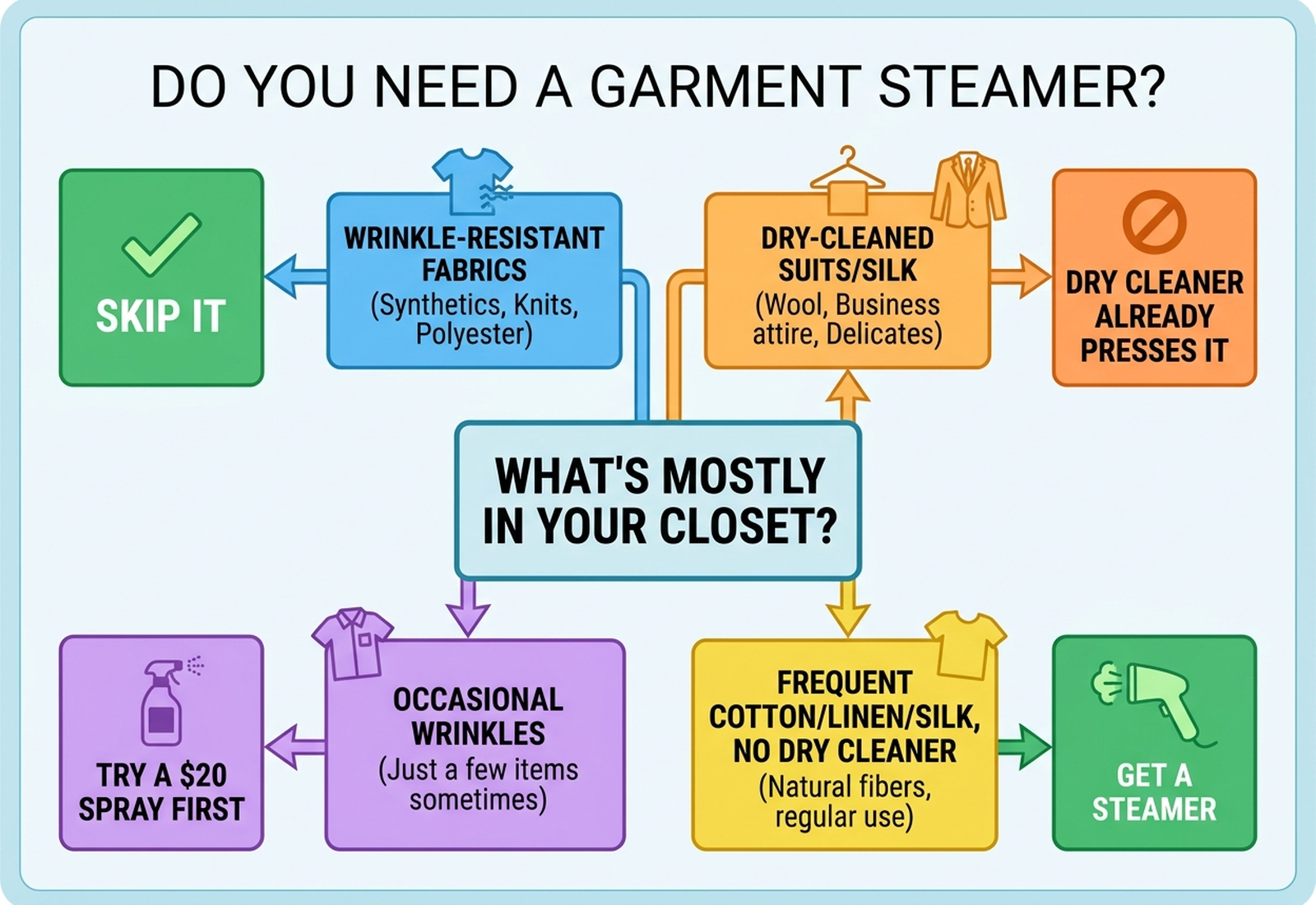
Start with what’s actually hanging in the closet: if most of it is performance or wrinkle-resistant fabric, the core problem rarely shows up and a steamer adds little. If the wrinkle-prone pieces are suits, blazers, or silk already going to a dry cleaner on a regular basis, that service is likely already bundled into the bill — skip the purchase unless the volume of between-cleaning touch-ups is high enough to justify it. If neither applies, ask how often a touch-up is actually needed: a few times a month is covered by a $20 bottle of wrinkle-release spray, while cotton, linen, or silk worn multiple times a week — or a lack of convenient dry-cleaner access — justifies a dedicated handheld in the $30–$45 range, scaling up to a $100 upright unit for high-volume or professional wardrobes.
Limitations
This analysis relies on Consumer Reports’ published October 2026 test results, Wirecutter’s editorial buying guide, published 2026 market-sizing reports on the garment steamer and wrinkle-resistant fabric markets, and published US dry-cleaning price surveys, rather than our own side-by-side test of any specific steamer model. Garment steamer and wrinkle-resistant fabric market size estimates vary by $1 billion or more across research firms depending on methodology, and the figures cited here represent the middle of that published range. Dry-cleaning prices vary significantly by region and garment type; the $4–$11 range cited is a national approximation and should be checked against local pricing. Claims about steam temperature and bacteria reduction circulate widely in manufacturer and retailer marketing but were not independently verified by a testing organization in the sources reviewed for this article, so they are presented as commonly cited claims rather than confirmed facts. We did not find a sourced, verifiable figure for what share of steamer buyers fall into the three closet types discussed here, so that proportion is presented as an analytical argument rather than a cited statistic. Prices fluctuate on amazon.com and should be verified on the current product page before buying.
Bottom Line
Garment steamers earned their market growth honestly — for anyone who regularly wears delicate or wrinkle-prone fabric without easy dry-cleaner access, a $30–$100 unit delivers real, well-tested value, and Consumer Reports’ own data shows meaningful gains over older models. But the same fabric-market, dry-cleaning-price, and product-testing data that explains the category’s popularity also shows three closets worth checking before buying: wardrobes already dominated by wrinkle-resistant fabric, wardrobes where the wrinkle-prone pieces are already pressed by a dry cleaner being paid anyway, and occasional-wear closets that a $20 bottle of spray already covers. If one of those describes your closet and you don’t specifically need the crisp, repeated-use steaming a dedicated unit provides, the data points toward keeping what you already have rather than adding another appliance to the counter.
Before you buy, paste the product link into Arekore — our AI assistant checks review authenticity, surfaces what the one-star reviews actually complain about, and compares prices, free, in about five minutes.