Exercise Bikes 2026: 3 Buyers Who Should Skip One

The U.S. home exercise bike market is still growing — Allied Market Research pegs the segment at roughly $1.6 billion in 2023, projecting growth to about $3.2 billion by 2033 at a 7.2% compound annual growth rate, with stationary cycles cited as one of the fastest-growing categories in home fitness equipment. But a growing market isn’t the same as a good purchase for every household. Separate survey data on home gym equipment puts unused-equipment rates at roughly 27% to 40%, and cardio-equipment adherence specifically has been reported to drop by about 40% within the first three months of ownership. A bike that ends up as a towel rack is a bad outcome regardless of how good the bike itself is.
As an Amazon Associate, Arekore earns from qualifying purchases. The Amazon product links in this article include our affiliate tracking ID and may earn us a commission if you buy through them, at no additional cost to you. See our Links Policy for details on how we select products and how commissions do not influence our recommendations.
TL;DR
- Skip an exercise bike if you don’t have a dedicated spot for it, if you already have gym access you aren’t using, or if past cardio equipment purchases have a track record of going unused in your household.
- None of the popular models reviewed here are low-quality — the risk is almost always about fit with a routine, not the hardware itself.
- If you do buy, a basic spin bike or a budget folding model carries far less sunk cost than a $1,500+ smart connected bike with a required monthly subscription.
How We Reached These Conclusions (Methodology)
This is an editorial analysis, not a hands-on test; we did not personally buy or use the bikes covered here. This guide synthesizes four sources: (a) market-sizing and category-growth data from industry research firms covering the U.S. home exercise bike market; (b) independent lab and usability testing from Consumer Reports, covering both upright and recumbent bike categories; (c) aggregated amazon.com customer reviews on best-selling models in each technical category, sampled in October 2026, with sample sizes noted per product where available; and (d) manufacturer-published specifications, which we label explicitly as manufacturer claims rather than independently verified figures. Consumer survey data on home-gym-equipment abandonment comes from separate industry surveys of equipment owners, not from Amazon or the manufacturers discussed below. We did not have access to return-rate data broken out by individual ASIN, so return risk is discussed qualitatively based on recurring complaint themes, not precise percentages.
Three Technical Approaches, and What Each One Actually Solves
Exercise bikes aren’t one category — they’re three, and picking the wrong one for your space or body is a separate failure mode from picking a bad model.
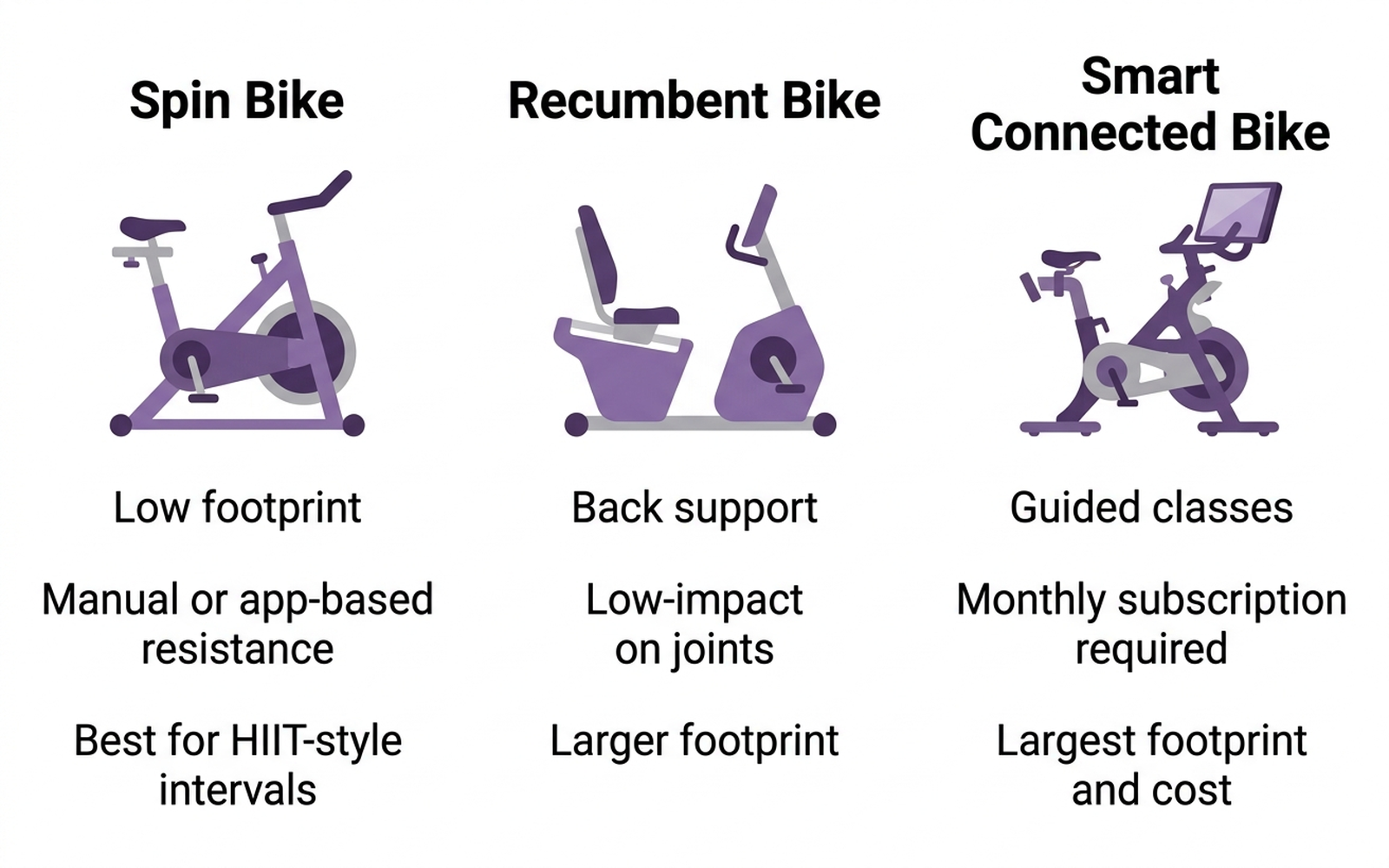
- Spin bikes (Schwinn IC4, entry-level studio-style cycles) use a forward-leaning, standing-capable riding position with a heavy flywheel and manual or knob-based magnetic resistance. They’re compact, don’t require a subscription to function, and suit interval-style training — but the upright, narrow saddle position is uncomfortable for some riders over long sessions.
- Recumbent bikes put the rider in a reclined seat with back support and the pedals out in front, reducing strain on the lower back and knees. Consumer Reports’ testing has consistently rated recumbent models well for comfort and accessibility, particularly for older adults or anyone with joint issues, at the cost of a larger overall footprint.
- Smart connected bikes (Peloton, NordicTrack iFit-enabled cycles, Echelon) add a large touchscreen, live and on-demand classes, and automatic resistance or incline adjustment. They’re the most expensive category up front and typically require an ongoing monthly subscription to unlock full functionality — the screen itself does very little without it.
The Models Being Compared
Peloton Bike (ASIN B0D3Q2K4H1) is the category’s best-known smart connected bike: per Peloton’s published specs, it has a 21.5-inch rotating touchscreen, 100 levels of manual magnetic resistance, a 38-lb flywheel, and a 297-lb weight capacity. It requires Peloton’s All-Access Membership, priced around $44 per month, to use the class library; the bike’s own public subscriber-churn disclosures put average monthly churn at roughly 2.2% in its most recent fiscal quarter, with the company’s own executives attributing part of that specific quarter’s increase to a change in billing-failure emails rather than a shift in underlying member behavior.
Check the Peloton Bike on Amazon
Peloton Bike+ (ASIN B0BVD3DC8B) adds a larger 24-inch screen and auto-resistance that follows instructor cues, at a higher price point than the standard Bike, with the same monthly membership requirement.
Check the Peloton Bike+ on Amazon
NordicTrack Commercial Studio Cycle, S15i/S22i (ASIN B07W6JT26B) competes directly with Peloton via iFit, NordicTrack’s own class and coaching platform, and adds automatic incline/decline (up to 20% incline, -10% decline per manufacturer specs) that syncs to on-screen terrain. Commercial-grade steel construction is rated by the manufacturer to support riders up to 350 lbs. Reviewers commonly note a difficult two-person assembly process and some handlebar or monitor wobble during hard efforts.
Check the NordicTrack Commercial Studio Cycle on Amazon
Schwinn IC4 (ASIN B07WZXSDKW) is a subscription-optional spin bike: it connects via Bluetooth to Peloton’s app, Zwift, and Schwinn’s own JRNY app, but works as a standalone bike with its backlit LCD console if you skip all of them. It holds a 4.4-out-of-5 rating across more than 6,000 Amazon reviews, with reviewers frequently describing it as a lower-cost alternative to a Peloton with comparable build quality.
Check the Schwinn IC4 on Amazon
Echelon EX-5s Smart Connect Bike (ASIN B09KTJYLRQ) sits between the Schwinn and the Peloton: a touchscreen-ready smart bike (tablet or phone mount, not a built-in large display on the base model) with 32 resistance levels and a lower up-front price than Peloton, paired with Echelon’s own monthly membership for class content.
Check the Echelon EX-5s on Amazon
XTERRA Fitness FB150 (ASIN B01LYFWKMH) represents the budget, small-footprint end of the category: a folding, battery-powered bike with 8 manual resistance levels that collapses to about 18 inches square. It carries a 4.5-star rating across roughly 29,000 Amazon reviews — the single most-reviewed bike in this comparison — and no subscription of any kind.
Check the XTERRA FB150 on Amazon
How These Bikes Are Actually Used, According to Aggregated Reviews
Spec sheets describe what a bike can do. Reviews describe what actually happens to it after the first few weeks.
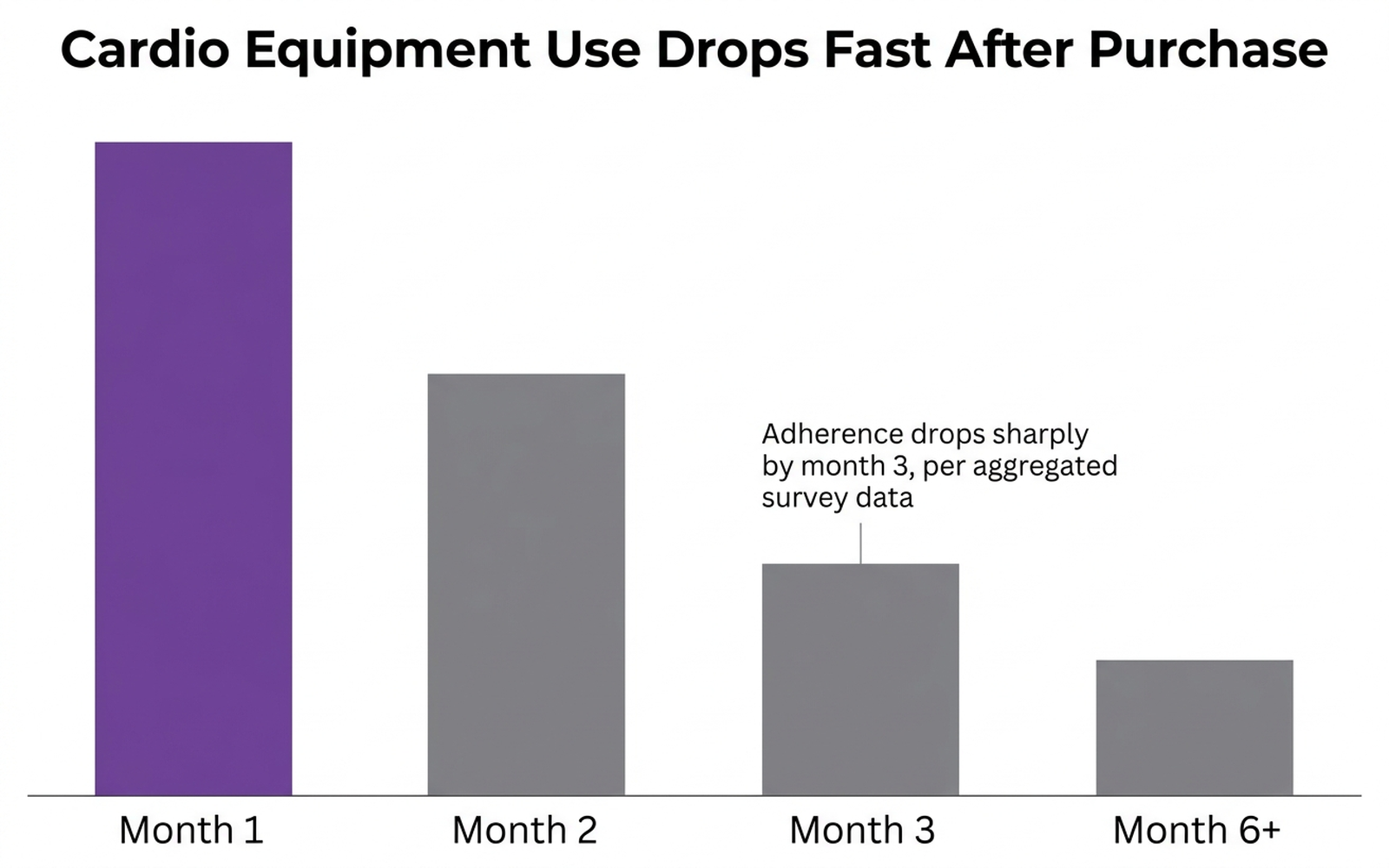
Three usage patterns recur across the review data and the broader survey research on home fitness equipment:
- Heavy use in month one, then a steep drop-off. Industry survey data on cardio-equipment adherence puts the drop at roughly 40% within the first three months — consistent with the general home-gym-equipment finding that roughly a quarter to as much as 40% of purchased equipment goes substantially unused. The hardware doesn’t change in that window; the habit does.
- Clutter and footprint complaints, especially for smart connected bikes. Full-size touchscreen bikes like Peloton and NordicTrack’s studio cycles have a fixed footprint in the 4-to-5-foot range that doesn’t fold away, and that permanence is a recurring theme in lower-starred reviews once the bike stops being used daily — it becomes furniture that happens to also be exercise equipment.
- Subscription fatigue on smart bikes specifically. Peloton’s own disclosed churn data shows members canceling the content subscription while, in many cases, still owning the hardware — the winback campaigns Peloton has run specifically target former subscribers who kept the bike but dropped the membership, which is itself evidence that the two don’t always get used together for long.
Comparison Table
Prices are approximate amazon.com figures as of 2026-10-20 and fluctuate.
| Model | Approx. price | Monthly subscription | Amazon rating | Sample size |
|---|---|---|---|---|
| Peloton Bike | $1,300–$1,700 | ~$44/mo for full class library | N/A (frequently sold via Peloton’s own site) | — |
| Peloton Bike+ | $1,900–$2,700 | ~$44/mo for full class library | N/A | — |
| NordicTrack Commercial S15i/S22i | $1,500–$1,800 | iFit membership required for guided/auto features | Mixed, per aggregated review themes | — |
| Schwinn IC4 | $800–$1,000 | Optional (JRNY, Peloton, Zwift app) | 4.4 / 5 | ~6,181 reviews |
| Echelon EX-5s | $1,000–$1,600 | Echelon membership for class content | Mixed | — |
| XTERRA FB150 (folding) | $100–$180 | None | 4.5 / 5 | ~29,541 ratings |
Should You Skip It? A Decision Guide
This is the core question of this article, and it isn’t about which bike is “best” — it’s about whether a bike is the right purchase for your household at all.
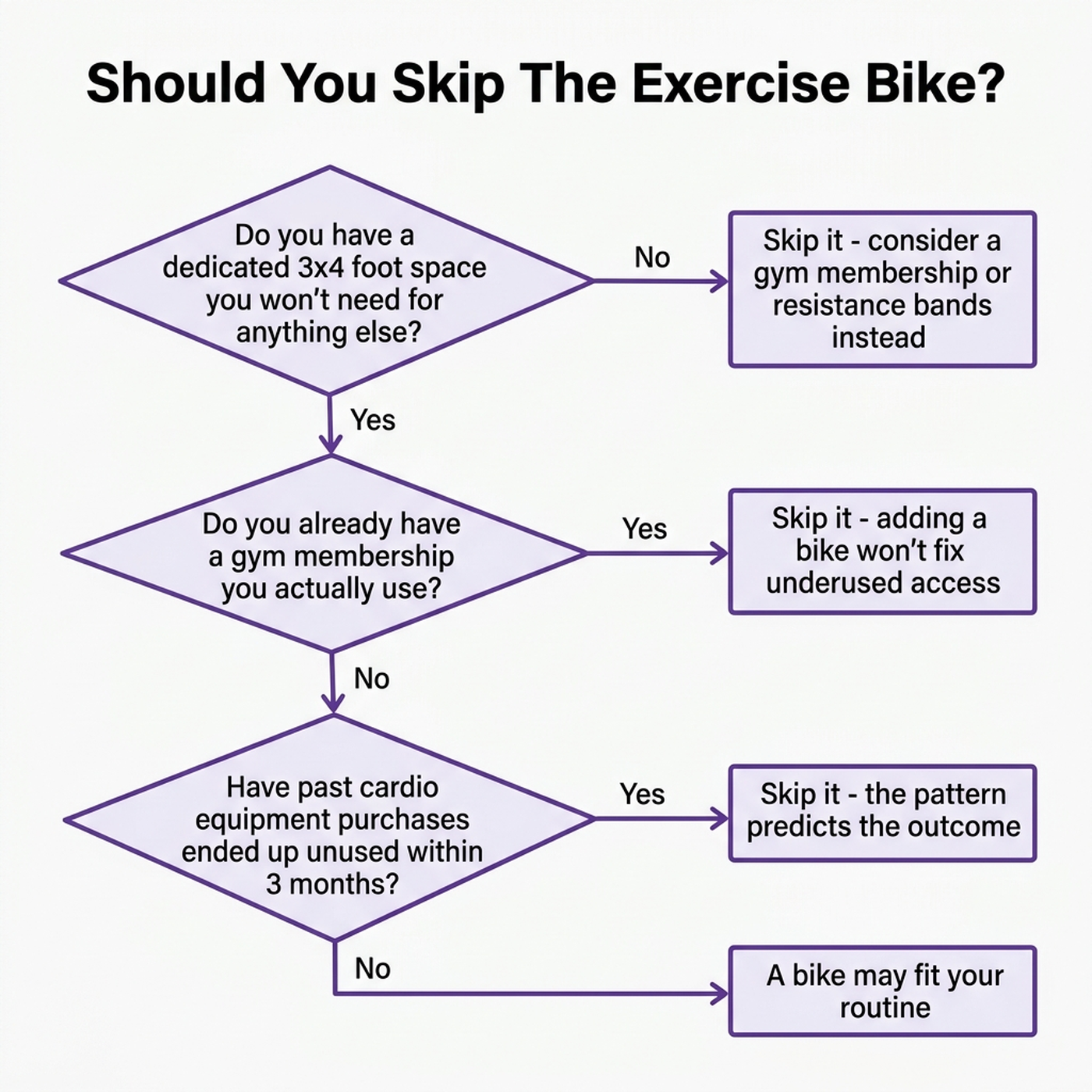
1. You don’t have a dedicated spot you won’t need for anything else. Even the smallest folding bike in this comparison, the XTERRA FB150, still needs roughly 18 inches of floor space when stored, and a full-size spin or smart bike needs a permanent 3-to-5-foot footprint that can’t double as anything else. If the bike’s eventual home is “wherever it fits that day,” it’s far more likely to end up pushed into a corner — and aggregated reviews on full-size connected bikes repeatedly describe exactly that outcome once daily use stops.
2. You already have gym access you aren’t using. A bike doesn’t fix a motivation problem; it just relocates it. If a current gym membership, apartment fitness room, or community center pool already goes mostly unused, buying $800 to $2,700 of equipment to solve the same underlying habit gap rarely works — the data on cardio-equipment adherence drop-off applies just as much to a bike in the living room as to a machine at the gym.
3. Your household has a pattern of abandoning cardio equipment. Survey data putting unused home gym equipment at roughly 27% to 40% isn’t abstract — it’s a documented, repeatable pattern, and the single best predictor of future use is past use. A treadmill, elliptical, or rowing machine currently serving as a clothes rack is a stronger signal than any spec sheet about what a new bike is likely to become.
If none of these three apply — you have a space you won’t repurpose, you don’t already have underused gym access, and your household’s track record with cardio equipment is actually good — a bike may be a reasonable purchase. The subscription-optional models (Schwinn IC4, XTERRA FB150) carry the least financial downside if the habit doesn’t stick, since there’s no recurring membership to cancel on top of the hardware cost.
Warranty and Return-Policy Notes
Amazon’s standard return window is 30 days from delivery for most items in this category, though large freight-shipped items like full-size exercise bikes can carry different return logistics (freight pickup rather than a simple mail-back), so check the specific listing before ordering. Manufacturer warranties vary by brand and are separate from Amazon’s return window:
- Peloton backs the Bike and Bike+ frame with a 12-month warranty on most components per the manufacturer; confirm current terms on Peloton’s own site, since warranty coverage has changed between hardware generations.
- NordicTrack publishes a 10-year frame warranty on its Commercial Studio Cycle line, with shorter coverage windows on electronics and parts.
- Schwinn publishes a 2-year warranty on the IC4’s frame and mechanical parts.
- Echelon and XTERRA each publish their own standard limited warranties; terms and duration vary by model year, so check the current listing before buying.
If a defect appears after Amazon’s return window closes, the manufacturer’s warranty, not Amazon, is the path to pursue.
Recommendations
- If any of the three skip conditions above apply to you: don’t buy a bike this cycle. Consider resistance bands, a used gym-access arrangement, or simply revisiting the decision in a few months once the underlying space or motivation question is resolved.
- If you want a bike and have genuine space plus a reasonable adherence track record: a subscription-optional spin bike like the Schwinn IC4 limits the downside if the habit fades, since there’s no recurring membership tied to the hardware.
- If budget and space are the binding constraints, not motivation: a folding budget bike like the XTERRA FB150 is a low-cost way to test the habit before committing to a $1,000+ purchase.
- If guided classes and built-in accountability are specifically what’s been missing from past attempts: a smart connected bike (Peloton, NordicTrack, Echelon) is the category designed to solve that — but budget for the subscription as an ongoing cost, not an optional add-on, when deciding if the total price fits.
Limitations
This analysis relies on publicly available market data, independent lab testing from Consumer Reports, aggregated amazon.com customer reviews, and manufacturer-published specifications; we did not personally test any of the bikes covered here. Return-rate and abandonment statistics cited are drawn from industry and survey research on home fitness equipment broadly, not from Amazon or from per-ASIN data for the specific products listed, since that data is not publicly available at the product level. Individual results depend heavily on household habits, available space, and prior exercise history, which this analysis cannot predict for any specific reader. Prices, subscription costs, and warranty terms are current as of the time of writing and are subject to change; confirm current terms on the product listing or manufacturer site before purchasing.
Bottom Line
Every bike in this comparison performs reasonably well at the job it’s built for — the Schwinn IC4’s build quality rivals bikes twice its price, the XTERRA FB150’s folding footprint genuinely works for small apartments, and Peloton’s and NordicTrack’s class ecosystems solve a real accountability problem for people who need it. The risk in this category isn’t buying a bad bike; it’s buying a good bike that doesn’t match your space, your existing gym access, or your household’s actual track record with cardio equipment. Answering those three questions honestly, before checking a single spec sheet, is the highest-leverage step in this entire purchase decision.
Before you buy, paste the product link into Arekore — our AI assistant checks review authenticity, surfaces what the one-star reviews actually complain about, and compares prices, free, in about five minutes.