Coffee Grinders 2026: 3 Coffee Drinkers Who Don't Need One
A home burr grinder is the upgrade every “serious coffee” guide recommends first — before a better kettle, before a fancier dripper, before anything else. The logic is sound on its face: coffee starts going stale the moment it’s ground, so grinding right before brewing should always taste better than a bag that was ground weeks ago at a factory.
But “always better” and “worth $80–$200 and a new appliance on the counter” are different claims, and the National Coffee Association’s own data on how Americans actually brew shows the gap between fresh-ground and pre-ground is irrelevant for a large share of coffee drinkers — not because freshness doesn’t matter, but because their brewing method, consumption pattern, or format never lets grind quality become the limiting factor in the first place. A closer look at three specific coffee-drinking habits shows exactly where the data says a grinder adds nothing.
As an Amazon Associate, Arekore earns from qualifying purchases. The Amazon product links in this article may include our affiliate tracking ID and may earn us a commission if you buy through them, at no additional cost to you. See our Links Policy for details on how we select products and how commissions do not influence our recommendations.
TL;DR / Quick Verdict
- Single-serve pod drinkers get zero benefit from a grinder — by design. The National Coffee Association’s Fall 2025 National Coffee Data Trends report puts single-serve pod brewing at 28% of at-home coffee preparation, second only to drip machines at 38%. K-Cup-style pods arrive pre-ground and factory-sealed; there is no beans-to-grounds step in that workflow for a grinder to improve.
- Cold brew’s long steep time is forgiving of grind inconsistency. Coffee-industry grind guidance consistently places cold brew’s required grind at the coarse end of the scale, specifically because a 12-to-24-hour steep has enough time to extract evenly even when particle sizes aren’t uniform — the opposite of espresso, where grind consistency is the single biggest variable.
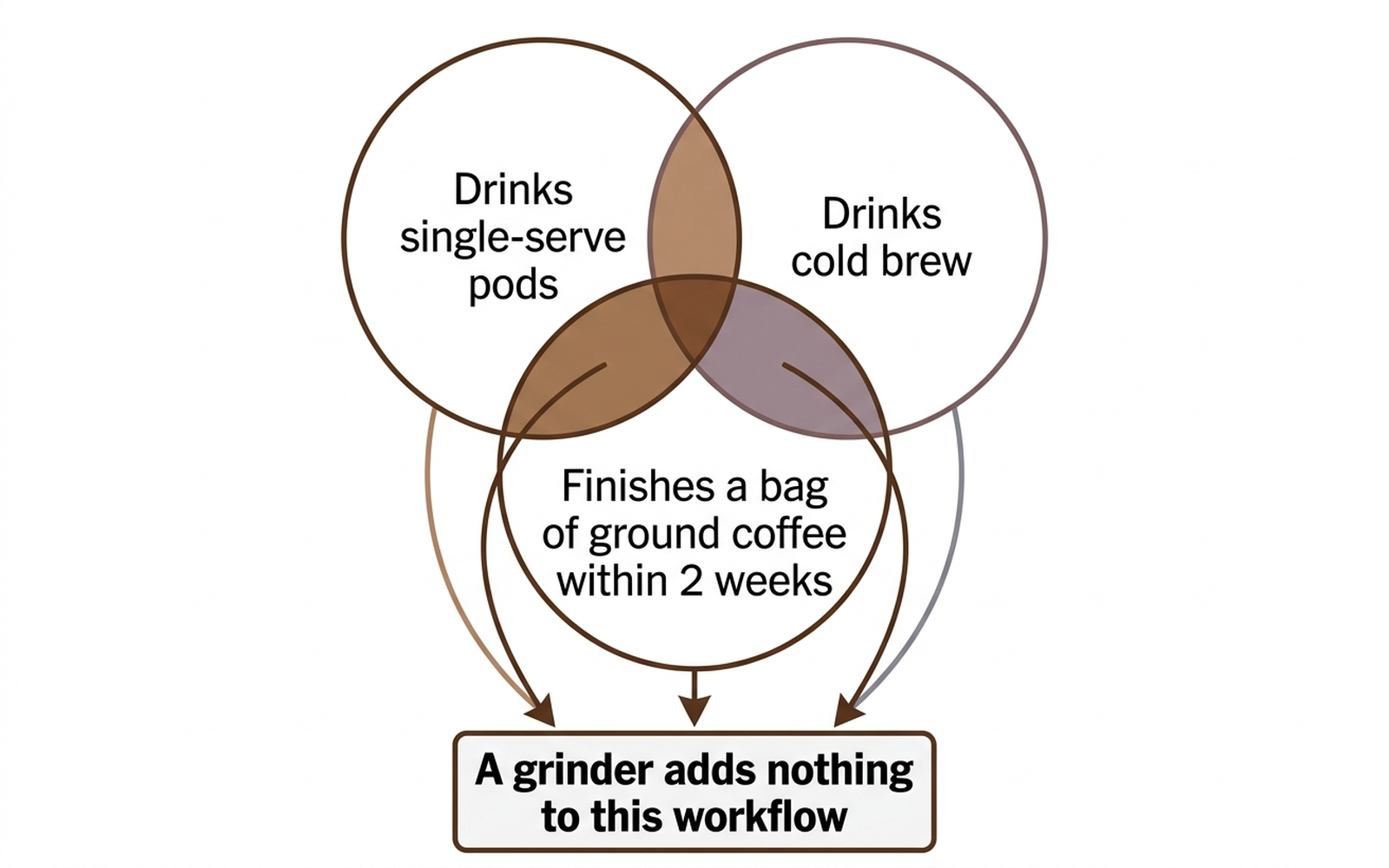
- Staleness, not grind precision, is the real quality lever for light, infrequent drinkers. Consumer Reports’ own burr-grinder testing shows grind consistency problems show up most in medium grind performance (the setting drip machines use) — but a household that finishes a bag of pre-ground coffee within one to two weeks of opening it sidesteps the staleness problem that pre-ground coffee is actually vulnerable to, making the grinder’s main advantage moot.
- 85% of past-day coffee drinkers now brew at home — the highest share the NCA has recorded since 2012 — which is exactly why “does my home setup need a grinder” is a bigger question in 2026 than it was when more coffee was bought already-made at a shop.
How We Reached These Conclusions (Methodology)
This is an editorial analysis, not a hands-on test. We did not personally test the grinders or alternative products covered here. This guide synthesizes: (a) the National Coffee Association’s Fall 2025 and Spring 2026 National Coffee Data Trends reports on at-home brewing-method share and where Americans drink their coffee; (b) Consumer Reports’ burr-grinder lab testing, which scores grinders separately on coarse, medium, and fine grind consistency; (c) published coffee-roasting and specialty-coffee guidance on how grind-size tolerance varies by brew method, particularly the contrast between espresso’s narrow grind window and cold brew’s wide one; (d) general food-science consensus on coffee staleness, which is driven primarily by surface-area exposure to oxygen and moisture after grinding, not by grind-size precision; and (e) aggregated amazon.com customer-review sentiment on best-selling single-serve machines, pre-ground coffee, and cold-brew makers, sampled in October 2026. Figures are attributed to their source; where a figure is a manufacturer’s own marketing claim rather than an independently measured result, it is labeled as such. Prices are amazon.com figures at the time of writing (October 2026) and fluctuate.
Why “Always Grind Fresh” Isn’t Universal Advice
The freshness argument for grinding your own beans is real: ground coffee has far more surface area exposed to air than whole beans, so it loses aromatic compounds faster, and a bag that’s been open on a shelf for weeks will taste flatter than coffee ground minutes before brewing. Specialty-coffee guidance is consistent on this point, and it’s the reason “grind right before you brew” shows up in nearly every serious coffee buying guide.
What that advice leaves out is that freshness only matters if the brewing method and consumption pattern actually let you taste the difference, and grind consistency — the thing a $80–$200 burr grinder is actually built to deliver over a cheap blade grinder — matters even more narrowly. Consumer Reports’ own grinder testing bears this out indirectly: it scores machines separately by grind setting, and models that excel at coarse or fine grinds don’t necessarily perform as well at medium, the grind drip machines need. That’s a sign that “better grinder” isn’t a single uniform upgrade — it’s method-specific, and some methods barely benefit at all:
- Pre-ground-by-design formats remove grinding from the equation entirely. Single-serve pods are sealed at the factory; no amount of grinder quality at home changes what’s inside the pod.
- Some brew methods have a wide grind-tolerance window. Cold brew’s long steep time is explicitly more forgiving of inconsistent particle size than espresso or pour-over, where an uneven grind directly causes uneven extraction and a noticeably worse cup.
- Staleness is a time-and-storage problem, not strictly a grinding-precision problem. A household that buys smaller bags and finishes them quickly avoids the main failure mode of pre-ground coffee — regardless of whether the bag was ground by a cheap blade grinder, a premium burr grinder, or a factory.
The Three Coffee Drinkers Where the Data Says Skip It
1. Single-serve pod drinkers
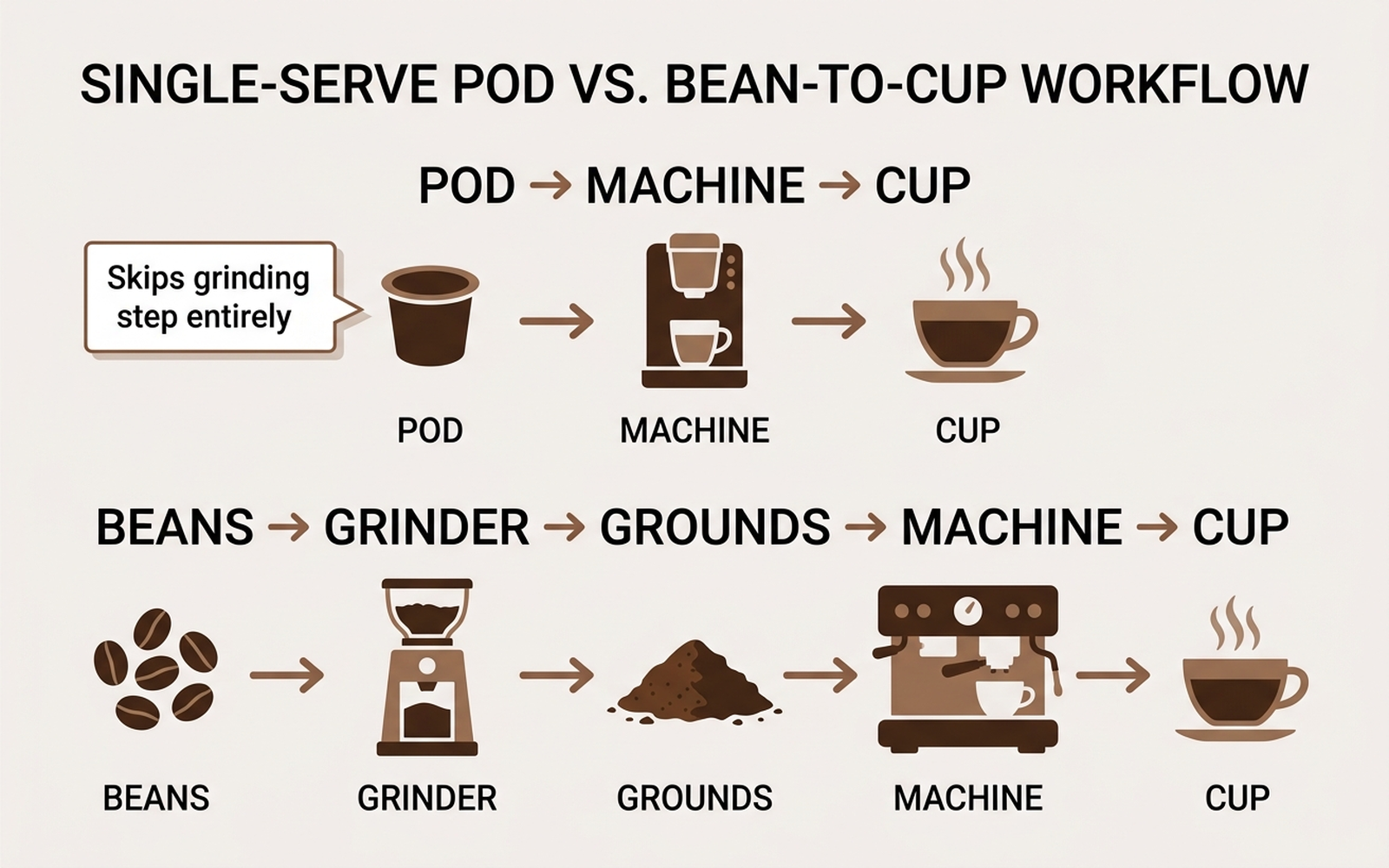
Single-serve pods account for 28% of at-home coffee preparation per the NCA’s Fall 2025 data — a format built entirely around pre-measured, pre-ground, factory-sealed coffee. A grinder has no role in this workflow at all: there are no whole beans to grind, and the format’s entire appeal (speed, no mess, no dialing in a grind setting) is specifically the opposite of what a grinder-and-manual-brew setup offers. Buying a burr grinder alongside a pod machine doesn’t improve pod coffee in any way; the two purchases serve unrelated workflows.
The Keurig K-Classic Single Serve K-Cup Pod Coffee Maker (amazon.com) remains one of the best-selling machines in this format; aggregated Amazon sentiment favors its simple three-brew-size dial and large reservoir, with the main critique being pod cost per cup versus bagged coffee — a tradeoff this household has already accepted by choosing the pod format, not a reason to also buy a grinder.
Check the Keurig K-Classic Coffee Maker on Amazon
2. Cold brew drinkers
Cold brew’s defining step — steeping coarse grounds in cold or room-temperature water for 12 to 24 hours — is explicitly more tolerant of inconsistent particle size than hot-brew methods. Specialty-coffee grind guidance places cold brew at the coarsest end of the grind spectrum precisely because the long steep time gives water enough contact time to extract evenly even when some particles are slightly larger or smaller than others. That’s the opposite of espresso, where grind inconsistency shows up immediately as channeling and uneven extraction.
Consumer Reports’ testing is consistent with this: among burr grinders it tested, coarse-grind performance scored well even on units that didn’t lead at the harder, finer settings — the setting cold brew actually needs is the one that’s easiest for a grinder (or a coarse pre-ground bag) to get right. A dedicated cold brew steeping pitcher skips the grinder question entirely by using coarse pre-ground coffee, which is widely available and inexpensive.
The Takeya Deluxe Cold Brew Coffee Maker, 1 Quart (amazon.com) is one of the most-reviewed cold brew pitchers in this category; aggregated sentiment favors its airtight lid and fine-mesh filter, with the main critique being that the included filter needs regular rinsing to avoid clogging — a minor maintenance note, not a reason to add a $100+ grinder to a cold brew routine that doesn’t need one.
Check the Takeya Deluxe Cold Brew Coffee Maker on Amazon
3. Light, fast-turnover drinkers who finish a bag within one to two weeks
Staleness in pre-ground coffee is driven by prolonged exposure to oxygen and moisture after grinding, which is why coffee that’s been sitting opened on a shelf for a month tastes flat compared to coffee ground that morning. But that failure mode depends on time, not on whether a grinder exists in the kitchen. A household that drinks coffee occasionally — not daily, and not in large volumes — and buys a smaller bag sized to be finished within one to two weeks of opening never gives pre-ground coffee the time it needs to go noticeably stale. For that household, a $80–$200 grinder solves a freshness problem they were never actually experiencing.
The Dunkin’ Original Blend Medium Roast Ground Coffee, 30 Oz. Canister (amazon.com) is one of the best-selling pre-ground options on Amazon; aggregated sentiment favors its consistent medium roast and resealable canister, with the main critique being that it’s a mainstream blend rather than a single-origin specialty roast — a tradeoff that matters far more to a daily, high-volume drinker than to someone brewing a cup or two a few times a week.
Check the Dunkin’ Original Blend Ground Coffee on Amazon
When a Grinder Still Makes Sense
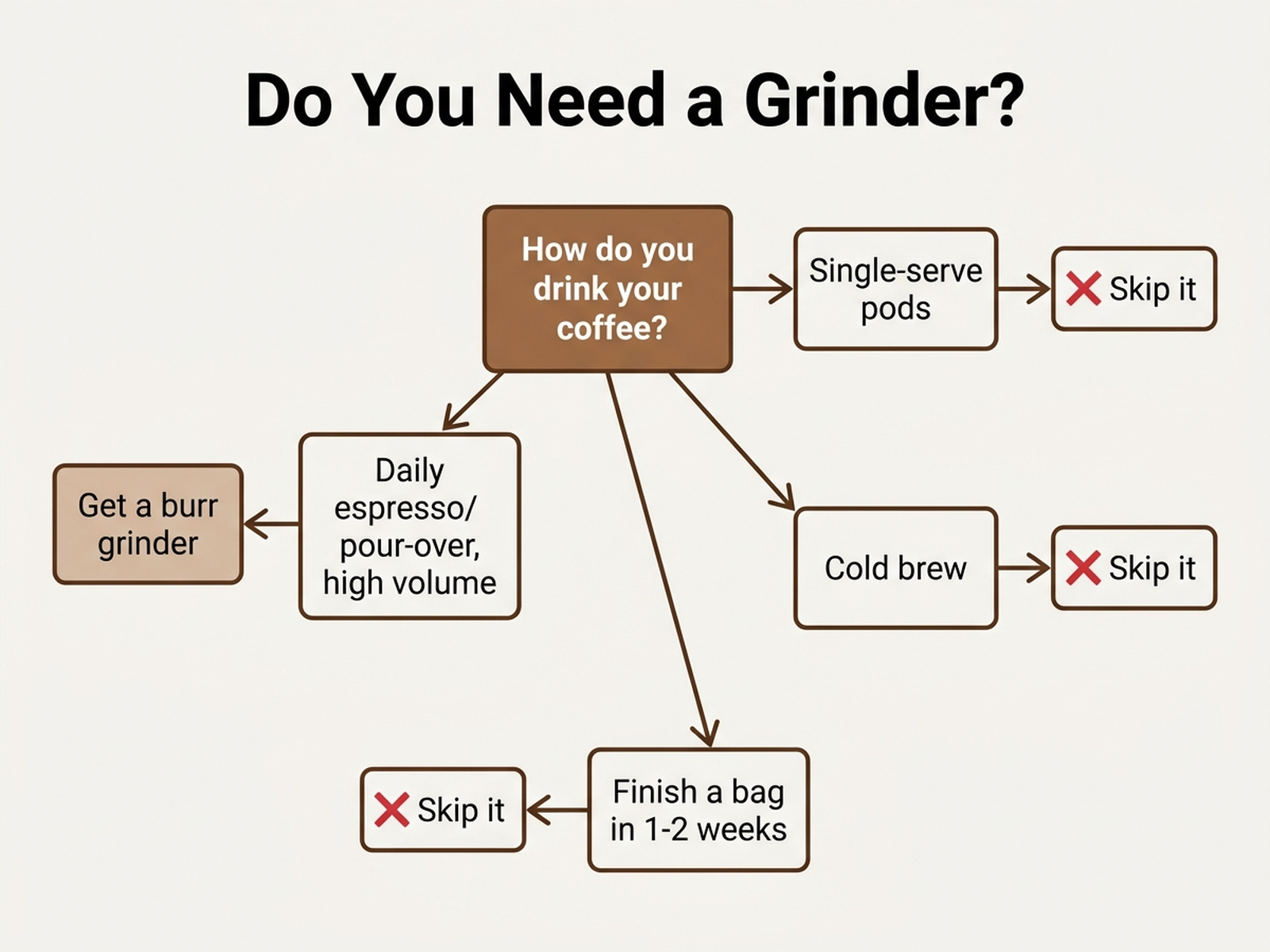
None of this is a case against grinders broadly. The data supports buying one specifically when: you regularly brew espresso or pour-over, where grind consistency directly determines whether the cup tastes balanced or bitter/sour; you drink enough daily, higher-volume coffee that a bag doesn’t survive two weeks before staleness becomes noticeable; or you specifically enjoy single-origin and specialty beans where the flavor difference between fresh-ground and pre-ground is large enough to be worth the extra appliance and the extra step every morning. Consumer Reports’ own testing confirms today’s better burr grinders, including models like the Baratza Encore and Bodum Bistro, perform well across grind settings for exactly this kind of daily, method-sensitive use.
Comparison Table
Prices are approximate amazon.com figures as of 2026-10-15 and fluctuate.
| Your coffee habit | What the data suggests | Alternative product | Typical cost |
|---|---|---|---|
| Drinks single-serve pods | Grinder has no role in this format | Keurig K-Classic Coffee Maker | ~$90–$120 |
| Drinks cold brew | Long steep tolerates coarse pre-ground coffee | Takeya Deluxe Cold Brew Coffee Maker, 1 Quart | ~$20–$25 |
| Light drinker, finishes bag in 1–2 weeks | Staleness window never arrives | Dunkin’ Original Blend Ground Coffee, 30 oz | ~$15–$20 |
| Regular espresso/pour-over, daily high-volume, specialty beans | Grind consistency and freshness both matter daily | Burr grinder (e.g. Baratza Encore, Bodum Bistro) | ~$80–$200 |
Limitations
This analysis relies on the National Coffee Association’s National Coffee Data Trends reports, Consumer Reports’ burr-grinder testing, published specialty-coffee grind-tolerance guidance, general food-science consensus on coffee staleness, and aggregated amazon.com review sentiment, rather than our own side-by-side taste test of ground versus freshly ground coffee. Brewing-method share figures describe a national survey population at a point in time and may not reflect any individual household’s habits. Grind-tolerance guidance for cold brew and other methods is drawn from widely published coffee-industry consensus rather than a single controlled lab study, and staleness timelines vary by how a bag is stored (airtight, away from light and heat) as much as by time elapsed. Individual taste sensitivity to grind freshness varies, and some light drinkers may still notice a difference a typical taster would not.
Bottom Line
A burr grinder earns its reputation honestly for the drinker it’s built for: daily espresso or pour-over habits, high coffee volume, and a preference for specialty beans, where grind consistency and minute-fresh grounds are the difference between a great cup and a mediocre one. But the same National Coffee Association data that shows pod machines and drip coffee dominating at-home brewing also explains why a grinder sits unused on plenty of counters — the format, the brew method, or the consumption pace already removes the problem a grinder solves. If you brew pods, drink mostly cold brew, or finish a small bag of coffee within a couple of weeks, the data points toward skipping the grinder and putting that $80–$200 toward the machine or the beans you’ll actually use daily.
Before you buy, paste the product link into Arekore — our AI assistant checks review authenticity, surfaces what the one-star reviews actually complain about, and compares prices, free, in about five minutes.