Air Fryer 2026: 3 Kitchen Setups Where You Don't Need One
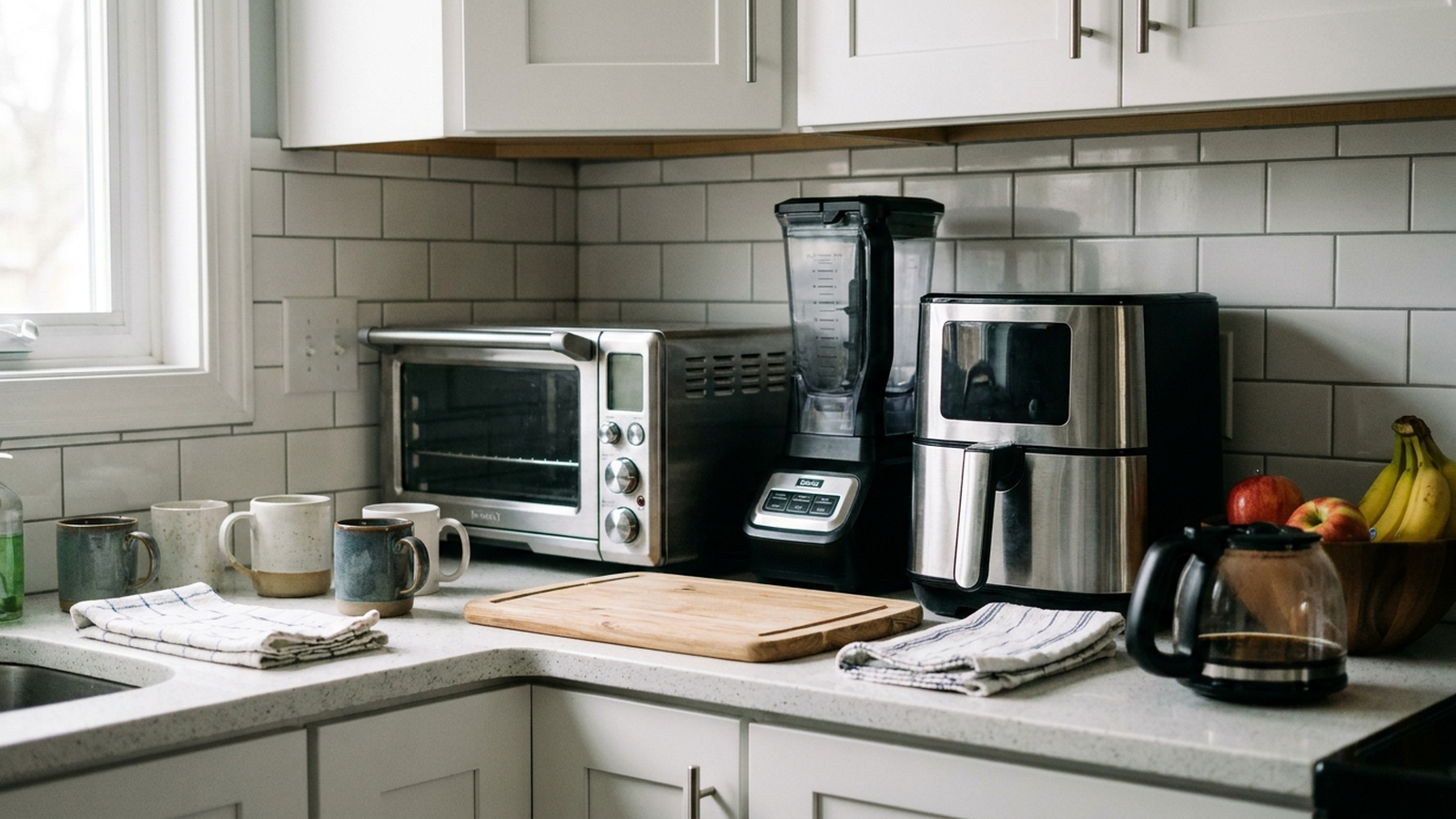
Air fryers crossed a real threshold in the last two years: household penetration in the US now exceeds 45% heading into 2026, according to market-tracking estimates, with some brand-commissioned surveys putting ownership as high as 60%. That is no longer early-adopter territory — it is approaching the saturation levels of coffee makers and toaster ovens. But wide adoption is not the same as universal fit, and a parallel body of data — from NPD’s small-appliance usage tracking to Consumer Reports’ own capacity tests — points at three specific kitchen setups where the appliance most people are being sold ends up on a shelf, unopened, within a few months.
This is not an argument that air fryers are bad. It is an argument that the fit depends on your counter space, the oven you already have, and how many people you cook for — and the data on all three is more specific than “everyone needs one.”
This article is provided by Arekore, an AI shopping assistant. Paste a product URL and our AI checks review authenticity, digs into low-star feedback, and compares prices in about five minutes.
TL;DR / Quick Verdict
- Small-appliance abandonment is common and well-documented. An NPD Group survey of 1,200 US households found 57% own at least three under-used small appliances, and only 29% said they actively use more than half of what they own — the air fryer is a leading candidate for that unused third.
- Consumer Reports’ own lab tests show advertised capacity runs larger than measured capacity. One 5.9-quart model measured out at 3.9 quarts of usable basket space in CR’s testing — a gap that matters most for anyone cooking for more than two people.
- If your oven already has an air-fry setting, a dedicated unit is largely redundant. Air-fry oven modes use a stronger convection element to produce a comparable crisped exterior, per manufacturer documentation from Frigidaire, Electrolux, and Whirlpool.
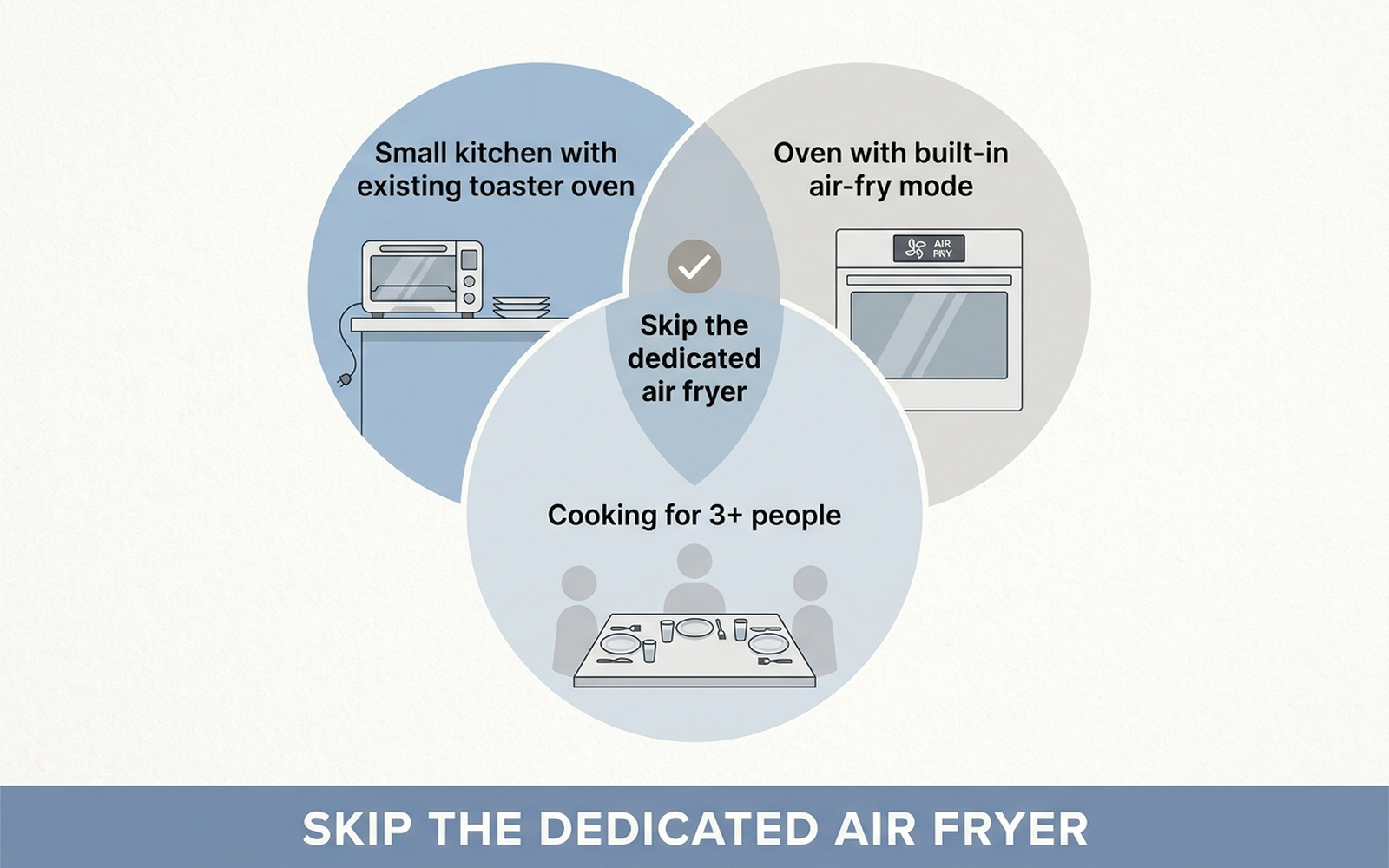
- Three setups where the data favors skipping it: kitchens with limited counter space that already own a toaster oven, ranges or wall ovens with a built-in air-fry mode, and households regularly cooking for three or more people where basket capacity becomes the binding constraint.
How We Reached These Conclusions (Methodology)
This is an editorial analysis, not a hands-on test. We did not personally test the appliances covered here. This guide synthesizes: (a) NPD Group’s small-kitchen-appliance usage survey data on ownership and under-use rates; (b) Consumer Reports’ lab-measured air fryer capacity tests, which compare manufacturer-claimed capacity against actual usable basket volume; (c) manufacturer technical documentation from Frigidaire, Electrolux, and Whirlpool describing how built-in range air-fry modes differ from standard convection; (d) market-penetration and household-ownership statistics from Statista and market.us; (e) Consumer Reports’ and America’s Test Kitchen’s published buying guidance on air fryer capacity and household size; and (f) aggregated amazon.com customer-review sentiment on best-selling compact air fryers and toaster-oven-air-fryer combos, sampled in July 2026. Figures are attributed to their source; where a number is a manufacturer’s own marketing claim rather than an independently measured result, it is labeled as such. Prices are amazon.com figures at the time of writing and fluctuate.
Why So Many Air Fryers End Up Unused
The abandonment pattern is not specific to air fryers — it is a structural feature of the small-appliance category. NPD Group’s household survey found that 57% of US households own at least three under-used small appliances, and only 29% said they actively use more than half of what they own. A separate 2026 survey of 1,000 home cooks found that only 12% of owned kitchen gadgets saw use at least five days a week. Air fryers sit squarely inside this pattern for three overlapping, data-backed reasons:
- They duplicate a function most kitchens already have. A well-functioning convection toaster oven produces comparable results to a dedicated air fryer for the large majority of foods people actually air-fry — frozen snacks, reheated leftovers, vegetables — because both rely on the same forced-hot-air mechanism, per independent kitchen-appliance testing.
- Advertised capacity overstates real capacity. Consumer Reports’ lab measurements found baskets and trays consistently smaller than their marketed quart rating — in one case, a model advertised at 5.9 quarts measured at 3.9 quarts of actual usable space in CR’s tests.
- They take real counter space in kitchens that already have too little. The average cluttered kitchen counter holds 14 to 22 daily items, against a professional-organizer recommendation of four to seven — and a countertop appliance used less than daily is one of the first things space-constrained households report needing to remove.
The Three Setups Where the Data Says Skip It
1. Small kitchens that already own a toaster oven
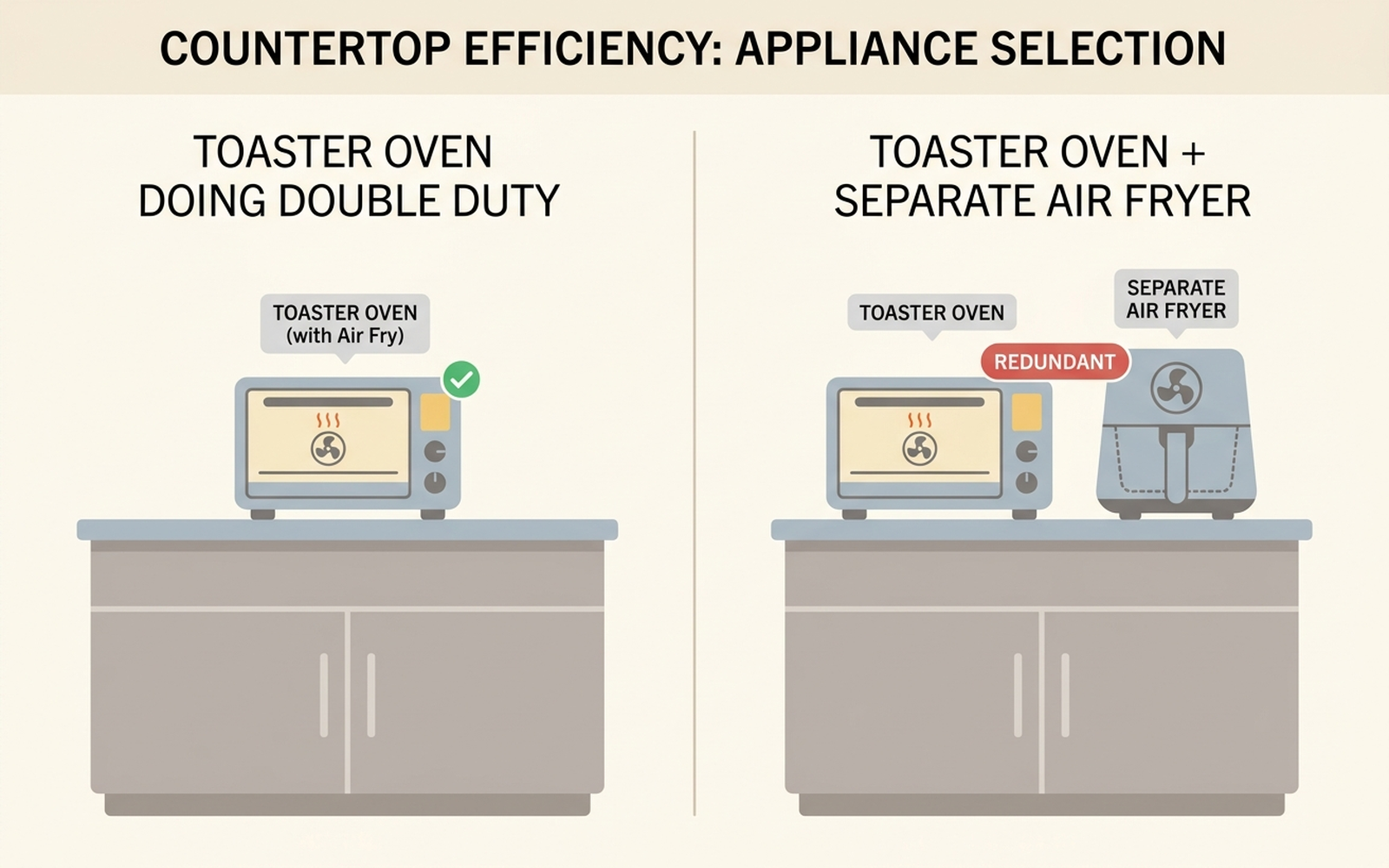
If your kitchen already has a toaster oven and limited counter real estate, a dedicated air fryer is close to pure redundancy. Reviewed (part of USA Today) has tested built-in air-fry oven functions directly against dedicated units and found the crisped result close enough that the deciding factor is usually convenience, not cooking quality. Independent testing consistently notes that an air fryer “takes up about as much space as a toaster oven, if not more,” while doing a narrower range of jobs — a toaster oven also toasts, bakes, and broils, which a basket-style air fryer does not.
For this setup, the higher-value purchase is a toaster oven with an air-fry setting built in, replacing two appliances with one footprint. The Cuisinart TOA-65 Digital AirFryer Toaster Oven (1800W, amazon.com) is one of the most-reviewed models in this combined category; aggregated Amazon sentiment favors its digital preset controls and interior capacity, with the recurring critique being that the exterior footprint is still larger than a basic toaster.
Check the Cuisinart TOA-65 AirFryer Toaster Oven on Amazon
2. Ranges or wall ovens with a built-in air-fry mode
If your range or wall oven already has an air-fry setting, buying a countertop unit on top of it is close to redundant capacity. Frigidaire’s and Electrolux’s own technical documentation describes their air-fry oven mode as running a convection element “more than twice as powerful” as standard convection specifically to produce the fast, concentrated airflow that crisps food — the same mechanism a countertop air fryer uses, just at oven scale. Whirlpool’s comparison guidance reaches the same conclusion: the air-fry setting on a range is a specialized convection mode, not a fundamentally different technology from what a $100 countertop unit does.
The practical gap is capacity, not cooking method: an oven’s air-fry rack holds far more food than any countertop basket, at the cost of a slightly longer preheat. For a household that already owns this range feature, the data does not support adding a second, smaller version of the same tool.
3. Households regularly cooking for three or more people
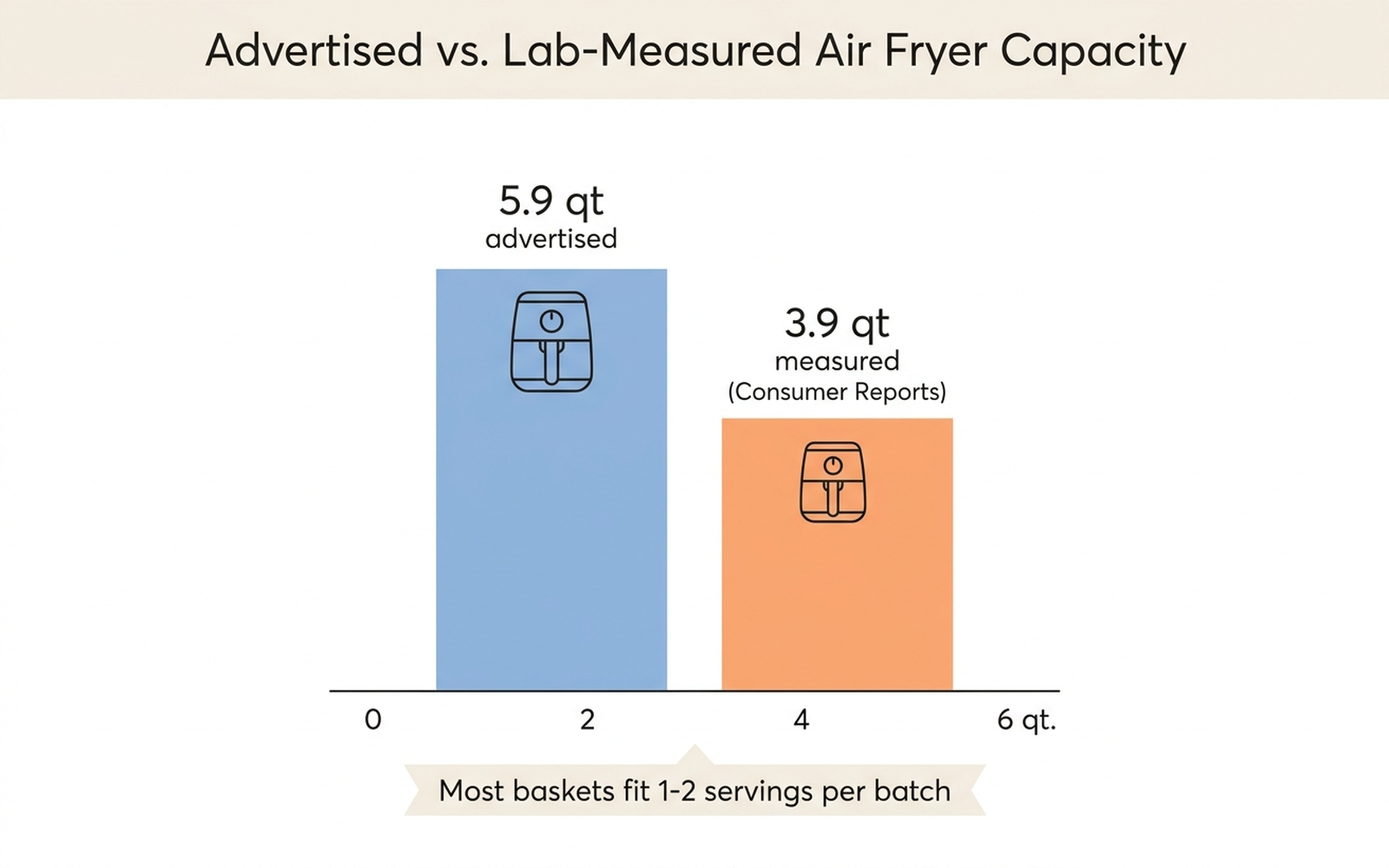
The most consistent complaint in aggregated amazon.com reviews of compact and mid-size air fryers is that the basket cannot fit a family-sized portion in a single batch — reviewers commonly note a basket is “big enough for one, maybe two people” or that “you can barely fit one chicken breast.” Consumer Reports’ lab measurements back up why: baskets and trays test out smaller than their advertised quart rating across multiple models the organization has reviewed. For a household of three or more, that means either buying an oversized (and countertop-dominating) XL model, or accepting multiple cook batches per meal — which erodes the speed advantage that is the appliance’s main selling point.
For this setup, a large sheet pan set used in a full-size oven scales linearly with family size in a way a basket does not. The Nordic Ware Naturals Half Sheet, 2-Pack (amazon.com) is a widely reviewed option sized for full-oven batch cooking, with aggregated sentiment favoring its even browning and warp resistance over the multiple small batches a countertop basket would require for the same meal.
Check the Nordic Ware Naturals Half Sheet 2-Pack on Amazon
When an Air Fryer Still Makes Sense
None of this is a blanket case against the category. The data supports buying one specifically when: you cook mostly for one or two people, your oven lacks a convection or air-fry mode, you have genuine spare counter space, and you value the several-minutes-faster preheat and cleanup over a toaster oven or full oven. That is a real and common household profile — it is simply not every household, which is where the marketing and the usage data diverge.
Comparison Table
Prices are approximate amazon.com figures at the time of writing (July 2026) and fluctuate.
| Your setup | What the data suggests | Alternative product | Typical cost |
|---|---|---|---|
| Small kitchen, own a toaster oven | Skip a dedicated unit | Cuisinart TOA-65 AirFryer Toaster Oven | ~$130–$170 |
| Range/wall oven has air-fry mode | Skip entirely — redundant | None needed | $0 |
| Cooking for 3+ people regularly | Basket capacity is the binding constraint | Nordic Ware Naturals Half Sheet 2-Pack + full oven | ~$25–$35 |
| Cooking for 1–2, no convection oven, spare counter space | Dedicated air fryer still fits | Compact single-basket air fryer | ~$60–$100 |
Limitations
This analysis relies on NPD Group’s household-appliance usage survey, Consumer Reports’ published capacity testing, manufacturer technical documentation, and aggregated amazon.com review sentiment, rather than our own side-by-side test of any specific model. Household ownership and under-use percentages describe surveyed populations at a point in time and vary by survey methodology; an individual household’s actual usage may differ. Basket capacity figures are drawn from Consumer Reports’ specific tested units and may not generalize to every model in a product line. Individual cooking needs vary by recipe, portion size, and how a household weighs speed against counter space.
Bottom Line
Air fryers earned their popularity honestly — for the right kitchen, they are faster and easier to clean than a full oven. But the same survey data that explains their rapid adoption also explains why a documented majority of small-appliance owners have at least a few units gathering dust: the fit is conditional, not universal. If your kitchen already has a toaster oven, a range with an air-fry mode, or a household size that outgrows a basket, the data points toward skipping the dedicated purchase and using what you already have.
Before you buy, paste the product link into Arekore — our AI assistant checks review authenticity, surfaces what the one-star reviews actually complain about, and compares prices, free, in about five minutes.