Standing Desks 2026: 3 Workers Who Don't Need One
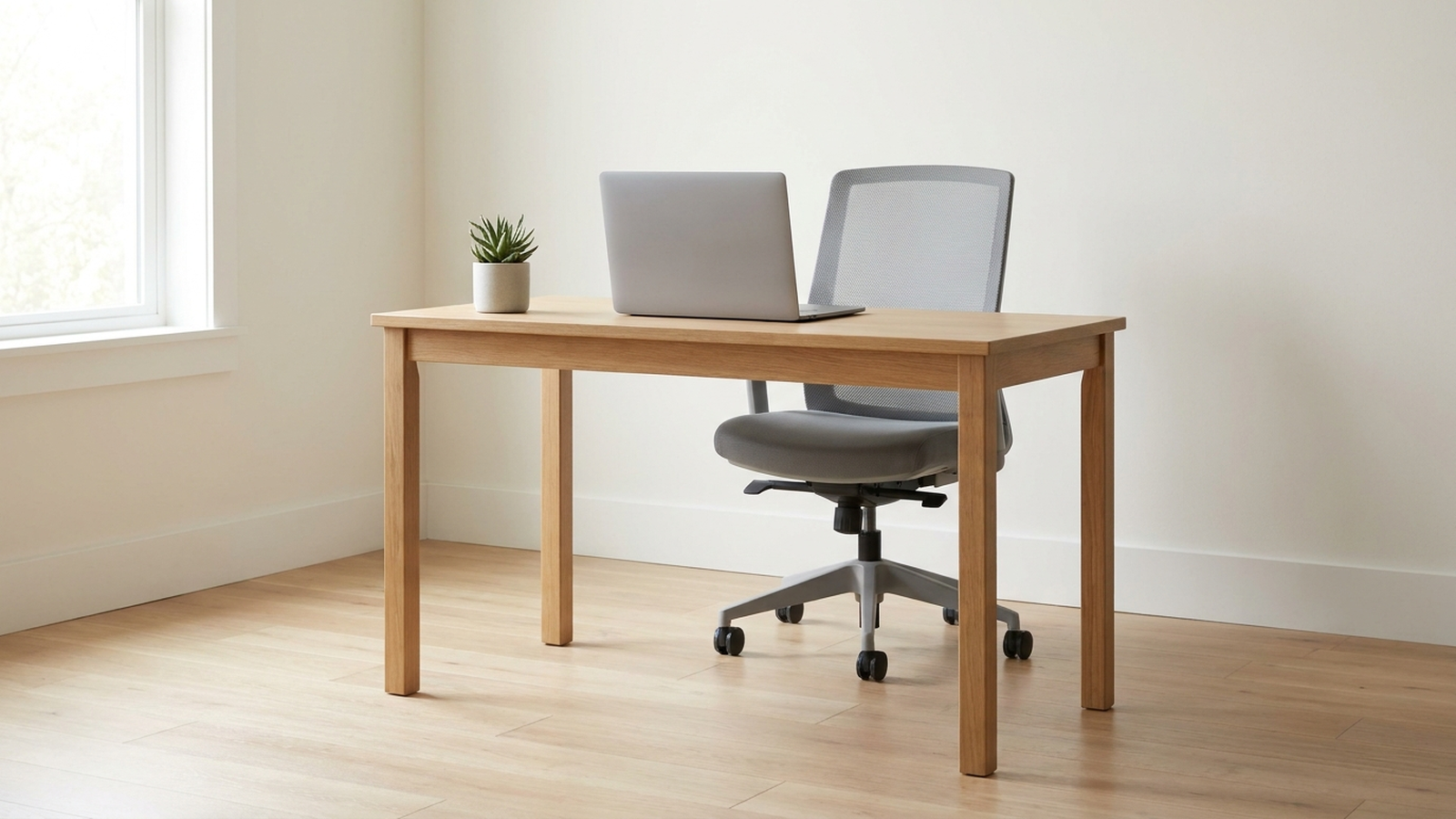
Every home-office guide in 2026 recommends a standing desk, and the market backs that up: the global category is on pace for roughly $9 billion in revenue this year, with North America — overwhelmingly the United States — accounting for more than a third of it. A well-built electric desk from Uplift or FlexiSpot is a genuinely good product; independent testers have praised the category’s stability and build quality for years.
But “a good product” and “a product you specifically need” are different questions, and the research on standing desks answers the second one more narrowly than the marketing suggests. The calorie-burn case is nearly nonexistent, the back-pain case depends heavily on how you alternate between sitting and standing rather than simply owning the hardware, and a meaningful share of buyers — hybrid workers, renters in tight apartments, and people whose bodies don’t tolerate prolonged standing well — get most of the benefit from something that costs a fraction of a $400–$900 electric desk.
As an Amazon Associate, Arekore earns from qualifying purchases. The Amazon product links in this article may include our affiliate tracking ID and may earn us a commission if you buy through them, at no additional cost to you. See our Links Policy for details on how we select products and how commissions do not influence our recommendations.
TL;DR / Quick Verdict
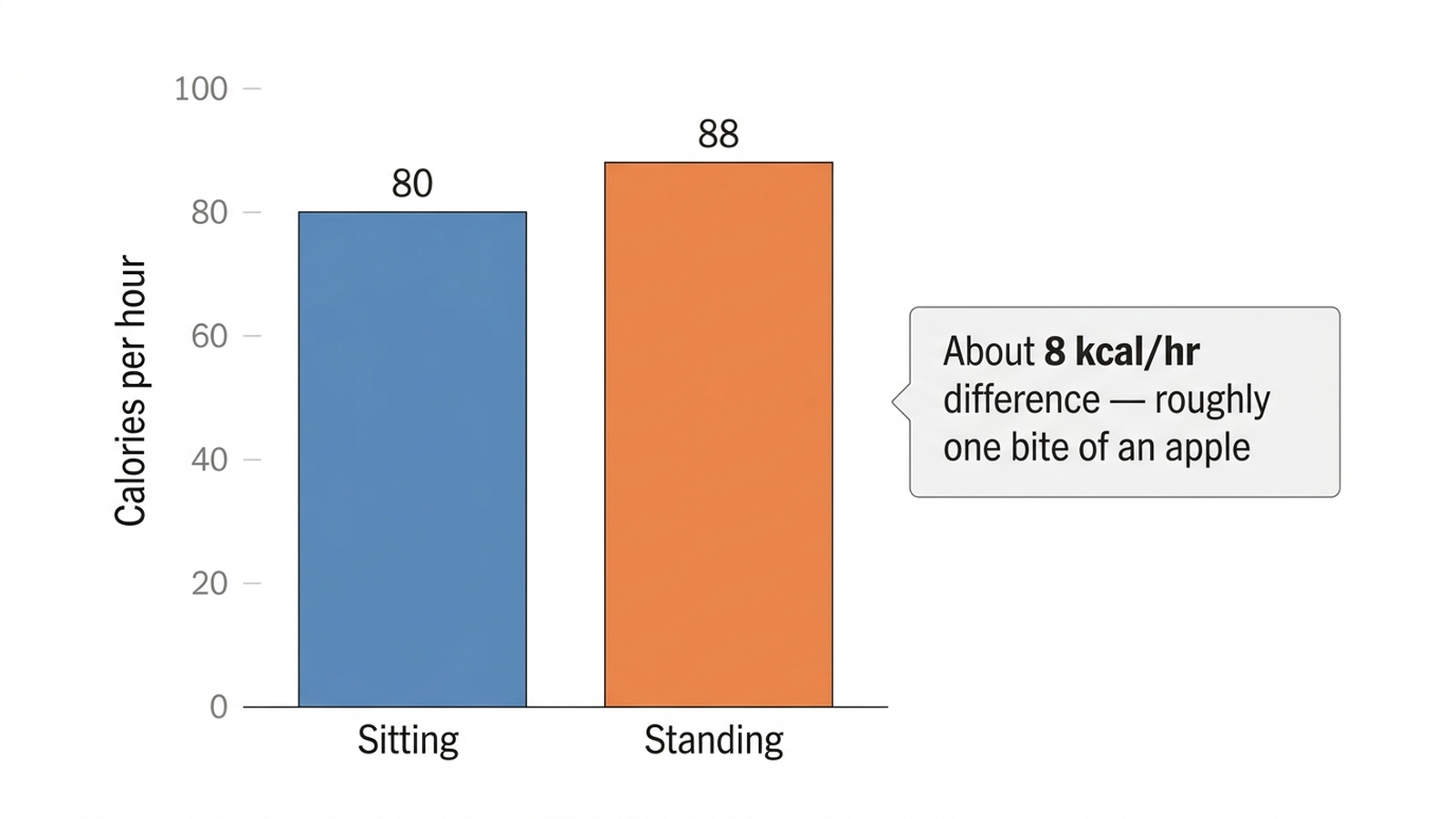
- The calorie-burn case is essentially a myth. Standing burns roughly 8–9 more calories per hour than sitting — about one bite of an apple over a full standing session, not a weight-loss strategy.
- The back-pain case is real but schedule-dependent, not desk-dependent. A 2025 randomized trial found a fixed 30-minutes-sitting-to-15-minutes-standing schedule meaningfully reduced low back pain over three months — the ratio mattered, not simply owning an electric desk. Standing all day instead of sitting all day creates its own pain pattern in a large share of users.
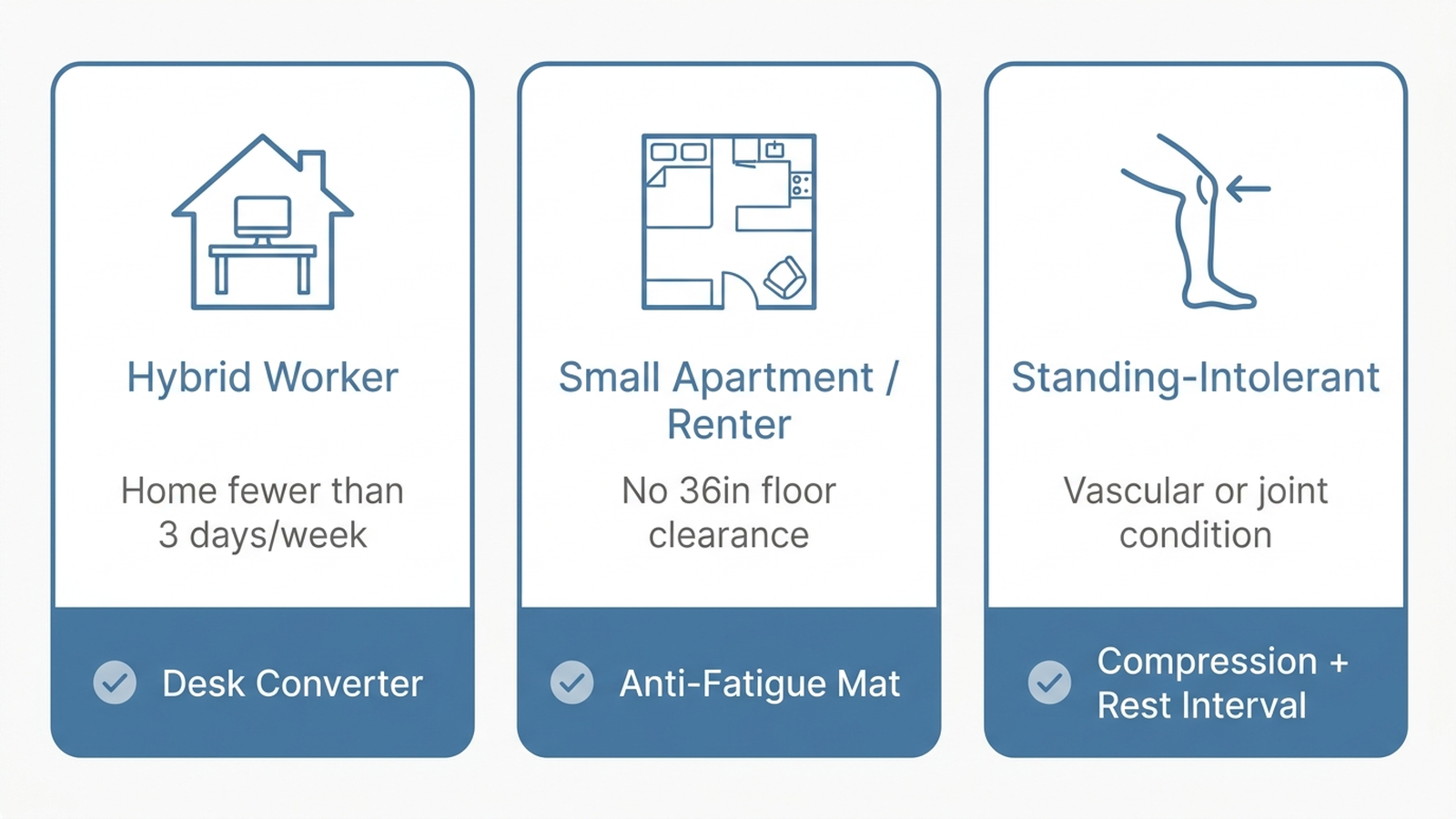
- Hybrid workers who are in the office 3+ days a week rarely recoup the cost of a full electric desk at home. A $180–$230 desktop converter delivers the same sit-stand rotation on the days it’s actually used.
- Renters in small apartments often lack the 36 inches of clearance a sit-stand desk needs at standing height. A fixed desk plus an anti-fatigue mat solves the comfort problem without the footprint problem.
- People whose bodies don’t tolerate prolonged standing well (certain vascular or joint conditions) are working against the same research that undercuts all-day standing in the first place — a rest-forward interval and graduated compression are the evidence-backed fix, not a taller desk.
How We Reached These Conclusions (Methodology)
This is an editorial analysis, not a hands-on test. We did not personally test the products covered here. This guide synthesizes: (a) published calorie-expenditure research on standing versus sitting, including Harvard Health’s summary and Journal of Physical Activity and Health data; (b) a 2025 randomized controlled trial on sit-stand scheduling and low back pain, and a 2025 systematic review and meta-analysis on ergonomic interventions for musculoskeletal pain; (c) Consumer Reports’ published ergonomics guidance and office-chair testing standards; (d) US hybrid-work survey data on in-office day requirements; (e) aggregated amazon.com customer review sentiment for the alternative products named below, sampled in September 2026; and (f) market-size estimates from Grand View Research and GM Insights. Where a figure is a manufacturer’s claim rather than an independently measured result, it is labeled as such. Prices are amazon.com figures at the time of writing and fluctuate.
What the Research Actually Shows
The pitch for a standing desk usually leans on two claims: it helps you burn more calories, and it fixes back pain. Both hold up less well under scrutiny than the marketing implies.
Calorie burn is close to negligible. A Harvard Health analysis puts standing at roughly 88 calories burned per hour against about 80 for sitting — an 8-calorie-per-hour difference. Separate research published in the Journal of Physical Activity and Health found a similar gap, around 8–9 extra calories per hour, translating to roughly 24–27 additional calories across three hours of standing in a day. That is not a meaningful weight-management tool on its own, and no credible testing body markets a standing desk as one anymore.
Back pain is a scheduling problem more than a furniture problem. The American Chiropractic Association recognizes sit-stand workstations as useful for back-pain prevention — but only when used with proper ergonomics and genuine position rotation, not as a replacement for sitting all day with standing all day. That caveat matters: independent reporting on prolonged-standing research finds that roughly 4 in 10 people develop new low back pain from standing for extended periods, meaning a desk used incorrectly can trade one pain pattern for another rather than eliminate it. A 2025 randomized trial found real, measurable improvement — but the intervention was a specific 30-minutes-sitting-to-15-minutes-standing schedule, not simply desk ownership. A separate 2025 systematic review and meta-analysis confirmed ergonomic interventions broadly reduce musculoskeletal pain, but “ergonomic intervention” spans chairs, monitor height, and posture coaching, not standing desks exclusively.
The practical implication: the health case for a $400–$900 electric desk rests on using a specific interval schedule consistently, not on the hardware itself. A cheaper way to hit that same schedule — a desktop converter, a kitchen timer, or a chair with real lumbar support — gets most people most of the benefit the research actually measured.
Three Workers Who Don’t Need One
1. Hybrid workers in the office three or more days a week
US hybrid-work surveys in 2026 show required in-office time climbing toward three days a week on average, with 39% of hybrid workers now going in three days and 34% going in four. For someone home only one or two days a week, a $400–$900 electric desk sits mostly unused — the daily-use case that justifies Uplift’s or FlexiSpot’s dual-motor mechanics and multi-year warranties simply doesn’t apply at that frequency.
A Rocelco 32” Height-Adjustable Standing Desk Converter (ASIN B015GCGOD8) solves the same problem for the days it’s needed: it sits on top of an existing desk, lifts a keyboard tray and monitor platform via gas-spring assist, and typically runs $180–$230 on amazon.com — well under half the price of a comparably equipped electric desk. Aggregated Amazon reviews for the ADR line consistently praise the smooth, one-handed lift and the fact that it requires no permanent desk replacement, which matters for a worker who isn’t home enough to justify a dedicated sit-stand base. The trade-off: converters occupy desk space when lowered and have a lower weight capacity than a full desk, so a triple-monitor daily setup is a poor fit — but for someone using the standing position a couple of days a week, that’s rarely the constraint.
Check the Rocelco 32” Standing Desk Converter on Amazon
2. Renters in small apartments without desk clearance
Fitting a full sit-stand desk into a small apartment runs into a floor-space problem before it runs into a budget problem. Reporting on compact home offices consistently notes that a sit-stand desk needs roughly 36 inches of clearance behind it at standing height, versus 18–24 inches for a normal seated desk — a difference that simply doesn’t exist in many studios and micro-apartments, especially where a desk shares a wall with a closet or window. Renters also have less incentive to invest in furniture sized around today’s specific unit rather than a future move.
For that household, the fix isn’t a shorter standing desk — it’s decoupling the “stand sometimes” goal from the desk entirely. A cushioned surface at a counter, dresser, or bar-height surface the apartment already has, paired with a genuine anti-fatigue mat, delivers the comfort benefit of standing breaks without adding a second piece of furniture. The ComfiLife Anti-Fatigue Mat (ASIN B0797Q5HL7), a 3/4-inch high-density foam mat that typically runs $40–$45 on amazon.com, carries a rating around 4.6 from tens of thousands of aggregated reviews and a lifetime warranty (manufacturer terms). It solves the comfort side of standing at any surface without requiring 36 inches of clearance or a piece of furniture that won’t fit the next apartment.
Check the ComfiLife Anti-Fatigue Mat on Amazon
3. People whose bodies don’t tolerate prolonged standing well
This is the group the underlying research argues against buying a standing desk for most directly. If roughly 4 in 10 people develop new low back pain from extended standing, and the 2025 RCT that actually improved pain outcomes used a 30-minutes-sitting-to-15-minutes-standing ratio rather than long standing blocks, then someone with an existing vascular condition (varicose veins, a history of leg swelling) or a joint condition aggravated by standing is working against the same physiology that limits standing desks for everyone else — just more acutely.
The evidence-backed fix for that profile is a rest-forward interval, not a taller desk: a seated setup with genuine lumbar support, a phone timer or smart-speaker routine reminding you to change position every 30–45 minutes, and — for the leg-swelling and fatigue side specifically — graduated compression. SB SOX Graduated Compression Socks (ASIN B09WM3WJGN, 20-30 mmHg) are the product a peer-reviewed 2023 study in Human Factors measured directly: 40 subjects on 12-hour standing shifts showed a statistically significant reduction in leg fatigue, swelling, and discomfort wearing graduated compression versus regular socks. That is a physiologically measured benefit, at roughly $16–$20 a pair — a fraction of what a standing desk costs, addressing the specific symptom a standing desk would otherwise aggravate.
Check SB SOX Graduated Compression Socks on Amazon
When a Standing Desk Clearly Is Worth It
None of this is an argument that standing desks are overrated across the board. The case is strong for someone who works from a dedicated home office five days a week, has the floor space for a full sit-stand base, and — critically — will actually use the interval schedule the research supports rather than standing all day out of habit. For that buyer, our separate comparison of the Uplift V2, FlexiSpot E7, and VIVO electric desks walks through which model fits which budget and use case.
Comparison Table
Prices are approximate amazon.com figures at the time of writing (September 2026) and fluctuate.
| Your situation | What the data suggests | Alternative | Typical price |
|---|---|---|---|
| Hybrid, in-office 3+ days/week | Converter covers the days it’s needed | Rocelco 32” Converter | ~$180–$230 |
| Small apartment, no 36” clearance | Comfort without the footprint | ComfiLife Anti-Fatigue Mat | ~$40–$45 |
| Standing-intolerant condition | Rest interval + compression, not more standing | SB SOX Compression Socks | ~$16–$20/pair |
| Full-time home office, dedicated space | Electric desk pays off | Uplift V2 / FlexiSpot E7 | ~$450–$900 |
Decision Flowchart
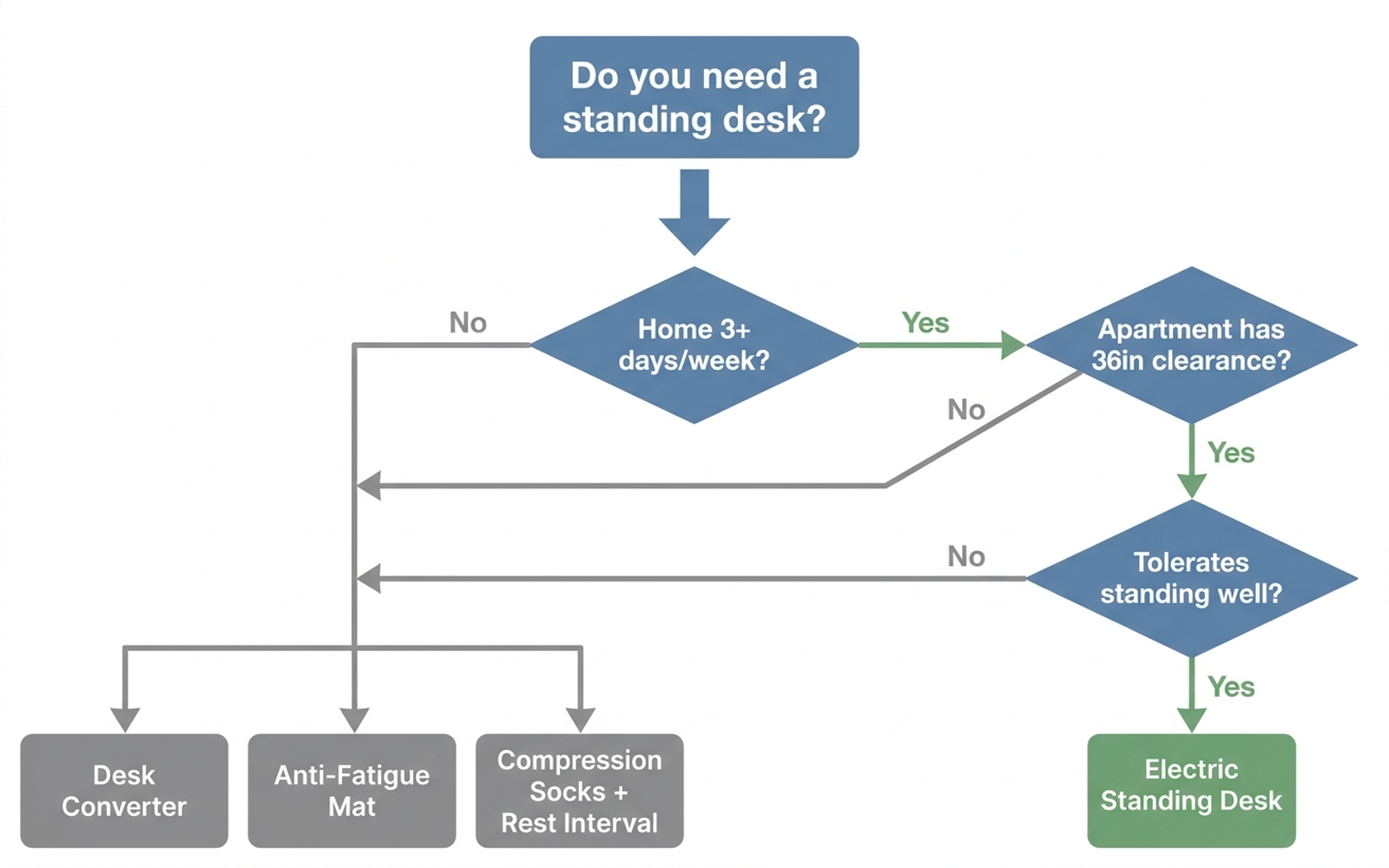
Start with how many days a week you’re actually working from the desk in question. If it’s fewer than three, a converter captures nearly all the benefit for a fraction of the price. If you’re home full-time but your space can’t fit 36 inches of clearance, treat the mat and a bar-height surface as the fix instead of forcing a desk that won’t comfortably fit. If your body has a history of leg swelling or pain from standing, address that directly with a rest interval and compression before adding a piece of furniture that encourages more standing, not less. Only when none of those apply — full-time home office, adequate floor space, and a body that tolerates standing well — does the case for an electric sit-stand desk clearly outweigh the cheaper alternatives.
Limitations
This analysis relies on published calorie-expenditure research, a single 2025 randomized controlled trial on sit-stand scheduling, a 2025 systematic review on ergonomic interventions broadly (not standing desks specifically), Consumer Reports’ published ergonomics guidance, US hybrid-work survey data, a 2023 peer-reviewed compression-sock study, and aggregated amazon.com review sentiment, rather than our own controlled testing of any product named here. Individual results for back pain, leg fatigue, and standing tolerance vary significantly by underlying health condition, and none of this is medical advice — anyone with a diagnosed vascular or musculoskeletal condition should consult a physician about standing tolerance rather than relying on general research summaries. Prices fluctuate on amazon.com and should be verified on the current product page before buying.
Bottom Line
A standing desk is a good product for the buyer it’s actually built for: someone working from a dedicated home office most days, with the floor space to fit one, who will use a real sit-stand interval rather than just standing out of habit. That is a narrower group than the marketing implies. Hybrid workers who are rarely home, renters without the clearance a sit-stand base needs, and people whose bodies don’t tolerate prolonged standing well all get most of the researched benefit — schedule variety, comfort, reduced leg fatigue — from a converter, a mat, or compression socks costing a fraction of the price.
Before you spend $400–$900 on any desk, it’s worth checking whether the listing’s reviews are genuine and the price is actually competitive. That’s what Arekore is built for: paste the Amazon URL and our AI shopping assistant checks review authenticity, surfaces what the one- and two-star reviews really complain about, and compares pricing across retailers in about five minutes — so the desk (or the alternative) you buy fits how you actually work, not the algorithm’s top pick.