Smart Locks 2026: 3 Renters Who Shouldn't Bother
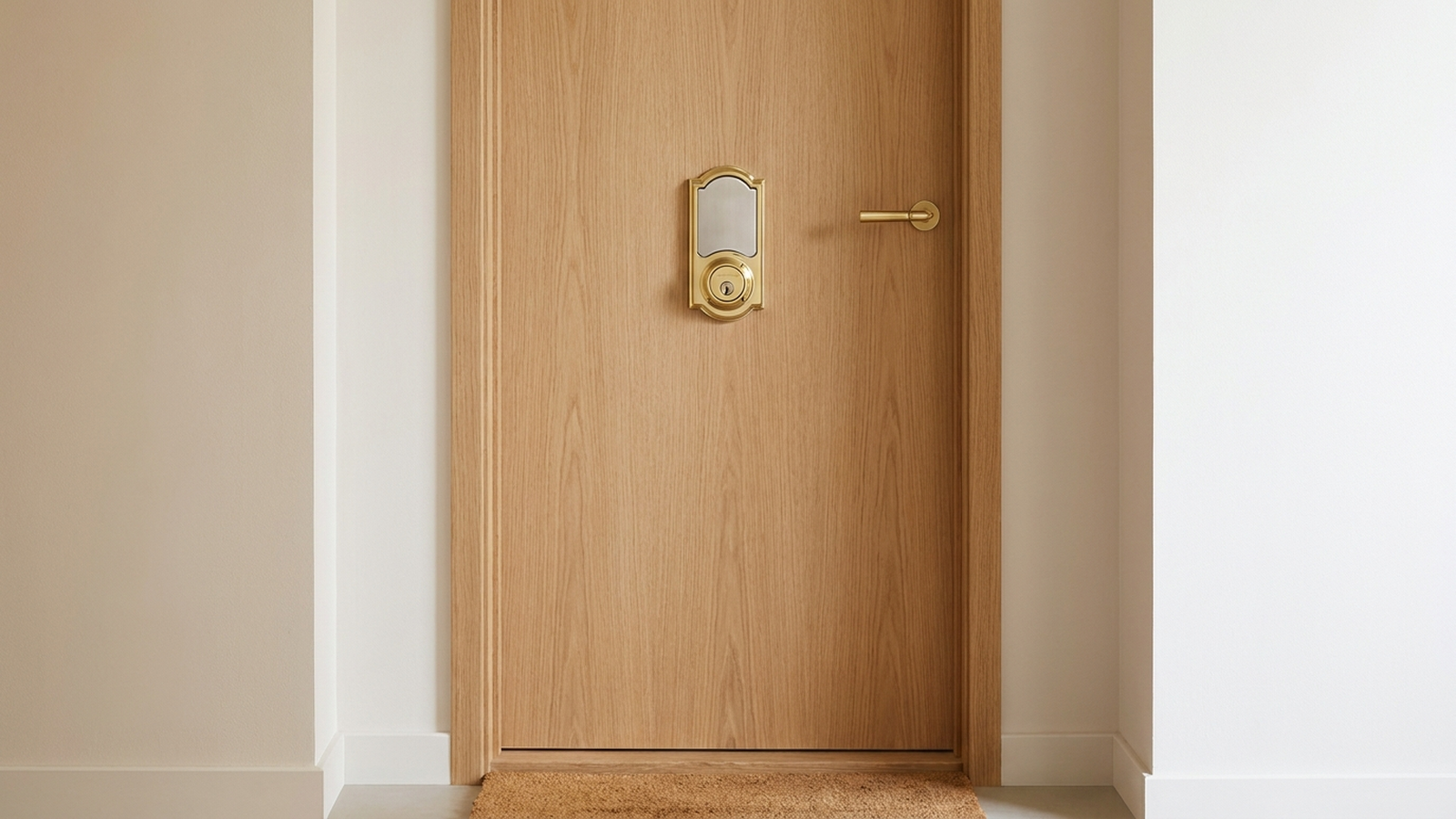
The US smart lock market is on track for roughly $1.6 billion in sales in 2026, part of a global category growing from about $4.0 billion in 2026 to a projected $14.3 billion by 2033, according to Fortune Business Insights and Grand View Research market reports. But renters make up close to 35% of US households, per Census-derived rental-market data, and a closer look at lease-restoration rules, independent lab testing, and manufacturer battery specs shows three renter setups where a smart lock purchase doesn’t deliver what the marketing promises — not because the hardware is fake, but because the actual failure points and cost structure don’t match a rental’s constraints.
This isn’t an argument that smart locks are bad. It’s an argument that the fit depends on what your lease actually lets you install, what part of your door is really the weak point, and how much battery and connectivity maintenance you’re willing to take on for a home you don’t own — and the data on all three is more specific than “every renter should feel safer with an app-controlled deadbolt.”
As an Amazon Associate, Arekore earns from qualifying purchases. The Amazon product links in this article may include our affiliate tracking ID and may earn us a commission if you buy through them, at no additional cost to you. See our Links Policy for details on how we select products and how commissions do not influence our recommendations.
TL;DR / Quick Verdict
- A smart lock usually doesn’t fix a rental’s actual weak point. Consumer Reports’ 2026 lab testing — a 100-pound battering ram, lock-picking, and a cordless-drill attack — found that several well-reviewed smart locks, including the Level Lock+ Connect, Aqara Smart Lock U100, and Lockly Secure Pro, still failed forced-entry tests, and traced the failure mostly to short screws holding the strike plate to the door frame, not the lock cylinder itself. A ~$10–$15 reinforced-screw kit fixes that; a $130–$260 smart lock doesn’t.
- Renters locked into no-permanent-alteration leases only qualify for retrofit-only models, and the value they add on top of a key is thin. Retrofit locks like the Level Bolt install inside your existing deadbolt without changing your keys or the door’s exterior look — the one genuinely lease-safe option — but they leave the physical key working as backup and add roughly $130 of Bluetooth convenience on top of a lock whose actual security hasn’t changed.
- Wi-Fi remote access costs roughly two-thirds of your battery life. Yale’s own published spec for the Assure Lock 2 shows about 3 months of battery life on the Wi-Fi model versus about 9 months on the Bluetooth-only version — a meaningful lockout risk for a renter who, unlike a managed condo resident, usually has no on-call super to let them back in at midnight.
- Three renter setups where the data favors skipping it: renters whose real vulnerability is a weak strike plate, renters restricted to feature-limited retrofit locks by a strict lease, and renters who want remote Wi-Fi access but can’t absorb the battery/lockout tradeoff it requires.
How We Reached These Conclusions (Methodology)
This is an editorial analysis, not a hands-on test. We did not personally test the products covered here. This guide synthesizes: (a) Consumer Reports’ 2026 door-lock lab testing program, which subjects models to a 100-pound battering ram, lock-picking attempts, and cordless-drill attacks before scoring smart features; (b) manufacturer-published specifications from Yale, Level, and Kwikset covering battery life, connectivity type, and pricing as of September 2026; (c) US and global smart-lock market-size figures from Fortune Business Insights and Grand View Research, and renter-household share figures aggregated from Census data by rental-market research sites (ipropertymanagement.com, The Zebra); (d) renter-focused lease and security-deposit guidance from multiple lock-industry buying guides covering reinstallation and landlord-approval norms; and (e) Amazon customer review sentiment on battery life and Wi-Fi reliability for specific retrofit and Wi-Fi models. Prices are amazon.com and manufacturer-published figures at the time of writing (September 2026) and change frequently.
Why Smart Lock Adoption Doesn’t Mean Universal Fit for Renters
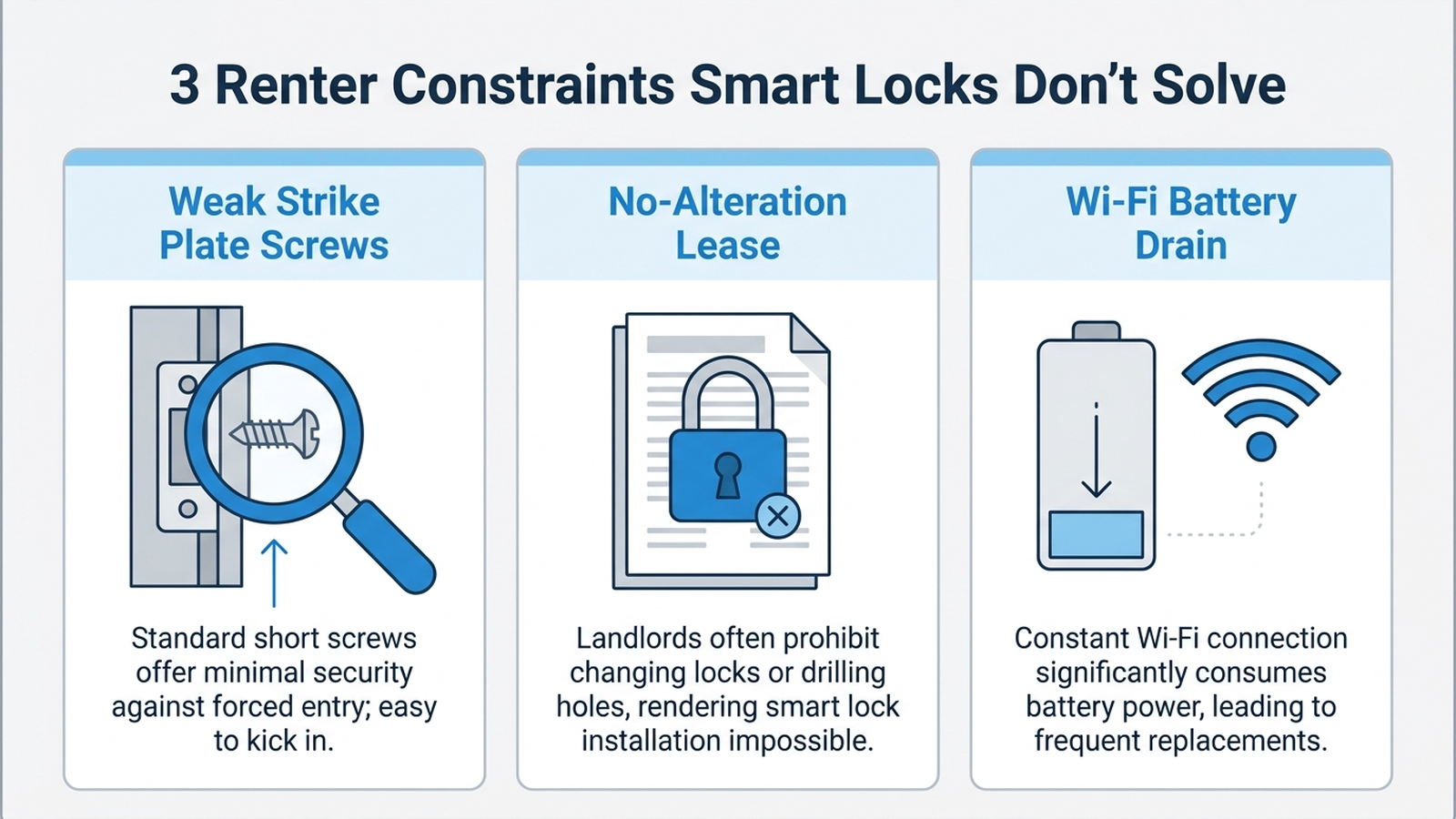
Smart locks are marketed as a single upgrade that makes any door more secure and more convenient at the same time. The lab-test, lease-policy, and battery data behind that pitch shows four separate constraints that hit renters harder than owners:
- The lock is often not the weak point — the door frame is. Consumer Reports’ 2026 testing found that several premium smart locks with strong retail reviews still failed cordless-drill and forced-entry tests, and the recurring root cause was short screws attaching the strike plate to the frame rather than a flaw in the lock cylinder itself — a problem a ~$10 longer-screw kit fixes regardless of which lock is installed.
- Lease-restoration rules push renters toward the least feature-rich category. Renter-focused buying guides consistently note that most smart locks replace the entire deadbolt assembly, requiring the tenant to save every original screw, strike plate, and key to reinstall at move-out — and a missing part at that point is described as “an easy deposit deduction.” Renters under a strict no-alteration clause are pushed toward retrofit-only models that skip this problem, but that category comes with real feature tradeoffs.
- The retrofit category’s value proposition is thin once you already have a working key. Retrofit models like the Level Bolt keep the original keyway intact and add Bluetooth auto-lock/unlock on top of it — but that means the core security function hasn’t changed at all, only the convenience layer has, for roughly $130. Reviews of the category are generally positive on setup and lease-compliance; the friction point buyers raise is less “does it work” and more “is $130 of Bluetooth convenience worth it when the key still has to work as backup anyway.”
- Wi-Fi connectivity — the feature renters want most for remote access — is also the biggest battery drain. Yale’s own spec sheet for the Assure Lock 2 shows roughly 3 months of battery life on Wi-Fi versus about 9 months on Bluetooth-only, and Amazon review sentiment on Wi-Fi models like the Kwikset Halo repeatedly cites weak signal strength and locks going “offline” in the companion app.
The Three Renters Where the Data Says Skip It
1. Renters whose real vulnerability is the strike plate, not the lock
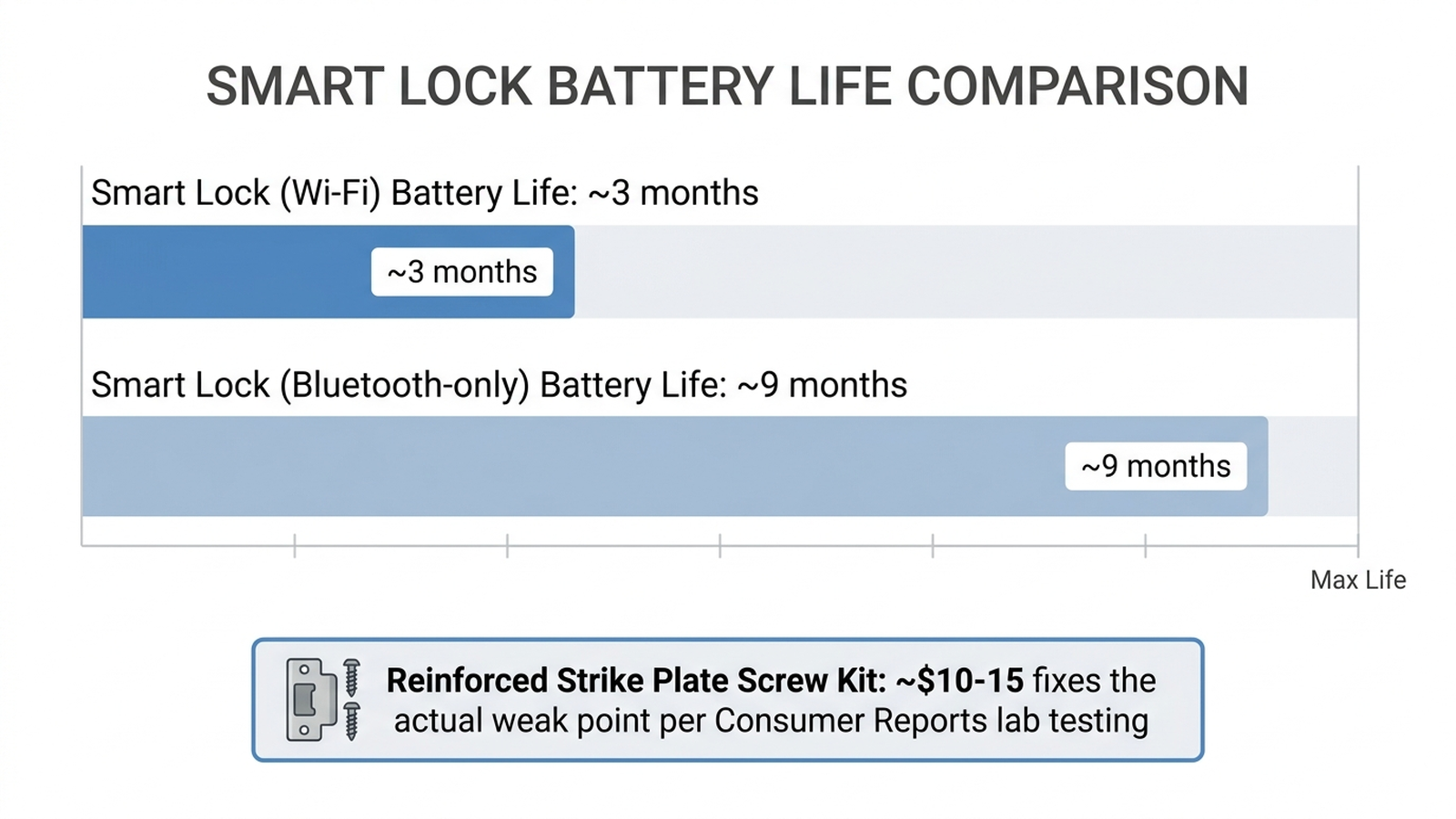
Consumer Reports’ 2026 lab program runs each lock through a 100-pound battering ram, lock-picking attempts, and a cordless-drill attack before it ever scores the smart features. Several models that carry strong retail ratings — the Level Lock+ Connect, Aqara Smart Lock U100, and Lockly Secure Pro among them — still failed those physical tests, and Consumer Reports traced the cause largely to the short screws most builders use to attach a strike plate to the door frame, not a defect in the lock mechanism itself.
For a renter whose door has that common builder-grade strike plate, spending $130–$260 on a smart lock doesn’t touch the actual weak point CR identified. The fix that does is a reinforced strike-plate screw kit with 3-inch screws that bite into the framing stud behind the jamb — a change so minor it rarely needs more than a quick heads-up to a landlord, and one that’s fully reversible with the original short screws kept in a labeled bag for move-out. The Reinforced Door Screw Kit for Strike Plates, Deadbolt Plates, and Hinges (ASIN B0F89QLT6J) is a widely available option built specifically for this fix.
Check the Reinforced Door Screw Kit on Amazon
2. Renters restricted to feature-limited retrofit locks by a strict lease
Retrofit smart locks like the Level Bolt install inside the existing deadbolt, keep the original exterior keyway intact, and remove cleanly at move-out — which is exactly why lock-industry buying guides recommend the category specifically for renters under leases that prohibit any visible hardware change. That lease-compliance is real and valuable. But it also means the lock keeps the original key as the actual backup: the security function hasn’t changed, only the convenience layer has, for roughly $130.
For a renter in this exact situation — strict lease, short remaining term, mainly wants convenience rather than a security upgrade — the practical math often doesn’t favor that ~$130 purchase for a 12-month or shorter lease. Keeping the existing key and adding a portable, no-installation device for extra peace of mind while home covers the same underlying want at a fraction of the cost. The Addalock Original Portable Door Lock (ASIN B00186URTY) is a widely reviewed option that requires no batteries, no app, and no landlord notification at all.
Check the Addalock Portable Door Lock on Amazon
3. Renters who want Wi-Fi remote access but can’t absorb the lockout tradeoff
Remote access — checking or unlocking the door from a phone away from home — is the single feature that separates a Wi-Fi smart lock from a cheaper Bluetooth-only one, and it’s also the feature that drains the battery fastest. Yale’s own published spec for the Assure Lock 2 shows about 3 months of battery life on the Wi-Fi model versus about 9 months on the Bluetooth-only version — a three-fold difference tied directly to keeping a Wi-Fi radio active. Amazon review sentiment on Wi-Fi-connected models such as the Kwikset Halo repeatedly describes weak signal strength and the lock dropping “offline” in the companion app, which strands the remote-access feature exactly when a renter would want to use it.
A dead battery or dropped Wi-Fi connection is an inconvenience for a homeowner who can call a locksmith on their own schedule. For a renter, it’s often a genuine lockout, since most rentals don’t come with a superintendent or 24-hour maintenance line the way a full-service condo building might. For this renter, the Wi-Fi tier isn’t worth the battery tradeoff: a Bluetooth-only keypad deadbolt delivers keyless entry via a code or phone at roughly three times the battery life, and skipping the Wi-Fi radio removes the specific failure mode that causes the lockout in the first place.
When a Smart Lock Still Makes Sense for a Renter
None of this is a blanket case against smart locks in rentals. The data supports buying a full-featured, Wi-Fi-connected model specifically when: your landlord has explicitly approved a full deadbolt replacement (some buildings even install them as an amenity), you’re subletting or hosting short-term guests and need a usage log or remote code changes between stays, or you’ve already fixed the strike-plate weak point and are adding smart features on top of a physically sound door. That’s a real and common renter profile — it just isn’t every renter with a one-year lease.
Comparison Table
Prices are approximate amazon.com figures at the time of writing (September 2026) and fluctuate.
| Your setup | What the data suggests | Alternative product | Typical cost |
|---|---|---|---|
| Weak strike plate is the actual vulnerability (CR lab-test finding) | Fix the frame, not the lock | Reinforced Door Screw Kit (3-inch screws) | ~$10–$15 |
| Strict no-alteration lease, short remaining term | Skip the low-value-add retrofit lock, add portable security instead | Addalock Portable Door Lock | ~$18–$25 |
| Wants remote access but can’t absorb battery/lockout risk | Bluetooth-only keypad deadbolt over Wi-Fi model | Bluetooth smart deadbolt (~9 mo. battery) | ~$130–$180 |
| Landlord-approved full replacement, or subletting/hosting with usage-log needs | Wi-Fi smart lock still fits | Wi-Fi smart deadbolt | ~$180–$260 + batteries every ~3 mo. |
Decision Flowchart
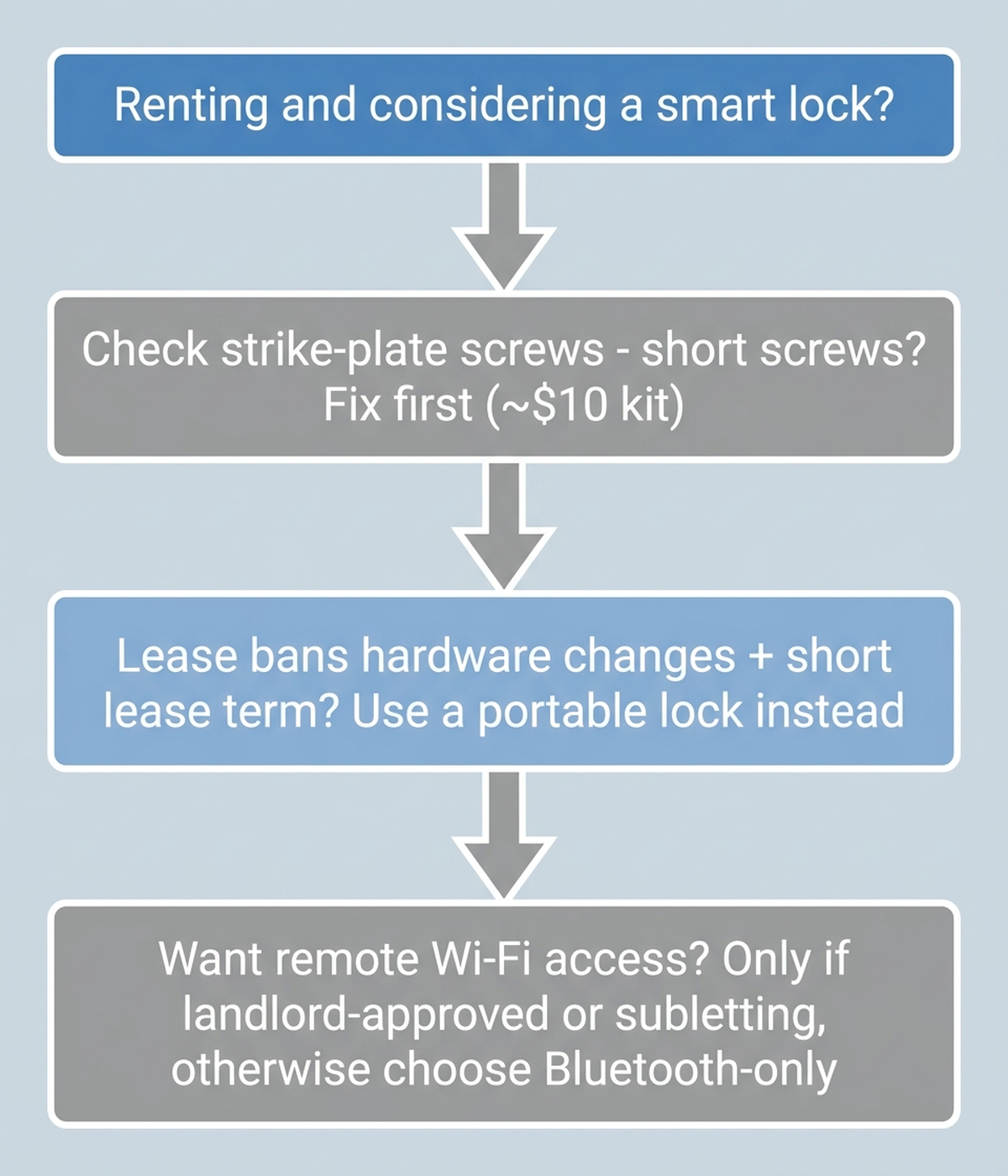
Start with your door frame: if you haven’t checked your strike-plate screws, fix those first — Consumer Reports’ data says that’s the more common failure point regardless of which lock you install. If your lease bars any hardware change and your term is short, skip the retrofit category’s thin convenience-per-dollar and use a portable lock instead. If you do want a smart deadbolt, choose Bluetooth-only unless you specifically need remote access from outside the home, since Wi-Fi cuts battery life roughly to a third. Only when a landlord has approved a full replacement, or you’re subletting and need remote usage logs, does the full Wi-Fi tier deliver on its promise for a renter.
Limitations
This analysis relies on Consumer Reports’ 2026 published lab-test results, manufacturer-published specification sheets, aggregated Amazon review sentiment, and rental-market and lease-policy guidance from multiple industry buying guides, rather than our own side-by-side test of any specific lock model. Lab-test failures cited here (Level Lock+ Connect, Aqara Smart Lock U100, Lockly Secure Pro) describe specific tested units and may not represent every unit of that model reaching every buyer. Battery-life figures are manufacturer specifications under stated conditions; real-world battery life varies with usage frequency, temperature, and door alignment. Lease and security-deposit rules vary by state, city, and individual landlord, so renters should confirm their own lease terms rather than relying on the general guidance summarized here. Individual results vary based on door condition, building Wi-Fi strength, and how closely a renter’s situation matches the scenarios described.
Bottom Line
Smart locks earned their market growth honestly — for the right door and the right lease, they solve a real convenience and access-control problem. But the same lab-test, lease-restoration, and battery data that explains the category’s rise also explains why it’s the wrong purchase for a specific set of renters: those whose actual weak point is a builder-grade strike plate, those whose strict lease only qualifies them for a retrofit lock that adds little beyond a working key, and those who want remote access without the battery tradeoff it demands. If any of those describe your rental, the data points toward a reinforced strike plate, a portable lock, or a Bluetooth-only deadbolt — not the full Wi-Fi smart lock.
Before you buy, paste the product link into Arekore — our AI assistant checks review authenticity, surfaces what the one-star reviews actually complain about, and compares prices, free, in about five minutes.