Robot Lawn Mowers 2026: 3 Yards That Don't Need One
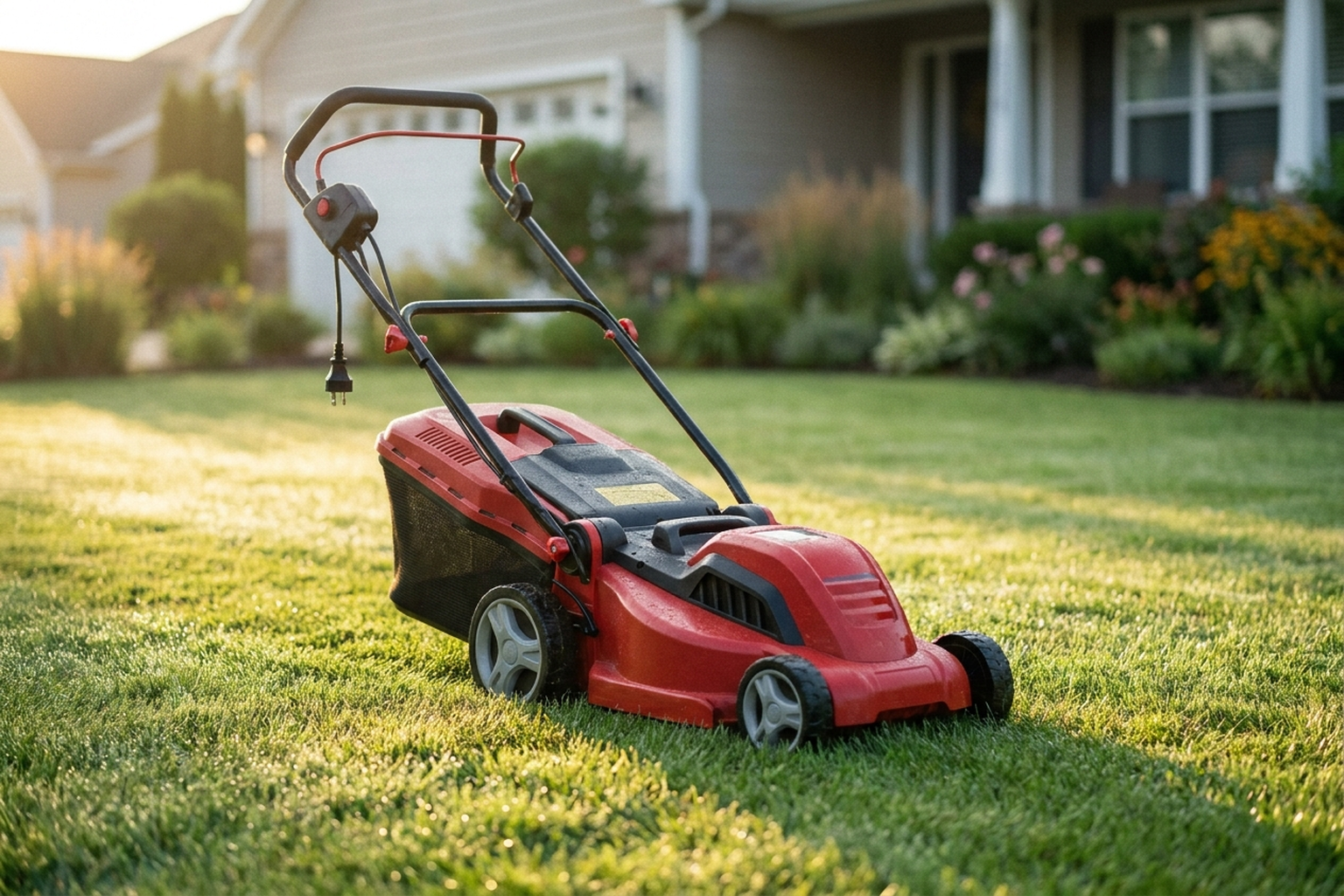
Robot lawn mower reviews tend to follow the same script: slope rating, navigation tech, app polish, then a recommendation to buy. What that script usually skips is the much more basic question of whether a given yard needs one at all. Independent buying guides increasingly answer that question directly, and the data on US lawn sizes, mowing frequency, and ownership cost backs them up — a meaningful share of households would spend $700 to $3,000-plus solving a problem a $150 push mower already solves in ten minutes.
This isn’t an argument that robot mowers are a bad category. Reviewers at Wirecutter and elsewhere rate the better models highly for cut quality and genuinely eliminate a weekly chore for the right yard. It’s an argument that “the right yard” is a narrower group than the always-buy-the-robot framing implies — and that three common yard and household profiles get little to no practical benefit from the premium.
As an Amazon Associate, Arekore earns from qualifying purchases. The Amazon product links in this article may include our affiliate tracking ID and may earn us a commission if you buy through them, at no additional cost to you. See our Links Policy for details on how we select products and how commissions do not influence our recommendations.
TL;DR / Quick Verdict
- A meaningful share of US lawns are small enough that a robot mower solves a chore that barely exists. A 2026 measurement study of over 1,000 US lawns puts the median mowable lawn at roughly 8,600 sq ft, with the smallest quarter of surveyed lawns under about 5,000 sq ft — squarely inside Tom’s Guide’s “if it takes 5-10 minutes to mow, you probably don’t need a robot” territory.
- Obstacle-heavy, multi-zone, or gravel-adjacent yards fight the technology instead of benefiting from it. Tom’s Guide’s own “signs your yard isn’t suitable for a robot mower” guide lists narrow gated passages, disconnected zones, gravel paths, and lumpy or pet-damaged ground as recurring failure points.
- Payback period rarely favors the robot if you already own a mower. Trade coverage estimates five years or longer to recoup a robot mower’s price against DIY push-mowing, before assigning any dollar value to the time saved.
- A large share of non-owners aren’t holding out for a better model — they’ve already decided against one. A 2025 survey of US lawn owners found only about 13% own a robot mower, and of non-owners, roughly half cite price and over 40% simply don’t want one.
- The exception that still justifies a robot mower: a flat, boundary-clear yard of a quarter acre or more, mowed weekly, where the owner values the time back more than the up-front cost.
How We Reached These Conclusions (Methodology)
This is an editorial analysis, not a hands-on test. We did not personally test the products covered here. This guide synthesizes: (a) independent buying-guide coverage from Tom’s Guide, including its dedicated “signs your yard isn’t suitable for a robot mower” and “reasons to buy vs. reasons to skip” pieces; (b) a 2026 third-party lawn-measurement study of over 1,000 traced US lawns (measurelawn.com), which puts the median traced lawn at roughly 8,600 sq ft and the smallest quarter of lawns under about 5,000 sq ft; (c) NAHB-reported Census data on new single-family home lot sizes, which put the 2025 median new-construction lot at roughly 8,500 sq ft (new-construction lots only, not a figure for all existing US homes); (d) a 2025 Lawn Love survey of 1,072 US adults (708 lawn-owning respondents) on robot mower ownership and purchase intent; (e) manufacturer specifications and current amazon.com listings for the comparison products named below; and (f) general robotic-mower navigation and leaf-litter-handling consensus published by manufacturers and reviewers. Where a figure is a manufacturer’s own claim rather than an independently measured result, it is labeled as such. Prices are amazon.com figures at the time of writing and fluctuate.
What a Robot Mower Actually Buys You — and Where That Stops Mattering
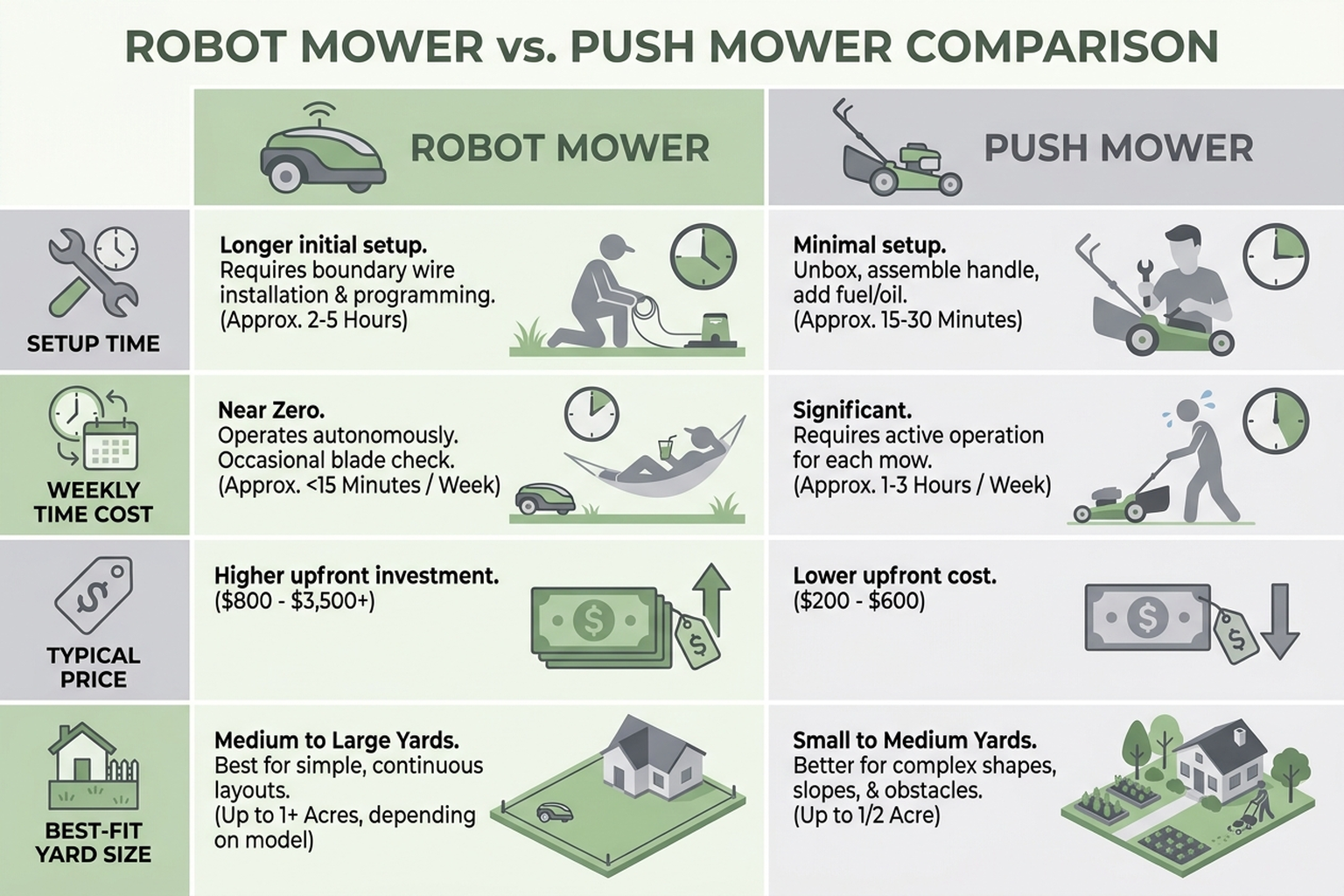
The honest case for a robot mower is time, not cut quality. Once a yard is mapped — either by burying boundary wire or walking a perimeter in an app — the mower runs on its own schedule, and the owner stops spending a weekly 30-to-60-minute block pushing a mower around the yard. For a quarter-acre-plus lawn mowed every week for eight-plus months a year, that adds up to real hours back over a season, which is the argument reviewers who recommend the category are actually making.
What that argument assumes is a weekly mowing chore large enough to be worth automating in the first place. Tom’s Guide’s “5 reasons to buy and 5 reasons to skip” piece states the skip case plainly: if a yard “can be mowed without breaking into a sweat,” a manual or electric push mower costs a fraction of a robot mower’s price for functionally the same outcome. A sub-5,000-square-foot lawn — the smallest quarter of lawns in measurelawn.com’s 2026 study — takes most owners well under fifteen minutes with a push mower. Automating a fifteen-minute task doesn’t eliminate a meaningful chore; it buys convenience at the price of a boundary-mapping setup, a charging dock, winterizing routine, and a four-figure price tag.
Three Yards Where a Push Mower Is Genuinely Enough
1. Small lawns under roughly 5,000 square feet
Measurelawn.com’s 2026 study of over 1,000 traced US lawns puts the smallest quarter of surveyed lawns under about 5,000 sq ft, and NAHB-reported Census data on new-construction lots shows a similar pattern at the lot level — a 2025 median new single-family lot of roughly 8,500 sq ft, well short of the quarter acre (~10,890 sq ft) often treated as the robot-mower baseline, and with an even smaller mowable lawn area once house, driveway, and beds are subtracted. For a lawn in this range, a Greenworks 10 Amp 17-Inch Corded Electric Lawn Mower (ASIN B01MZACPNB), typically listed around $140–$150 on amazon.com, covers the job in one pass without a battery to charge, a boundary to map, or a dock to install. The tradeoff — a power cord limiting range — is a non-issue on a lawn this size, and the total cost sits at roughly a fifth of even the cheapest wire-based robot mower.
Check the Greenworks 17-Inch Corded Electric Mower on Amazon
For an even smaller lot, or an owner who wants a zero-maintenance, zero-emissions option, the Scotts 716-18S 18-Inch 7-Blade Push Reel Mower (ASIN B084MNP9Y3, roughly $140–$160) needs no power source at all — just a weekly ten-minute push, which is the entire chore a robot mower would otherwise be bought to eliminate.
Check the Scotts 18-Inch Push Reel Mower on Amazon
2. Obstacle-heavy, multi-zone, or gravel-adjacent yards
Robot mowers solve a geometry problem — staying inside a mapped boundary — and that problem gets harder, not easier, as a yard gets more irregular. Tom’s Guide’s “signs your yard isn’t suitable for a robot mower” piece names several recurring failure patterns directly: narrow gated side-yard passages that require manually carrying the mower between zones or paying for a satellite relay station, gravel paths that can stop the mower or fling stones into the blades, and lumpy or pet-damaged ground that produces patchy cuts or a stuck mower. None of these are hypothetical edge cases — side yards with gates, gravel driveways bordering lawn, and dog-owning households are all common, not rare.
A Greenworks 40V 14-Inch Brushless Cordless Push Mower (ASIN B0DDV1XKLG, with a 4.0Ah battery and charger), typically listed in the $250–$280 range, handles irregular layouts the way a human already does — by walking through a gate, lifting over a step, or avoiding a gravel patch — without needing a satellite relay station or a re-mapped boundary every time the yard’s obstacles shift.
Check the Greenworks 40V Cordless Push Mower on Amazon
3. Renters and owners who already have a working mower
A 2025 Lawn Love survey of US lawn owners found only about 13% currently own a robot mower; among non-owners, roughly half cite price as the reason and over 40% simply don’t want one — not “haven’t gotten around to it yet,” but an active preference against the category. That tracks with the payback math: trade coverage estimates it can take five years or longer to recoup a robot mower’s purchase price against continuing to push-mow, before assigning any value to the time saved, and that calculation gets worse, not better, for a renter who may move before the payback period completes, or for anyone who already owns a paid-off mower and would be replacing working equipment rather than buying new. For this group, the practical answer is to keep the mower already in the garage, or, if it needs replacing anyway, buy another low-cost push mower rather than a robot.
When a Robot Mower Actually Earns Its Price
None of this is a case against the category broadly. The data supports a robot mower like the Worx Landroid S (ASIN B097NGYWST, typically $550–$650 on amazon.com) for a flat-to-moderately-sloped yard of a quarter acre or more, with a continuous boundary free of gravel paths and narrow gated passages, mowed weekly through most of the growing season, owned by someone who specifically values getting that weekly 30-to-60-minute block back and plans to stay in the home long enough for the time savings to offset the price. That’s a real and common profile among larger-lot suburban homeowners — it just describes a smaller share of US lawns than “just buy the robot” coverage tends to assume, per measurelawn.com’s median lawn-size data.
Check the Worx Landroid S (WR165) on Amazon
Comparison Table
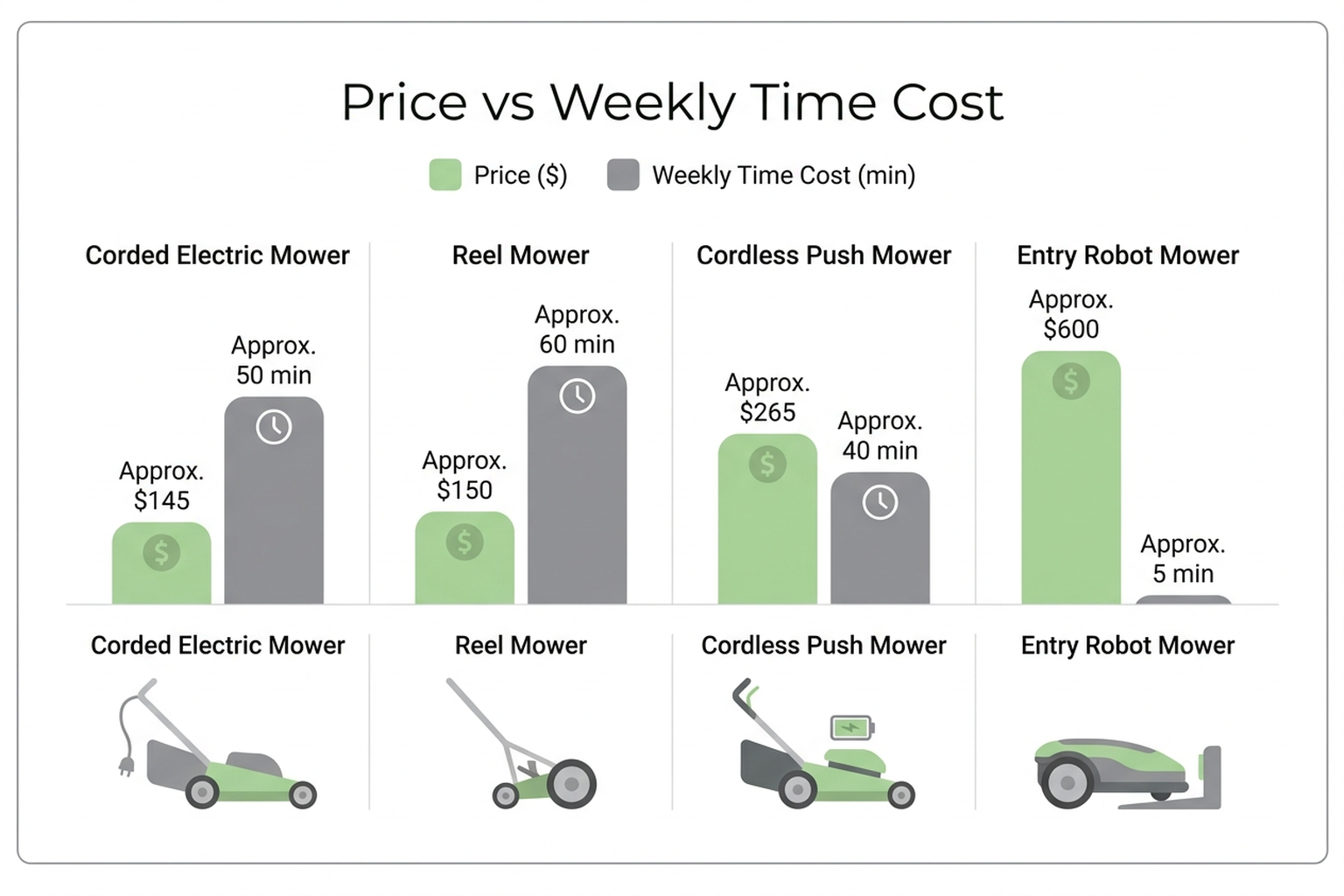
Prices as of 2026-10-02 — verify the current listing before buying.
| Your yard | What the data suggests | Model | Typical price |
|---|---|---|---|
| Under ~5,000 sq ft, simple shape | Push mower matches the robot’s result in minutes | Greenworks 17” Corded Electric | ~$140–$150 |
| Very small lot, want zero maintenance | Manual reel mower needs no charging or mapping | Scotts 716-18S 18” Reel Mower | ~$140–$160 |
| Irregular shape, gates, gravel, or pets | Human navigation handles obstacles a robot can’t | Greenworks 40V Cordless Push | ~$250–$280 |
| Quarter acre+, flat, mowed weekly, time-constrained | Robot mower’s time savings can justify the price | Worx Landroid S (WR165) | ~$550–$650 |
Decision Flowchart
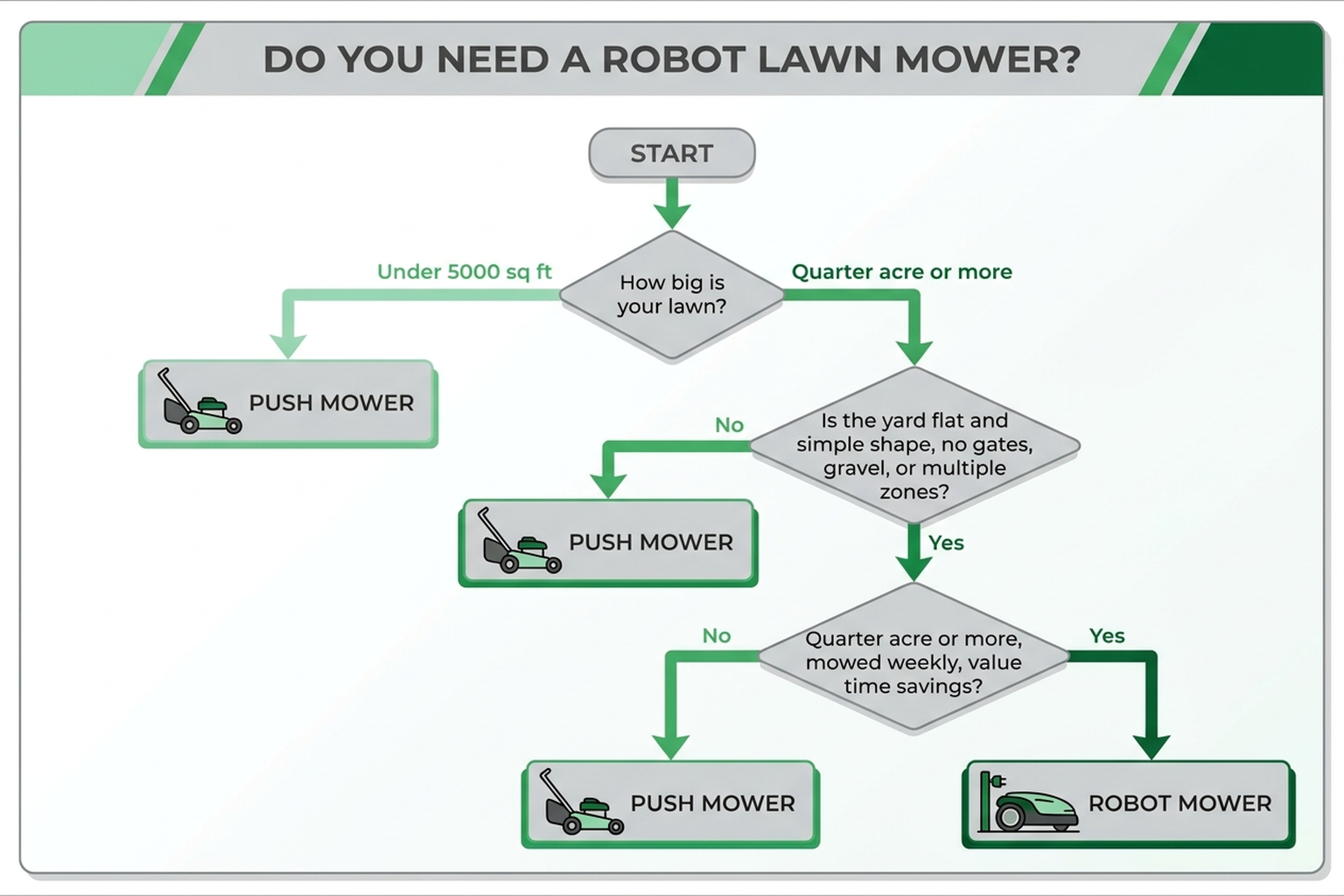
Start with lawn size: if the mowable area is under roughly 5,000 sq ft — true for the smallest quarter of US lawns per measurelawn.com’s 2026 measurement data — a corded electric or reel mower finishes the job in about the same time a robot mower would spend on setup alone. If the lawn is larger but irregular — narrow gated passages, gravel paths, multiple disconnected zones, or heavy pet or child traffic — Tom’s Guide’s documented failure patterns suggest a cordless push mower will cause fewer headaches than fighting the geometry with a robot. Only when the yard is a quarter acre or more, flat, continuously bounded, and mowed on a weekly schedule does the robot mower’s time-savings case clearly outweigh its four-figure price.
Limitations
This analysis relies on published buying-guide coverage from Tom’s Guide, a third-party lawn-measurement study (measurelawn.com, 2026) and national lot-size statistics, a 2025 consumer survey on robot mower ownership (Lawn Love), and manufacturer specifications, rather than our own side-by-side test of any specific mower. Payback-period estimates come from secondary trade coverage rather than an audited cost model, and actual results depend on local electricity or gas prices, how much an individual values their own time, and how long they plan to stay in the home. Yard-fit guidance (size thresholds, obstacle patterns) reflects aggregated third-party reporting rather than a controlled side-by-side trial across every robot mower model on the market. Prices fluctuate on amazon.com and should be verified on the current product page before buying.
Bottom Line
Robot mowers genuinely save time on the yards they’re built for — flat, continuous, quarter-acre-plus lots mowed weekly. But a meaningful share of US lawns are smaller than that, a documented set of obstacle patterns (gates, gravel, uneven or pet-damaged ground) make the technology fight the yard instead of helping it, and roughly half of non-owners have already looked at the price and decided against it rather than waited for a better deal. If a $150 push mower or a $140 reel mower already finishes the job in ten minutes, the data doesn’t support replacing it with $700-plus of robotics to do the same thing on a schedule.
Before buying either a robot mower or a push mower, it pays to check that the listing’s reviews are genuine and the price is competitive. That is exactly what Arekore does: paste the Amazon URL and our AI analyzes review authenticity, surfaces what the one-star reviews actually complain about, and compares pricing in about five minutes — so you end up with the mower that fits your actual yard, not the one the algorithm pushes hardest.