Noise-Cancelling Headphones 2026: 3 Buyers Who Skip Them

Flagship active noise-cancelling (ANC) headphones have never tested better. The 2026 crop, led by the Sony WH-1000XM6 and the Bose QuietComfort Ultra (2nd Gen), sits at the point where independent labs report the top models separated by single-digit percentage differences in noise reduction. That performance ceiling is real. It’s also not the deciding factor for every buyer, and the safety, market, and pricing data behind three specific listener types points toward skipping a flagship ANC purchase entirely — not because the hardware underperforms, but because the use case doesn’t match what ANC is built to solve.
This isn’t an argument against noise cancellation. It’s an argument that fit depends on where you listen, how you get there, and how often you’d actually use the feature you’re paying $350-450 for.
As an Amazon Associate, Arekore earns from qualifying purchases. The Amazon product links in this article may include our affiliate tracking ID and may earn us a commission if you buy through them, at no additional cost to you. See our Links Policy for details on how we select products and how commissions do not influence our recommendations.
TL;DR / Quick Verdict
- Outdoor runners, cyclists, and pedestrian commuters lose real safety margin to full ANC isolation. A widely cited BMJ Injury Prevention study tracking headphone-related pedestrian incidents found 116 reported deaths or injuries between 2004 and 2011, with 70% of those collisions fatal — a baseline finding that outdoor-safety guides still cite when steering runners and cyclists toward open-ear designs instead of sealed ANC cups.
- Listeners whose main environment is already quiet get little marginal benefit from flagship-tier ANC. A home office, a private car, or a mostly-empty room doesn’t generate the sustained broadband noise ANC is designed to cancel, so the $350-450 flagship premium buys noise reduction that never gets used.
- Infrequent flyers and light commuters rarely clear the cost-per-use math on a flagship model. If loud, ANC-relevant environments — flights, trains, open offices — come up less than roughly once a month, a $60-80 hybrid ANC model delivers most of the audible benefit at a fraction of the price.
- Three profiles where the data favors skipping a flagship purchase: safety-first outdoor users, quiet-environment listeners, and low-frequency travelers who don’t fly or commute in loud settings often enough to justify the premium tier.
How We Reached These Conclusions (Methodology)
This is an editorial analysis, not a hands-on test. We did not personally test the products covered here. This guide synthesizes: (a) 2026 ANC performance comparisons and long-term testing from RTINGS.com, Tom’s Guide, and SoundGuys covering the Sony WH-1000XM6 and Bose QuietComfort Ultra (2nd Gen); (b) the BMJ Injury Prevention study on headphone-related pedestrian incidents (2004-2011 data, still cited as a foundational reference in current outdoor-safety guidance) alongside 2026 cycling-safety buying guides from Cycling Weekly and BikeRadar; (c) bone-conduction and open-ear headphone market-growth data from market.us and Omdia, as reported via Impulse Gamer; (d) audiologist commentary on ANC and hearing safety from Ask an Audiologist and Beverly Hills Hearing; and (e) manufacturer-published specifications and amazon.com pricing at the time of writing. Prices are approximate amazon.com figures as of September 2026 and change frequently.
Why “Best ANC” Isn’t the Same Question as “Right for You”
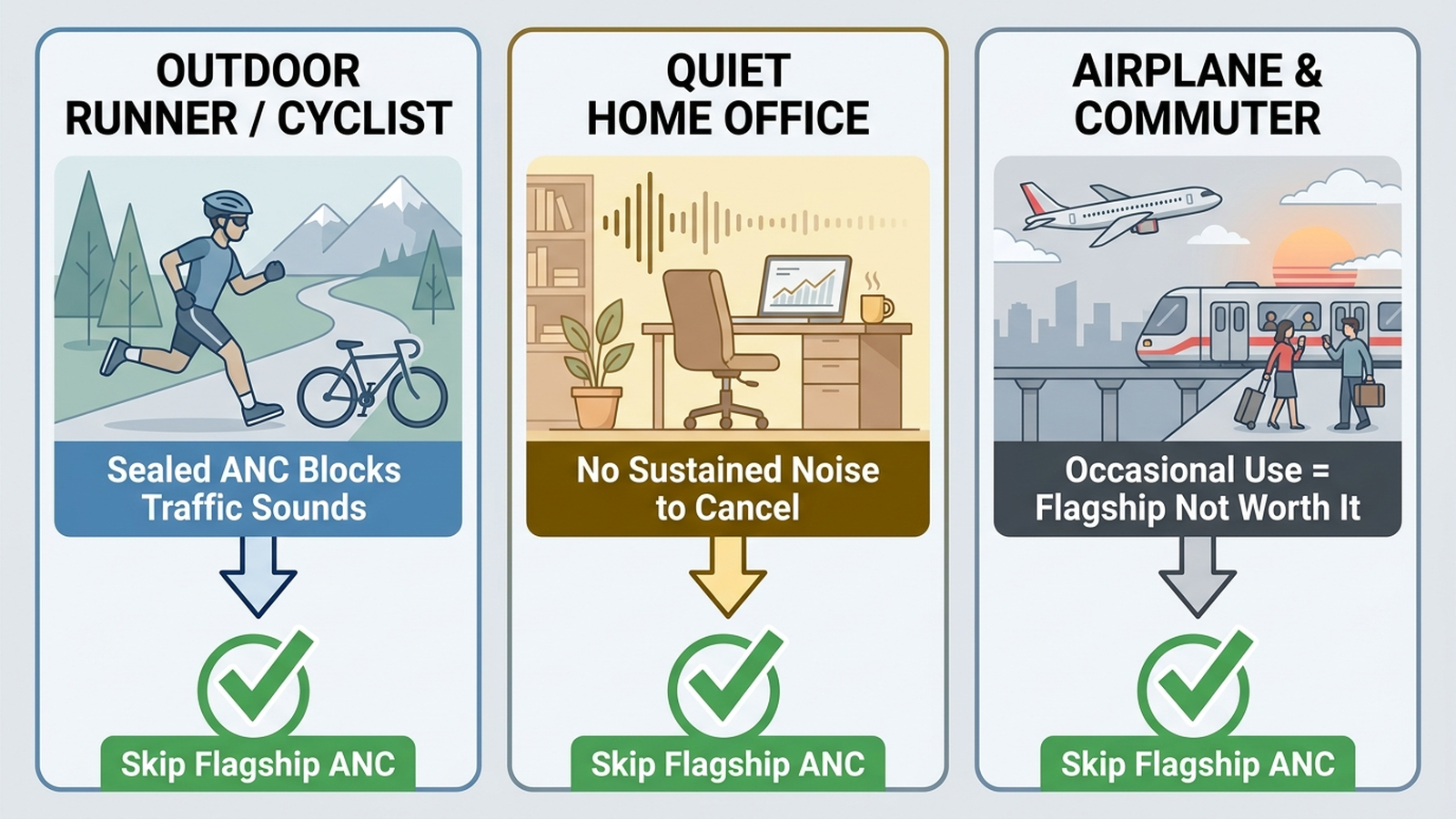
Headphone reviews mostly answer one question: which model cancels the most noise. That’s a fair question for a narrow use case — sealed cabin noise on a long flight, or a loud open-plan office. But three separate factors in the underlying data mean flagship ANC doesn’t generalize to every listener:
- Full noise isolation removes a safety input outdoor users depend on. Sealed ANC cups are built to suppress the same broadband, low-frequency sound — road noise, wind, engine hum — that also carries an approaching car, cyclist, or train. Outdoor-safety guides from Cycling Weekly and BikeRadar consistently steer runners and cyclists away from sealed noise-isolating designs for exactly this reason, independent of how well any specific model cancels noise.
- ANC only cancels noise that’s actually present. Active cancellation works by generating an inverse waveform against sustained ambient sound — engine drone, HVAC hum, crowd noise. A home office, private car, or quiet room doesn’t produce enough of that sustained noise floor for the feature to do meaningful work, so the flagship premium pays for a capability that goes largely unused.
- The premium tier is priced for daily high-noise use, not occasional trips. The Sony WH-1000XM6 and Bose QuietComfort Ultra (2nd Gen) both sit in the $429-448 range. For someone who flies or commutes through consistently loud environments a few times a year rather than a few times a week, that per-use cost rarely clears what a $60-80 hybrid ANC model already covers.
The Three Listeners Where the Data Says Skip It
1. Outdoor runners, cyclists, and pedestrian commuters
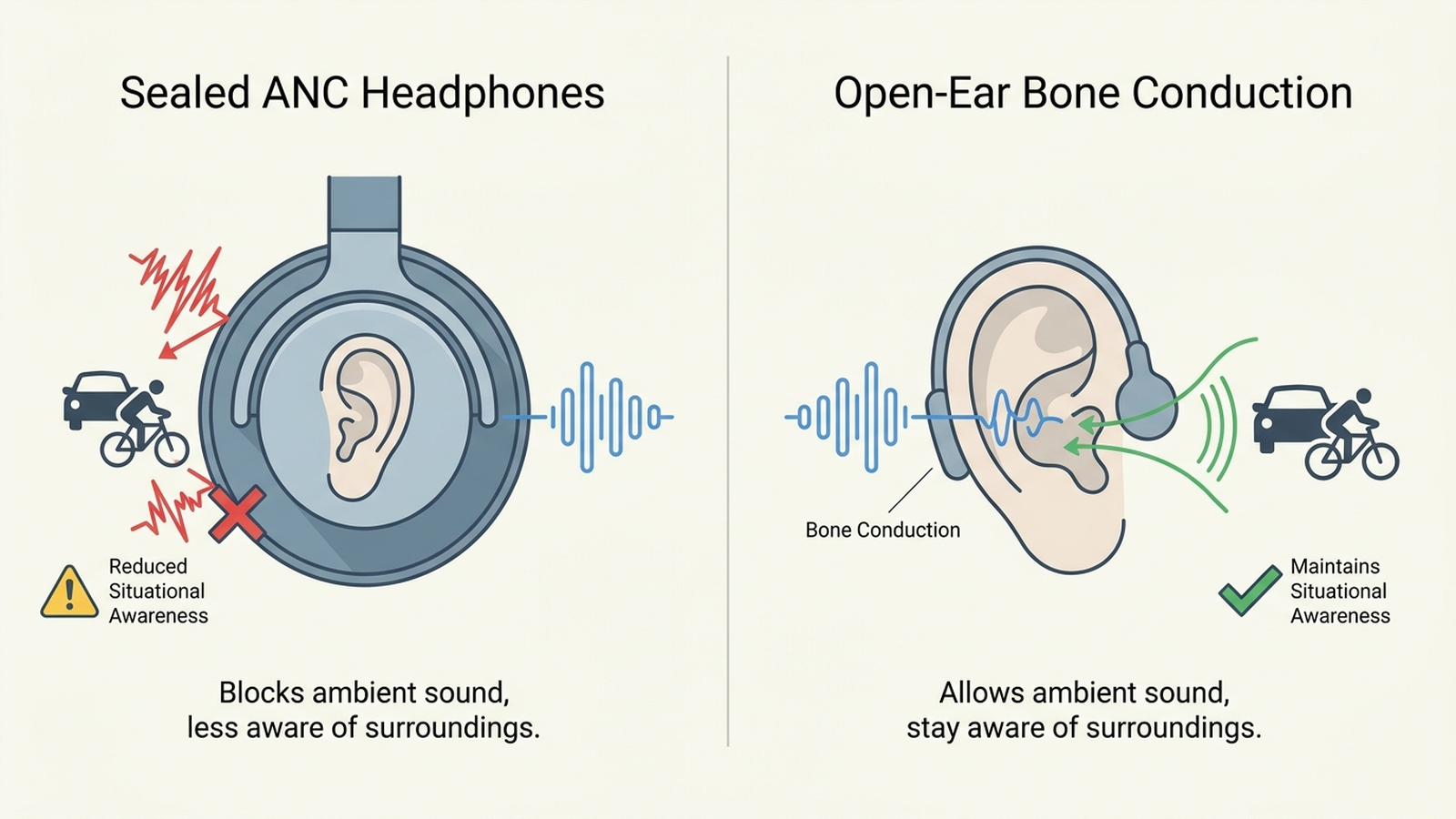
The safety case here doesn’t hinge on any single ANC model’s noise-cancellation percentage — it hinges on what full isolation removes from an outdoor environment shared with vehicles, cyclists, and other pedestrians. A BMJ Injury Prevention study tracking US headphone-related pedestrian incidents between 2004 and 2011 documented 116 reported deaths or injuries, a count that rose from 16 in 2004-05 to 47 in 2010-11, with 70% of the incidents ending in death even though a warning signal such as a horn or siren was sounded in roughly a third of cases. That data is older, but it remains the most-cited baseline reference in current outdoor-safety guidance from publications like Cycling Weekly, BikeRadar, and Velo, which still recommend open-ear designs over sealed ANC cups for road running and cycling in 2026.
For this listener, the fix isn’t a lower-ANC-setting compromise — it’s a different form factor. Open-ear bone-conduction headphones route sound through the cheekbone rather than sealing the ear canal, leaving ambient traffic and voice sounds fully audible. The SHOKZ OpenRun Pro 2 (ASIN B0DDCGKZBT) is a widely reviewed open-ear sport headphone built specifically for this use case, with an IP55 sweat-resistance rating and roughly 12 hours of battery life.
Check the SHOKZ OpenRun Pro 2 on Amazon
2. Listeners whose main environment is already quiet
Active noise cancellation works by generating a continuous inverse waveform against sustained ambient sound, which is why it’s most audible in environments with a steady low-frequency noise floor: aircraft cabins, trains, city traffic, open offices. A quiet home office, a private car, or a household with no persistent HVAC or street noise doesn’t generate enough of that baseline for ANC to meaningfully change the listening experience — audiologist resources including Ask an Audiologist and Beverly Hills Hearing note that ANC’s main measurable benefit is letting listeners keep volume lower in genuinely noisy settings, a benefit that doesn’t apply when the room is already quiet.
For this listener, a non-ANC wireless headphone covers the actual use case — music and calls in a low-noise room — without paying for a feature that has nothing to cancel. The JBL Tune 520BT (ASIN B0C1HGKNG7) is a widely reviewed budget on-ear model with roughly 57 hours of battery life and no ANC circuitry to pay for.
Check the JBL Tune 520BT on Amazon
3. Infrequent flyers and light commuters
The Sony WH-1000XM6 and Bose QuietComfort Ultra (2nd Gen) list at roughly $429-448, a price built around daily exposure to loud, sustained-noise environments — frequent flights, daily train commutes, open-plan offices. Tom’s Guide’s extended head-to-head testing found the two flagships separated mainly by comfort and battery life rather than a decisive noise-cancellation gap, meaning most of the flagship-tier ANC benefit is also present in less expensive hybrid models. For someone who encounters those loud, ANC-relevant environments only occasionally — a handful of flights a year, an infrequent train commute — the cost-per-use math on a $429+ purchase rarely closes.
A mid-range hybrid ANC model captures most of the audible benefit for a fraction of the price. The Anker Soundcore Life Q30 (ASIN B0F7L8ZRS9) is a widely reviewed hybrid ANC over-ear headphone with a manufacturer-rated 40-hour ANC battery life, priced well under the flagship tier.
Check the Anker Soundcore Life Q30 on Amazon
When Flagship ANC Still Makes Sense
None of this argues against noise-cancelling headphones as a category. The data supports a flagship purchase specifically when: you spend meaningful time in genuinely loud, sustained-noise environments — frequent flights, a daily loud commute, an open-plan office — and you’re indoors or otherwise not depending on ambient sound for safety. That’s a large and common listener profile. It just isn’t every listener with a $400 budget and a wish list.
Manufacturer-published specifications for these models, such as claimed noise-reduction and battery-life figures, are manufacturer-reported claims rather than figures this analysis independently verified; treat them as directional rather than exact.
Comparison Table
Prices are approximate amazon.com figures at the time of writing (September 2026) and fluctuate.
| Your situation | What the data suggests | Alternative product | Typical price |
|---|---|---|---|
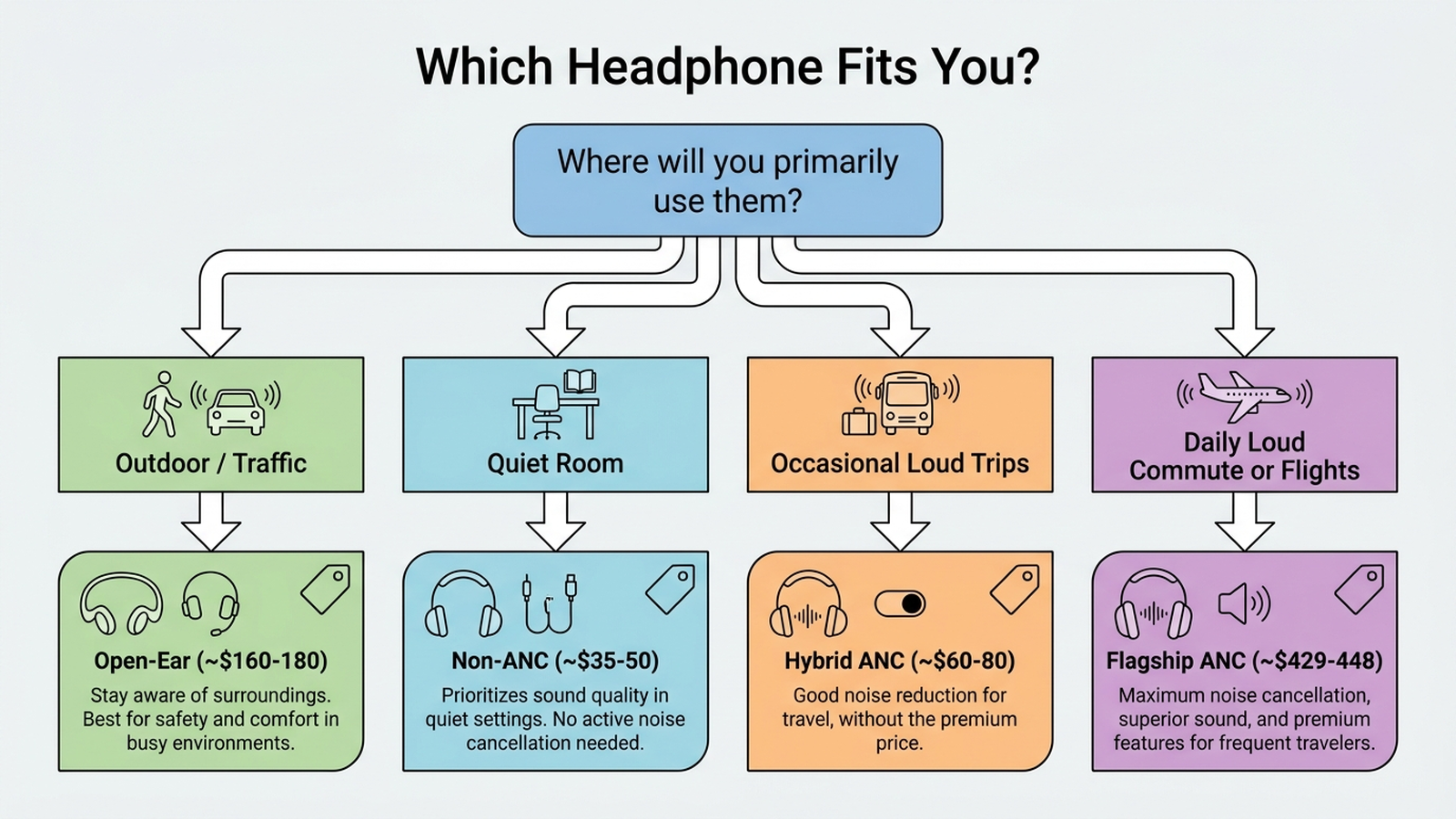
| Outdoor runner, cyclist, or pedestrian commuter | Skip sealed ANC — keep ambient awareness | SHOKZ OpenRun Pro 2 (open-ear, bone conduction) | ~$160-180 |
| Main listening environment is already quiet | Skip ANC entirely — no sustained noise to cancel | JBL Tune 520BT (non-ANC, on-ear) | ~$35-50 |
| Infrequent flyer or light commuter | Skip the flagship tier, not ANC itself | Anker Soundcore Life Q30 (hybrid ANC) | ~$60-80 |
| Daily flights, loud commute, or open-plan office | Flagship ANC still fits | Sony WH-1000XM6 or Bose QuietComfort Ultra (2nd Gen) | ~$429-448 |
Decision Flowchart
Start with your primary environment: if you’re outdoors around traffic, cyclists, or other pedestrians, skip sealed ANC and choose an open-ear design regardless of budget — this is a safety call, not a cost call. If your main listening happens in an already-quiet room or car, skip ANC entirely and put the budget toward comfort or sound quality instead. If neither applies but you encounter loud, sustained-noise environments only occasionally, a mid-range hybrid ANC model covers most of the benefit. Only when loud environments are a near-daily occurrence does the flagship tier’s price consistently pay for itself.
Limitations
This analysis relies on published lab and long-term test data from RTINGS.com, Tom’s Guide, and SoundGuys, market-growth statistics for the open-ear and bone-conduction category from market.us and Omdia, one foundational pedestrian-safety study (BMJ Injury Prevention, 2004-2011 data) that is older than our usual 2024+ threshold but remains the primary cited source in current outdoor-safety guidance, and audiologist-published commentary on ANC and hearing, rather than our own side-by-side test of any specific model. Individual comfort, ear shape, and glasses fit affect real-world ANC headphone comfort in ways lab noise-reduction percentages don’t capture. Noise-cancellation performance and pricing change with firmware updates and sales; figures here reflect the time of writing.
Bottom Line
Flagship ANC headphones earned their reputation honestly — for the right listener, they solve a real problem well. But the same safety, acoustic, and pricing data that explains their appeal also explains why the flagship purchase is the wrong call for three specific groups: outdoor users who need ambient awareness more than isolation, quiet-environment listeners with no sustained noise to cancel, and infrequent travelers whose usage doesn’t clear the cost-per-use math on a $400+ purchase. If any of those describe how and where you actually listen, the data points toward an open-ear design, a non-ANC model, or a mid-range hybrid — not the flagship tier.
Before you buy, paste the product link into Arekore — our AI assistant checks review authenticity, surfaces what the one-star reviews actually complain about, and compares prices, free, in about five minutes.