Home Security Cameras 2026: 3 Homes That Don't Need One
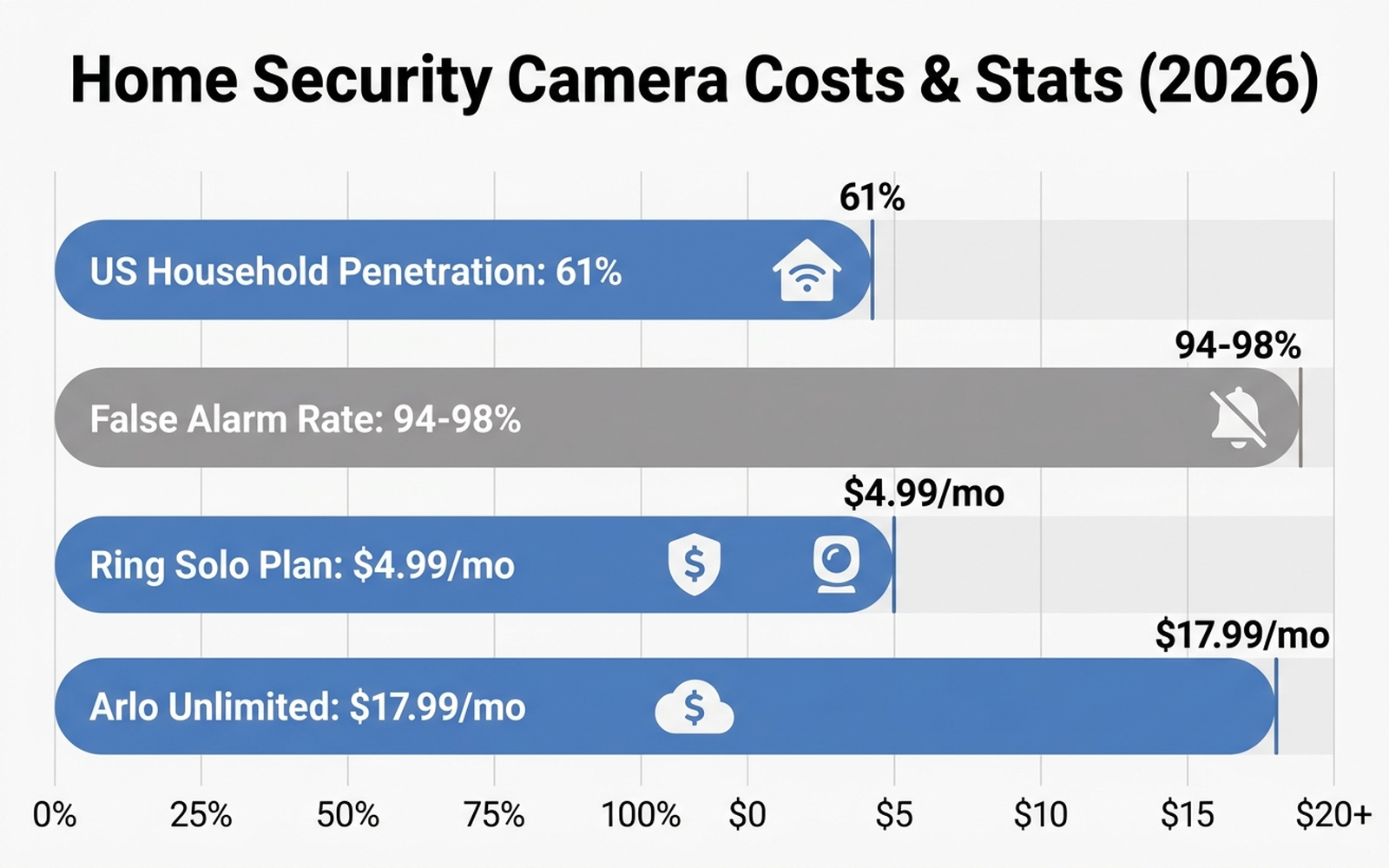
Security cameras are one of the fastest-growing smart-home categories in the US, with roughly 61% of US households now owning at least one, up from about 52% in 2024, according to SafeHome.org’s 2026 Home Security Market Report. But adoption isn’t the same as fit, and the data behind that growth — on false-alarm rates, subscription costs, tenant policy, and breach history — points at three specific household types where a camera purchase doesn’t pay off, not because the hardware is bad, but because the setup doesn’t match what the camera is built to solve.
This isn’t an argument against security cameras. It’s an argument that the fit depends on your building’s existing security, your lease terms, and how much recurring subscription and privacy exposure you’re actually willing to take on — and the data on all three is more specific than “every home benefits from a camera.”
As an Amazon Associate, Arekore earns from qualifying purchases. The Amazon product links in this article may include our affiliate tracking ID and may earn us a commission if you buy through them, at no additional cost to you. See our Links Policy for details on how we select products and how commissions do not influence our recommendations.
TL;DR / Quick Verdict
- Renters in buildings with existing surveillance and lease restrictions rarely add real security. Many leases require written landlord approval before mounting a camera, and tenant camera law generally limits recording to your own doorway — a duplicate layer on top of a building’s own lobby or hallway cameras.
- Low-crime neighborhoods mostly buy a false-alarm generator, not a deterrent. Between 94% and 98% of all security alarm activations police respond to are false, per the US Department of Justice and the International Association of Chiefs of Police — and that false-positive rate doesn’t fall just because your neighborhood is safe; it mostly just means the camera has fewer real events to correctly flag.
- Households unwilling to pay a recurring subscription end up with a camera that can’t do its main job. Ring, Arlo, and most cloud-connected cameras require a paid plan (roughly $4.99–$19.99/month) for video history beyond a short free window — without it, a “security camera” only shows a live feed, not a recorded incident.
- Three setups where the data favors skipping it: renters under lease restrictions with existing building security, low-crime households mainly seeking peace of mind, and privacy-conscious households unwilling to accept recurring subscription costs and cloud-breach exposure.
How We Reached These Conclusions (Methodology)
This is an editorial analysis, not a hands-on test. We did not personally test the products covered here. This guide synthesizes: (a) household penetration and market-growth statistics from SafeHome.org’s 2026 Home Security Market Report and Grand View Research’s 2026 US smart-home-camera market reports; (b) false-alarm and police-response data from the US Department of Justice’s “False Burglar Alarms” guidance and the International Association of Chiefs of Police, as aggregated by industry researcher Intellisee; (c) current subscription pricing published directly by Ring, Arlo, and Wyze as of September 2026; (d) tenant/landlord camera-policy summaries from multiple legal-guide publishers (GetSafeAndSound, eufy’s tenant-rights guide) covering common-area consent requirements and state-level audio-consent law; and (e) publicly reported security-breach disclosures affecting Ring and Wyze, including the FTC’s 2023 enforcement action against Ring and Wyze’s February 2024 breach notice. Prices are amazon.com and manufacturer-published figures at the time of writing and change frequently.
Why Camera Adoption Doesn’t Mean Universal Fit
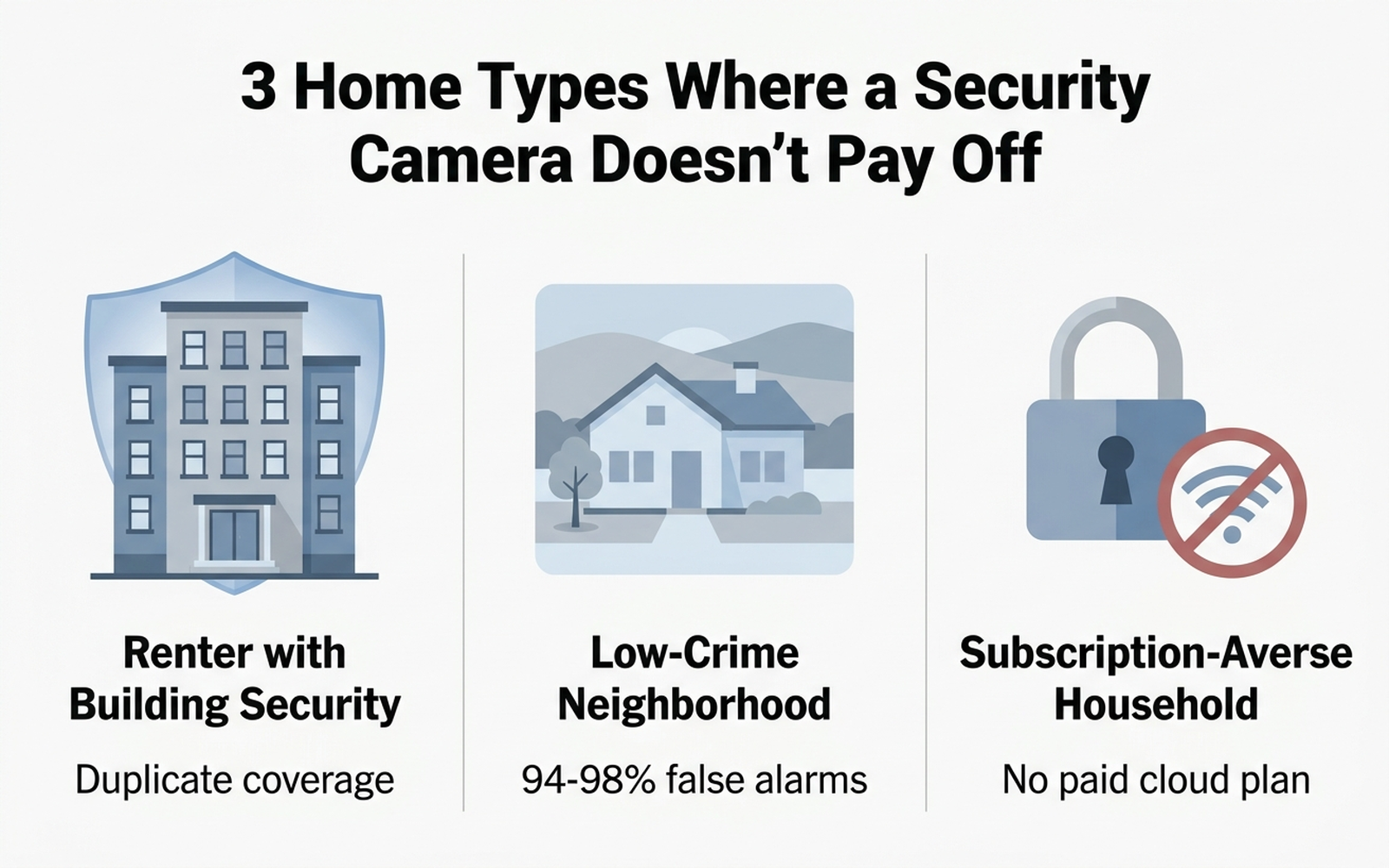
Security cameras are marketed as a single answer to “know what’s happening at your door,” but the category’s own adoption and cost data shows three separate constraints that don’t apply evenly to every home:
- Lease terms and tenant law cap what a renter’s camera can actually cover. Legal guides on tenant camera rights consistently note that cameras are permitted at a renter’s own door but restricted in shared hallways and common areas without written landlord sign-off, and audio recording is subject to state consent law — all of which shrinks the coverage a renter’s own camera adds on top of a building’s existing lobby or entry cameras.
- The false-alarm math doesn’t discriminate by neighborhood. The US Department of Justice and the International Association of Chiefs of Police both put the false-alarm share of security-alarm activations at 94–98%, driven mostly by pets, wind, and delivery motion rather than a neighborhood’s actual crime rate — so a low-crime household ends up with a device generating mostly the same false-positive noise, for a lower baseline chance of ever catching a real event.
- The core recording feature is usually paywalled. Ring’s Solo plan runs $4.99/month for a single device and its Multi plan $9.99/month for cloud storage across every device at one location; Arlo charges $7.99/month (billed annually) for one camera or $17.99/month for unlimited cameras with 30-day storage. Wyze is the exception with 14 days of free rolling cloud storage, but most mainstream brands need an ongoing subscription for the recorded-video function that is the actual point of owning a camera.
The Three Homes Where the Data Says Skip It
1. Renters with existing building security and lease restrictions
Multi-unit apartment buildings increasingly ship with their own lobby, hallway, and parking-lot cameras as building-wide infrastructure. Layered on top of that, tenant-law guides note that cameras are broadly permitted at your own unit’s door but restricted in shared hallways and common areas without written landlord approval, and several states — including California, Florida, and Illinois — require all-party consent for any audio a camera might also capture. Most leases now include a specific doorbell-camera clause a tenant has to review before installing anything, wired or wireless.
For a renter in that situation, a personal camera mostly duplicates coverage the building already provides, while adding a lease-compliance step and a monthly subscription for video history the building’s own system may already retain. A better fit is a device that improves entryway visibility and access without recording anyone: a wireless, adhesive-mount motion-sensor light avoids the drilling, lease violation risk, and subscription entirely. The Mr. Beams MB522 Wireless Motion-Sensing LED Step Light (ASIN B00BH2ZZCS) is a widely reviewed battery-powered option that mounts with adhesive tape, no wiring or landlord sign-off required.
Check the Mr. Beams MB522 Motion-Sensing LED Light on Amazon
2. Low-crime neighborhoods mainly seeking peace of mind
The false-alarm math here is the crux of the issue: the US Department of Justice and the International Association of Chiefs of Police both cite a 94–98% false-alarm rate for security-alarm activations nationally, driven overwhelmingly by pets, wind, passing traffic, and delivery motion rather than an area’s actual crime rate. That baseline false-positive rate doesn’t improve in a low-crime neighborhood — the camera still flags the same volume of non-events, while having statistically fewer real incidents to ever catch. Video-verified alarms do get police to respond roughly 80% faster, per alarm-industry researcher Securitas Technology, but that speed benefit only matters when there’s a real event to verify in the first place.
For a household in this position, the practical security gain per dollar tends to come from access control rather than surveillance: a smart deadbolt that eliminates lost-key and unlocked-door risk without an always-on camera feed or a monthly subscription. The Kwikset Halo Touch Fingerprint Wi-Fi Smart Lock (ASIN B08DYZCW3S) is a widely reviewed no-hub smart deadbolt with fingerprint and app-based entry, priced as a one-time purchase with no required subscription.
Check the Kwikset Halo Touch Smart Lock on Amazon
3. Privacy-conscious households unwilling to accept subscription cost and breach exposure
Cloud-connected cameras carry two recurring costs beyond the hardware price: the monthly subscription needed for recorded (not just live) video, and a documented history of account and cloud-security incidents across major brands. The FTC’s 2023 enforcement action found that Ring had allowed employees and contractors broad access to customers’ private videos and had failed to implement basic protections that let hackers take over customer accounts and cameras. Wyze separately disclosed a breach in February 2024 that exposed some users’ camera thumbnails and event data to other customers’ accounts. Neither incident means every camera brand is unsafe, but both are a reminder that an internet-connected camera is also a cloud account with its own attack surface — a trade-off a purely privacy-focused household may reasonably decide isn’t worth the monthly fee.
For this household, the same motion-sensor light and smart-deadbolt combination covers most of the practical benefit — visibility and access control — without a cloud video account attached to the home at all. Households already covered under scenarios 1 or 2 above can use either product without adding a subscription-based camera on top.
When a Security Camera Still Makes Sense
None of this is a blanket case against the category. The data supports buying one specifically when: you own your home or have clear landlord approval, your neighborhood has a documented higher package-theft or break-in rate, and you’re prepared to pay the recurring subscription that most brands require for actual video history rather than just a live feed. That is a real and common household profile — it just isn’t every household with a front door.
Comparison Table
Prices are approximate amazon.com figures at the time of writing (September 2026) and fluctuate.
| Your setup | What the data suggests | Alternative product | Typical cost |
|---|---|---|---|
| Renter with building security + lease restrictions | Skip a personal camera — improve visibility instead | Mr. Beams MB522 Motion-Sensing LED Light | ~$25–$35 |
| Low-crime neighborhood, mainly wants peace of mind | Access control beats surveillance for the false-alarm math | Kwikset Halo Touch Smart Lock | ~$180–$230 |
| Privacy-conscious, subscription-averse household | Same visibility/access benefit, no cloud video account | Mr. Beams light + Kwikset Halo Touch | ~$205–$265 combined |
| Owned home, documented local break-in/package-theft risk, will pay for cloud storage | Security camera still fits | Cloud-connected security camera | ~$100–$400 + $5–$20/mo |
Decision Flowchart
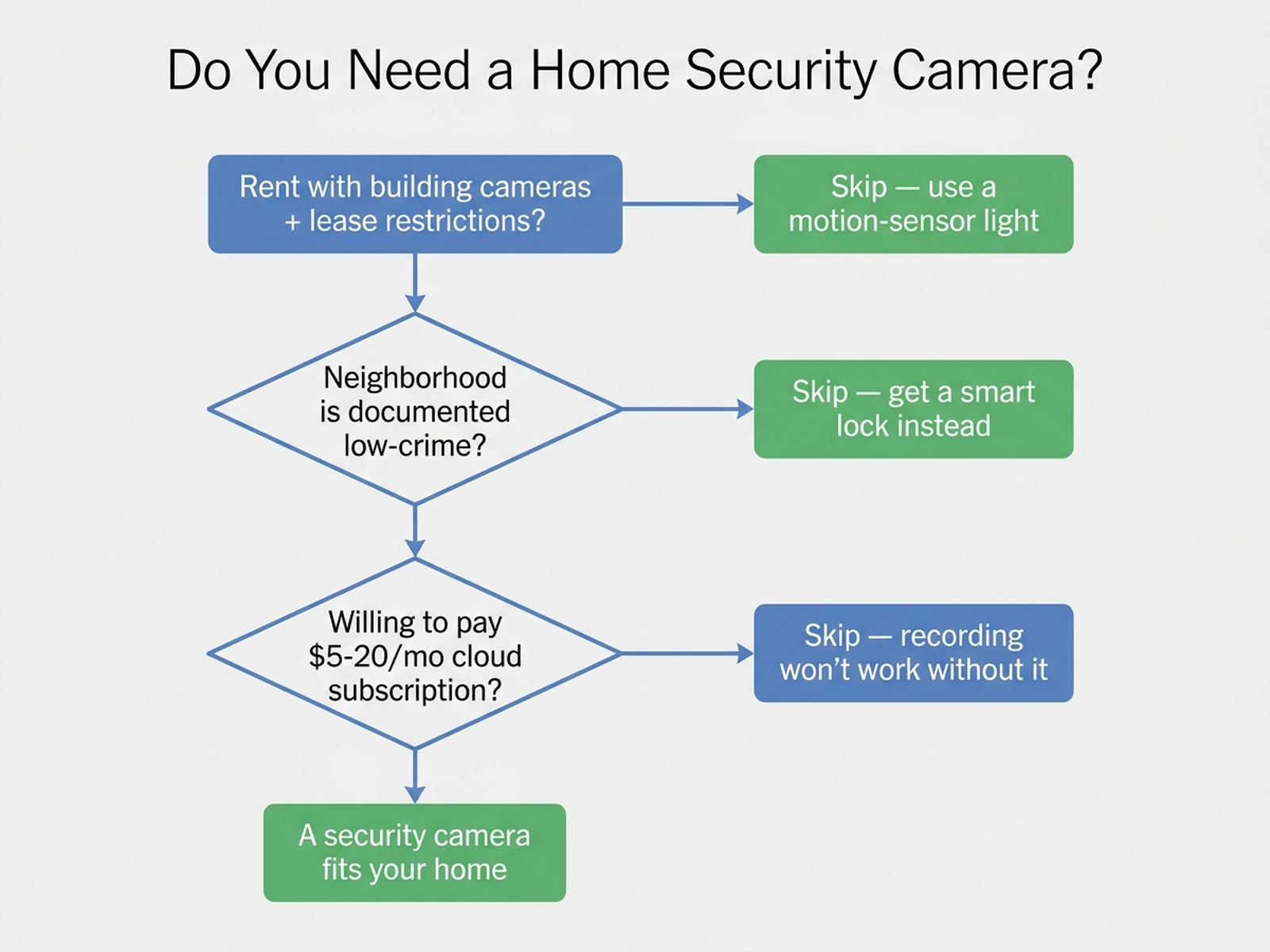
Start with your housing situation: if you rent in a building that already has lobby or hallway cameras and your lease restricts personal camera installs, skip the camera and improve entryway visibility instead. If you own or have landlord approval but live in a documented low-crime area, a smart lock closes the access-control gap without adding a false-alarm-prone camera. If neither of those applies but you’re not willing to pay an ongoing cloud subscription of roughly $5–$20/month, the recording feature that makes a camera useful won’t work for you anyway. Only when you have approval to install, a documented local risk, and willingness to pay for cloud storage does the category deliver on its promise.
Limitations
This analysis relies on published market-penetration statistics, DOJ and IACP false-alarm data, brand-published subscription pricing, tenant-law guide summaries, and publicly reported breach disclosures, rather than our own side-by-side test of any specific camera model. False-alarm rates cited here are national aggregates and may not reflect any single neighborhood’s actual experience. Tenant camera rules vary by state, city, and individual lease, so renters should confirm their own lease terms and local law rather than relying on the general guidance summarized here. The breach incidents cited (FTC action against Ring, Wyze’s 2024 disclosure) describe specific past events, not an ongoing or universal vulnerability in every camera on the market today. Individual results vary based on neighborhood, building policy, and how closely a household’s risk profile matches the scenarios described.
Bottom Line
Security cameras earned their growth honestly — for the right home, they solve a real problem. But the same adoption, false-alarm, and cost data that explains the category’s rise also explains why it’s the wrong purchase for a documented set of households: renters with existing building security and lease restrictions mostly duplicate coverage they already have, low-crime households mainly buy a false-alarm generator, and subscription-averse households end up owning a camera that can’t do its main recording job. If any of those describe your home, the data points toward a motion-sensor light, a smart lock, or both — not a camera.
Before you buy, paste the product link into Arekore — our AI assistant checks review authenticity, surfaces what the one-star reviews actually complain about, and compares prices, free, in about five minutes.