High-End Blenders 2026: When a $30 Model Is Actually Enough
Every blender buying guide on the internet ends the same way: buy the Vitamix. Independent lab testers consistently rate premium machines highest on ice-crushing fineness, purée smoothness, and long-term durability, and a $350–$700 blender genuinely does outperform a $30 one on every one of those measures. But “performs better in a lab test” and “is worth the extra $300–$650 for how you actually use it” are two different questions, and the data on real household blending habits answers the second one differently than the lab results answer the first.
This isn’t an argument that premium blenders are overrated. It’s an argument that the case for one depends on how often you blend, what you blend, and how long you expect to keep the machine — and for a specific, common set of households, a budget model matches the premium experience closely enough that the extra spend doesn’t pay for itself.
As an Amazon Associate, Arekore earns from qualifying purchases. The Amazon product links in this article may include our affiliate tracking ID and may earn us a commission if you buy through them, at no additional cost to you. See our Links Policy for details on how we select products and how commissions do not influence our recommendations.
TL;DR / Quick Verdict
- Consumer Reports’ own lab testers say it directly: a blender priced under $100 “could be a perfectly solid choice for the average home user,” even though pricier machines score higher on creaminess and ice-crushing fineness in side-by-side testing.
- Occasional blenders (a few times a week or less) are the clearest fit for a budget model. The gap between a $30 blender and a $350 one shows up mainly in daily, heavy-duty use — thick nut butters, dense frozen fruit, restaurant-grade smoothness — not in a Tuesday-night protein shake.
- Single-serve and small-household users rarely need premium capacity or power. A 20–24 oz. personal blender covers one or two smoothies at a time without the 64 oz. jar, the counter footprint, or the price of a full-size premium machine.
- First-time buyers testing the habit face real downside risk from starting at $350+. A large share of small kitchen appliances stop getting regular use within the first year; a $30 blender caps that risk at $30 instead of ten times as much.
- The exception that still justifies premium: daily use, thick low-liquid blends (nut butter, dense soups), leafy greens you want fully liquefied, or wanting the machine to still be running in year ten.
How We Reached These Conclusions (Methodology)
This is an editorial analysis, not a hands-on test. We did not personally test the products covered here. This guide synthesizes: (a) Consumer Reports’ lab-testing methodology and published ratings for full-size and budget blenders, including its stated conclusion that sub-$100 models can be a solid fit for typical home use; (b) independent reporting and side-by-side testing from RTINGS, America’s Test Kitchen, and Tom’s Guide comparing budget and premium blenders on ice-crushing, purée smoothness, and noise; (c) aggregated amazon.com customer review sentiment for budget models, sampled in August 2026; (d) US market-research estimates on blender household penetration and category size from Future Market Insights; and (e) manufacturer specifications for the specific models named below. Where a figure is a manufacturer’s own claim rather than an independently measured result, it is labeled as such. Prices are amazon.com figures at the time of writing and fluctuate.
What the Extra $300–$650 Actually Buys You
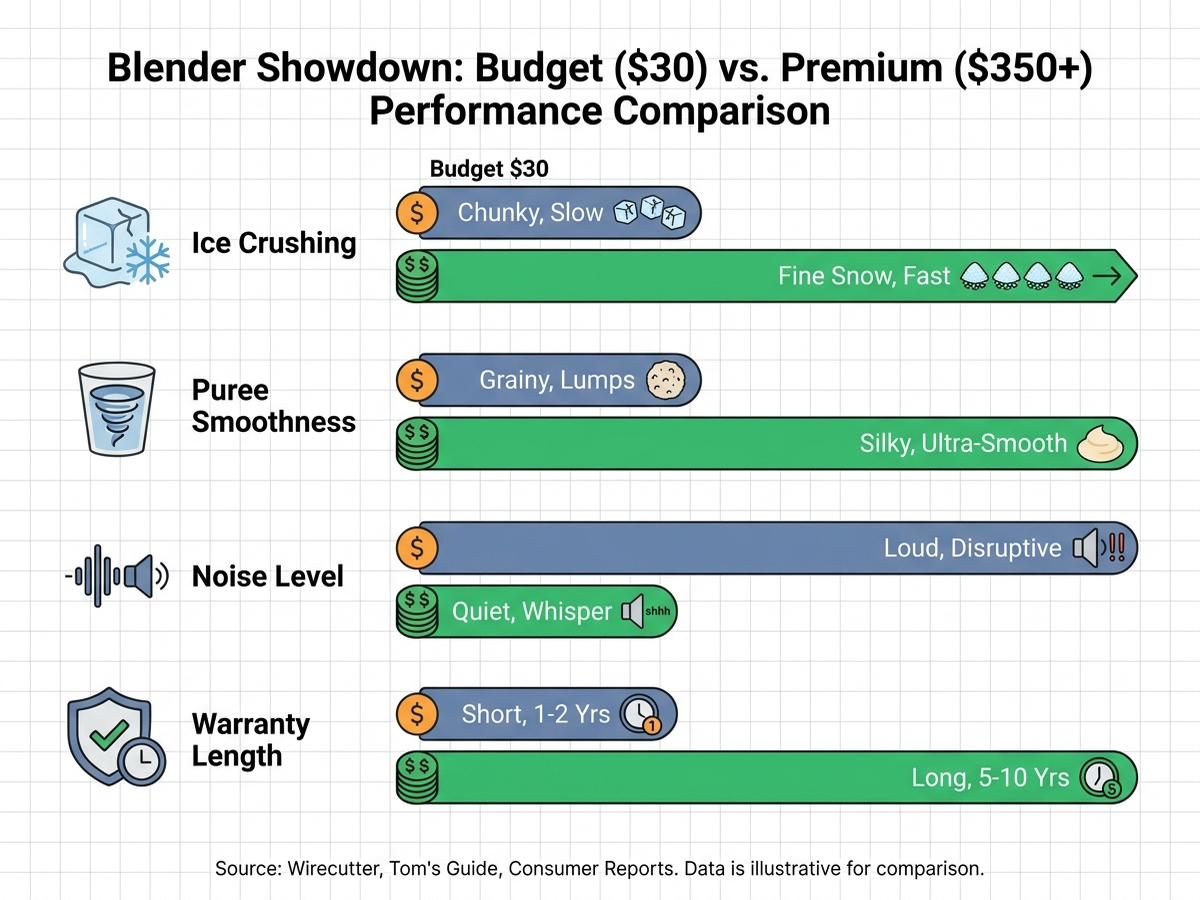
Independent lab testing is consistent on this point: premium blenders like the Vitamix 5200 and Blendtec Total Classic do produce measurably better results than budget models. Consumer Reports’ testing finds that higher-wattage, higher-priced blenders translate into creamier smoothies, silkier soups, more finely milled whole grains, and glossier nut butters — and crushed ice that comes out closer to fresh snow than to gravel. That gap is real and repeatable across labs.
What the same testing also shows is where that gap matters least. Consumer Reports explicitly rates several sub-$100 models — the Ninja BN701 Professional Plus (around $99.99, manufacturer price) among them — as strong performers on standard tasks like puréeing and icy drinks, concluding that a less-than-$100 blender “could be a perfectly solid choice for the average home user.” The premium advantage concentrates in the hardest tasks: thick, low-liquid blends that need a tamper or extremely high torque, and repeated daily use over a decade where a heavier-duty motor and metal gearing outlast a lighter plastic-geared unit. For a household that blends smoothies, shakes, and the occasional soup, that’s a narrower set of situations than the “always buy premium” advice implies.
Three Households Where a $30 Blender Is Genuinely Enough
1. Occasional blenders — a few times a week or less
If you’re making a smoothie two or three times a week rather than daily, the durability gap that justifies a premium blender’s price barely gets exercised. A Hamilton Beach Power Elite (ASIN B00EI7DPI0), a 700-watt (manufacturer-rated), 40 oz. glass-jar blender that typically lists in the $30–$40 range on amazon.com, holds a 12-function dial, dishwasher-safe glass jar, and aggregated customer reviews in the tens of thousands with a rating around 4.2 out of 5 stars. Reviewers’ recurring praise centers on it handling everyday smoothies, frozen-fruit shakes, and basic ice crushing without issue; the recurring complaint — blade dulling or motor strain after heavy, frequent use — is exactly the scenario that doesn’t apply to occasional blending.
At light-to-moderate frequency, the wear pattern that eventually favors a metal-geared premium motor over a lighter plastic-geared budget one simply doesn’t accumulate fast enough to matter within a normal 3–5 year ownership window.
Check the Hamilton Beach Power Elite on Amazon
2. Single-serve and small-household users
A lot of premium-blender capacity goes unused in a household that blends for one or two people at a time. The Hamilton Beach Personal Blender with Travel Lid (ASIN B00803D7JK) uses a compact single-serve jar in the 14–20 oz. range depending on configuration, built specifically for one smoothie or shake at a time rather than a family-sized 64–72 oz. batch. It typically lists under $20–$25 on amazon.com. For someone making one protein shake a day, the 64 oz. Vitamix jar and its accompanying counter footprint and price tag solve a batch-size problem that single-serve users don’t have.
Aggregated customer reviews for personal-format blenders in this category consistently cite the drink-and-go travel lid and easy one-handed cleanup as the main draw — features a full-size premium jar doesn’t optimize for in the first place.
Check the Hamilton Beach Personal Blender on Amazon
3. First-time buyers testing whether the habit sticks
Small kitchen appliances have a well-documented pattern of heavy use in month one followed by a sharp drop-off once the initial health kick or New Year’s resolution fades — a pattern reflected in the steady stream of lightly-used blenders that show up on secondhand marketplaces within their first year. Starting at $30–$40 instead of $350–$700 caps the downside of that pattern at a tenth of the cost if the habit doesn’t stick, while still leaving room to upgrade to a premium machine later if it does. A mid-tier step-up option, the Ninja BN701 Professional Plus with Auto-iQ (ASIN B0855B5Z6F, roughly $85–$100 on amazon.com), gives a first-time buyer a middle path — Consumer Reports-rated durability and 1,400 peak-watt power (manufacturer-rated) — without committing to premium pricing before the habit is proven out.
Check the Ninja BN701 Professional Plus on Amazon
When Premium Actually Earns Its Price
None of this is a case against Vitamix or Blendtec. The data supports paying for one when you blend daily, regularly make thick low-liquid mixtures like nut butter or dense frozen banana that need a tamper or very high torque to move through the blades, want leafy greens fully liquefied rather than left in visible fibrous shreds, or specifically want a machine backed by a 7-year full warranty (manufacturer terms) that owners commonly report using for a decade or more. That’s a real and common profile — a Vitamix 5200 (ASIN B004F9L4EI, roughly $349–$489 on amazon.com) is the model independent reviewers most consistently point to for that use case — it just isn’t every household that owns a blender.
Comparison Table
Prices are approximate amazon.com figures at the time of writing (August 2026) and fluctuate.
| Your usage pattern | What the data suggests | Model | Typical price |
|---|---|---|---|
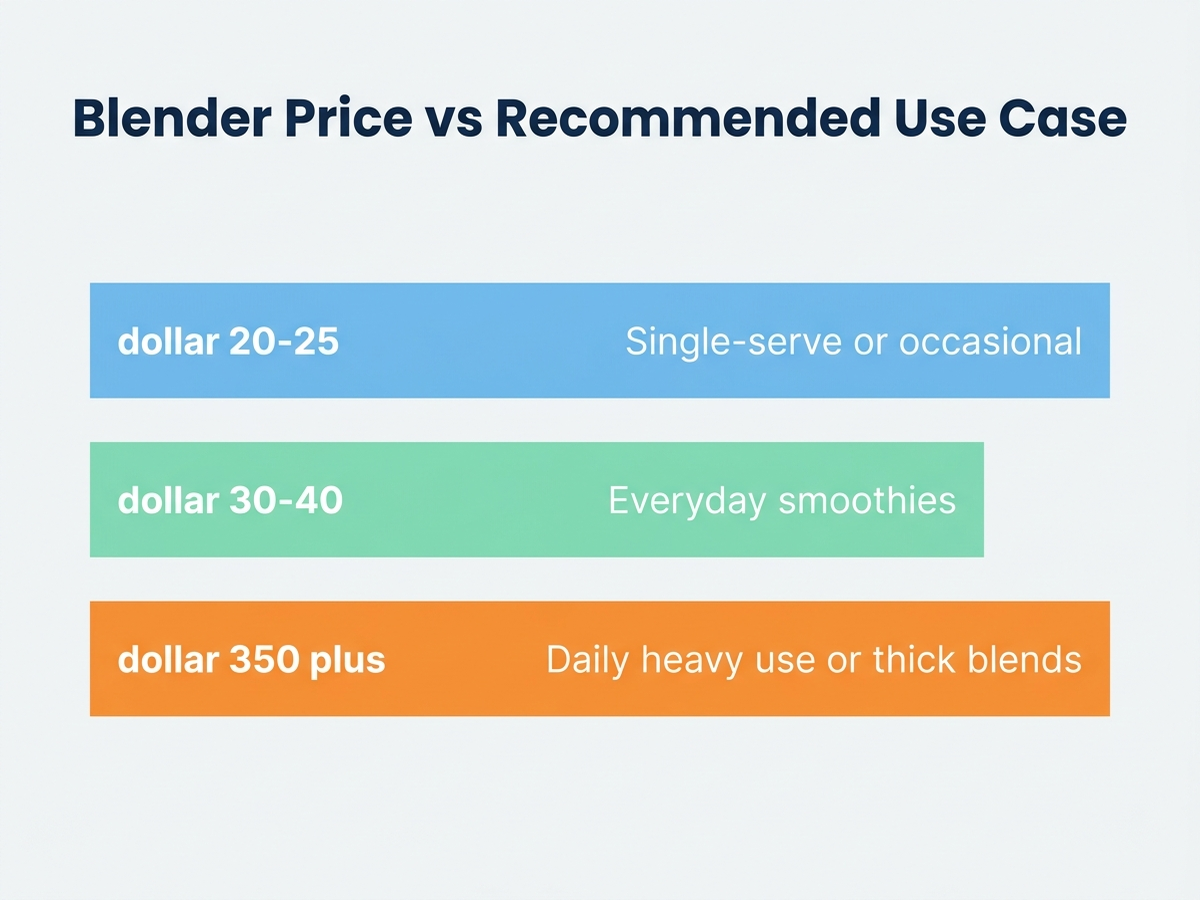
| Occasional (2-3x/week), standard smoothies | Budget model matches premium closely enough | Hamilton Beach Power Elite | ~$30–$40 |
| Single-serve, 1-2 people | Personal-format jar, no wasted capacity | Hamilton Beach Personal Blender | ~$20–$25 |
| Testing the habit, first blender | Cap downside risk before upgrading | Hamilton Beach Power Elite or Ninja BN701 | ~$30–$100 |
| Daily use, thick blends, want a decade of service | Premium motor and warranty pay for themselves | Vitamix 5200 | ~$349–$489 |
Decision Flowchart
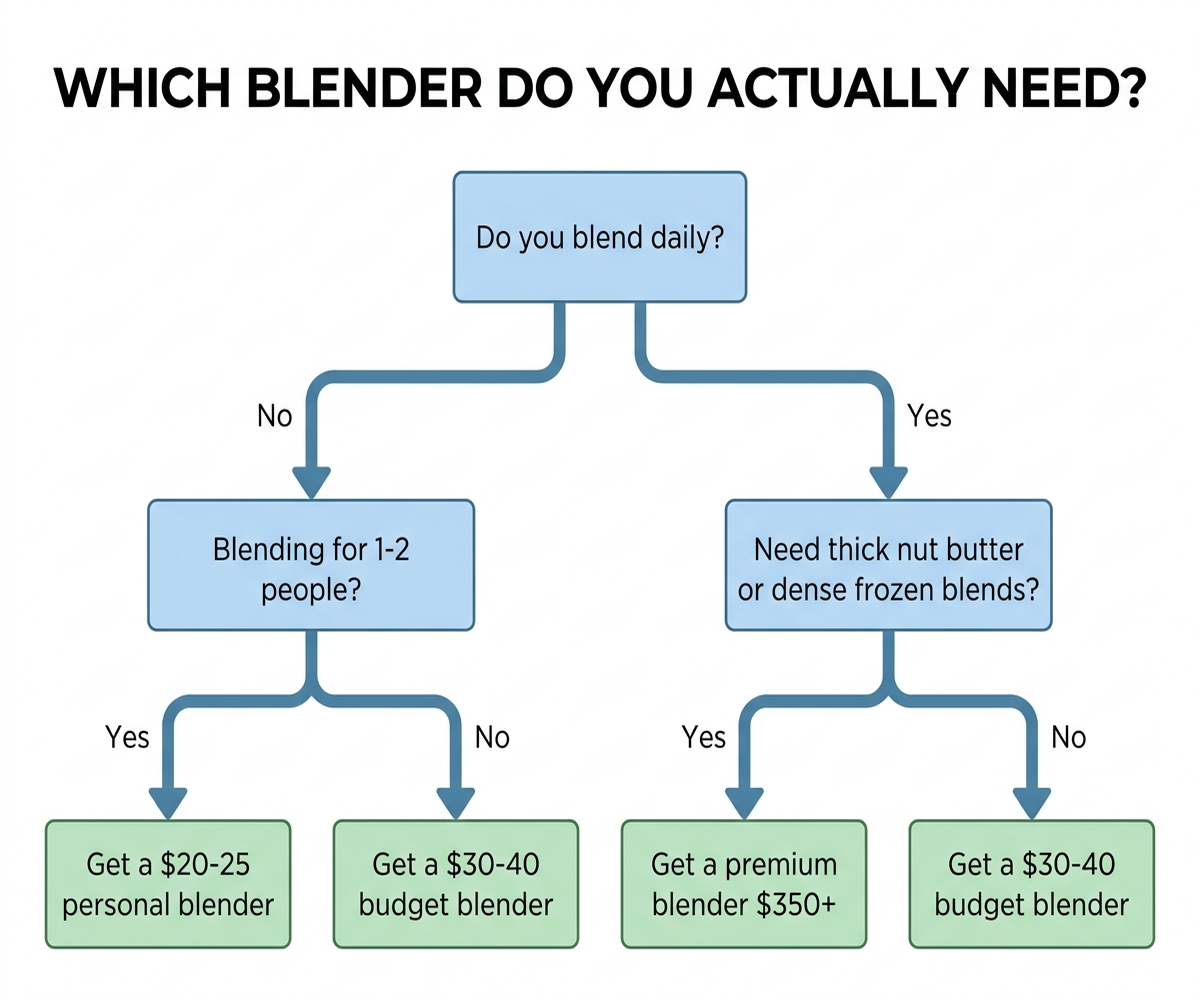
Start with how often you actually blend. If it’s a few times a week or less, a $30–$40 budget model handles the same smoothies and shakes a premium machine would, and the durability gap won’t accumulate fast enough to matter. If you’re blending for one or two people at a time, a compact single-serve blender avoids paying for capacity you won’t use. If you’re not sure the habit will stick, start at the low end and upgrade later if it does. Only when you blend daily, need thick low-liquid mixtures fully processed, or want a machine rated to last a decade does the premium price tag clearly pay for itself.
Limitations
This analysis relies on Consumer Reports’ published lab-testing conclusions, independent reporting from RTINGS, America’s Test Kitchen, and Tom’s Guide, aggregated amazon.com customer review sentiment, and manufacturer specifications, rather than our own side-by-side test of any specific model. Wear-pattern claims about budget blenders under heavy daily use are based on aggregated reviewer reports and general appliance-durability patterns rather than a controlled longevity study, and individual unit results vary with usage habits, ingredient mix, and unit-to-unit manufacturing variance. Prices fluctuate significantly on amazon.com and should be verified on the current product page before buying.
Bottom Line
Premium blenders win every lab test for a reason — the motor, the blade geometry, and the build quality really are better. But the households that need every bit of that advantage are a narrower group than “just buy the Vitamix” suggests: occasional blenders, single-serve users, and first-time buyers testing the habit all get most of the practical result from a $20–$40 machine, based on Consumer Reports’ own testing conclusions and aggregated review data. If daily heavy use, thick nut-butter-style blends, or a decade-long duty cycle don’t describe your kitchen, the data points toward saving the $300-plus and buying the $30 model instead.
Before you buy either one, it pays to check that the listing’s reviews are genuine and the price is competitive. That is exactly what Arekore does: paste the Amazon URL and our AI analyzes review authenticity, surfaces what the one-star reviews actually complain about, and compares pricing in about five minutes — so you end up with the blender that fits how often you actually cook, not the one the algorithm pushes hardest.