Soundbars 2026: 3 Living Rooms That Don't Need One

Soundbars are one of the most widely adopted home-audio categories in the U.S. — industry survey data from the Consumer Technology Association puts soundbar ownership at roughly 51% of U.S. households, and the global soundbar market is estimated at around $8 billion in 2026 by multiple industry research firms, with mid-single-digit annual growth projected through the early 2030s. That popularity is well-earned: modern TVs are thinner than ever, and thin cabinets can’t fit speaker drivers large enough to reproduce real bass or wide stereo separation. But a soundbar being the right upgrade for most living rooms doesn’t mean it’s the right upgrade for every living room. We looked at where the gains are smallest — and where skipping one is the more defensible purchase decision.
As an Amazon Associate, Arekore earns from qualifying purchases. The Amazon product links in this article include our affiliate tracking ID and may earn us a commission if you buy through them, at no additional cost to you. See our Links Policy for details on how we select products and how commissions do not influence our recommendations.
TL;DR
- Skip a soundbar if your TV is small and watched from close range, if you live in an apartment with shared walls or floors, or if your current TV already has above-average built-in audio.
- None of the soundbars discussed here are bad products — the issue is fit between the room and the category, not the hardware.
- If you skip the bar, a wireless TV headphone transmitter solves the dialogue-clarity problem that most people actually have, without the bass-transmission risk a subwoofer introduces in shared-wall housing.
How We Reached These Conclusions (Methodology)
This is an editorial analysis, not a hands-on test; we did not personally buy or use the products covered here. This guide synthesizes four sources: (a) industry market-sizing and household-penetration data on the U.S. soundbar category; (b) independent lab and usability testing from RTINGS, Consumer Reports, TechRadar, and Tom’s Guide covering both soundbars and built-in TV audio technology; (c) aggregated amazon.com customer reviews on best-selling soundbars and TV-headphone alternatives, sampled in October 2026, with sample sizes noted per product where available; and (d) manufacturer-published specifications, which we label explicitly as manufacturer claims rather than independently verified figures. We did not have access to return-rate data broken out by individual ASIN, so return and satisfaction patterns are discussed qualitatively based on recurring review themes, not precise percentages.
Three Ways Rooms Actually Get Better TV Audio
A soundbar isn’t the only path to better sound — it’s one of three, and which one fits depends on the room, not just the budget.
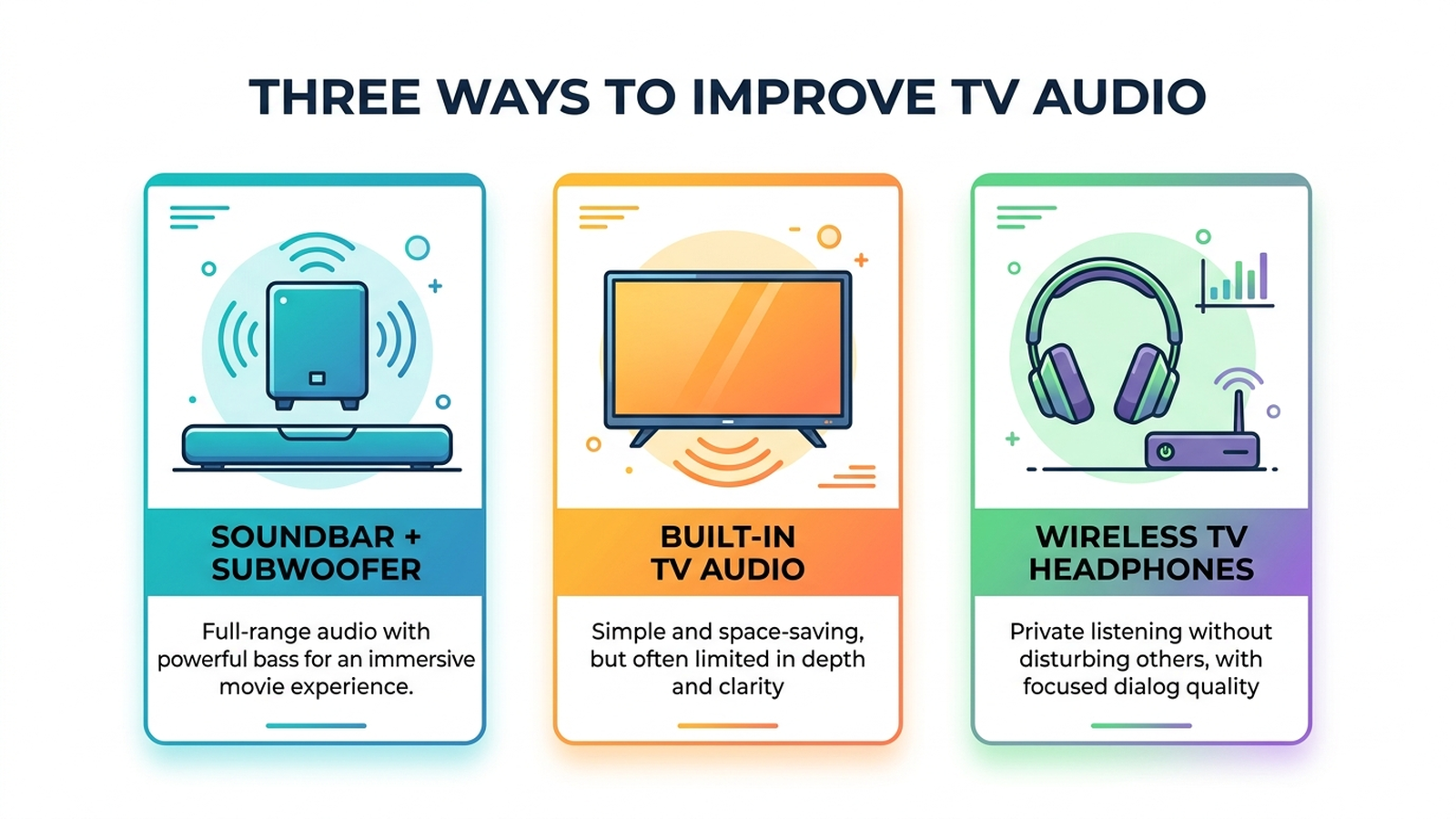
- Traditional soundbar + subwoofer. A single bar (or bar-plus-sub combo) sits below or in front of the TV and reproduces a wider stereo image, clearer dialogue, and real bass that thin TV speakers physically cannot. This is still the right answer for most living rooms, especially larger ones with multiple simultaneous listeners.
- Built-in advanced TV audio. Some current TVs already do more than their cabinet size suggests. Sony’s Acoustic Surface Audio+ technology, used on several Bravia OLED models, vibrates the screen itself with actuators behind the panel to produce sound — RTINGS lists Sony OLEDs among the best-sounding TVs it has tested, and TechRadar’s review of the Sony Bravia 8 II specifically notes it “sounds as good as it looks,” concluding that, unlike most OLEDs, you won’t definitively need to add a soundbar. Separately, LG has rolled out Dolby Atmos FlexConnect to select 2025 and 2026 OLED models via software update, letting the TV pair directly with wireless speakers (LG’s own Sound Suite M5/M7 line, per manufacturer specs) without routing through a traditional soundbar at all, per reporting from TechRadar and Tom’s Guide.
- Wireless TV headphone transmitter. A small transmitter plugs into the TV’s optical or headphone output and streams audio to a dedicated wireless headset, letting one or two people hear clear dialogue at any volume without filling the room with sound at all. This is the category most often overlooked by people assuming a soundbar is the only upgrade available.
The Products Being Compared
Avantree Ensemble (ASIN B08629PFFQ) is a wireless TV headphone and transmitter set built specifically for TV watching rather than general Bluetooth listening. Per Avantree’s published specs, it offers roughly 35 hours of playtime, optical/AUX/Bluetooth transmitter compatibility, and a “Clear Voice” dialogue-boost mode. It’s marketed toward seniors and late-night viewers who don’t want to disturb others in the room or through a wall.
Check the Avantree Ensemble on Amazon
VIZIO V-Series V21x-J8 (ASIN B09HMRJRH7) represents the budget end of the traditional-soundbar category: a 2.1-channel bar with a wireless subwoofer, Dolby Audio and DTS Virtual:X processing, and Bluetooth streaming, typically priced well under $150. It’s the kind of entry-level bar most likely to end up in the small, close-viewing-distance rooms this article argues against for soundbars generally — reviews of similarly specced budget bars, including Amazon’s own Fire TV Soundbar line, describe the virtualized surround effect as only marginally wider than native TV speakers at typical couch distances, per TechRadar’s testing.
Check the VIZIO V21x-J8 on Amazon
Samsung HW-Q990D (ASIN B0CZLZNJ86) and Sonos Arc Ultra (ASIN B0DFK28LBB) sit at the premium end — full Dolby Atmos height-channel systems with wireless rear speakers and subwoofers, the category’s genuine answer for a large living room with serious movie-night use. Both are strong products; they’re simply overbuilt for the three room profiles described below.
Check the Samsung HW-Q990D on Amazon · Check the Sonos Arc Ultra on Amazon
What Aggregated Reviews Say About Fit, Not Just Sound Quality
Spec sheets describe what a soundbar can reproduce. Reviews describe what happens once it’s installed in a specific room.
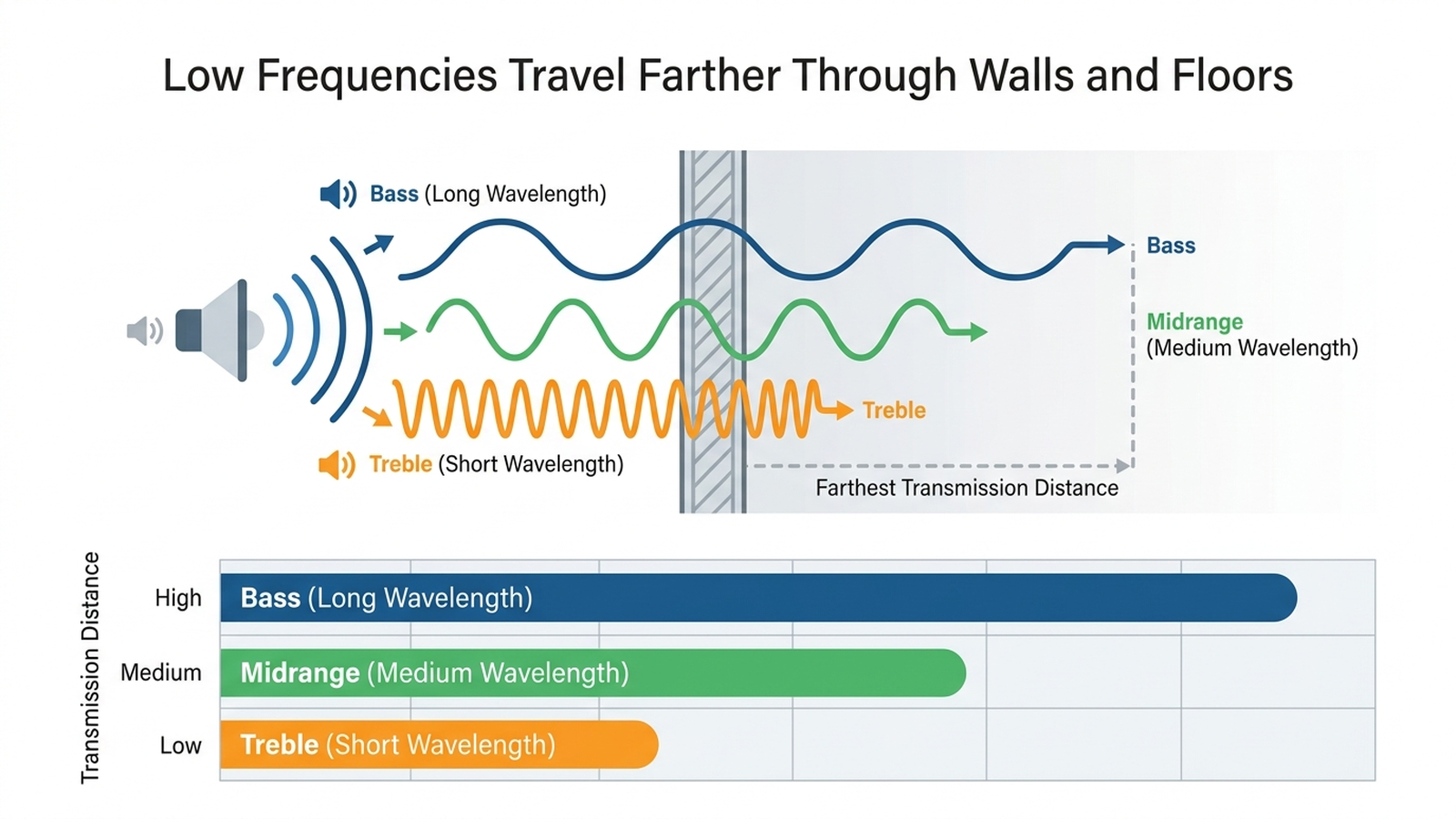
- Bass is the specific frequency range that causes apartment noise complaints. Home-theater and acoustics writeups consistently point to the subwoofer, not the soundbar itself, as the main source of neighbor friction — low frequencies travel through shared walls and floors far more efficiently than midrange or treble, meaning a subwoofer can be audible (and felt as vibration) a floor away even when the bar’s dialogue and effects channels aren’t. Several apartment-living writeups recommend placing the sub away from shared walls and decoupling it from hard flooring specifically because of this.
- Entry-level bars show the smallest gains in small rooms. TechRadar’s and other outlets’ testing of budget bars, including Amazon’s own Fire TV Soundbar line (hovering near a 70% five-star share per aggregated Amazon ratings), repeatedly notes that at typical close-couch viewing distances in a small room, the virtualized “wider” soundstage is only marginally different from the TV’s native speakers, and bass can sound thin or distorted on movie content rather than genuinely deeper.
- Wireless TV headphones solve the complaint people actually have. The most common TV-audio complaint — muddy dialogue, especially during action scenes with loud effects — is a clarity problem, not strictly a bass or width problem. A dedicated TV headphone transmitter with a dialogue-boost mode addresses that directly, and does it without adding a speaker that broadcasts into a shared space at all.
Comparison Table
Prices are approximate amazon.com figures as of 2026-10-21 and fluctuate.
| Option | Approx. price | Solves | Shared-wall friendly? | Amazon rating |
|---|---|---|---|---|
| Avantree Ensemble (TV headphones) | $90–$110 | Dialogue clarity, zero room noise | Yes | Mixed-to-positive, per aggregated reviews |
| VIZIO V21x-J8 (budget soundbar) | $90–$130 | Modest width/bass gain over TV speakers | No — includes a subwoofer | Mixed |
| Samsung HW-Q990D (premium Atmos) | $1,100–$1,500 | Full home-theater surround | No — strongest bass output in this set | Strong, per aggregated reviews |
| Sonos Arc Ultra (premium Atmos) | $950–$1,000 | Full home-theater surround | No — includes optional wireless sub | Strong, per aggregated reviews |
| Built-in TV audio (Sony Acoustic Surface Audio+, select LG OLEDs with FlexConnect) | $0 (already owned) | Adequate-to-strong audio with no added hardware | Yes | N/A — feature of TV already purchased |
Should You Skip It? A Decision Guide
This isn’t about which soundbar sounds best in a lab — it’s about whether your specific room is a good fit for the category at all.
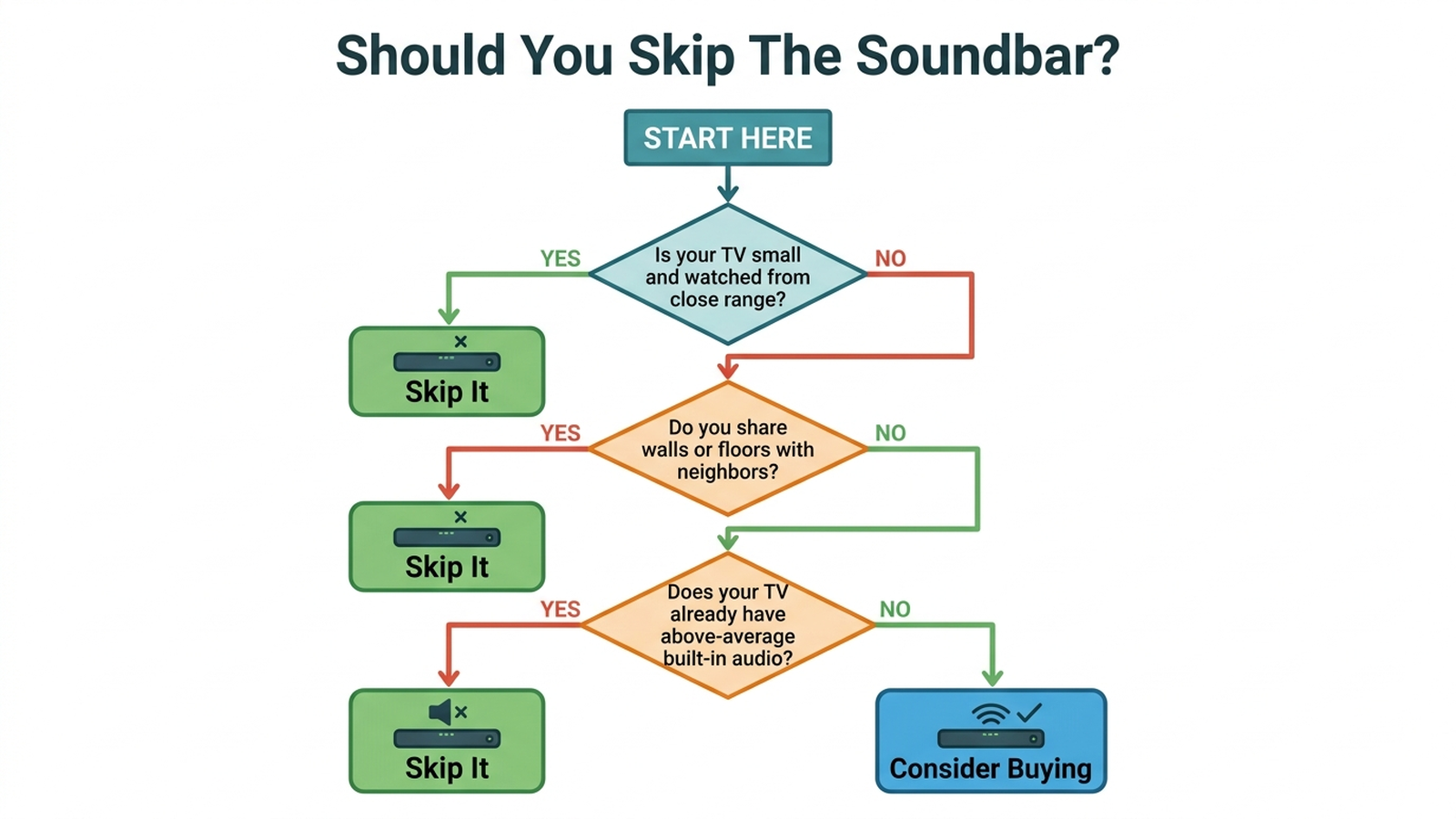
1. Your TV is small and watched from close range. A 32-to-43-inch bedroom or dorm-room TV, watched from a few feet away, doesn’t have the physical width for a soundbar’s stereo-separation gains to register the way they do on a 65-inch living-room set six-plus feet from the couch. Aggregated reviews on entry-level bars repeatedly describe this exact scenario as producing only a marginal improvement over the TV’s own speakers.
2. You live somewhere with shared walls or floors. Apartments, condos, and attached townhomes are the setting where a subwoofer’s bass output is most likely to generate a noise complaint, because low frequencies propagate through building structure far more efficiently than the mid and high frequencies that carry dialogue. A wireless TV headphone transmitter gets the clarity gain most people actually want, with zero risk of becoming a dispute with the downstairs neighbor.
3. Your TV already has above-average built-in audio. If you bought a Sony Bravia OLED with Acoustic Surface Audio+, or an LG OLED on the list of models supporting Dolby Atmos FlexConnect, you’ve already paid for meaningfully better-than-average built-in sound. Adding a traditional soundbar on top duplicates a capability you already own, rather than fixing a gap.
If none of these three apply — your TV is large, your household doesn’t share walls or floors with neighbors sensitive to bass, and your current TV’s speakers are the thin, generic kind most mid-range sets ship with — a soundbar remains the single highest-impact audio upgrade available for the price.
Warranty and Return-Policy Notes
Amazon’s standard return window is 30 days from delivery for most items in this category. Manufacturer warranties are separate from Amazon’s return window and vary by brand:
- Samsung publishes a 1-year limited warranty on the HW-Q990D per the manufacturer; terms can vary by purchase channel.
- Sonos publishes a 1-year limited warranty on the Arc Ultra, extendable in some regions through product registration, per the manufacturer.
- VIZIO publishes a 1-year limited warranty on its V-Series soundbars per the manufacturer.
- Avantree publishes its own standard limited warranty on TV headphone sets; terms vary by model, so check the current listing before buying.
If a defect appears after Amazon’s return window closes, the manufacturer’s warranty, not Amazon, is the path to pursue.
Recommendations
- If any of the three skip conditions above apply to you: don’t add a traditional soundbar this cycle. A wireless TV headphone transmitter like the Avantree Ensemble solves the dialogue-clarity complaint most people actually have, without a subwoofer’s shared-wall risk.
- If your room is small but you still want some bar-style improvement: a budget 2.1-channel bar like the VIZIO V21x-J8 is a reasonable low-cost test, but temper expectations on how much wider the soundstage will actually feel at close range.
- If your living room is large, doesn’t share walls with sensitive neighbors, and your TV has generic built-in speakers: a full Atmos system like the Samsung HW-Q990D or Sonos Arc Ultra remains the category’s strongest option and is worth the investment.
- If you already own a TV with Sony Acoustic Surface Audio+ or LG Dolby Atmos FlexConnect support: try the built-in audio for a few weeks before buying anything — you may have already paid for the upgrade you’re about to buy again.
Limitations
This analysis relies on publicly available market data, independent testing from RTINGS, Consumer Reports, TechRadar, and Tom’s Guide, aggregated amazon.com customer reviews, and manufacturer-published specifications; we did not personally test any of the products covered here. Noise-transmission outcomes depend heavily on specific building construction, unit layout, and neighbor sensitivity, none of which this analysis can predict for any individual home. Prices, warranty terms, and TV model compatibility for features like Dolby Atmos FlexConnect are current as of the time of writing and are subject to change; confirm current terms and compatibility on the product listing or manufacturer site before purchasing.
Bottom Line
Every product in this comparison does its job well — the HW-Q990D and Arc Ultra are genuinely excellent full-room systems, the VIZIO bar is a fair budget option for what it is, and the Avantree Ensemble solves a clarity problem a soundbar is often bought to fix anyway. The risk in this category isn’t buying a bad soundbar; it’s buying a soundbar at all when a small room, a shared wall, or a TV with already-above-average audio makes a different option the better fit. Checking those three things first, before comparing spec sheets, is the single highest-leverage step in this purchase decision.
Before you buy, paste the product link into Arekore — our AI assistant checks review authenticity, surfaces what the one-star reviews actually complain about, and compares prices, free, in about five minutes.