Smart Scale Giving Wrong Readings? Here's Why (2026)
TL;DR. A smart scale that shows a different weight every time you step on it usually isn’t broken — it’s reacting to real, measurable variables: hydration level, what floor it’s sitting on, a low battery, or a weak Wi-Fi/Bluetooth signal that lets the app log a bad reading. Body-composition numbers (body fat %, muscle mass) swing far more than raw weight because bioelectrical impedance is inherently noisy; the weight sensor itself is usually the most reliable part of the device. Independent lab testing from Consumer Reports has also found real accuracy differences between models — some read consistently within a fraction of a pound, others have measurably drifted by several pounds in controlled tests.
A note on links and methodology
As an Amazon Associate, Arekore earns from qualifying purchases. The Amazon product links in this article include our affiliate tracking ID and may earn us a commission if you buy through them, at no additional cost to you. See our Links Policy for details on how we select products and how commissions do not influence our recommendations.
We did not personally test the scales recommended below. Every diagnostic and product claim in this article is an editorial synthesis of public data, cited inline.
Methodology
This is an editorial analysis based on publicly available data collected in late August and early September 2026. We did not run our own controlled scale-accuracy tests; instead we synthesized:
- Consumer Reports’ bathroom scale lab testing methodology and findings, which weigh a calibrated reference scale against consumer models at seven weight points (25–200 lb), test repeat-reading consistency, and test unevenly distributed weight (standing off-center).
- Independent scale reviews and testing coverage from Tom’s Guide and TechRadar, covering current smart scale models sold on amazon.com.
- Manufacturer troubleshooting documentation from RENPHO, eufy, Wyze, and Withings describing low-battery, Wi-Fi-sync-failure, and surface-related error states.
- Clinical and health-publication explainers (Healthline, BodySpec) on how bioelectrical impedance analysis (BIA) works and why hydration and other physiological factors affect it.
- Aggregated Amazon customer review sentiment on amazon.com for the specific products recommended in this article, read via each product’s “Top reviews” and customer Q&A sections in early September 2026. We do not report a precise review-count N because Amazon’s review panels do not expose a stable, independently verifiable count; a fabricated number would be misleading.
We deliberately do not simulate a specific personal experience, invent a fake reviewer persona, or claim we personally own the units discussed. Treat the diagnostics below as a synthesis of documented testing and manufacturer guidance, not a substitute for checking your own unit’s manual.
1. Weight readings and body-fat readings fail for different reasons
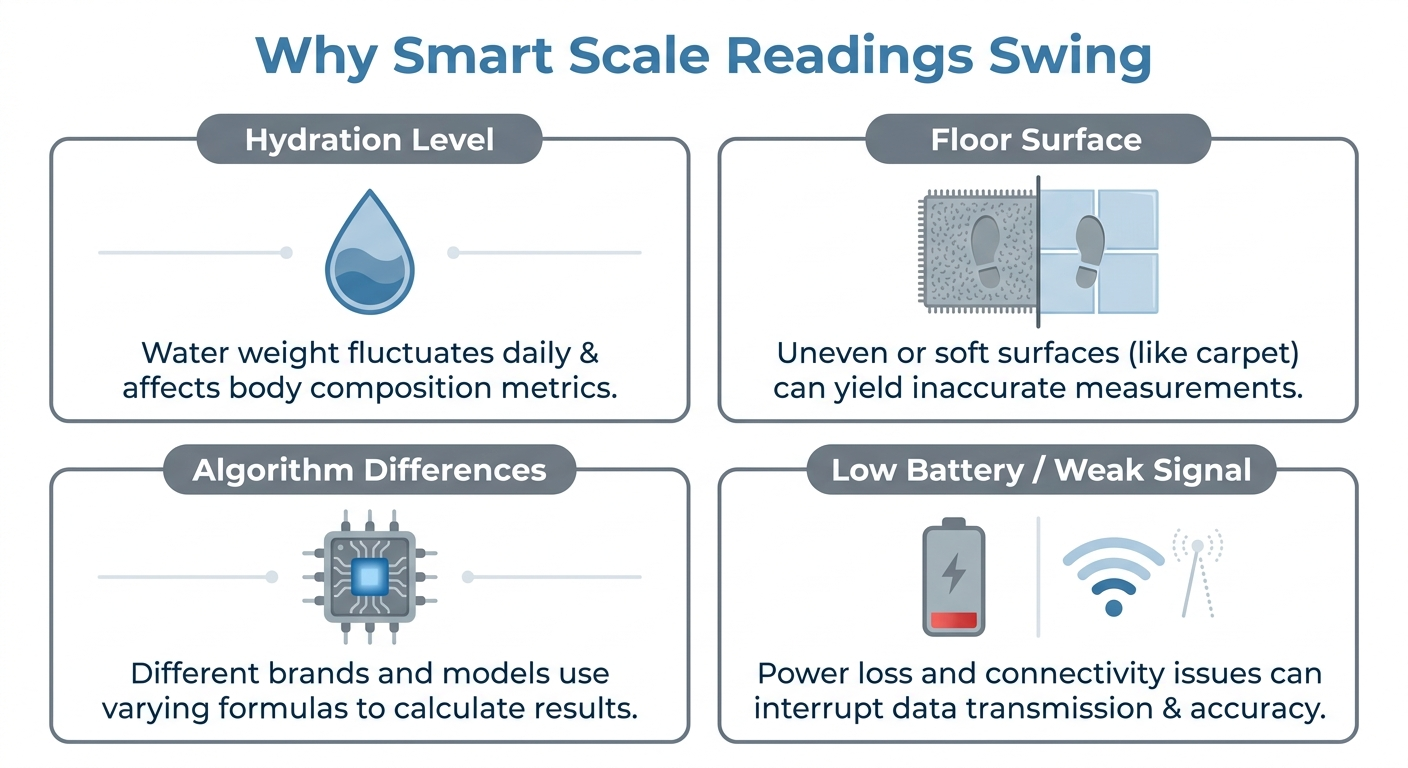
The single most useful thing to know before troubleshooting a smart scale is that it is really two instruments in one body: a mechanical weight sensor (a strain gauge, essentially the same technology as a basic bathroom scale) and a bioelectrical impedance analysis (BIA) circuit that estimates body fat, muscle mass, and other composition metrics by sending a weak electrical current through your feet.
These fail differently:
- The weight number is the more mechanically stable of the two. According to health-publication explainers synthesizing BIA research, the weight reading is reliable, while body composition estimates are rough approximations that vary based on hydration and other factors. If your weight is jumping by more than a pound or two between back-to-back weigh-ins with no food, drink, or clothing change in between, that points to a hardware or surface problem, not a physiological one.
- The body-fat and muscle-mass numbers swing for physiological reasons that have nothing to do with the scale being defective. BIA is affected by hydration, salt intake, food timing, recent workouts, sleep, and even travel, and studies summarized by health publications show these estimates can miss fat-mass totals by roughly 5–10 lb depending on conditions — a day-to-day swing of several percentage points on hydration alone is normal, not a malfunction. Because the electrical current largely travels through the lower body, BIA scales are also making an assumption about upper-body composition based on a limited measurement path, another built-in source of variance across every brand.
The practical takeaway: if it’s the body-fat percentage jumping around, that’s largely working as designed — track the trend over weeks, not the single-day number. If it’s the weight in pounds that’s inconsistent, move to the causes below.
2. Floor surface is the most common cause of inconsistent weight readings
Manufacturer troubleshooting documentation from scale makers is consistent on this point: a scale’s four feet each need to press evenly into a hard, flat surface for the internal sensors to register weight correctly. Carpet fibers compress unevenly under each foot, and different rooms have different floor firmness, so the same scale can read differently in a carpeted bedroom than on bathroom tile.
This matters more for smart scales than old-fashioned mechanical scales, because BIA measurement additionally requires a stable, flat stance with even weight distribution for the electrical circuit to read consistently — an uneven surface throws off both the weight sensor and the composition estimate at once.
Fix: move the scale to the hardest, flattest floor in your home — tile, hardwood, or vinyl over concrete — and leave it there permanently rather than moving it between rooms. If a hard floor isn’t available, manufacturer guidance recommends placing a rigid board (not a soft mat) under the scale on carpet, then re-calibrating in that new spot.
3. Low battery and weak Wi-Fi/Bluetooth sync are underrated causes
Two more mundane causes show up repeatedly in manufacturer support documentation and aggregated customer review sentiment for connected scales:
- Low battery. Several models display an explicit low-battery code (RENPHO’s shows “Lo”) but continue to attempt a reading anyway with degraded sensor voltage, producing numbers that drift before the scale finally refuses to power on. Manufacturer guidance recommends replacing batteries at the first sign of an inconsistent reading, not waiting for a hard failure.
- Weak Wi-Fi signal during app sync. Wi-Fi-connected scales (as opposed to Bluetooth-only ones) attempt to upload each reading to the companion app immediately; a weak signal can produce a failed sync (RENPHO’s app shows “FAIL” in this case) that either drops the reading entirely or, on some models, logs a stale cached value instead of the fresh one. This produces a specific symptom worth recognizing: the number on the scale’s own display is correct, but the number that shows up in the app days later doesn’t match what you saw when you stepped off.
If your app history doesn’t match what you remember seeing on the scale’s display, the sync — not the sensor — is the likely culprit.
4. Real accuracy and consistency differences exist between brands
This is the part that isn’t just about user error. Consumer Reports’ bathroom scale testing — which weighs seven calibrated reference amounts from 25 to 200 lb, repeats each measurement to test consistency, and tests off-center standing — has found measurable differences between models. In one round of testing across six digital scales, Consumer Reports found one model, the Qardio QardioBase, consistently overestimated weight by 6 to 10 lb — a hardware/calibration issue specific to that unit, not something a user could fix by changing floors or batteries.
Beyond single-model outliers, algorithm-level differences are baked into how every BIA scale works: composition readings can vary by roughly 3–5% or more between different scales measuring the same person under identical conditions, because manufacturers use different proprietary algorithms, electrode configurations, and population reference datasets. That’s a legitimate reason two scales in the same household will never fully agree on body-fat percentage, even when both are functioning correctly.
5. How to actually get a consistent reading
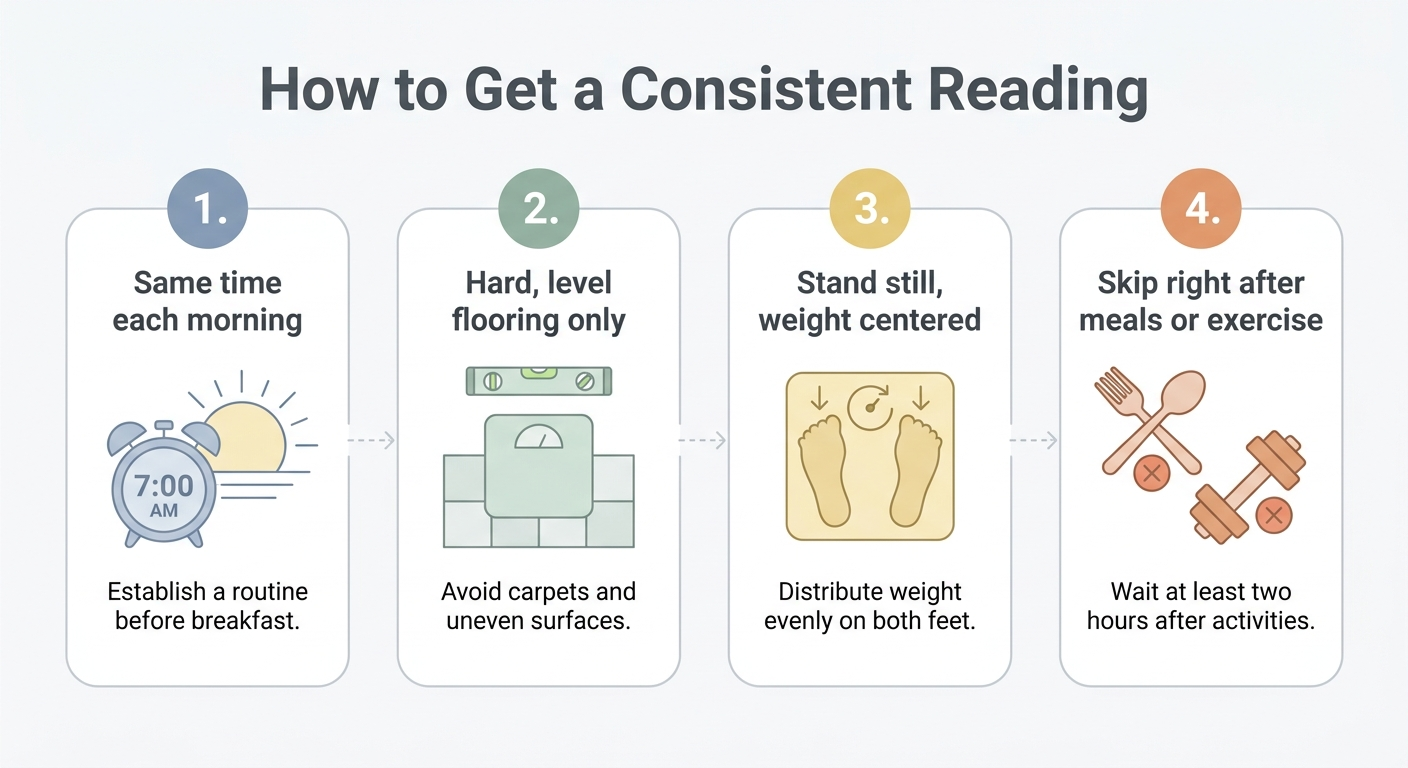
- Weigh at the same time of day, under the same conditions — most commonly recommended as first thing in the morning, before food or drink, minimally clothed. This controls for the hydration and food-timing variance described above.
- Keep the scale permanently on a hard, level floor. Don’t move it between a tile bathroom and a carpeted bedroom.
- Stand still with your weight centered and evenly distributed on both feet until the reading locks.
- Replace batteries at the first sign of an inconsistent reading, not after a full failure.
- Confirm Wi-Fi signal strength if you use a Wi-Fi-connected model, and check the app log against the scale’s on-device display after a sync to catch dropped readings.
- Re-calibrate after any move, using the scale’s built-in calibration mode on the new surface, per manufacturer instructions.
- Track weight trend over 1–2 weeks, not single-day swings, and treat body-composition numbers (fat %, muscle mass) as directional rather than precise — this is a documented limitation of BIA technology across every brand, not a defect in your specific unit.
6. If it’s still inconsistent after all of that: editorial recommendations by use case
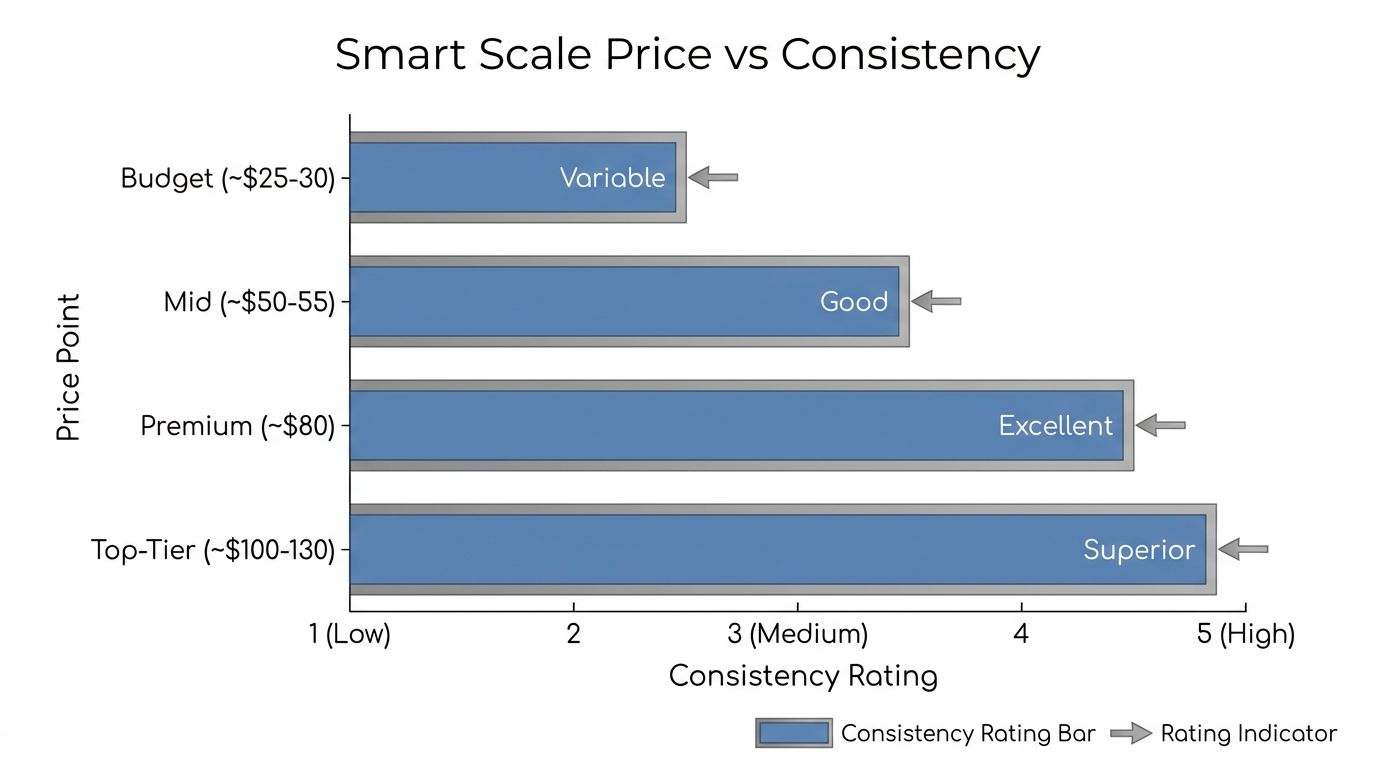
If a scale is still giving wildly inconsistent weight readings (not body-fat readings) after checking floor surface, battery, and calibration, the unit itself may be the problem. Based on the testing and review sources above, here’s how current amazon.com options compare by scenario. Prices as of 2026-09-03; verify current pricing on the product page before buying, as these are not live-updated.
| Model | Price (approx., as of 2026-09-03) | Best for | What the data says |
|---|---|---|---|
| Wyze Scale S | ~$25–30 | Budget, weight-only tracking | Bluetooth-only 4-electrode BIA scale; aggregated Amazon sentiment is favorable at this price tier, though Wi-Fi sync isn’t a factor since it’s Bluetooth-only |
| RENPHO Core 1S | ~$25–35 | Budget with app history | High review volume on amazon.com; manufacturer documentation explicitly addresses the low-battery (“Lo”) and failed-sync (“FAIL”) states covered above |
| eufy Smart Scale P2 Pro | ~$55–75 | Households wanting more metrics | 16 tracked measurements and a 50g/0.1 lb sensor resolution spec; mid-tier pricing between the budget and premium options here |
| Withings Body Smart | ~$99–130 | Highest data confidence | Clinically validated in development per manufacturer claims (an unverified manufacturer statement, not an independent clinical trial we reviewed); tracks weight to a claimed 50-gram resolution |
Editorial read: for weight-only tracking where consistency matters most, the data above doesn’t show a strong accuracy gap between the budget and premium tiers — the floor-surface and battery fixes in section 5 matter more than which of these four you buy. The premium tier’s advantage is in additional validated metrics (heart rate, more granular body composition) and app polish, not in fixing the fundamental BIA consistency limitations that apply to every brand.
Limitations
This analysis relies on publicly available manufacturer documentation, third-party lab testing summaries, and aggregated customer review sentiment — we did not run our own side-by-side accuracy tests across these four models. Consumer Reports’ specific test results cited above (the Qardio QardioBase overestimation finding) apply to the model and testing round described in their published methodology and may not generalize to every model on the market today. Individual unit-to-unit variance, the specific floor in your home, and your own hydration patterns will all affect your results more than which brand you choose. If precise body composition data matters for a medical reason, a home BIA scale is not a substitute for a clinical-grade measurement (e.g., DEXA scan) discussed with a healthcare provider.
Bottom line
Before assuming a smart scale is broken, rule out the boring causes first: soft or uneven flooring, a low battery, a weak Wi-Fi sync, and normal BIA variance in the body-composition numbers. Move the scale to a permanent spot on a hard floor, weigh under consistent conditions, and track the trend rather than any single reading. Visit Arekore to verify current pricing and availability on any of these models before buying.