Weber vs Traeger: Which Grill Is Right for You in 2026?
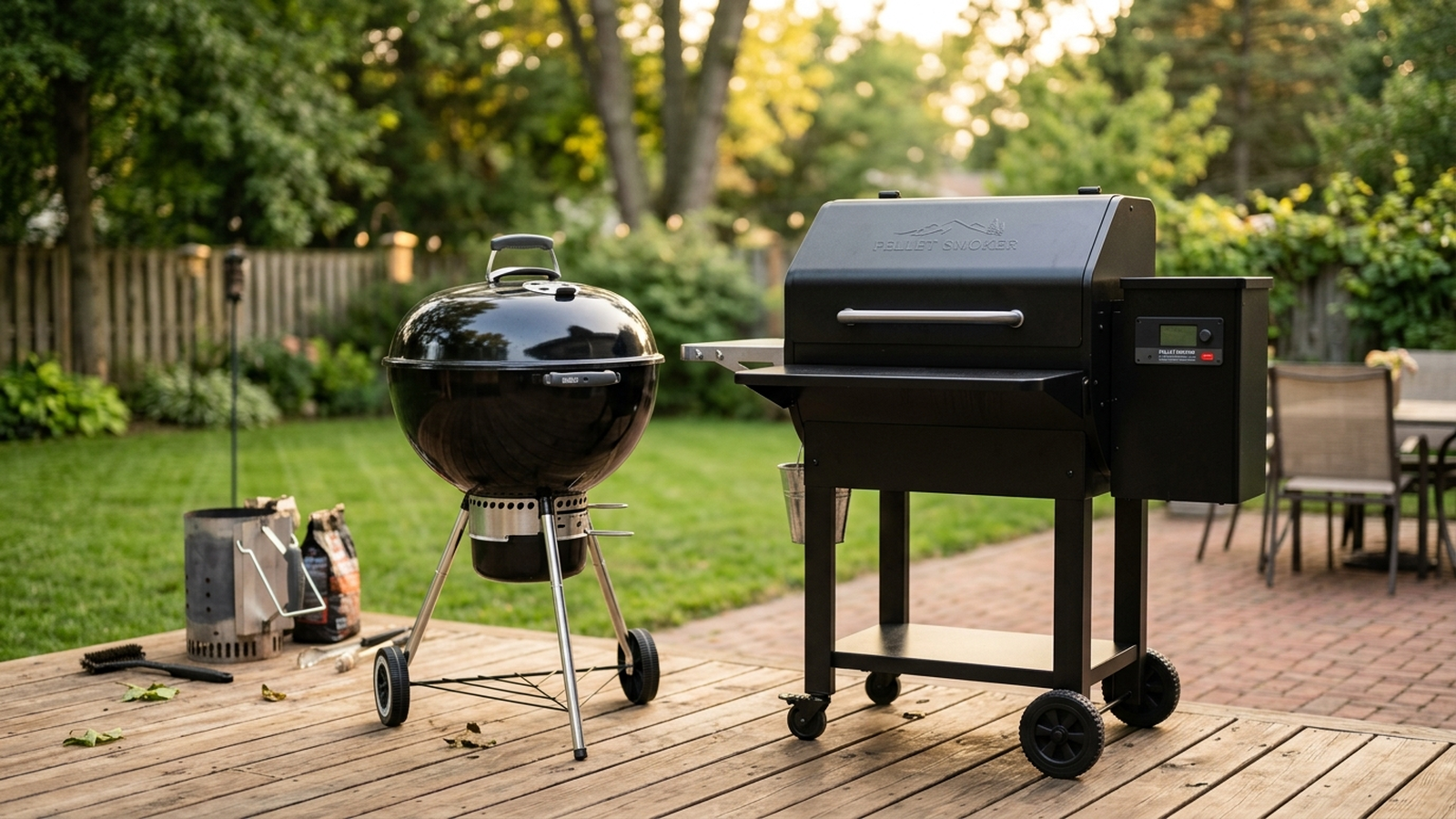
“Weber vs Traeger” is a strange comparison on paper — Weber built its name on charcoal and gas, Traeger built its name on wood-pellet smokers, and for most of both companies’ histories they barely competed for the same dollar. That changed once Weber entered pellet grills with the SmokeFire and, later, the Searwood line, and once Traeger pushed into propane with the Flatrock griddle. This guide treats the question the way most buyers actually experience it: not “which brand is better,” but “which cooking technology — and which specific model — fits how I actually cook.” We rely on HPBA (Hearth, Patio & Barbecue Association) ownership data, Consumer Reports testing, and aggregated Amazon customer sentiment, rather than a brand-loyalty argument.
As an Amazon Associate, Arekore earns from qualifying purchases. The Amazon product links in this article include our affiliate tracking ID and may earn us a commission if you buy through them, at no additional cost to you. See our Links Policy for details on how we select products and how commissions do not influence our recommendations.
TL;DR / Quick Verdict
- Best for traditional live-fire grilling (steaks, burgers, dogs): the Weber Genesis E-325S (gas) or the Weber Original Kettle Premium 22-Inch (charcoal) — direct-flame cooking that a pellet grill cannot fully replicate for a hard sear.
- Best for low-and-slow smoking with the least hands-on effort: the Traeger Pro 780 — auger-fed, app-controlled, and the pellet category’s best-selling mid-tier model, built for ribs, brisket, and pulled pork without babysitting a fire.
- Best if you want both smoke and a hot sear in one grill: the Weber Searwood 600 — Weber’s pellet line adds a direct-flame “Sear Zone” that Traeger’s mainstream lineup does not offer, at the cost of roughly $300 more than a comparable Traeger.
- Cheapest entry point into real backyard cooking: the Weber Original Kettle, at well under $250 — charcoal kettles remain the single most-owned grill format in the US by a wide margin.
- The factor buyers underweight: pellet grills (Traeger and Weber’s pellet line alike) depend on a working auger, hopper, and electronics — components that charcoal and gas grills simply don’t have, and that are the single most common source of complaints and repairs across the category.
How We Reached These Conclusions (Methodology)
This is an editorial analysis, not a hands-on review; we did not personally test the grills covered here. This guide synthesizes (a) aggregated amazon.com customer ratings and review substance, sampled in October 2026 — for example, Amazon listings for the Traeger Pro 780 show ratings in the mid-4-star range across hundreds of verified reviews; (b) independent third-party testing, principally Consumer Reports’ grill test program, which evaluates heat evenness, indirect-cooking performance, and durability, and has specifically reviewed the Traeger Ironwood 650 and multiple Weber charcoal and pellet models; (c) ownership and market data from the Hearth, Patio & Barbecue Association (HPBA), the industry’s primary trade group; and (d) manufacturer specifications for cooking area, temperature range, and warranty terms. Where we cite a manufacturer figure, we label it as a manufacturer claim rather than an independently verified result. Prices are amazon.com figures at the time of writing and change frequently.
Technical Approach: Three Ways to Apply Heat
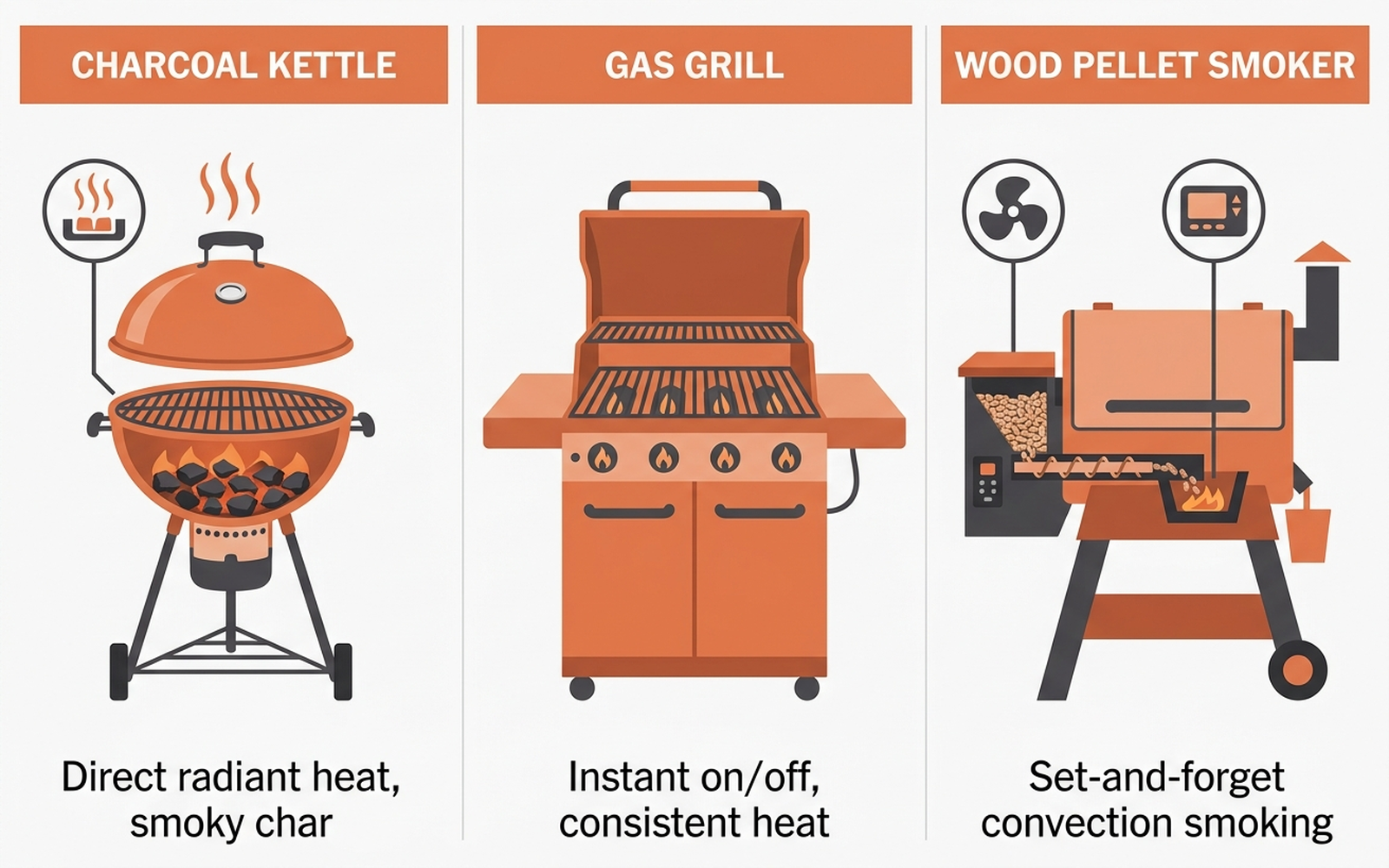
Before comparing specific models, it helps to understand that “Weber vs Traeger” is really a choice between three distinct heating methods, and Weber alone now makes grills in all three categories.
- Charcoal (Weber’s original category): burning charcoal briquettes or lump charcoal directly under the food produces the highest peak temperatures of the three methods and a distinct smoky char that reviewers and pitmasters consistently describe as the benchmark flavor for live-fire cooking. The tradeoff is manual fire management — lighting, venting, and adding coals — and no realistic way to hold an exact temperature for an 8-hour cook unmonitored.
- Gas (Weber’s other original category): propane or natural-gas burners under cast-iron or porcelain-enameled grates give near-instant startup, precise burner-by-burner temperature control, and no ash cleanup, at the cost of a milder flavor profile than charcoal — most reviewers agree gas cannot fully replicate charcoal’s char.
- Wood pellet (Traeger’s entire category, and now part of Weber’s lineup too): an electric auger feeds compressed hardwood pellets into a firepot, where a fan maintains convection airflow and a digital controller holds a set temperature automatically, often with WiFi/app control. This is the “smoker that behaves like an oven” category — it excels at unattended low-and-slow cooks (ribs, brisket, pulled pork) but tops out at a lower maximum sear temperature on most models than a dedicated gas or charcoal grill, and it is the only one of the three with moving electronic parts (auger motor, fan, controller board) that can fail.
HPBA’s State of the Barbecue Industry survey found that among US grill owners, 65% own a charcoal grill and 63% own a gas grill, while only 9% own a wood-pellet grill — pellet is still a minority category even as it gets disproportionate media coverage, which is worth keeping in mind before assuming “everyone is switching to Traeger.”
Head-to-Head: Entry-Level Charcoal vs Pellet (~$140–$1,000)
Weber Original Kettle Premium 22-Inch is the archetypal backyard charcoal grill — a porcelain-enameled steel bowl and dome lid, a built-in lid thermometer, and Weber’s “One-Touch” cleaning system that sweeps ash into a removable catch pan with a lever. It is one of the best-reviewed grills on Amazon at any price, commonly cited for how little changes year to year: Weber has sold a version of this kettle shape since the 1950s, and replacement parts (grates, wheels, vent assemblies) remain available decades after purchase, a durability factor independent reviewers specifically credit Weber for across its charcoal lineup. The standard Original Kettle runs around $139 on Amazon, with the Premium trim (better handle, hinged grate for adding coals) in the $219–$249 range depending on color (as of 2026-10-13).
Check the Weber Original Kettle Premium 22-Inch on Amazon
Traeger Pro 780 is Traeger’s mainstream mid-size pellet grill: 780 square inches of two-tier cooking space, a 500°F maximum temperature (manufacturer claim), and WiFIRE app control that lets a cook monitor and adjust the grill remotely. Amazon listings show ratings in the 4.4–4.6 range, and independent long-term reviews describe it as a dependable, if unremarkable, workhorse rather than a class-leading unit — Consumer Reports’ broader pellet-grill testing has rated competing Traeger models like the Ironwood 650 as solid performers without rating them best-in-class for the price. The most consistent criticism across owner reviews, on Traeger and competing pellet brands alike, is the auger: a pellet grill’s auger motor is a wear part, and forum threads and consumer-complaint sites document jams and, less commonly, motor failures within the first year on a minority of units — a risk that simply does not exist on a charcoal kettle. It typically lists around $999 on Amazon (as of 2026-10-13).
Check the Traeger Pro 780 on Amazon
Verdict at this tier: these two are not really substitutes for each other — the Kettle is a $150–$250 charcoal grill and the Pro 780 is a $1,000 smoker-oven hybrid. Buy the Kettle if the budget is fixed under $300 or the priority is live-fire char; buy the Pro 780 if the priority is unattended low-and-slow cooking and the budget supports it.
Head-to-Head: Gas Grill vs Direct-Flame Pellet Grill (~$850–$1,300)
Weber Genesis E-325S is Weber’s mainstream gas flagship: three stainless-steel burners rated around 39,000 BTU (manufacturer claim), porcelain-enameled cast-iron grates, and a Grease Management System that channels drippings away from the burners to reduce flare-ups. Consumer Reports’ testing has repeatedly placed Weber’s Genesis-class grills among the top performers for heat evenness, and Amazon reviews are consistently in the high-4-star range, with assembly difficulty — not cooking performance — the most common complaint. It typically lists in the $850–$950 range on Amazon (as of 2026-10-13).
Check the Weber Genesis E-325S on Amazon
Weber Searwood 600 is Weber’s answer to the “I want smoke flavor but also need to sear a steak” problem that pure pellet grills struggle with. It runs the same auger-and-firepot pellet mechanism as a Traeger, but adds a dedicated “Sear Zone” grate directly over the firebox that independent testing from AmazingRibs measured reaching a true 600°F across the grate — meaningfully hotter than the Traeger Pro 780’s 500°F ceiling (manufacturer claim), and hot enough for a real crust on a steak without finishing it on a separate grill. Early Weber pellet grills (the first-generation SmokeFire) had documented grease-fire and temperature-control problems; reviewers testing the Gen-2 SmokeFire and the newer Searwood line report those issues largely resolved, with Weber’s porcelain-enameled steel construction holding up better against rust than typical powder-coated competitors. It typically runs close to $999–$1,299 on Amazon depending on configuration (as of 2026-10-13), putting it on par with or above the Traeger Pro 780.
Check the Weber Searwood 600 on Amazon
Verdict at this tier: choose the Genesis if direct-flame grilling (steaks, burgers, kebabs) is the primary use case and you don’t want pellet-grill maintenance at all. Choose the Searwood if you specifically want one grill that can both smoke low-and-slow and sear hot — a job the Traeger Pro 780 cannot do as well, since its max temperature and lack of a dedicated sear grate leave it better suited to indirect cooking than a hard crust.
Comparison Table
| Model | Fuel type | Cooking area | Max temp | Price (as of 2026-10-13) | Warranty |
|---|---|---|---|---|---|
| Weber Original Kettle Premium 22” | Charcoal | ~363 sq in | N/A (fire-dependent) | $219–$249 | 10-year on bowl/lid |
| Weber Genesis E-325S | Gas (propane/natural gas) | ~624 sq in | ~39,000 BTU | $850–$950 | 10-year on burner tubes/grates |
| Traeger Pro 780 | Wood pellet | 780 sq in | 500°F | ~$999 | 3-year |
| Weber Searwood 600 | Wood pellet + direct sear | ~648 sq in | 600°F (Sear Zone) | $999–$1,299 | 5-year |
All figures except the Searwood’s 600°F are manufacturer-published specifications, not independently re-measured in this analysis; the Searwood figure is the one exception, independently confirmed by AmazingRibs’ testing (see the Gas Grill vs Direct-Flame Pellet Grill section above). Prices are amazon.com listing figures sampled in October 2026 and should be reverified before purchase, since pellet-grill and gas-grill pricing fluctuates with seasonal demand.
Maintenance: What Each Fuel Type Actually Requires
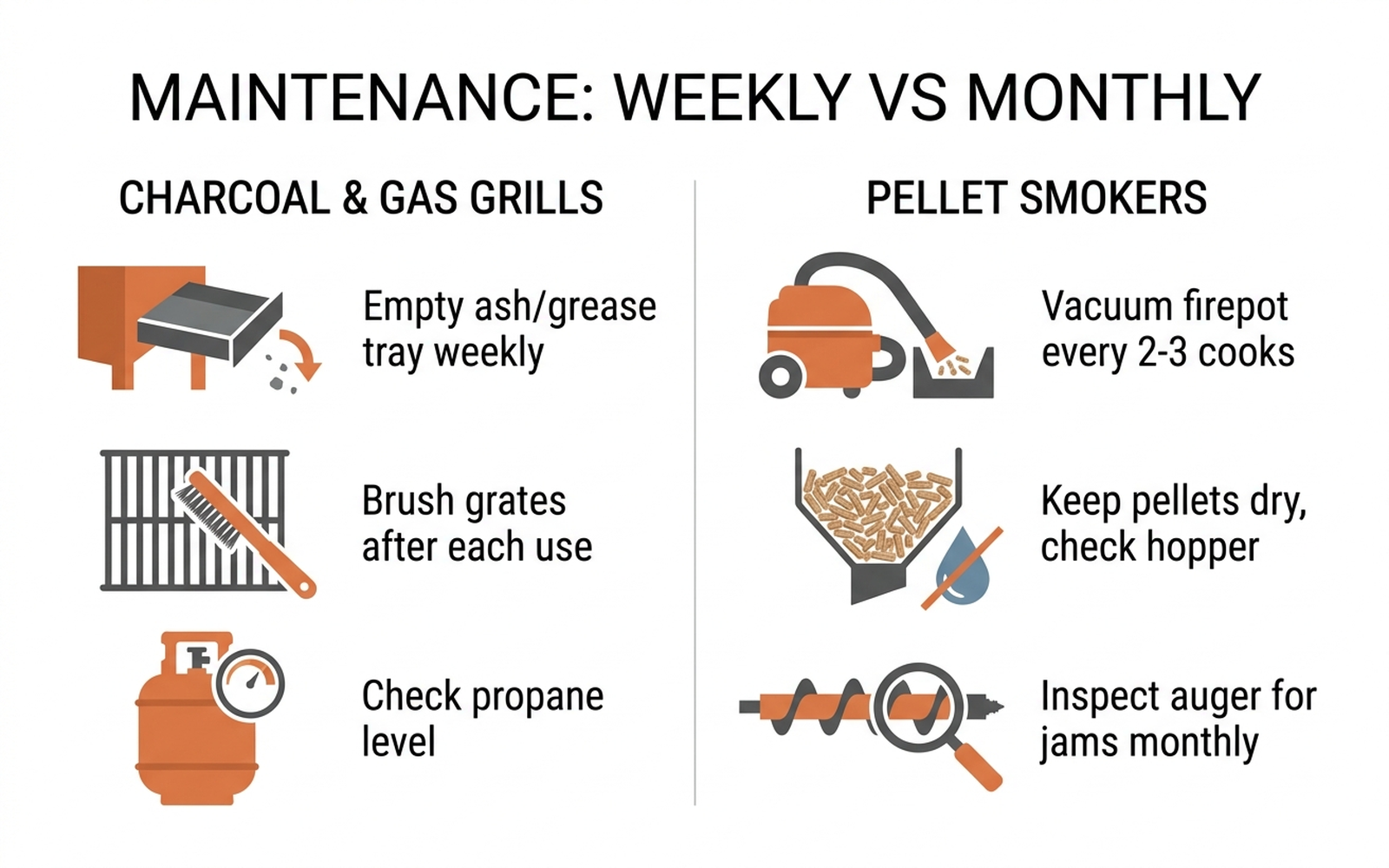
Maintenance burden is one of the most underweighted factors in a Weber-vs-Traeger decision, because it differs by fuel type more than by brand. Charcoal and gas grills need frequent but simple upkeep — emptying an ash or grease tray weekly, brushing grates after each use, and checking a propane tank’s fuel level. Pellet smokers need less frequent but more technical upkeep: vacuuming accumulated ash out of the firepot every two to three cooks (skipping this is a leading cause of uneven heat and auger strain), keeping pellets dry since moisture causes them to swell and jam the feed tube, and periodically inspecting the auger itself for binding. Reviewers who neglect firepot cleaning on any pellet brand — Traeger or Weber’s pellet line alike — report the clearest link to the temperature-control and auger complaints discussed below.
Which Grill Is Right for You
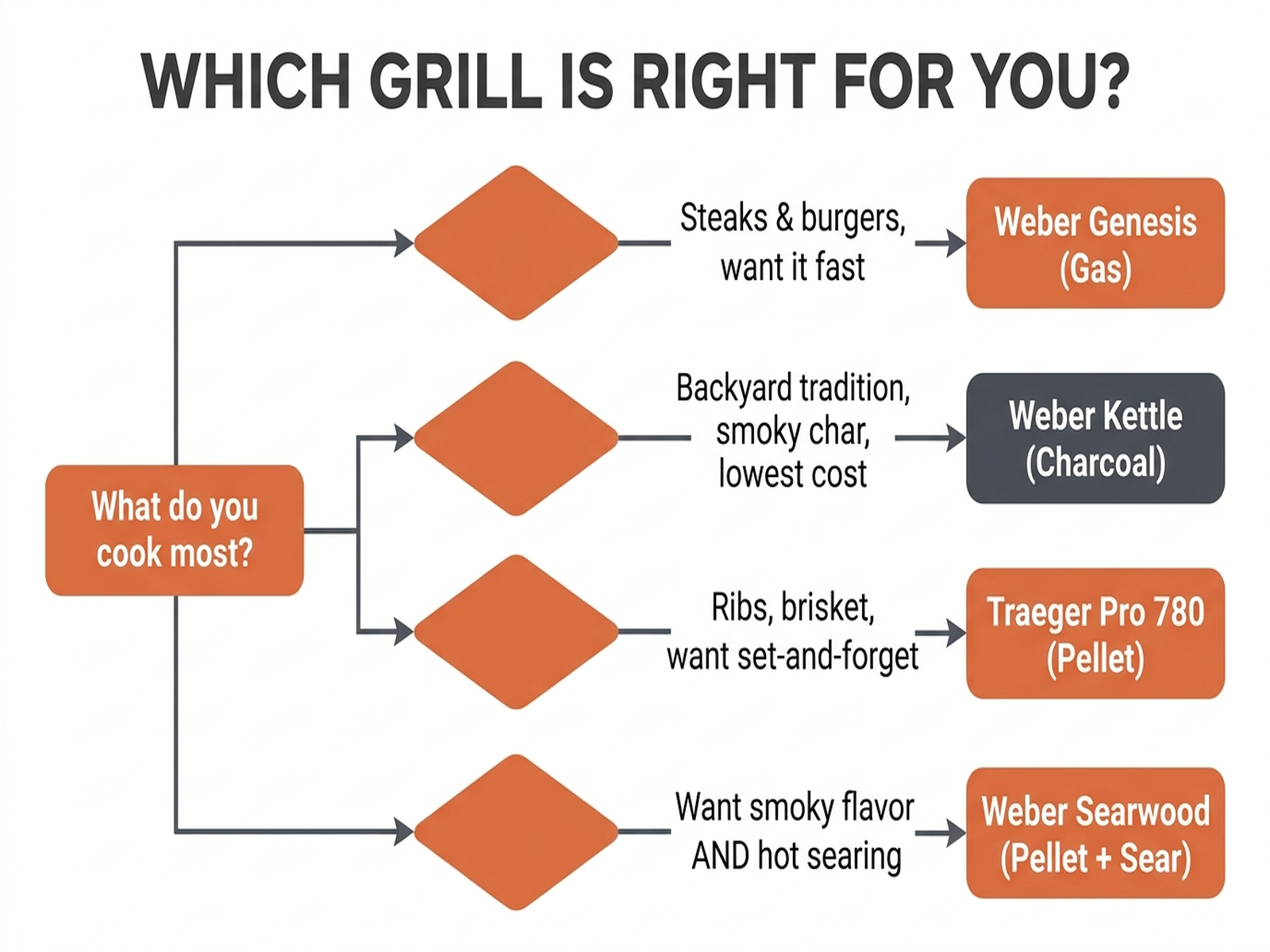
The fastest way to cut through the brand debate is to start from what you actually cook most often, not from brand reputation. Weeknight steaks and burgers point toward a gas grill; backyard tradition on the smallest budget points toward a charcoal kettle; ribs, brisket, and pulled pork with minimal hands-on effort point toward a dedicated pellet smoker; and wanting both smoky flavor and a hard sear in a single appliance points toward a pellet grill with a dedicated sear zone, which currently only Weber’s Searwood line offers at this price tier.
Customer Sentiment Synthesis
Across the models in this comparison, a consistent pattern emerges in aggregated Amazon reviews: Weber’s charcoal and gas lines draw praise almost entirely for build quality and longevity, with assembly annoyance as the dominant complaint. Pellet grills from both brands draw praise for convenience and consistent results, but a recurring minority of reviewers — across Traeger, Weber’s pellet line, and competing pellet brands alike — report auger jams, temperature-probe failures, or slow customer-service response on warranty claims. This is a category-wide pattern rather than a Traeger-specific or Weber-specific defect; independent reporting on pellet-grill reliability describes auger issues as “the most common issue owners report across every pellet grill brand.” Reviewers who want to minimize moving-parts risk entirely gravitate back toward charcoal or gas; reviewers who prioritize hands-off consistency accept the auger-related risk as a tradeoff for convenience.
Editorial Recommendation by Use Case
- Best for a first grill on a tight budget: Weber Original Kettle Premium — the lowest price in this comparison, decades of proven design, and the format most likely to have a bag of charcoal and tools already in a hand-me-down garage.
- Best for weeknight dinners and quick cooking: Weber Genesis E-325S — gas grills start in under 10 minutes and need no fuel-level guesswork beyond a propane gauge.
- Best for competition-style brisket, ribs, and pulled pork: Traeger Pro 780 — the category’s benchmark mid-tier pellet grill for unattended long cooks, backed by the largest third-party accessory and pellet ecosystem of any pellet brand.
- Best for one grill that does everything reasonably well: Weber Searwood 600 — the only model here that both smokes low-and-slow and sears at a genuinely high temperature, at a real cost premium over a Traeger of similar size.
- Best if you already have one type and are adding a second: many serious home cooks end up owning both a charcoal or gas grill for everyday cooking and a pellet grill for weekend smoking — the two formats solve different problems rather than competing directly.
Limitations
This analysis relies on publicly available reviews, HPBA industry survey data, and third-party test reporting; we did not personally test any of the grills discussed here. Reliability figures for pellet-grill augers and electronics are drawn from aggregated owner reports and consumer-complaint sites, which likely over-represent dissatisfied buyers relative to the full ownership base. Prices on amazon.com change frequently and vary by color, fuel type (propane vs natural gas), and regional availability; figures here reflect October 2026 listings and should be verified before purchase. Individual unit-to-unit variance exists in any manufactured product, and grill performance also depends heavily on climate, fuel/pellet quality, and maintenance habits not captured in this analysis.
Visit Arekore to compare current listings and verify specifications before buying.