Do Water Pitchers Actually Remove Lead? We Checked the Data
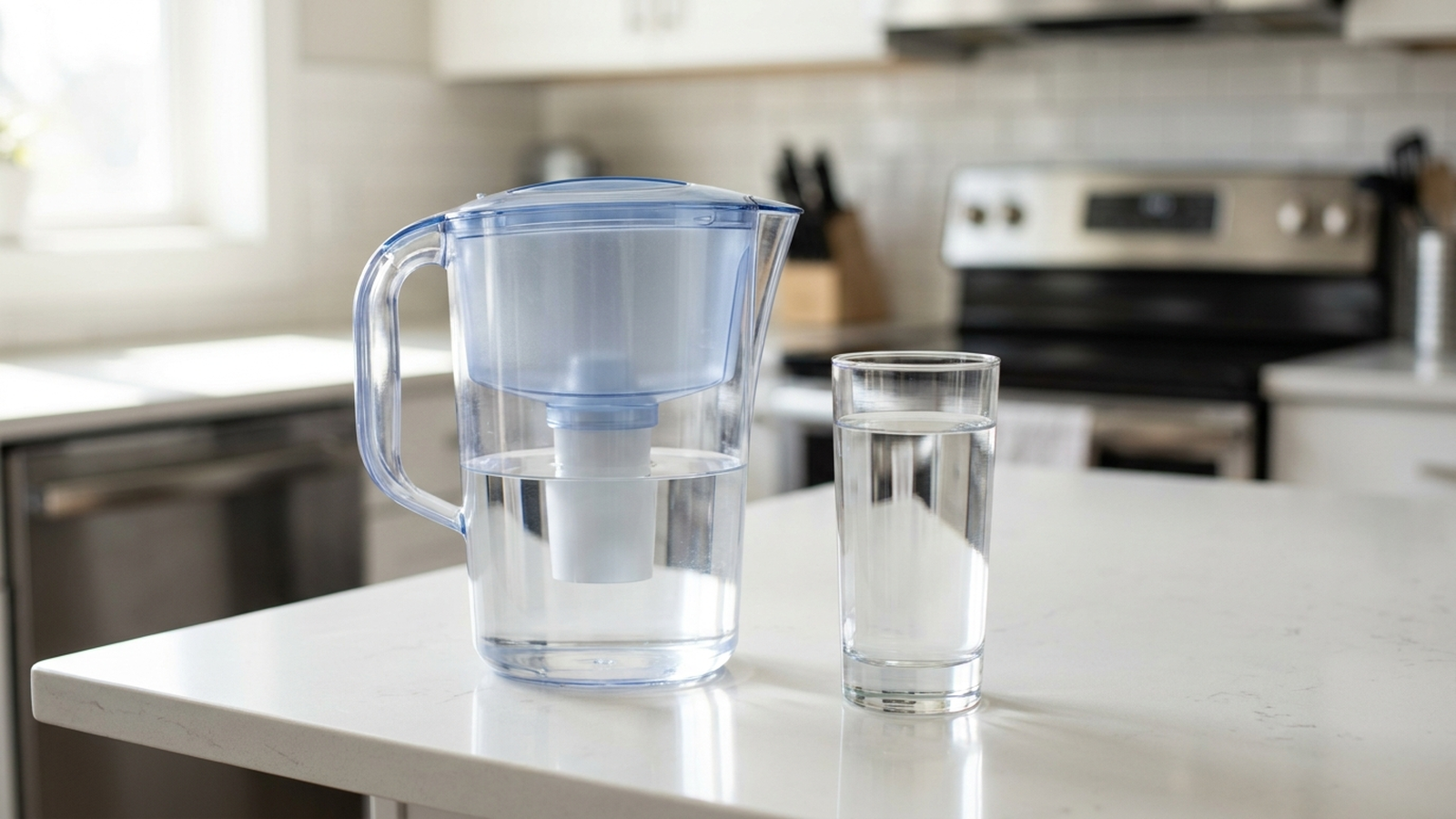
“Removes 99% of lead” is printed on the box of nearly every premium water filter pitcher sold on amazon.com, and it matters more than usual right now: the EPA’s Lead and Copper Rule Improvements, which took effect December 30, 2024, lowered the federal lead action level from 15 parts per billion (ppb) to 10 ppb and set a firm 10-year deadline for utilities to replace remaining lead service lines. The EPA’s own count of how many lines that affects has itself moved — from an estimated 9.2 million lead service lines in 2024 down to roughly 4 million in a 2026 revision, which the agency attributes to better utility inventory data rather than pipes actually disappearing.
So does a $35–$45 pitcher really deliver on that 99% number? We checked the certification data behind the claim and a peer-reviewed field study of how these filters perform outside a lab.
As an Amazon Associate, Arekore earns from qualifying purchases. The Amazon product links in this article include our affiliate tracking ID and may earn us a commission if you buy through them, at no additional cost to you. See our Links Policy for details on how we select products and how commissions do not influence our recommendations.
TL;DR / Quick Verdict
- The 99% claim is real, but it’s conditional on the specific filter model, not the pitcher brand. Brita’s base filter is not certified for lead reduction — only its upgraded Elite filter is. The same split applies to PUR’s basic filter versus PUR Plus.
- NSF/ANSI Standard 53 — the certification behind most lead claims — requires a filter to cut lead from 150 ppb down to 10 ppb or below, which is stricter than the EPA’s revised 10 ppb action level for tap water itself.
- In real-world field studies, NSF/ANSI 53 lead-certified filters worked as advertised 99% of the time (1,512 of 1,528 filters sampled reduced lead to the certified benchmark), according to a 2020 peer-reviewed analysis published in Environmental Science & Technology Letters.
- Performance drops under stress. The same research area found that filters tested beyond their certified capacity, or against water with colloidal (particle-bound) lead, failed far more often — in one lab study, only 61% of filters met the benchmark, and some replicates let through roughly half the influent lead even while nominally still within a certification-passing range.
- A filter can’t fix what it isn’t certified to remove. If your only goal is to reduce lead, buying a pitcher without checking its certification (many mid-range and budget models are certified for chlorine taste and odor only) accomplishes nothing for lead specifically.
Methodology
This is an editorial analysis, not a hands-on test — we did not personally test filter cartridges against a lead-spiked water source, and no home consumer can practically replicate an accredited lab’s testing conditions either. This article synthesizes: (a) NSF International, WQA, and IAPMO R&T certification documentation and standard requirements as published by each certifying body; (b) a 2023 peer-reviewed study in Water Research (Tang, Lytle, Achtemeier, and Tully) reviewing field and laboratory performance data across 23 prior studies covering roughly 1,528 field-deployed filters plus 150 lab-tested filters; (c) a separate 2021 peer-reviewed study in Environmental Science & Technology Letters (Purchase, Rouillier, Pieper, and Edwards) examining ten POU pitcher and faucet filter brands under extreme test conditions, including colloidal lead challenge water; (d) EPA Lead and Copper Rule documentation and the agency’s own service-line count revisions; and (e) manufacturer certification statements and aggregated Amazon customer review themes for the Brita Everyday Elite, PUR Plus, and ZeroWater Ready-Pour pitchers, reviewed in September 2026. Amazon does not expose a fixed, citable review count per listing, so we describe recurring qualitative themes rather than inventing a precise sample size.
What “NSF/ANSI 53 Certified for Lead” Actually Requires
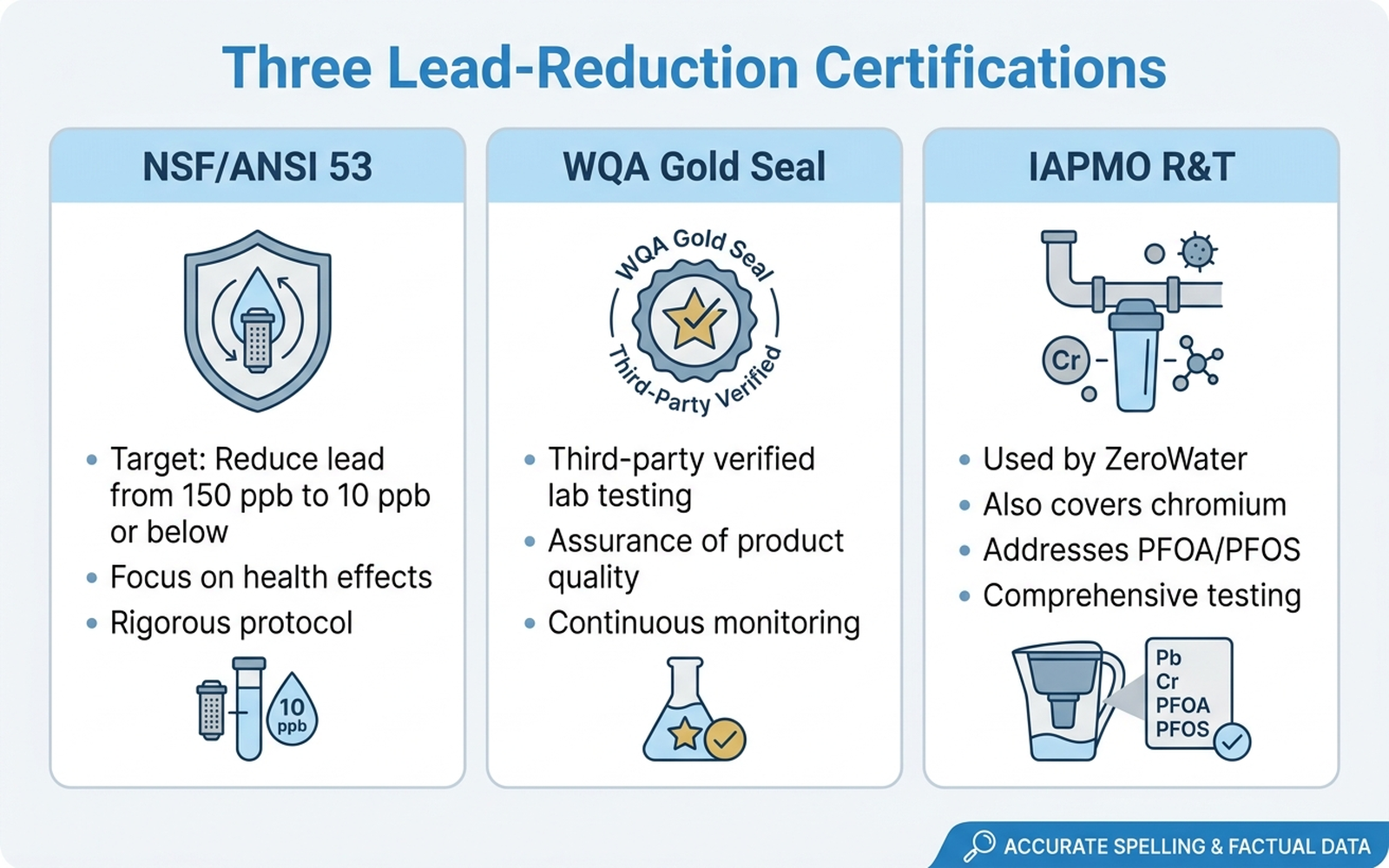
A “lead reduction” claim on a pitcher box is not marketing shorthand — it ties to one of three accredited certification programs, each with its own published test protocol:
- NSF/ANSI Standard 53 (“Health Effects”): the most common certification cited by Brita and PUR. To pass, a filter must reduce influent water spiked to 150 ppb lead down to an effluent concentration of 10 ppb or below, tested in an ISO/IEC 17025-accredited lab. That 10 ppb benchmark is notably stricter than the EPA’s own revised tap-water action level of 10 ppb — meaning a certified filter is held to the same numeric bar utilities themselves must meet, not a looser consumer-product standard.
- WQA Gold Seal: an independent third-party verification mark, often layered on top of an NSF/ANSI standard rather than replacing it — PUR markets its Plus filter as WQA-certified for lead specifically, alongside separate NSF certifications for other standards.
- IAPMO R&T: the certification ZeroWater uses, which bundles lead reduction together with chromium and PFOA/PFOS (per- and polyfluoroalkyl “forever chemicals”) reduction under one mark, reflecting ZeroWater’s broader ion-exchange approach rather than a narrower carbon-block design.
None of these bodies test every unit sold — they test a statistically sampled batch of a specific, named filter model. That distinction is the single most common source of confusion in aggregated customer complaints and comparison articles alike.
Independent testing outside the US points the same direction: Germany’s Stiftung Warentest, in a 2022 pitcher-filter test, found Brita’s Maxtra+ filter (the European counterpart cartridge to the US Elite line) filtered lead and copper particularly well and rated it the strongest performer among the pitchers tested — while cautioning that filtration effectiveness drops off after repeated cycles, reinforcing the same replacement-schedule point made below.
The Real-World Track Record: A Peer-Reviewed Look
Certification testing happens in a controlled lab. The more useful question for a household is how these filters perform once they’re installed on an actual kitchen counter, run past their rated capacity by a forgetful owner, or exposed to water chemistry a standardized lab test doesn’t fully replicate.
A 2023 analysis in Water Research, led by EPA-affiliated researchers (Tang, Lytle, Achtemeier, and Tully), reviewed 23 prior studies covering 1,528 field-deployed filters (a mix of pitcher and faucet-mounted units) and 150 additional units tested under laboratory conditions. The findings cut in two directions:
- In the field, NSF/ANSI 53 lead-certified filters performed close to their certified promise: 1,512 of 1,528 field-deployed filters (about 99%) reduced lead to at or below the 10 ppb benchmark.
- Under laboratory conditions designed to stress-test filters beyond typical certification testing — including use past rated capacity — only 91 of 150 filters (about 61%) met that same benchmark.
A separate 2021 peer-reviewed study in Environmental Science & Technology Letters, led by researchers who have studied lead-in-water crises including Flint, Michigan (Purchase, Rouillier, Pieper, and Edwards), examined ten pitcher and faucet-filter brands pushed to as much as 200% of rated capacity using challenge water containing colloidal (particle-bound, rather than fully dissolved) lead at roughly 1,000 micrograms per liter — a far higher and more chemically difficult influent than the standard NSF/ANSI 53 test water. Most brands still performed well. But the study documented specific failure modes: leaking cartridges, premature clogging, and in one case a physical hole in the filter media. Colloidal lead proved harder to capture than dissolved lead across several units — in some replicate tests, roughly half of the influent lead passed through a filter that would still have passed the standard NSF/ANSI 53 certification protocol, because the standard’s test water doesn’t specifically stress colloidal lead capture at that concentration.
The takeaway isn’t that certified filters don’t work — the field data says they overwhelmingly do. It’s that a certification mark describes performance up to a specific gallon capacity and a specific test-water chemistry, not an unconditional guarantee against every possible tap-water composition.
How to Confirm Your Own Filter Is Actually Certified
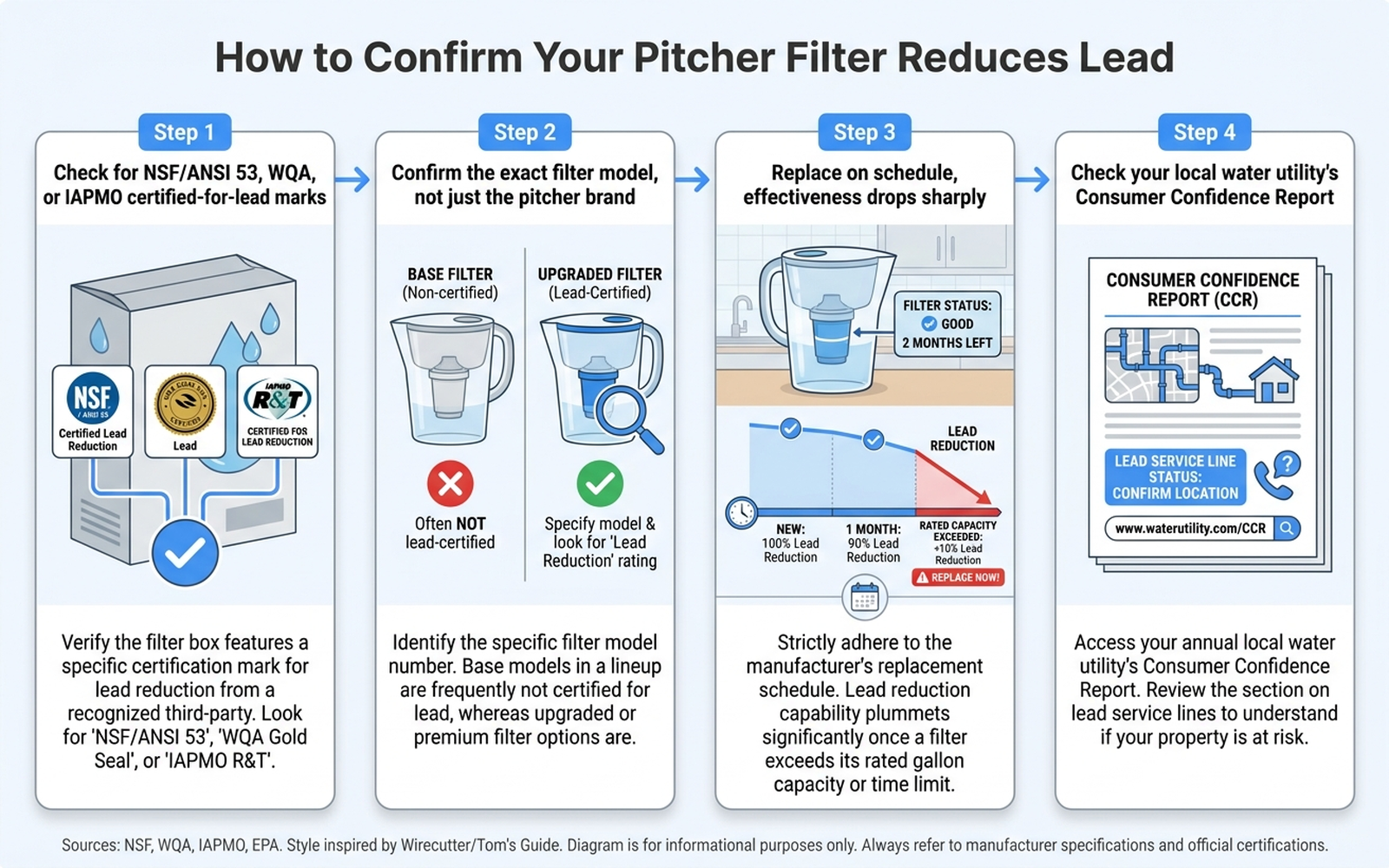
- Check the filter box, not the pitcher box, for a certification mark naming lead specifically. A pitcher’s outer packaging often lists the brand’s full contaminant-reduction story; the filter cartridge itself is the certified component, and swapping in a non-certified compatible filter voids that claim entirely.
- Match the exact filter model, not just the brand. Brita’s base “Standard” filter is certified for chlorine taste and odor only — lead reduction requires the upgraded “Elite” (formerly “Longlast”) filter. PUR’s basic filter is similarly not lead-certified; the “Plus” filter is.
- Replace on the manufacturer’s schedule, and don’t stretch it. The field-versus-lab performance gap above is driven substantially by filters run past their rated gallon capacity — a habit that’s easy to fall into once a filter still visually “works” (water still comes out, still tastes fine) despite failing silently on lead capture.
- Check your local water utility’s annual Consumer Confidence Report for lead service line status, since a filter’s job is easiest — and its failure mode of exceeded capacity least consequential — when influent lead concentrations start lower to begin with.
Should You Actually Worry? A Simple Way to Decide
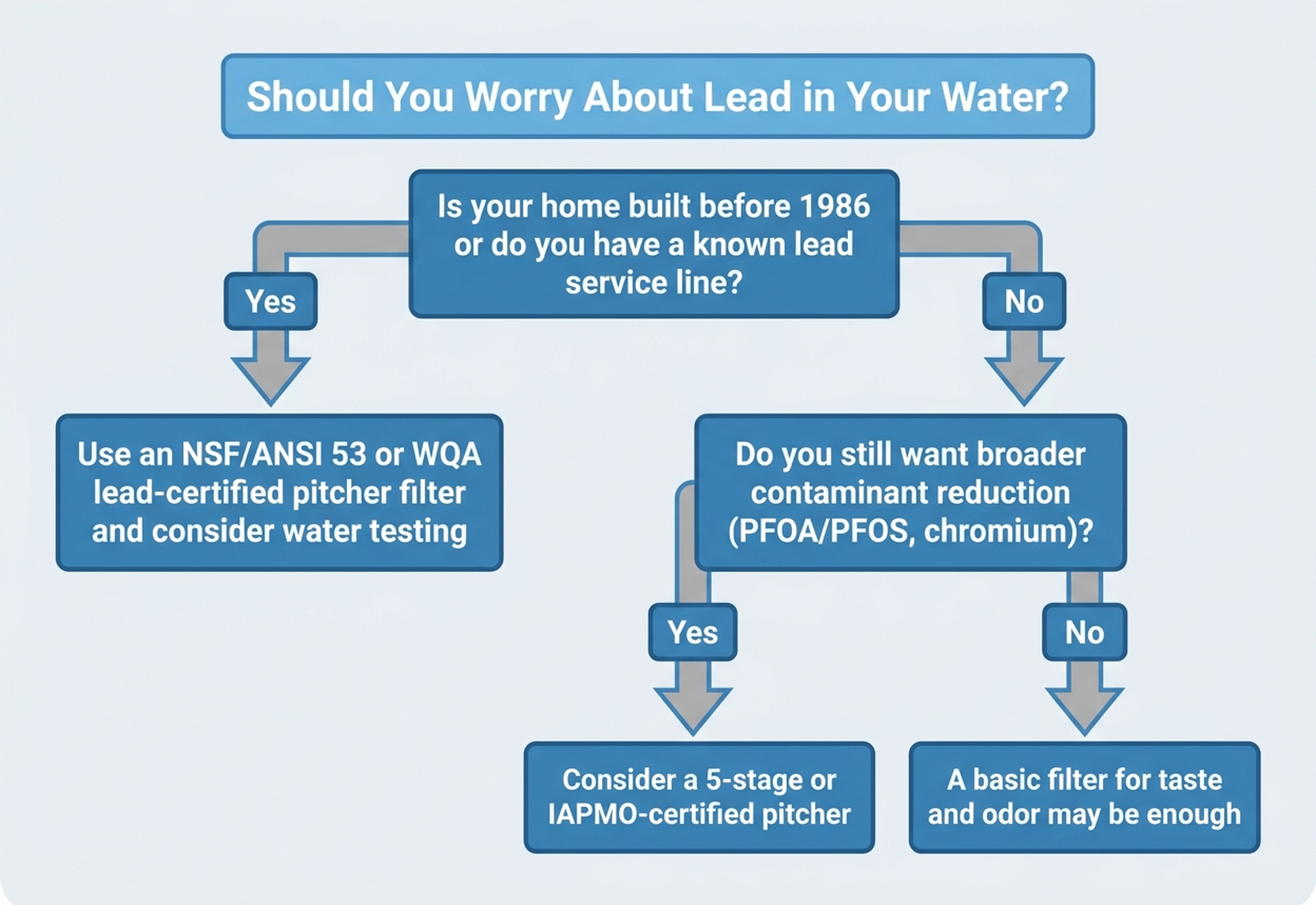
Lead risk in tap water is overwhelmingly a plumbing-age and service-line question, not a water-treatment-plant question — most municipal water leaves the treatment plant free of lead and picks it up from lead pipes, lead solder, or brass fixtures on the way to the tap. Homes built before 1986 (when the U.S. banned lead pipes and lead solder in new plumbing) carry meaningfully higher risk, as do any home documented to have a lead service line in a utility inventory. For those households, a certified filter — used within its rated capacity — is a reasonable, low-cost interim safeguard while service-line replacement programs work through the multi-year backlog referenced above; households without those risk factors can weigh a certified filter primarily against the other contaminants (PFOA/PFOS, chromium, taste and odor) they may also want reduced, since NSF/ANSI 53 lead certification is not the only reason to own a pitcher.
Three Certified Options, Compared
| Model | Price (as of 2026-09-07) | Lead Certification | Rated Filter Life | Notes |
|---|---|---|---|---|
| Brita Everyday Elite (10-Cup, Elite filter) | ~$34.99–$41.99 | NSF/ANSI 53, WQA — 99% lead reduction (Elite filter only; Standard filter is not lead-certified) | ~120 gallons (~6 months) | Lowest ongoing cost per certified gallon of the three |
| PUR Plus (11-Cup) | ~$40.00 | WQA-certified for lead; NSF-certified separately for chlorine, mercury, and NSF/ANSI 401 contaminants (Plus filter only; base PUR filter is not lead-certified) | ~40 gallons (~2 months) | Filter-change light indicator; reviewers note it as reassurance the certified filter is actually still active |
| ZeroWater Ready-Pour (10-Cup) | ~$36.99–$45.00 | IAPMO R&T — lead, chromium, PFOA/PFOS | ~20–40 gallons | Ships with a TDS meter so households can visually confirm filter exhaustion rather than relying on a calendar alone |
Prices are approximate figures observed on amazon.com around the stated date and fluctuate with lightning deals and multi-packs; check the current listing before buying. Filter life is manufacturer-rated and varies with local water hardness and sediment load — the field-versus-lab data above is exactly why running a filter well past these figures is the behavior most likely to undermine its certified lead performance.
Brita Everyday Elite (10-Cup)
Brita’s Elite filter carries the NSF/ANSI 53 and WQA marks for 99% lead reduction and is rated for roughly 120 gallons — the longest certified filter life of the three, which independent reporting and aggregated reviews both credit as the reason it’s typically the cheapest option on a per-certified-gallon basis.
Check the Brita Everyday Elite Pitcher on Amazon
PUR Plus (11-Cup)
PUR’s Plus filter is WQA-certified for lead reduction and separately NSF-certified across chlorine, mercury, and NSF/ANSI 401 emerging-contaminant standards, at a shorter roughly 40-gallon rated filter life than Brita’s Elite.
Check the PUR Plus 11-Cup Pitcher on Amazon
ZeroWater Ready-Pour (10-Cup)
ZeroWater’s 5-stage ion-exchange filter is IAPMO R&T certified for lead alongside chromium and PFOA/PFOS, the broadest certified contaminant list of the three, though its shorter roughly 20–40 gallon rated capacity means more frequent replacement to keep that certification’s performance intact.
Check the ZeroWater Ready-Pour Pitcher on Amazon
Limitations
This analysis relies on publicly available certification documentation, peer-reviewed research examining filter brands and models that may not be identical to the current-generation cartridges sold today, and aggregated public reviews rather than a first-party test of the specific units linked above. Filter performance depends heavily on local water chemistry, sediment load, and how closely a household follows the replacement schedule — factors this article cannot verify for any individual reader’s tap water. Anyone with a documented or suspected lead service line should treat a pitcher filter as one part of a broader response, not a substitute for utility-provided water testing or service-line replacement where available.
Verify Before You Buy
Certification marks change between filter generations, and Amazon listings sometimes bundle a pitcher with a non-certified compatible filter rather than the manufacturer’s own certified cartridge. Before buying, confirm the specific filter model and its certification directly on the manufacturer’s site or the NSF/WQA/IAPMO public listing databases — and visit Arekore to compare current listings before you buy.