Vitamix vs Ninja: Which Blender Wins in 2026?
Vitamix and Ninja sit at opposite ends of the same shelf. One is the machine culinary schools and smoothie shops have relied on for decades; the other is the brand that made high-power blending affordable enough for a college dorm. Shoppers rarely cross-shop them by accident — the real question is usually “do I actually need Vitamix money, or will Ninja get the job done?” This guide compares specific models head-to-head across three price tiers, using aggregated Amazon customer data, independent third-party testing, and manufacturer specifications, rather than repeating the generic “best blenders” roundup format.
As an Amazon Associate, Arekore earns from qualifying purchases. The Amazon product links in this article include our affiliate tracking ID and may earn us a commission if you buy through them, at no additional cost to you. See our Links Policy for details on how we select products and how commissions do not influence our recommendations.
TL;DR / Quick Verdict
- Overall winner for most buyers: it depends on how you cook. RTINGS’ own head-to-head rates the Vitamix A3500 ahead of Ninja’s comparable Auto-iQ model on build quality and its handling of fibrous ingredients, but Ninja’s mid-tier models cost roughly a third of Vitamix’s price for a machine that handles daily smoothies just fine.
- Best flagship: the Vitamix A3500 — a 2.2-peak-HP motor, five automatic programs, and a 10-year warranty on Ascent-series machines, for buyers who blend daily and want a machine that lasts.
- Best flagship value on the Ninja side: the Ninja Foodi Power Blender Ultimate System (SS401) — blender, food processor, and single-serve extractor in one base, at roughly a quarter of the A3500’s price.
- Best mid-tier pick overall: the Vitamix 5200 — a Wirecutter-style category staple for over a decade, prized for handling hot soup and nut butter that budget blenders struggle with.
- Best value for occasional use: the Ninja Professional Plus line (BN701/BN751) — under $150 and more than powerful enough for smoothies and crushed ice, with the tradeoff being a 1-year (2-year if registered) warranty versus Vitamix’s 5-to-10-year coverage.
- The factor buyers underweight: warranty length. A Vitamix bought today is likely to outlast several Ninja blenders bought at the same total cost, which changes the math for anyone who blends daily.
How We Reached These Conclusions (Methodology)
This is an editorial analysis, not a hands-on review; we did not personally test the products covered here. This guide synthesizes three kinds of public information: (a) aggregated amazon.com customer ratings and the substance of reviews, sampled in September 2026 — for example, the Vitamix A3500’s Amazon listing shows an average rating of roughly 4.7 out of 5 across 300-plus verified reviews; (b) independent third-party testing and reporting from RTINGS, Tom’s Guide, and Consumer Reports, which has run its own dedicated Ninja-vs-Vitamix blender face-off; and (c) manufacturer specifications for motor power, warranty terms, and container capacity. Where we cite a manufacturer figure — peak horsepower, peak watts — we label it as a manufacturer claim rather than an independently verified result. Prices are amazon.com figures at the time of writing and change frequently.
Technical Approach: Motor, Blades, and Warranty
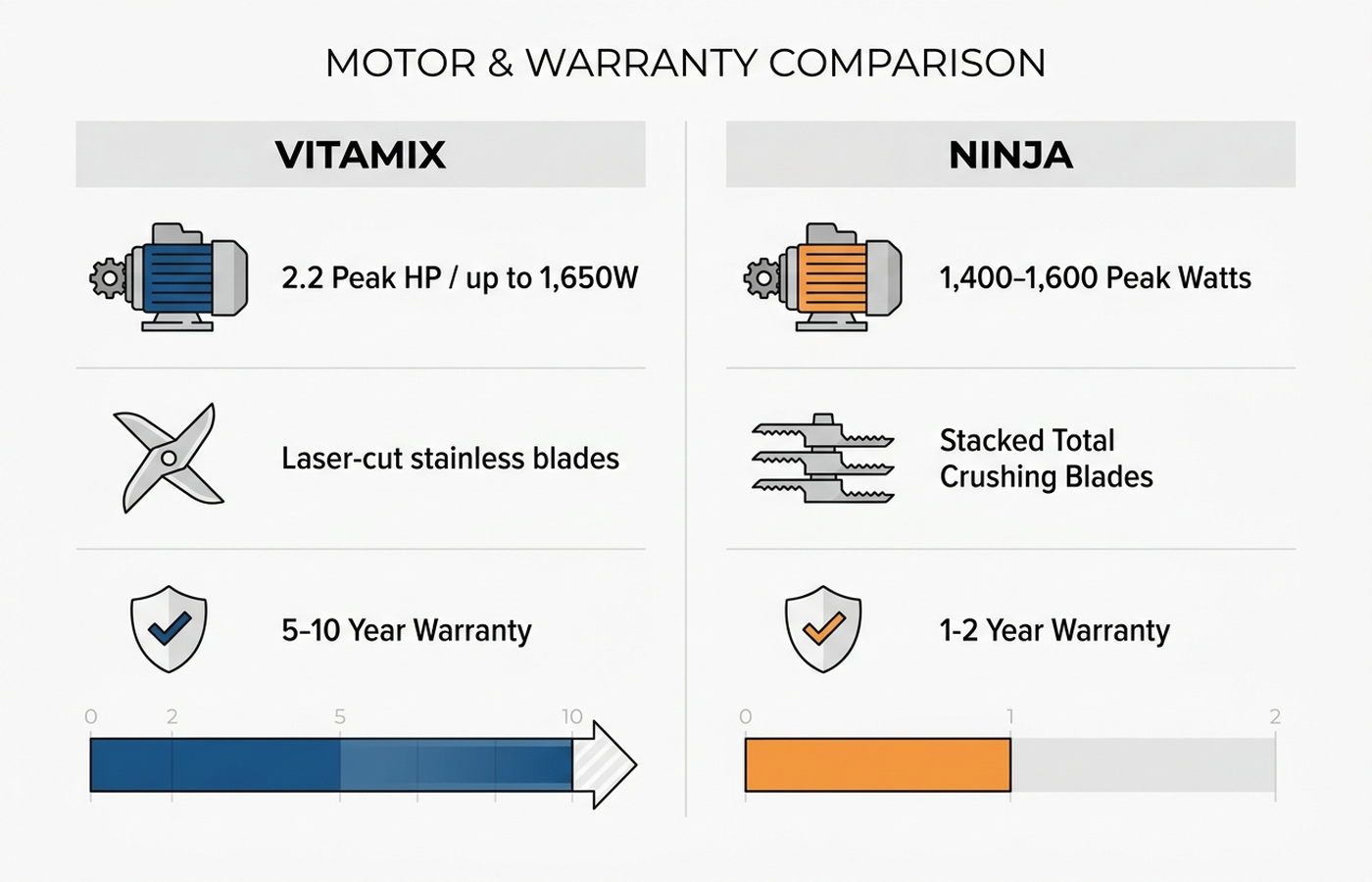
The two brands make genuinely different engineering bets, and understanding them explains most of the price gap.
- Motor. Vitamix rates its higher-end motors, including the one in the A3500, at 2.2 peak horsepower — commonly cited as roughly 1,400 to 1,650 peak watts depending on the source and measurement method (manufacturer claim). Ninja’s Professional Plus and Foodi Power Blender lines run 1,400 to 1,600 peak watts (manufacturer claim). On paper the numbers overlap; in practice, reviewers consistently credit Vitamix with more consistent torque under load — pushing through frozen fruit, ice, and thick nut butter — rather than raw top-end power.
- Container and blade design. Vitamix’s low-profile 64-ounce container and laser-cut stainless blades are built to create a self-feeding vortex that pulls ingredients down into the blades without a tamper for most recipes on the A3500 and 5200. Ninja’s “Total Crushing” stacked-blade design handles ice and frozen fruit well but is more dependent on liquid ratios and occasional manual scraping for dense mixtures like nut butter.
- Warranty. This is the sharpest divide between the brands. Vitamix backs its Ascent-series machines, including the A3500, with a 10-year full warranty; the 5200 (Legacy series) carries 7 years; and the entry-level Explorian E310 still carries 5 years. Ninja blenders carry a standard 1-year limited warranty, extendable to 2 years with registration within 28 days of purchase — and that coverage typically excludes normal wear on blade assemblies.
- Noise and hot-liquid handling. Independent reviewers, including PureWow’s side-by-side test, found the Vitamix Ascent A3500 notably quieter than the Vitamix 5200 and Ninja models during extended use, and specifically noted the A3500 handles hot soup effortlessly — a use case Ninja’s standard blender line is not rated for.
Head-to-Head: Flagship Tier (~$225–$650)
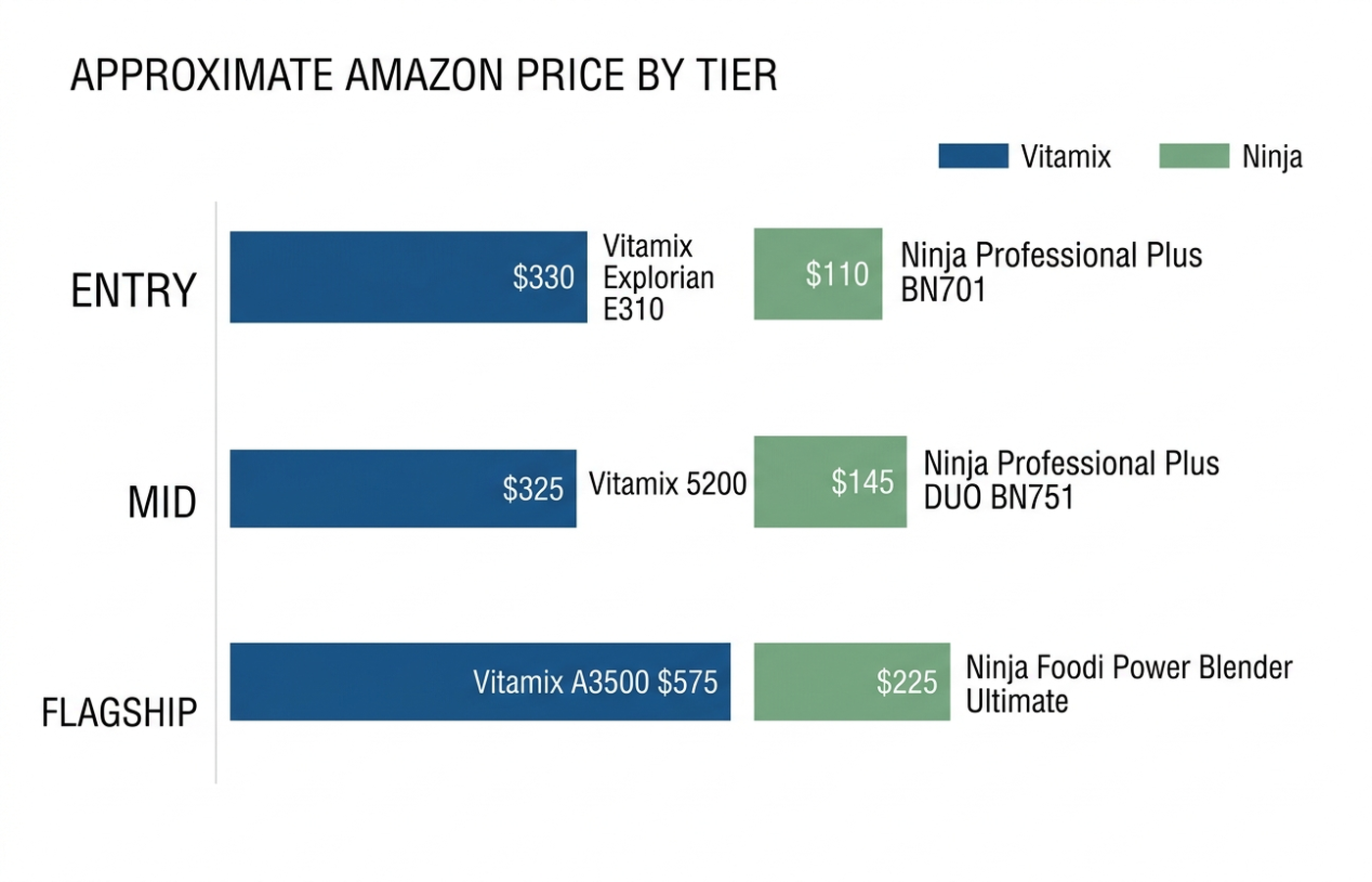
Vitamix A3500 is Vitamix’s flagship smart blender: a 2.2-peak-HP motor, five automatic programs (smoothie, hot soup, frozen dessert, dip/spread, self-cleaning), a digital timer, and built-in wireless connectivity that recognizes compatible containers. RTINGS’ own direct comparison rates the A3500 ahead of Ninja’s closest Auto-iQ competitor, crediting its build quality and its handling of fibrous, high-pulp ingredients. Tom’s Guide’s review concluded the A3500 “excels at nearly everything” it tried. On Amazon, the A3500 carries an average rating around 4.7 out of 5 from 300-plus reviews; the most common complaint is price, followed by occasional reports of touch-sensor issues on individual units and lackluster results on very dense nut butter without manual intervention. It typically lists around $649.95, with Amazon and third-party retailers regularly discounting it into the $500s (as of 2026-09-23).
Check the Vitamix A3500 on Amazon
Ninja Foodi Power Blender Ultimate System (SS401) takes a different approach entirely: rather than one very capable blender, it bundles a 72-ounce blending/food-processing pitcher, an XL smoothie-bowl maker, and a single-serve nutrient-extraction cup around a shared 1,600-peak-watt motor base with 7 Auto-iQ programs. It is best understood as a blender-plus-food-processor system competing on versatility rather than trying to out-blend the A3500 pound for pound. Aggregated owner feedback consistently praises the value of getting three appliances in one footprint, with the more common criticisms centered on the number of separate parts to wash and the base’s noise at full power. It typically runs in the $200–$250 range on Amazon (as of 2026-09-23), well under half the A3500’s usual street price.
Check the Ninja Foodi Power Blender Ultimate System on Amazon
Verdict at this tier: the A3500 wins on pure blending performance, quiet operation, and a warranty that dwarfs anything Ninja offers — a real advantage for daily users. The Foodi Power Blender Ultimate System wins on versatility per dollar, effectively replacing a food processor and single-serve blender alongside the pitcher, for roughly a third of the A3500’s price.
Head-to-Head: Mid Tier (~$130–$350)
Vitamix 5200 is the Legacy-series machine that has anchored independent “best blender” lists for over a decade, prized specifically for two things budget blenders struggle with: making genuinely smooth nut butter and safely blending hot soup straight from the stove. It uses physical dial controls rather than the A3500’s digital touchpad, which some buyers prefer for simplicity and reviewers note is one less thing to break. It carries a 7-year full warranty. List price runs around $419.95, with Amazon and manufacturer sales bringing it down to roughly $299.95–$349.95 during promotions (as of 2026-09-23).
Check the Vitamix 5200 on Amazon
Ninja Professional Plus DUO Blender (BN751) pairs a 1,400-peak-watt motor with a 72-ounce Total Crushing pitcher plus two 24-ounce to-go cups and 3 Auto-iQ presets for smoothies, frozen drinks, and nutrient extraction. It is the clearest “good enough for most people, most days” pick in this comparison: strong on ice and frozen fruit, weaker on dense nut butter and not rated for hot liquids. It typically sells in the $130–$160 range on Amazon (as of 2026-09-23) — roughly a third of the Vitamix 5200’s promotional price.
Check the Ninja Professional Plus DUO Blender on Amazon
Verdict at this tier: if hot soup and nut butter matter to you, the 5200’s decade-plus reputation is earned and worth the premium. If your blending is mostly smoothies, frozen drinks, and crushed ice, the BN751 delivers most of the everyday performance at less than half the price, with the tradeoff of a much shorter warranty.
Head-to-Head: Entry Tier (~$100–$350)
Vitamix Explorian E310 is Vitamix’s least expensive full-size machine, built around the same core motor and blade geometry as pricier Vitamix models in a simpler, dial-controlled package with a 48-ounce container and a 10-speed dial plus pulse. It is the way to buy into Vitamix’s build quality and 5-year warranty without paying flagship prices, though it lacks the A3500’s automatic programs and digital timer. Amazon pricing typically runs $299.99–$349.99 (as of 2026-09-23).
Check the Vitamix Explorian E310 on Amazon
Ninja Professional Plus Blender (BN701) is the standard entry point into the Ninja lineup: a 1,400-peak-watt motor, 72-ounce Total Crushing pitcher, and 3 Auto-iQ presets, without the DUO’s extra to-go cups. For buyers who want a capable everyday blender without much fuss, it is one of the most-reviewed blenders on Amazon at this price. It typically runs $99.99–$129.99 (as of 2026-09-23), making it the cheapest way into either brand’s current lineup by a wide margin.
Check the Ninja Professional Plus Blender on Amazon
Verdict at this tier: the BN701 is the value pick for anyone testing whether they even want a high-power blender. The Explorian E310 is the pick for buyers who already know they want Vitamix-grade durability and are willing to pay roughly three times as much to get it without flagship features.
Customer Sentiment Synthesis
- Vitamix A3500 owners overwhelmingly cite reliability and “set it and walk away” convenience from the automatic programs as the biggest strengths, with price being the most frequent complaint and a smaller number of reports of touch-sensor faults on individual units requiring a warranty repair.
- Vitamix 5200 owners, per aggregated reviews, most often mention its decade-plus track record and its ability to make genuinely smooth nut butter and hot soup — tasks that generate the most complaints on cheaper machines from either brand.
- Ninja Professional Plus and Foodi System owners frequently praise the price-to-performance ratio and, for the Foodi system specifically, the number of functions packed into one base. The most common critical themes are motor noise at full power, more manual scraping needed for dense mixtures, and the shorter 1-to-2-year warranty compared with competing high-power blenders.
- Consumer Reports has run its own dedicated Ninja-vs-Vitamix blender face-off, reflecting how frequently these two brands are directly compared by shoppers rather than benchmarked against the wider field — reinforcing that this is a genuinely common head-to-head decision, not an artificial matchup.
- Net read: sentiment favors Vitamix on longevity, quiet operation, and handling of hot or dense ingredients, and favors Ninja on upfront value and multi-function versatility — neither brand is complaint-free, and the right choice tracks closely with how often and how hard the machine will be used.
Side-by-Side Comparison
| Model | ASIN | Tier | Peak power | Warranty | Approx. price (as of 2026-09-23) |
|---|---|---|---|---|---|
| Ninja Professional Plus (BN701) | B0855B5Z6F | Entry | 1,400W (mfr. claim) | 1 yr (2 yr registered) | $100–$130 |
| Vitamix Explorian E310 | B0758JHZM3 | Entry | 2.0–2.2 HP (mfr. claim) | 5 yr | $300–$350 |
| Ninja Professional Plus DUO (BN751) | B0BMGSZMW9 | Mid | 1,400W (mfr. claim) | 1 yr (2 yr registered) | $130–$160 |
| Vitamix 5200 | B008H4SLV6 | Mid | 2.0 HP (mfr. claim) | 7 yr | $300–$350 |
| Ninja Foodi Power Blender Ultimate (SS401) | B098RCQVRB | Flagship | 1,600W (mfr. claim) | 1 yr (2 yr registered) | $200–$250 |
| Vitamix A3500 | B09TS1KKHV | Flagship | 2.2 HP (mfr. claim) | 10 yr | $500–$650 |
Motor power and warranty figures are manufacturer specifications; RTINGS’ comparative rating and the Amazon review averages cited above are independently sourced. Prices fluctuate — verify the current amazon.com price before buying.
Market Context: Why Vitamix Costs What It Costs
The North America household blender market was valued at roughly $1.15 billion in 2025 and is projected to keep growing at a compound annual rate near 7.9%, according to industry research. Within that market, pricing splits into clear tiers: a mass-market band roughly between $50 and $150 dominated by Ninja, Hamilton Beach, and Cuisinart, and a premium performance tier roughly between $150 and $400-plus led by Vitamix and Blendtec. That segmentation is not incidental — Vitamix has built its brand around the premium tier’s durability and food-service heritage, while Ninja has built share by pushing high-wattage performance down into mass-market prices. A related trend worth noting: the personal and single-serve blender segment has grown from an estimated 15% of the category a decade ago to roughly 25–30% in 2026, part of why Ninja’s multi-cup, multi-function systems like the Foodi line have gained ground — they answer a demand for versatility that a single-purpose pitcher blender does not.
How to Decide
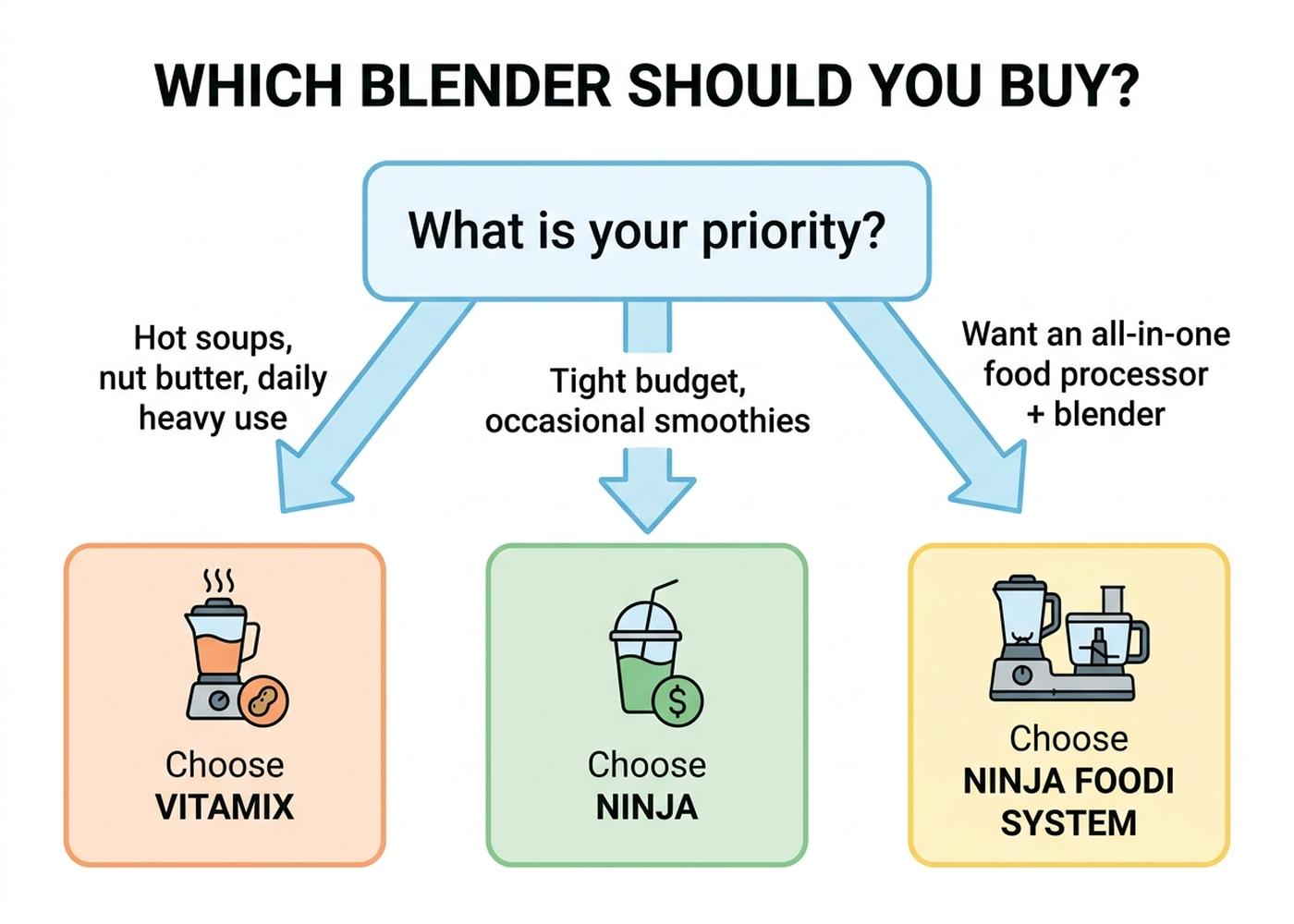
Start with how often you will actually use the machine, not the sticker price. If you blend daily, make your own nut butter or hot soup, or simply want a machine you expect to still be running in a decade, the Vitamix warranty alone — 5 to 10 years versus Ninja’s 1 to 2 — often pays for the price gap over the machine’s lifetime. If you blend a few times a week for smoothies, frozen drinks, and crushed ice, a Ninja Professional Plus model gets you most of the everyday performance for a fraction of the cost. If you want one base that replaces a blender, a food processor, and a single-serve cup, the Ninja Foodi Power Blender Ultimate System is the most versatile option in this comparison, even if it does not out-blend the A3500 pound for pound.
Editorial Recommendation by Use Case
- You blend daily and want the longest-lasting machine: the Vitamix A3500, backed by a 10-year warranty and the strongest independent test results in this comparison.
- You want Vitamix-grade durability without flagship pricing: the Vitamix 5200 (best for hot soup and nut butter) or the Vitamix Explorian E310 (simpler controls, still a 5-year warranty).
- You want the best value for occasional smoothies and crushed ice: the Ninja Professional Plus (BN701), the cheapest capable option in this comparison.
- You want one machine that also replaces a food processor and single-serve blender: the Ninja Foodi Power Blender Ultimate System (SS401).
- Everyone: register any Ninja purchase within 28 days to double the warranty to 2 years, and confirm current Vitamix warranty terms for your specific model before buying, since coverage varies by series.
Limitations
This analysis relies on publicly available reviews, third-party test reporting, and manufacturer specifications; we did not independently lab-test these units. Peak horsepower and peak wattage figures are manufacturer claims and are not directly comparable measurements of real-world blending performance, which also depends on blade geometry, container shape, and recipe. Amazon review sentiment reflects aggregated public feedback at the time of writing and can shift as new reviews accumulate. Prices and availability were accurate to our research at the time of writing and change frequently — verify current specs and pricing on the product page before buying.
Before you buy either brand’s blender, it pays to check that a listing’s reviews are genuine and that a sale price is an actual discount rather than an inflated “was” price. That is exactly what Arekore does: paste the Amazon URL and our AI analyzes review authenticity, surfaces the most useful low-star feedback, and compares pricing in about five minutes — so you end up with the blender that actually fits how you cook, not just the one with the biggest motor number on the box.