Toaster Oven Smoking When You Bake? 5 Real Causes (2026)

TL;DR. Most toaster oven smoke is thin, white or gray, and smells like food, grease, or hot metal — not a defect. The five most documented causes are crumb and grease buildup on the tray or heating elements, fatty food dripping directly onto an element, a brand-new unit burning off factory manufacturing oils, baking at too high a temperature for the food, and — far less common but serious — a worn heating element or wiring fault that keeps smoking even on a clean, empty run. Cleaning the crumb tray and interior, lining the tray under greasy foods, and running a one-time empty burn-off cycle on a new unit resolves the large majority of documented cases; smoke that continues on a clean, empty oven, or a burning-plastic smell, means unplug and contact support rather than keep troubleshooting.
A note on links and methodology
As an Amazon Associate, Arekore earns from qualifying purchases. The Amazon product links in this article include our affiliate tracking ID and may earn us a commission if you buy through them, at no additional cost to you. See our Links Policy for details on how we select products and how commissions do not influence our recommendations.
We also did not personally reproduce this issue on the specific machines named below. Every cause and fix in this article is an editorial synthesis of manufacturer support and manual documentation, a 2026 federal safety recall record for the toaster oven category, and aggregated public troubleshooting and customer-review reports, cited inline.
Methodology
This is an editorial analysis based on publicly available data collected in October 2026. We did not run a controlled test ourselves; instead we synthesized:
- Manufacturer manuals and support documentation — Cuisinart’s AirFryer Toaster Oven instruction booklets (TOA-60/65/95 series), Breville Smart Oven support content, and general crumb-tray and heating-element cleaning guidance published across major toaster oven brands.
- A 2026 federal safety record — the U.S. Consumer Product Safety Commission’s July 2026 recall of roughly 11,480 Panasonic electric toaster ovens (model NB-G200), issued after reports of insufficient cord insulation creating a shock and fire hazard. We cite this as the most recent toaster-oven-category CPSC action, not as evidence that cord insulation is a common cause of smoke specifically — the two failure modes are different, and we are explicit about that distinction below.
- Owner troubleshooting archives — JustAnswer threads on toaster ovens “leaking smoke,” and brand-agnostic troubleshooting guides covering crumb buildup, grease, and heating-element wear.
- Aggregated Amazon and third-party customer review sentiment for Black+Decker, Hamilton Beach, and Cuisinart toaster ovens, read from public review panels and ConsumerAffairs complaint archives in October 2026. We do not report a precise review-count N because these public panels do not expose a stable, verifiable count; a fabricated number would be misleading.
- Market and category data — per IndexBox and market-research estimates for 2026, roughly 60–68% of US households own a toaster or toaster oven, countertop toaster ovens sit in about 44% of American kitchens, and no single brand holds more than an estimated 15–20% unit share, which is part of why smoke-related troubleshooting questions span nearly every major brand rather than clustering on one.
We deliberately do not simulate a specific personal baking mishap or invent a fake reviewer persona. The advice below is a synthesis of manufacturer documentation, a public safety record, and aggregated troubleshooting patterns — treat it as a starting framework, not a substitute for your specific model’s manual or an active safety concern.
1. Five reasons a toaster oven smokes
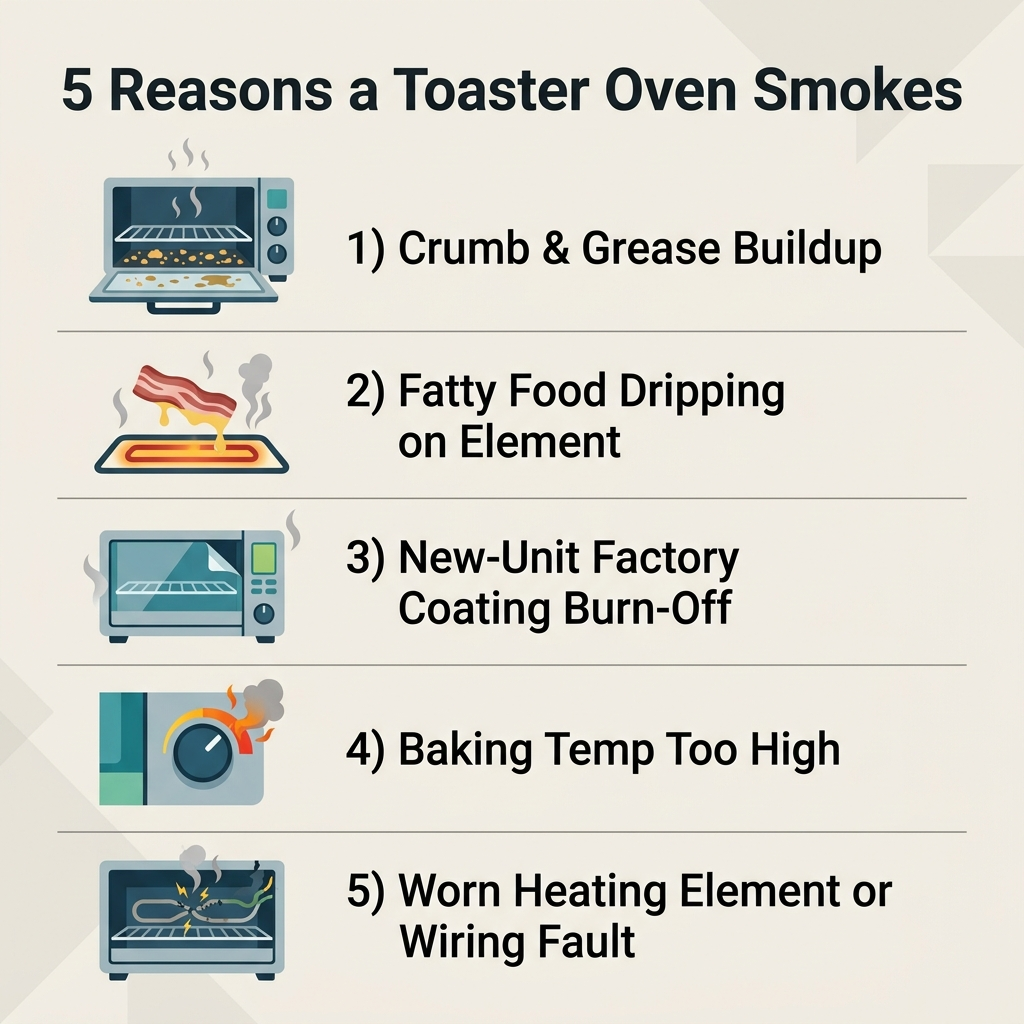
Before assuming the unit is broken, it helps to know that most smoke reports trace back to one of five causes, and four of them are maintenance or usage conditions rather than hardware failures:
| Cause | What it looks like | Fixable at home? |
|---|---|---|
| Crumb and grease buildup | Thin white/gray smoke that returns every bake; visible residue on tray or elements | Yes — clean thoroughly |
| Fatty food dripping onto an element | Smoke starts soon after fat begins rendering, smells like food | Yes — use a lined tray underneath |
| New-unit factory coating burn-off | Light smoke and a faint chemical smell only in the first 1–3 uses, then stops | Yes — run an empty burn-off cycle first |
| Baking temperature too high for the food | Smoke appears early in the bake, before food is done; often paired with over-browning | Yes — lower temp, add time |
| Worn heating element or wiring fault | Smoke continues on a clean, empty oven; burning-plastic smell; unit may trip a breaker | No — unplug and contact support |
General troubleshooting guidance collected across appliance-repair and manufacturer sources draws the same line every time: light smoke tied to food, grease, or a new unit’s break-in period is a normal, manageable occurrence, while smoke that persists on a clean, empty unit — or smells like burning plastic rather than food — signals a hardware problem. That distinction is the throughline across every source surveyed for this article.
2. Why crumbs and grease are the most common trigger
Toaster ovens cook with exposed heating elements just above and below the food, typically cycling between 300°F and 450°F depending on the setting. Crumbs that fall through the rack, and fat that drips from foods like bacon, sausage, cheese-topped dishes, or marinated chicken, land on the crumb tray or the elements themselves. The next time the oven heats up, that leftover residue chars and smokes — independent of whatever is currently inside. Appliance-repair guidance consistently names crumb and grease buildup as the single most common reported cause of toaster oven smoke, and recommends removing and washing the crumb tray after every few uses rather than waiting for a deep-clean interval.
A brand-new unit introduces a related but separate smoke source: manufacturing oils and protective coatings applied during production, which burn off the heating elements the first few times the oven reaches high heat. This is widely documented as normal and temporary, typically clearing within one to three uses, and manufacturers and appliance guides commonly recommend running a new, empty oven at its highest setting for 30–60 minutes in a ventilated room before the first real bake, specifically to burn off that coating without food in the way.
Baking at too high a temperature compounds both issues: crumbs and grease that might otherwise smolder slowly ignite faster at higher heat, and food itself is more likely to scorch and add burnt-food smoke on top of whatever residue is already present.
3. Brand-specific patterns worth knowing
Cuisinart. Cuisinart’s AirFryer Toaster Oven manuals (TOA-60/65/95 series) instruct owners to position the unit several inches from the wall and surrounding objects before first use, consistent with the ventilation that an empty burn-off cycle needs, and its troubleshooting guidance for persistent smoke or odor points first to the crumb tray and oven interior for food residue before anything else.
Breville. Owner and appliance-repair guidance for Breville’s Smart Oven line identifies carbonized food particles sitting directly on the heating elements or crumb tray as the typical heavy-smoking scenario, noting that once residue is baked on at the oven’s higher temperature settings, it effectively combusts on each subsequent use until physically removed — commonly with a non-metal scraping tool rather than chemical oven cleaner, which can damage the element’s coating. Separately, smoke or steam specifically leaking from the upper door corners rather than the vents is treated as a door-seal or gasket issue, not a grease or crumb problem, and is addressed by cleaning or replacing the gasket rather than scraping the interior.
Black+Decker and Hamilton Beach. Customer review archives for both brands include accounts of a toaster oven producing enough smoke mid-use to trigger a household smoke detector — in the reports we reviewed, this traced to food left unattended and overcooking (toast catching fire) or the unit’s highest heat setting running hot enough to smoke before the food was actually burning. Neither pattern is specific to these brands’ manufacturing quality in the sources we reviewed; it reflects the same unattended-high-heat dynamic documented across the category, though it’s a useful reminder that no toaster oven should be run on a high setting unattended for an extended bake.
Cross-brand safety context. The CPSC’s July 2026 recall of roughly 11,480 Panasonic NB-G200 toaster ovens was issued for insufficient cord insulation creating a shock and fire risk — a different failure mode from the smoke-and-grease pattern this article is mainly about. The recall notice cites four reports of tripped circuit breakers or outlets and one report of the unit no longer working, with no fires or injuries reported. We cite it here as the most recent toaster-oven-category CPSC action and as a reminder that electrical faults, while uncommon, are a documented real possibility in this product category — which is part of why a wiring-related smoke pattern (smoke with no food or grease source, especially paired with a tripped breaker) warrants contacting the manufacturer rather than continued troubleshooting.
4. What to actually do, in order
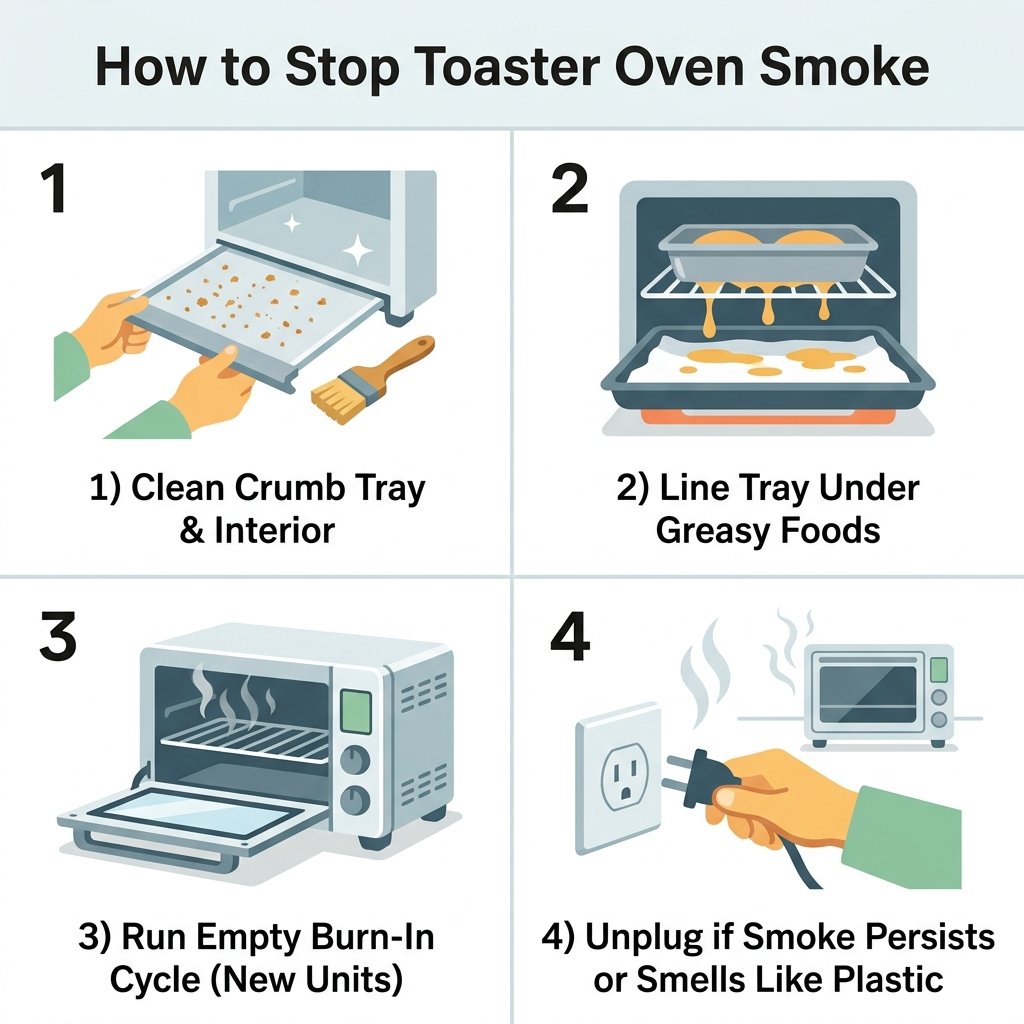
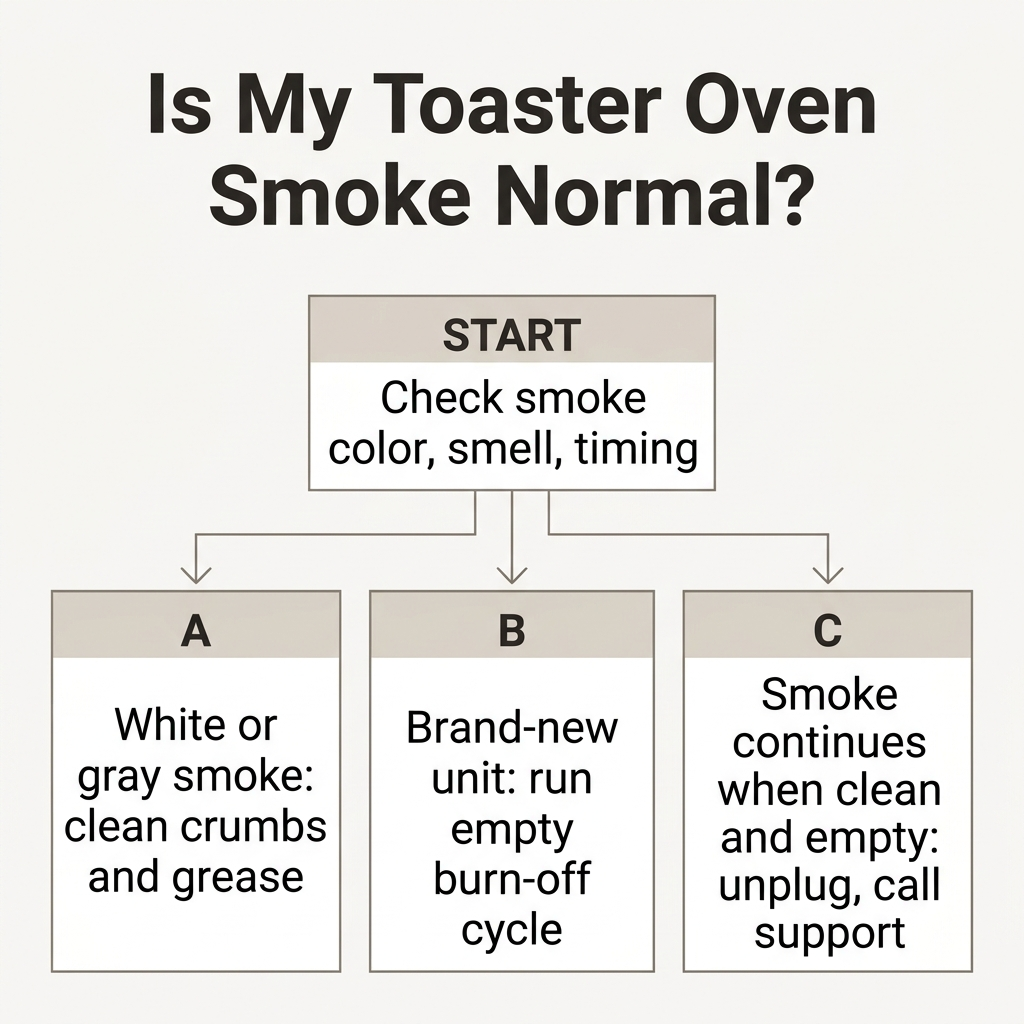
- Note the smoke color, smell, and timing before doing anything else. Thin white or gray smoke that smells like food, grease, or a faint chemical odor on a brand-new unit is the routine case below. Smoke with a burning-plastic smell, or smoke that appears on a clean, empty, unused oven, means skip straight to step 6.
- Cancel, unplug, and let the unit cool if smoke is heavy enough to be alarming, even if it looks like the routine grease-and-crumb type — this is standard guidance and avoids any risk while you assess.
- Clean the crumb tray and interior thoroughly. Guidance across appliance-repair sources and manufacturer manuals lists leftover crumbs and grease as the single most commonly cited cause; remove the tray, wash with warm soapy water once fully cooled, and wipe down the interior walls and visible elements with a damp cloth. Hardened grease on the elements may need a non-metal scraping tool rather than a chemical oven cleaner, which can damage the element’s coating.
- If the unit is brand-new, run an empty burn-off cycle first. Placing the empty oven at its highest temperature for 30–60 minutes in a ventilated room, with nothing inside, lets manufacturing coatings burn off before you bake actual food — this is the single most effective fix for new-unit smoke specifically.
- Lower the temperature for fatty or sugary foods and add a liner under the tray. A heat-resistant, reusable tray liner under bacon, sausage, or cheese-topped dishes catches drips before they reach the element; dropping the temperature slightly and extending cook time reduces how fast residue scorches.
- If smoke persists on a clean, empty, uncrowded oven, smells like burning plastic, or coincides with a tripped breaker, stop using it and contact manufacturer support rather than continuing to troubleshoot — that pattern is consistent with a worn heating element or wiring fault, not a cooking-condition issue.
5. If the fix is better grease management: current options
Editorial recommendation, not personal testing. Several of the causes above come down to giving crumbs and dripping fat somewhere to go besides the heating elements.
- Toaster Oven Liners for Bottom of Oven (4 Pack), Reusable Non-Stick, Compatible with Ninja, Cuisinart, Emeril Lagasse & More — a trim-to-fit tray liner that catches crumbs and grease before they reach the heating elements, aligned with the cleaning-forward guidance every brand surveyed gives as the first fix.
6. If it’s time for a new unit: current options
Editorial recommendation, not personal testing. If smoke traces back to an aging unit’s hard-to-reach grease buildup or worn elements, a current-generation convection toaster oven addresses element exposure and cleanability directly.
- Breville BOV845BSS Smart Oven Pro, Convection Toaster Oven, Brushed Stainless Steel — a current convection model from the brand whose own support guidance this article draws on for element-cleaning technique.
7. The decision flowchart
8. The bottom line
A toaster oven that smokes mid-bake is, in the large majority of documented cases, reacting normally to crumb and grease buildup, dripping fat from fatty foods, or a brand-new unit burning off factory coating — not a sign of a defective appliance. Cleaning the crumb tray and interior, lining the tray under greasy foods, and running a one-time empty burn-off cycle on a new unit resolves most reported cases without a service call or replacement. The one pattern that isn’t routine is smoke that continues on a clean, empty, uncrowded oven, especially with a burning-plastic smell or a tripped breaker — that combination points to a worn heating element or wiring fault, and it’s the point where unplugging and contacting manufacturer support is the right call rather than continuing to adjust baking habits.
Limitations of this analysis
To be explicit about what this article does not establish:
- We did not personally reproduce this issue on the specific machines named here. The causes and fixes described are drawn from manufacturer manuals, appliance-repair troubleshooting guides, a public CPSC safety record, and aggregated customer-review patterns, not from a controlled test we ran ourselves.
- The 2026 Panasonic NB-G200 recall addresses cord insulation and shock/fire risk, not smoke from cooking residue — it reports four tripped-breaker/outlet incidents and one unit that stopped working, no fires or injuries. We cite it as the most recent toaster-oven-category CPSC action and as context for taking electrical-fault patterns seriously, not as evidence linking that specific defect to the grease-and-crumb smoke this article mainly covers.
- Burn-off duration for new units varies by model and manufacturing batch, so “30–60 minutes” is directional guidance from general appliance sources, not a figure specific to one brand’s engineering spec.
- Amazon and ConsumerAffairs review sentiment was read from public review and complaint panels in October 2026 and reflects aggregated impressions, not a scientific sample.
- Market penetration and brand-share figures are current industry estimates that vary somewhat across research firms; we cite them as directional context, not a precise figure.