Surge Protector vs. Power Strip 2026: What $10 Buys You
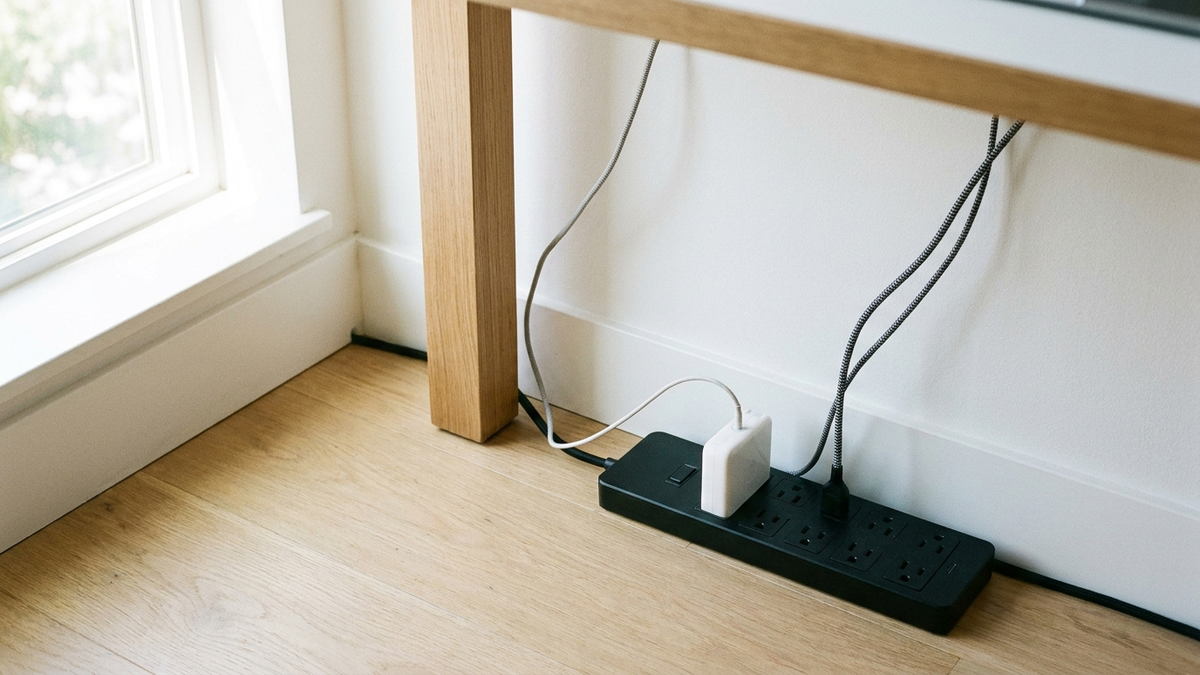
A six-outlet strip for $8 and an 11-outlet strip for $40 look almost identical on an Amazon results page — same black plastic, same flat cord, same row of sockets. Reviewers routinely use the two terms interchangeably, and plenty of budget power strips are labeled “surge protector” on the box even when the protection is minimal. The $10-plus price gap between the cheapest options and the mid-tier picks buys one specific thing: a set of components that absorb a voltage spike before it reaches whatever is plugged in. This analysis breaks down what that component actually does, when it is worth paying for, and which currently-listed amazon.com products back up their claims with a real joule rating and a real testing standard.
As an Amazon Associate, Arekore earns from qualifying purchases. The Amazon product links in this article may include our affiliate tracking ID and may earn us a commission if you buy through them, at no additional cost to you. See our Links Policy for details on how we select products and how commissions do not influence our recommendations.
TL;DR / Quick Verdict
- The one thing that tells them apart: a joule rating on the packaging. If a strip does not print a joule number, it is not a surge protector, no matter what the label says — that is the identifying test used across manufacturer and independent guidance alike.
- Best overall: the APC Performance SurgeArrest P11VNT3 (3,020 joules, 11 outlets, ~$40 at time of writing) — the pick Tom’s Guide and multiple outlets return to for wide-spaced outlets plus phone/coax/ethernet line protection.
- Best budget with USB: the Anker 351 Power Strip (2,100 joules, 12 outlets plus USB-A/USB-C, ~$26) carries a 4.8-star rating across roughly 19,000 Amazon ratings — one of the most reviewed strips in the category.
- Skip strips with no printed joule rating for anything expensive. The Consumer Product Safety Commission (CPSC) attributes roughly 2,000 residential fires a year to cords and plugs, and most of those failures trace back to overloaded, unrated strips rather than certified surge protectors.
How We Reached These Conclusions (Methodology)
This is an editorial analysis, not a hands-on review; we did not personally test the products covered here. This guide synthesizes (a) aggregated amazon.com customer review sentiment on currently-listed surge protectors and power strips, including a strip with roughly 19,000 ratings, sampled in July 2026; (b) independent testing and buying guides from Tom’s Guide, CNN Underscored, TechGearLab, and historical Consumer Reports and Stiftung Warentest lab testing; (c) the UL 1449 safety standard for Surge Protective Devices and CPSC fire-incident data; and (d) manufacturer specifications for joule ratings, clamping voltage, and connected-equipment warranties. Joule ratings, response times, and equipment-protection dollar figures are manufacturer claims unless attributed to UL or an independent lab. Prices are amazon.com figures at the time of writing.
The Technical Difference: What Is Actually Inside
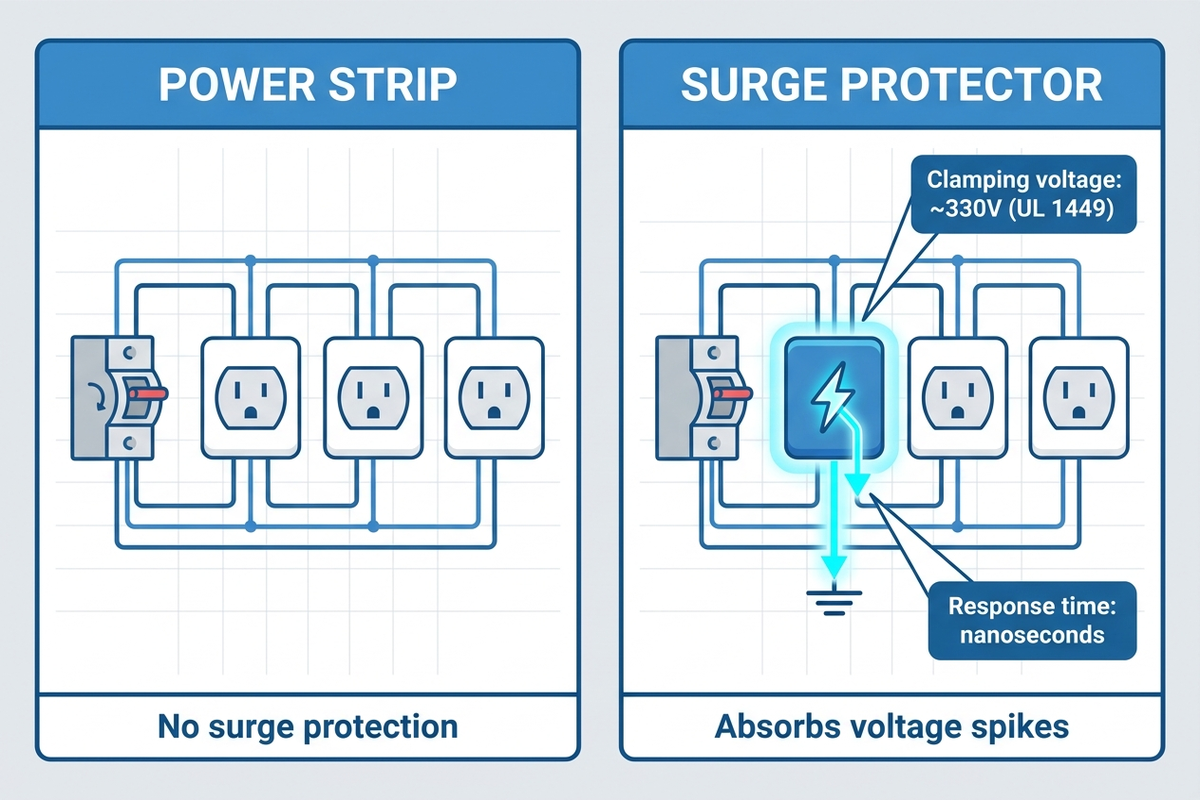
A power strip is, electrically, just a multi-outlet extension cord: wires, sockets, and usually a circuit breaker that trips if you draw too much current. It does nothing about voltage spikes — a lightning-adjacent surge or a refrigerator compressor kicking on elsewhere in the house passes straight through to whatever is plugged in.
A surge protector adds one or more Metal Oxide Varistors (MOVs) wired between the hot and neutral (and often ground) lines. Under normal voltage, an MOV does nothing. When voltage spikes above its threshold, its resistance collapses in nanoseconds, and it shunts the excess energy to ground instead of letting it reach the outlet. The two numbers that describe how well this works are:
- Clamping voltage (let-through voltage): the voltage that still reaches your device during a surge. Per the UL 1449 standard, a “low let-through” rating clamps around 330 volts, measured against a standardized 6kV/3kA test waveform. Lower is better.
- Joule rating: how much total surge energy the MOVs can absorb over their lifetime before they degrade. MOVs wear out with every surge they absorb — this is why a surge protector needs replacing periodically and cannot “reset” like a breaker.
The identifying test recommended across independent guidance is simple: look for a joule number on the box. If there is not one, the product is a power strip regardless of what marketing copy on the packaging implies.
Manufacturer-by-Manufacturer: How the Current Options Compare
APC (Schneider Electric) has built surge protection hardware for enterprise data centers since the 1980s, and its consumer SurgeArrest line carries that reputation into the $30-$50 tier. The P11VNT3 (3,020 joules, manufacturer spec) splits its 11 outlets into six widely spaced and five standard-spaced sockets, and adds jacks for telephone, coaxial, and ethernet line surge protection — relevant for anyone with a modem or a wired home office setup. It is the pick Tom’s Guide’s 2026 testing names for TV, console, and home-theater setups, alongside similar praise from other outlets for its outlet spacing and line protection.
Anker, better known for chargers and portable batteries, entered the power-strip category aggressively with the 351 Power Strip (2,100 joules, 12 AC outlets plus 2 USB-A and 1 USB-C port rated to 20W). At roughly $26, it undercuts APC while adding charging ports most dorm rooms and home offices actually use daily — and its Amazon review volume (approximately 19,000 ratings at 4.8 stars) suggests it has become a default pick for shoppers who found it through Amazon’s own bestseller ranking rather than a review site.
ECHOGEAR targets a narrower use case: AV racks, home offices, and gaming setups where a bulky strip does not fit behind furniture. Its ShockBlocker (3,420 joules, 8 outlets, UL certified) is the highest joule rating of the group, in a slimmer housing, backed by a manufacturer-stated 5-year, $25,000 connected-equipment warranty.
Amazon Basics covers the entry tier. Its 6-outlet, 790-joule model (with circuit breaker and LED indicator) is a real surge protector — the joule rating is printed — but at roughly a quarter of the APC unit’s protection headroom, it is best matched to low-cost peripherals rather than a home theater or a home office’s full desktop rig.
How to Use One Correctly (Most Reviews Get This Part Wrong)
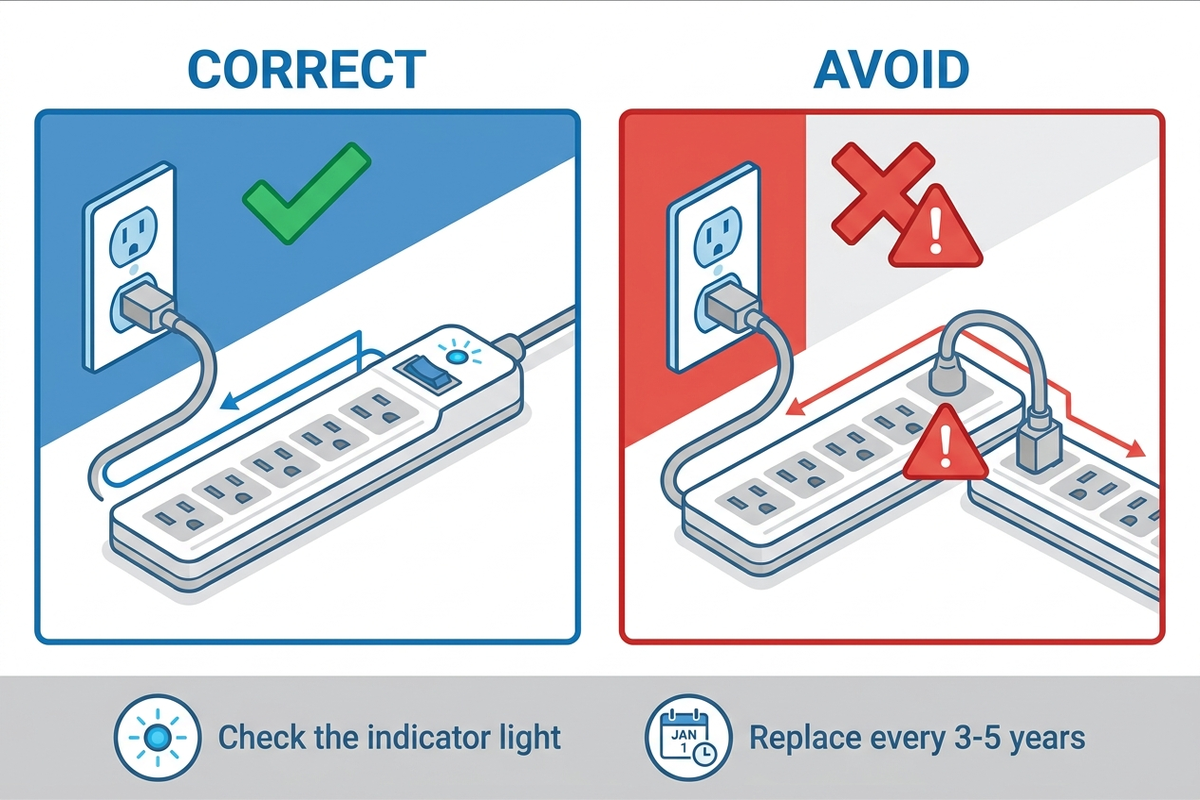
- Never daisy-chain. Plugging one power strip into another is flagged by CPSC guidance as a leading cause of circuit overload and fire risk. Every strip should plug directly into a wall outlet.
- Check the indicator light. Most surge protectors include an LED that confirms the MOV circuit is intact. Historical Consumer Reports testing found that on some older models, the light stayed on even after the surge protection had already failed — a reminder that the light confirms wiring continuity, not necessarily remaining joule capacity.
- Replace after a major event. A single large surge (a nearby lightning strike, a grid event) can consume most of a unit’s joule rating in one shot even if it keeps working afterward. Manufacturers and independent guides both recommend replacing a surge protector after any known large surge, and proactively every 3-5 years in normal use.
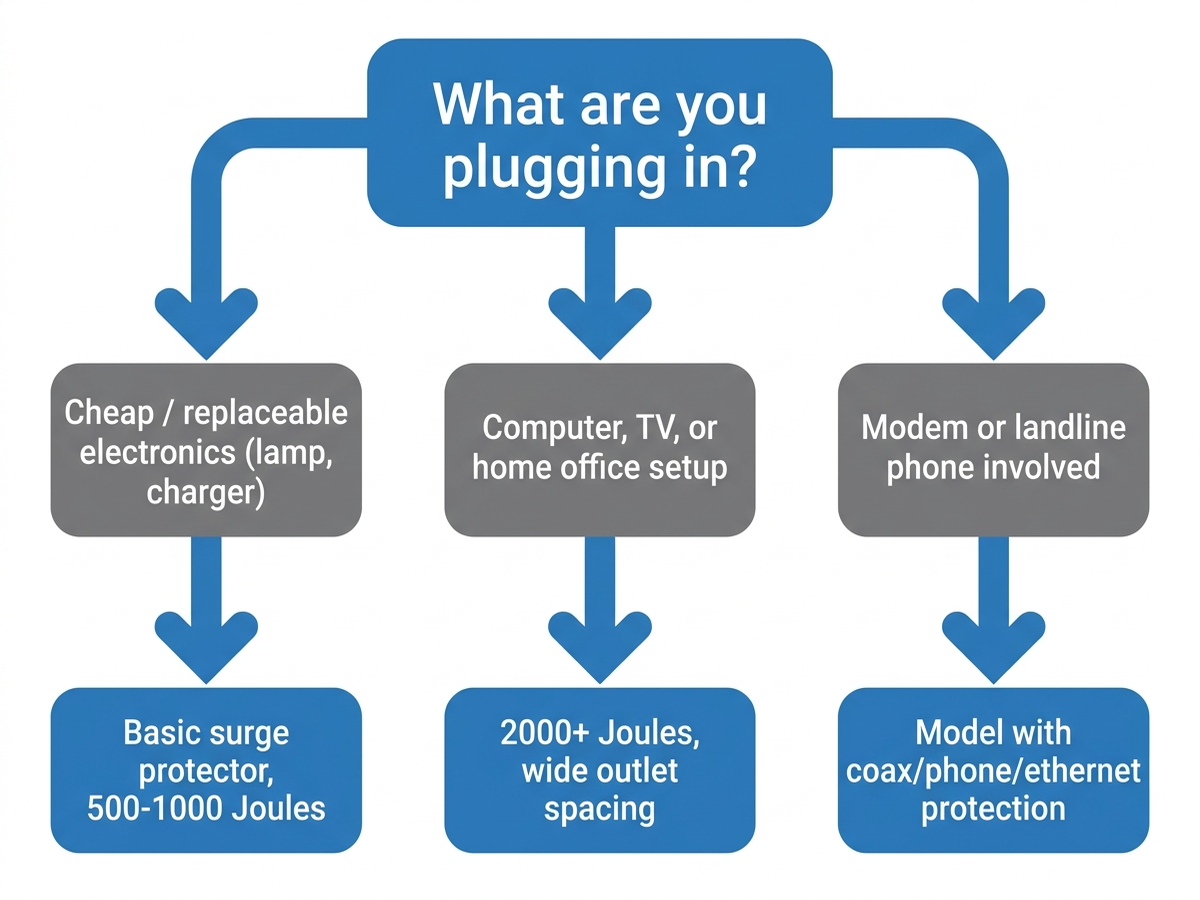
- Match joules to what is plugged in. A router or a lamp does not need 3,000+ joules. A desktop computer, monitor, or home theater receiver benefits from the higher end of the range.
Comparison Table
| Product | Joule Rating | Outlets | Extras | Price (at time of writing) | Amazon Rating |
|---|---|---|---|---|---|
| ECHOGEAR ShockBlocker | 3,420 J | 8 | UL certified, slim housing, $25,000 equipment warranty (mfr. claim) | ~$32 | — |
| APC Performance SurgeArrest P11VNT3 | 3,020 J | 11 (6 wide + 5 standard) | Phone/coax/ethernet protection | ~$40 | — |
| Anker 351 Power Strip | 2,100 J | 12 + 2 USB-A + 1 USB-C | TUV listed, $200,000 equipment protection (mfr. claim) | ~$26 | 4.8★ (~19,000 ratings) |
| Amazon Basics 6-Outlet Surge Protector | 790 J | 6 | Circuit breaker, LED indicator | ~$13 | — |
| Unrated “power strip” (no joule number printed) | None | Varies | Breaker only, no surge protection | ~$8-$10 | — |
Ratings and prices reflect the amazon.com listings checked at the time of writing and move frequently.
Warranty and “Connected Equipment Protection” Claims
Several manufacturers advertise a dollar figure — $25,000, $150,000, $200,000 — for damage to equipment plugged into their surge protector at the time of a covered surge. These figures are manufacturer marketing claims, not independently verified insurance payouts; they typically require the original receipt for both the surge protector and the damaged device, a claims process, and proof the unit was still under warranty. Treat the dollar figure as a signal of manufacturer confidence in the product, not as a guarantee of payout amount or speed.
Editorial Recommendation by Use Case
- Best overall for a home office or entertainment center: APC P11VNT3 — highest joule rating with practical outlet spacing and phone/coax/ethernet coverage in one unit, from a brand with a multi-decade surge-protection track record.
- Best budget pick with charging ports: Anker 351 — the largest verified review base in this comparison, at a price roughly a third lower than the APC pick, plus USB-A/USB-C ports most desks and dorm rooms use daily.
- Best for tight spaces (AV racks, under-desk mounts): ECHOGEAR ShockBlocker — highest joule rating of the group in the slimmest housing.
- Best for low-stakes electronics only: Amazon Basics 6-Outlet — adequate joule rating for lamps, chargers, and other low-cost peripherals, not for a full desktop setup.
Limitations
This analysis relies on publicly available manufacturer specifications, aggregated Amazon customer reviews, and independent testing and safety guidance rather than side-by-side hands-on lab testing performed by our editorial team. Joule ratings and connected-equipment warranty dollar figures are manufacturer-published unless otherwise attributed. MOV degradation over time is not something a shopper can verify from a product listing, and individual experience may vary based on local power quality, the number and type of devices plugged in, and unit-to-unit manufacturing variance. Stiftung Warentest’s most recent comprehensive power-strip lab test dates to 2011; more recent third-party lab data specific to these exact models was not available at the time of writing.