Subscription Creep 2026: Hidden Fees in Gadgets You Bought
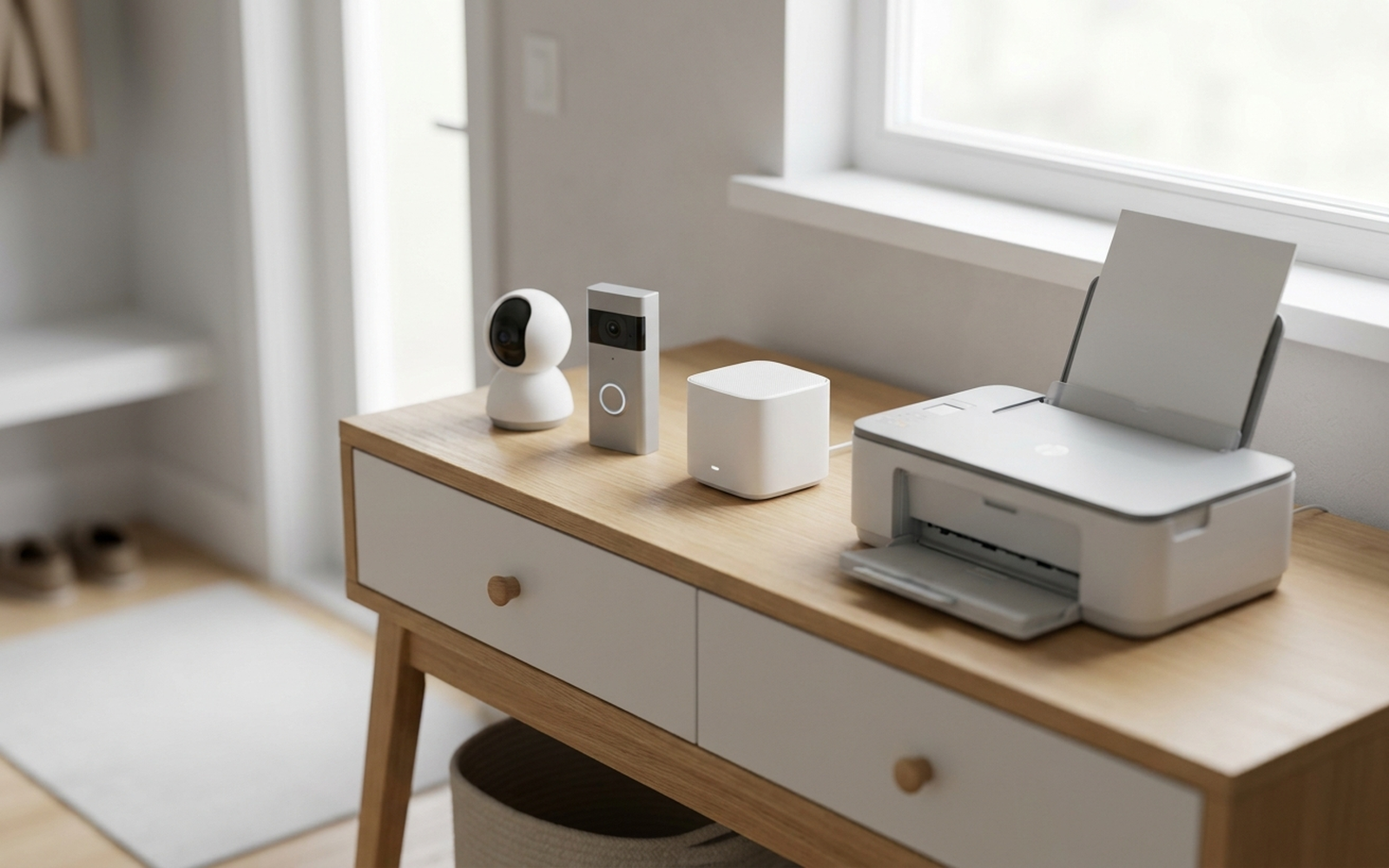
The receipt says “$99.” The device is a printer, a camera, a router — something with a single sticker price and, apparently, a single payment. Then the app asks you to sign in. Then it asks for a card. Cloud video history is “included” for 30 days and then it isn’t. The AI person-detection that sold you on the camera in the first place sits behind a $3-a-month toggle. None of this is a scam, exactly — it’s disclosed, somewhere, in a settings menu or a footnote. It is also not what “one-time purchase” implies to most buyers, and the gap between the two has a name: subscription creep.
This article is provided by Arekore, an AI shopping assistant. Paste a product URL and our AI checks review authenticity, digs into low-star feedback, and compares prices in about five minutes.
TL;DR / Quick Verdict
- The average U.S. household is already paying more than it thinks. Itemized subscription audits average $219/month in aggregate spending, while people asked to estimate their own total off the top of their head guess closer to $86/month — a gap of roughly $133/month, or about $1,596/year, per C+R Research’s widely cited subscription-spending survey.
- Some gadgets work fine without the subscription; others don’t. Robot vacuums and most security cameras keep their core function for free. Fitness equipment with locked training modes and some printer cartridges do not.
- Printer ink subscriptions carry a real lock-in mechanism. HP’s Instant Ink program uses firmware-level checks that deactivate enrolled cartridges — even ones with ink remaining — once the subscription ends, a design confirmed in HP’s own support documentation and widely reported in customer complaints.
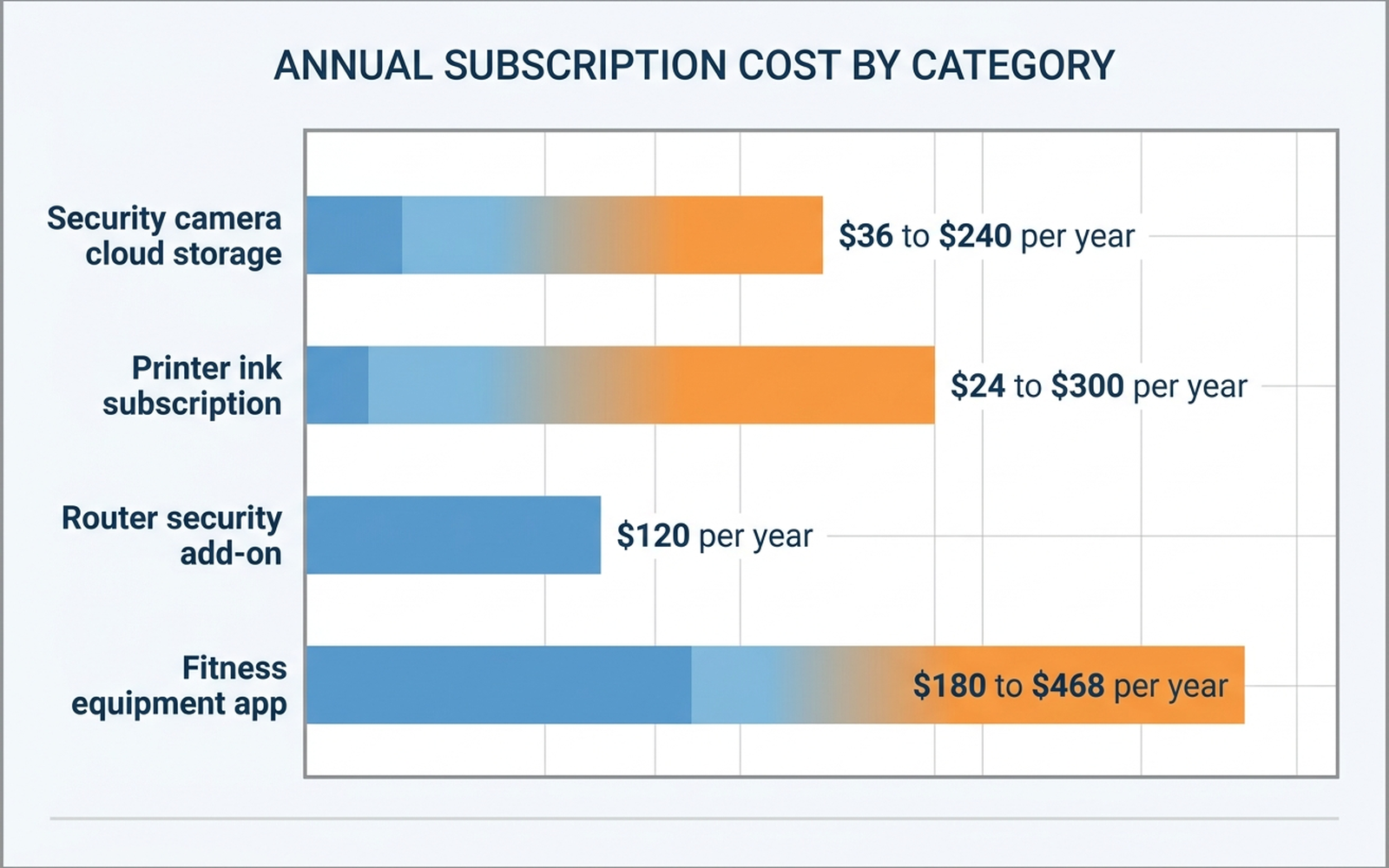
- Camera cloud storage is the most common recurring fee in smart-home gadgets, ranging from about $3 to $20 per month per device depending on the brand and video-history window.
- The FTC’s “click-to-cancel” rule was vacated by a federal appeals court in 2025 and is now back in a slow rulemaking process — meaning easy-cancellation protections you may assume exist are not currently federal law.
How We Reached These Conclusions (Methodology)
This is an editorial analysis, not a hands-on test of every subscription tier discussed. This guide synthesizes: (a) manufacturer support documentation and published pricing pages for HP Instant Ink, Ring Protect, Wyze Cam Plus, Arlo Secure, Google Home Premium (formerly Nest Aware), eero Plus, and iFit; (b) Consumer Reports’ published guidance on iFit and treadmill subscription requirements; (c) Tom’s Guide’s security-camera storage-plan comparison; (d) FTC public rulemaking records on the Negative Option Rule (“click-to-cancel”); (e) C+R Research’s 2026 consumer subscription-spending survey on forgotten and underestimated recurring charges; and (f) aggregated amazon.com customer-review sentiment on best-selling printer, camera, router, and treadmill listings, sampled in July 2026. We did not personally subscribe to and cancel every plan covered here. Figures are attributed to their source; manufacturer-published numbers are labeled as such rather than presented as independently verified. Prices are amazon.com and manufacturer-site figures at the time of writing and change frequently.
Why “One-Time Purchase” Rarely Means One Payment Anymore
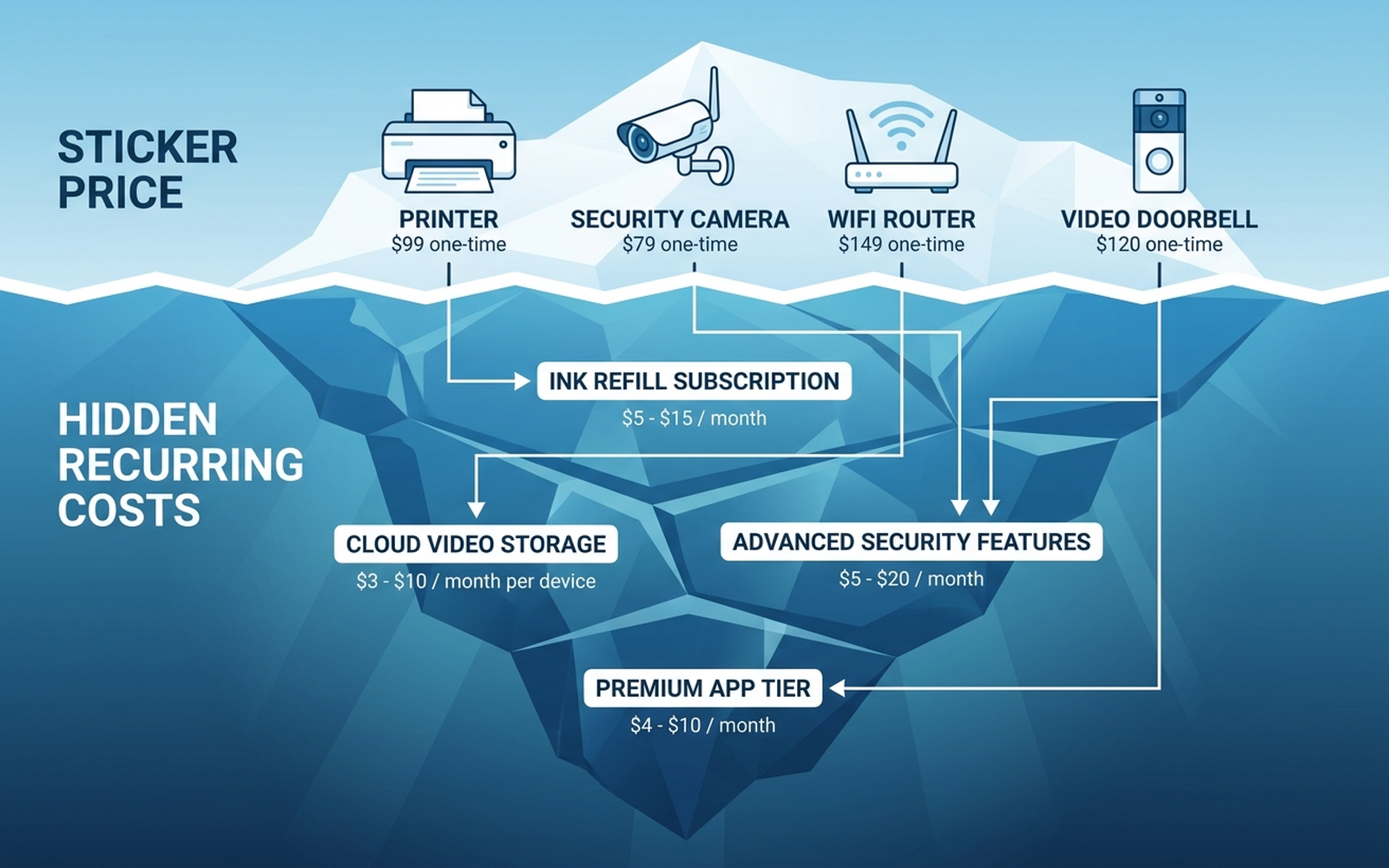
Three structural shifts explain why so many gadget categories now carry a subscription layer that the sticker price doesn’t disclose upfront:
- Hardware margins are thin; recurring-revenue margins are not. A camera or printer sold near cost is a loss leader for the software and cloud-storage subscription attached to it — the same margin logic that made game consoles and inkjet printers famous for selling hardware cheap and recouping profit on the consumable or service.
- Cloud features have real infrastructure costs. Video history, AI object detection, and remote access all run on servers somewhere, and companies increasingly pass that cost through as a subscription rather than folding it into the device price — which is defensible, but rarely communicated before checkout.
- Regulatory guardrails on easy cancellation are currently weaker, not stronger. The Eighth Circuit Court of Appeals vacated the FTC’s “click-to-cancel” rule in July 2025 on procedural grounds. The FTC reopened a rulemaking process in early 2026 and closed public comment in April 2026, but a final rule is not expected soon — leaving the current patchwork of state laws and the older, narrower Restore Online Shoppers Confidence Act (ROSCA) as the main federal tools against hard-to-cancel plans.
The Numbers, Category by Category
Printers: a subscription that can disable hardware you paid for
HP’s Instant Ink plans run from $1.99/month for a 15-page tier up to $24.99/month for a 700-page tier (with a free 15-page/month option also available), scaling with printing volume and positioned as a convenience — ink ships automatically before you run out. The catch, documented in HP’s own support materials and echoed across widely reported customer complaints, is that Instant Ink cartridges are tied to the subscription at a firmware level: when the subscription ends, enrolled cartridges are deactivated, even if they still contain usable ink. Reviewers on Trustpilot and in tech press coverage also describe page-limit overage charges (printing 250 pages on a 700-page plan still bills the full plan price) and difficulty getting refunds after cancellation. Non-subscription HP printers and third-party ink remain unaffected — the lock-in is specific to units enrolled in the Instant Ink program.
Security cameras and doorbells: cloud storage is the recurring fee, not the core function
Aggregated pricing across major brands in 2026, following price increases at several vendors since mid-2025: Wyze Cam Plus runs about $2.99/month per camera, with a flat multi-camera “Cam Unlimited” tier at $9.99/month; Ring Protect raised its Basic plan to $5.99/month per device and its Plus (unlimited-cameras-per-location) plan to $12/month effective February 2026; Google Home Premium (the rebranded Nest Aware) starts at $10/month for its Standard tier and $20/month for Advanced, both covering unlimited cameras, after Google’s own August 2025 price increase; and Arlo Secure runs $7.99/month for a single camera or $12.99/month for unlimited cameras, with a Secure Plus tier at $17.99/month adding 60-day history and 24/7 emergency response. Live view and motion push alerts typically still work without a subscription on most of these brands — it’s recorded video history and advanced AI detection (person vs. package vs. animal) that sit behind the paywall.
Mesh routers: security features layered on top of a device that already works
Eero Plus costs $9.99/month or $99.99/year and adds dark-web monitoring, ad blocking, a built-in VPN, and parental controls on top of an eero mesh system that routes internet traffic fully without it. This is closer to an optional upsell than a lock-in — the router performs its core job, networking your home, with zero subscription — but it is still a recurring line item many buyers don’t budget for at purchase time.
Fitness equipment: the category where “crippled without it” is real
NordicTrack and ProForm treadmills ship with iFit, a coaching platform sold in two tiers: iFit Train at $15/month and iFit Pro at $39/month (the tier most equipment-bundled trials upgrade into, and priced the same whether used by one person or the five-person family plan). Consumer Reports and equipment reviewers confirm manual mode always works without a subscription — but the interactive, trainer-led workouts that are the entire marketing pitch for these machines are locked behind the plan, and buyer complaints collected across retailer Q&A sections describe discovering this only after unboxing: “Available only to Premium Members” appearing across most pre-programmed workouts. At the $39/month Pro tier, a 3-year ownership period runs $1,404 in subscription costs alone — often exceeding the machine’s own purchase price.
Robot vacuums: mostly free, with a narrower add-on than fitness equipment
By contrast, iRobot’s Roomba lineup keeps scheduling, room-specific cleaning, and smart mapping free with the device purchase; the optional “Select” membership layers in auto-ship replacement parts and extended-warranty-style perks rather than gating core cleaning functionality. Reviewer sentiment across the category consistently ranks “no subscription required” as one of the most-praised features of competing brands like Roborock, suggesting buyers notice and reward the absence of a paywall even when the paywalled brand doesn’t restrict cleaning itself.
Customer Sentiment Synthesis
Aggregated amazon.com and manufacturer-community reviews for products in this space converge on two recurring themes. First, complaints cluster overwhelmingly around surprise, not price — reviewers describe the dollar amount as tolerable but the discovery method (a locked feature found after setup, an autorenewal noticed on a bank statement months later) as the actual grievance. Second, reviews for subscription-optional devices explicitly credit that flexibility as a purchase driver, even among buyers who ultimately do pay for the premium tier — the ability to decline it is treated as a trust signal independent of whether it’s used.
Should You Keep the Subscription? A Decision Framework
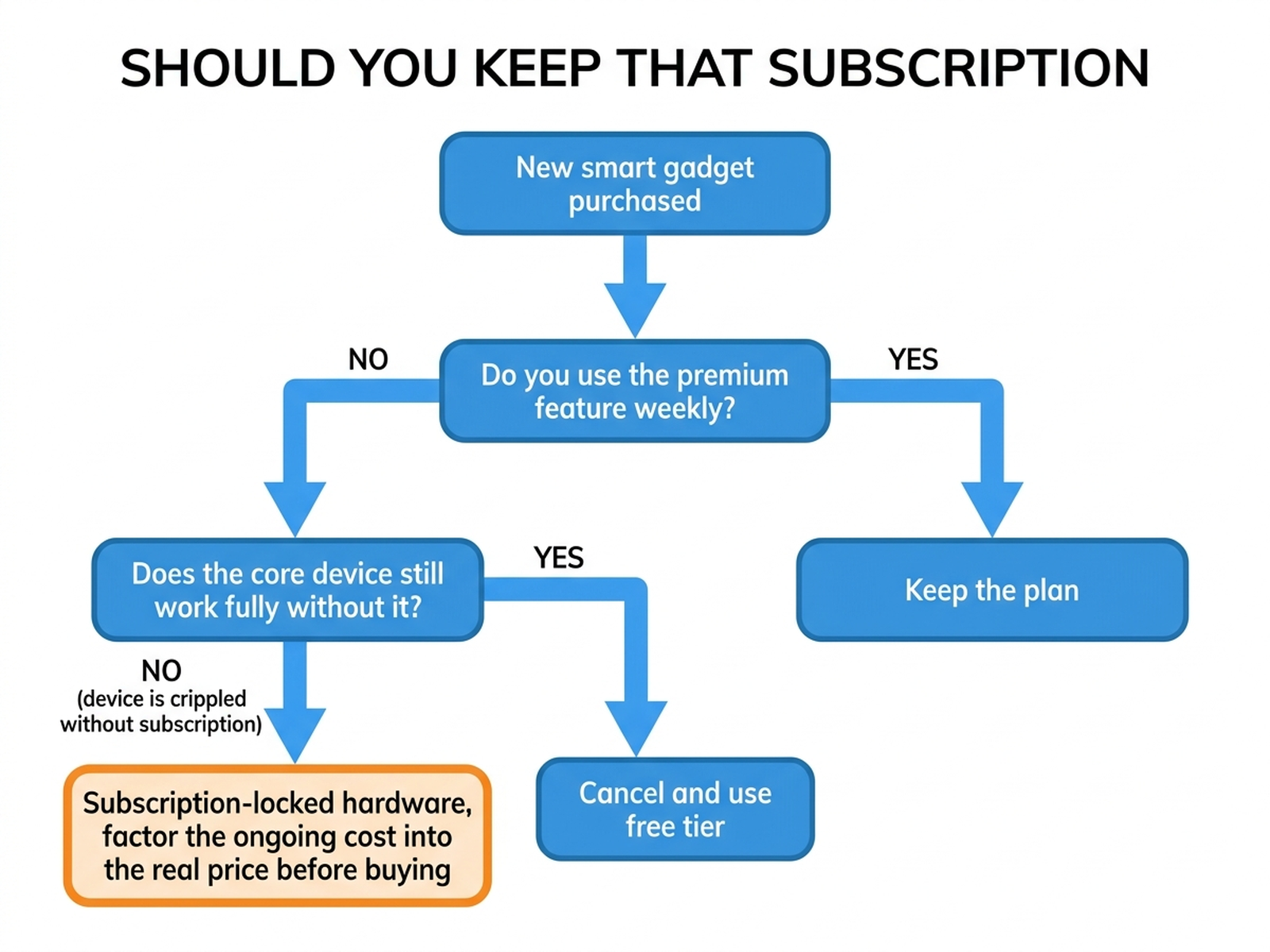
The dividing line across every category above isn’t the subscription’s existence — it’s whether the core device still functions without it. Camera live view, mesh-router networking, and robot-vacuum cleaning all work unsubscribed; treadmill coaching and Instant Ink’s continued cartridge function do not. Before buying, check specifically what breaks or locks if you never open the companion app’s payment screen — that answer, not the sticker price, is the number to budget against.
Comparison Table
Prices are amazon.com and manufacturer-published figures at the time of writing (July 2026) and fluctuate.
| Category | Device works without subscription? | Optional add-on cost | What’s actually locked |
|---|---|---|---|
| Inkjet printer (HP Instant Ink) | No, if enrolled | $1.99–$24.99/month | Cartridge itself deactivates at firmware level after cancellation |
| Security camera (Ring/Wyze/Arlo/Google Home) | Yes, live view works | $3–$20/month | Recorded video history, AI person/package detection |
| Video doorbell (Ring) | Yes, real-time alerts work | $5.99–$12/month | Video history playback, person alerts |
| Mesh router (eero) | Yes, fully functional | $9.99/month | VPN, ad blocking, dark-web monitoring |
| Robot vacuum (Roomba) | Yes, cleaning + mapping free | Varies (parts/warranty) | Auto-ship supplies, extended coverage |
| Smart treadmill (NordicTrack/iFit) | Manual mode only | $15–$39/month | Nearly all coach-led, pre-programmed workouts |
What the Data Says to Do About It
Before buying any connected device, look up the manufacturer’s own support page for what the product does with the subscription cancelled — not the marketing page, which rarely mentions it. For devices already in a drawer or on a wall, an annual “subscription audit” against a bank statement is the single most-cited fix in the 2026 spending research: the gap between the $86/month people estimate and the $219/month they’re actually charged only closes when someone looks at the itemized list, not the mental estimate. If a device’s most useful function is locked behind a recurring fee, the honest way to compare it against a subscription-free competitor is to add that fee to the purchase price for as many years as you plan to own it — which is what turns a “$399 treadmill” into a “$1,803 treadmill” over three years at the Pro membership tier.
Limitations
This analysis relies on manufacturer-published pricing and support documentation, Consumer Reports and Tom’s Guide reporting, FTC public rulemaking records, and aggregated review sentiment, rather than a hands-on subscribe-and-cancel test of every plan named here. Subscription pricing, tier structures, and cancellation policies change frequently and vary by region; figures here reflect July 2026 published rates and may not match your current billing screen. The FTC rulemaking status described here reflects the public record as of publication and is subject to change as the agency’s Negative Option Rule process continues. Individual experience may vary based on which specific plan tier, region, and account type applies to your device.
Bottom Line
The subscription layer sitting under 2026’s “one-time purchase” gadgets isn’t uniformly predatory — a mesh router or robot vacuum that works fully for free and offers a genuine optional upgrade is a different product, financially, than a printer whose cartridges stop working the day you cancel, or a treadmill whose entire marketed feature set sits behind a $39-a-month wall. The data says the fix isn’t avoiding smart devices altogether; it’s checking, before checkout, exactly what the device does on the day the subscription lapses — and pricing that answer into the purchase decision instead of discovering it in the settings menu three months later.
Before you buy, paste the product link into Arekore — our AI assistant checks review authenticity, surfaces what the one-star reviews actually complain about, and compares prices, free, in about five minutes.