Portable Power Station Winter Storage Guide 2026

TL;DR
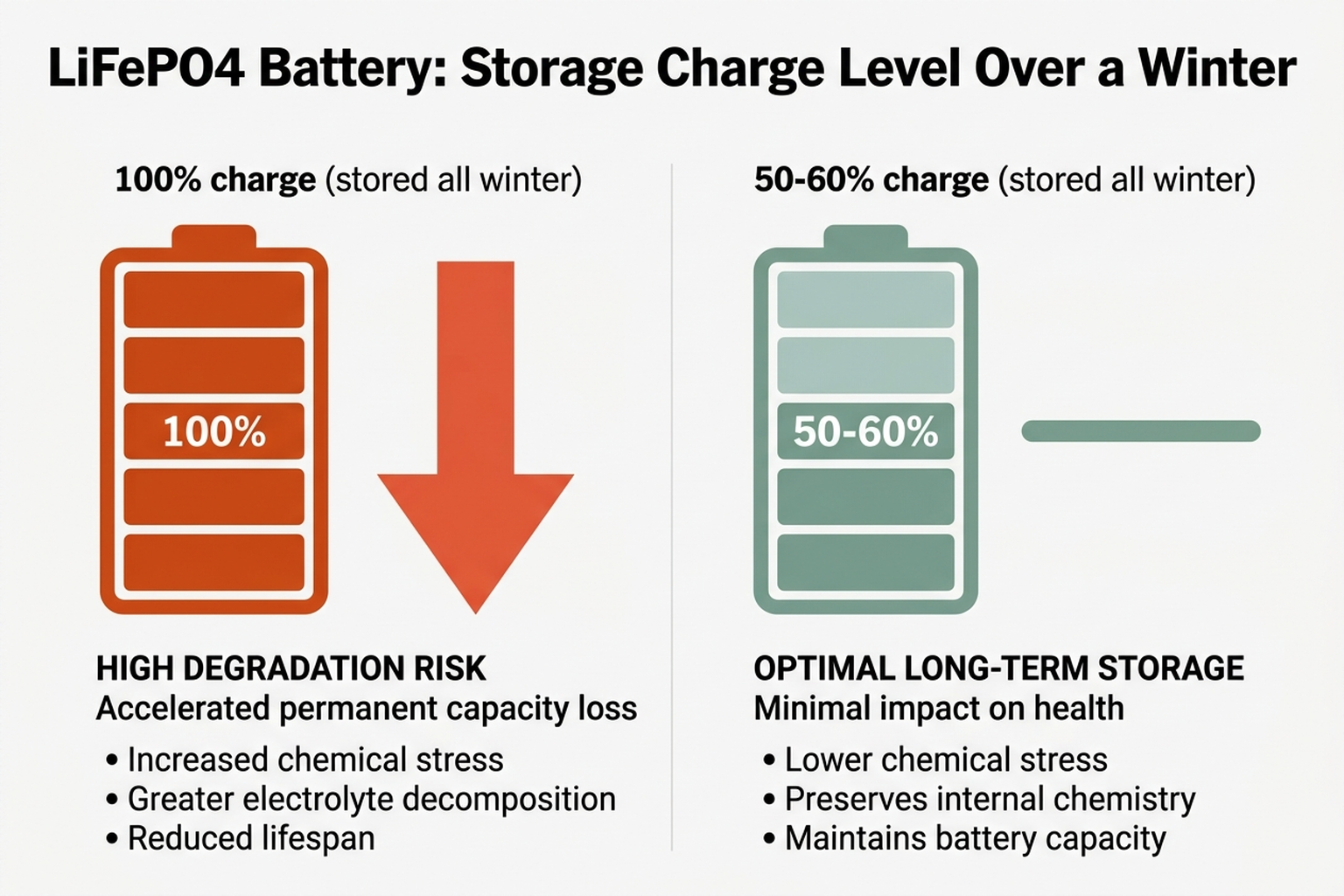
The two mistakes that quietly kill a portable power station over winter are storing it at 100% charge and storing it in an unheated garage or shed below freezing. Manufacturer guidance from Jackery, EcoFlow, Anker, and Bluetti converges on the same range for their LiFePO4 units: 50–80% charge, stored between roughly 50°F and 77°F, checked and topped up every one to three months. Charging a cold battery is also a specific risk — most LiFePO4 battery management systems (BMS) block charging below 32°F outright, and forcing current into a near-frozen cell that doesn’t have that protection can cause irreversible lithium plating. None of this requires special equipment; it requires remembering to check the unit twice over a four-to-five-month winter.
Methodology
This analysis synthesizes manufacturer storage specifications published by Jackery, EcoFlow, Anker, and Bluetti for their current LiFePO4 power stations, general LiFePO4 battery-chemistry guidance on low-temperature charging cutoffs from battery manufacturers and technical publishers, aggregated Amazon customer-review sentiment on four current US-market power stations (thousands of reviews across the four listings combined, though Amazon does not expose a precise per-model count we can cite exactly), and current portable-power-station market-size data from Grand View Research and MarkWide Research. We did not run a controlled multi-season degradation test ourselves; this is an editorial synthesis of publicly available manufacturer and third-party technical data, not first-hand longitudinal testing.
Why Winter Storage Is Different From Everyday Use
A portable power station that sits idle for a season is exposed to two stresses it doesn’t see during active use: a fixed, unmonitored state of charge for weeks at a time, and ambient temperatures that can swing from a warm house to a freezing garage or vehicle. Lithium battery chemistries, including the LiFePO4 (lithium iron phosphate) cells used in nearly every current mid-to-large power station, degrade fastest at their voltage extremes — fully charged or nearly empty — and that degradation compounds the longer the battery sits at an extreme without being touched. A unit used weekly and recharged after each use never really experiences “storage” conditions; a unit put away in October and not checked again until March does.
LiFePO4 is also more cold-tolerant for discharging (running a load) than for charging. Most of the BMS protection built into current power stations exists specifically to stop you from accidentally charging a cold battery, not from using one in the cold.
What the Manufacturers Actually Specify
- Jackery (Explorer 1000 v2 and similar current LiFePO4 models): recommends storing at 50–80% charge in a cool, dry location.
- EcoFlow (DELTA-series LiFePO4 units): recommends roughly 60% charge, with a published optimal storage range of 68°F–86°F (20–30°C) and a wider short-term tolerance down to about 14°F (-10°C).
- Anker SOLIX (current LiFePO4 lineup including the C1000 Gen 2 and F-series): recommends 50–80% charge and specifically warns against storage above 95°F (35°C), which matters as much as the cold side in a garage that gets hot in other seasons.
- Bluetti (Elite and AC-series LiFePO4 units): recommends a storage charge of no more than 80%, consistent with the broader manufacturer consensus.
Reading across all four, the overlapping safe zone is 50–80% charge, with temperature guidance tightest around 68°F–77°F (20–25°C) and most brands tolerating a wider range down toward 50°F on the cold side. Every manufacturer independently lands closer to 60% than to either extreme when they specify a single number rather than a range. None of the four recommends storing a unit at 100%, and none recommends letting it sit below roughly 20–30% for an extended period.
The Cold-Charging Problem, Specifically
Charging — not discharging — is where cold temperatures create a real failure mode. When a lithium-ion or LiFePO4 cell is charged below roughly 32°F (0°C), the charging process can deposit metallic lithium on the anode instead of absorbing it normally, a process called lithium plating. Plating is not self-correcting: it permanently reduces usable capacity, raises internal resistance, and in more severe cases, creates an internal short-circuit risk. Because this damage isn’t visible from the outside, a power station that’s been charged cold several times over a winter can show reduced runtime in spring with no obvious cause.
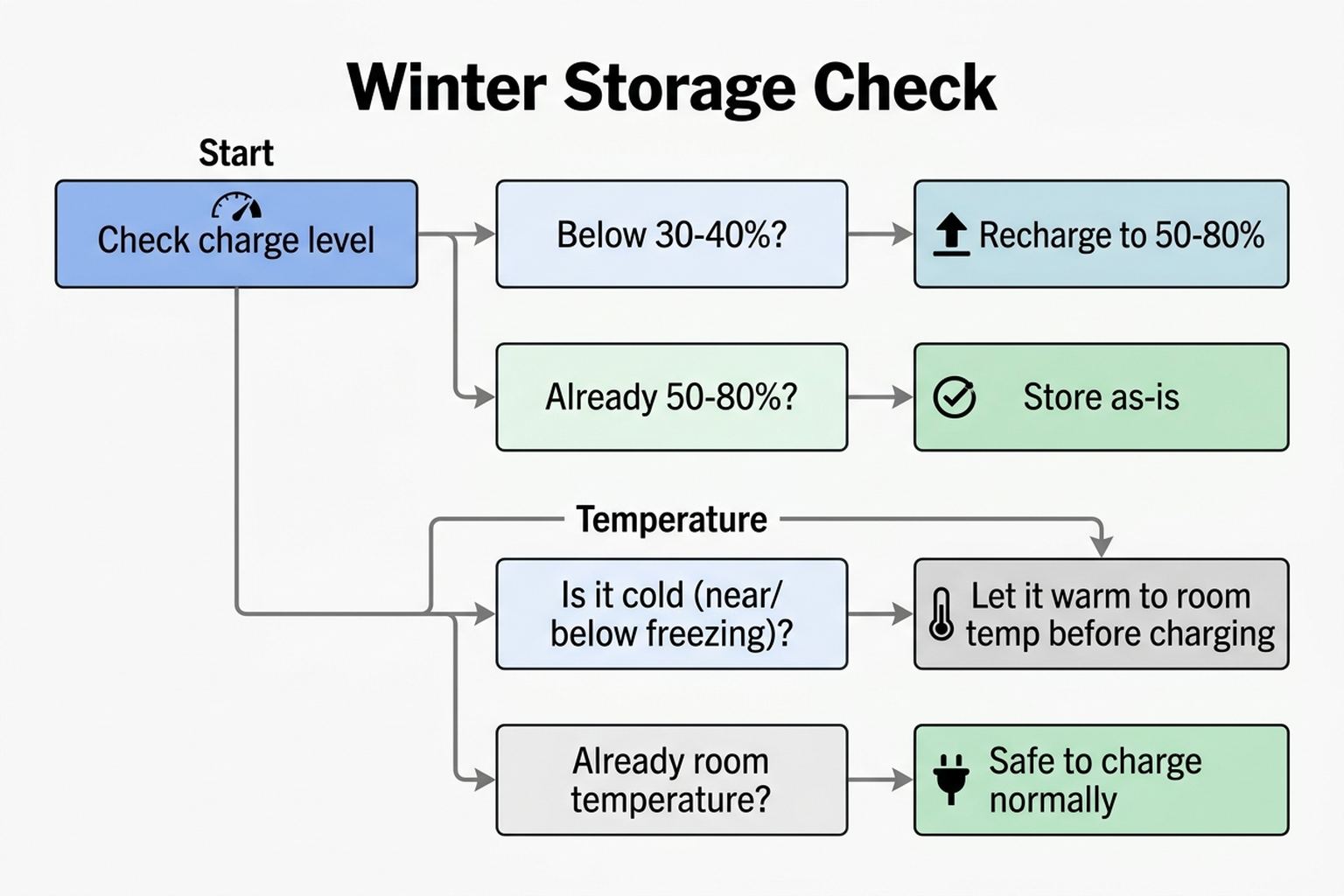
This is why most current power stations build a low-temperature charge cutoff into their BMS: if the internal cell-temperature sensor reads below freezing, the unit refuses to accept a charge at all, and resumes automatically once the cells warm — typically above about 41°F (5°C). Practically, this means the most common way to “break” a power station’s battery in winter is bringing it in cold from a vehicle or garage and immediately plugging it in before it warms to room temperature, rather than anything about simply leaving it unused in the cold.
Winter Storage Steps
- Charge (or discharge) to 50–60% before putting the unit away for the season. If it’s currently near full, run a load until it drops into range rather than leaving it at 100% for months.
- Store it somewhere climate-controlled, not in an unheated garage, shed, or vehicle. A closet, basement, or interior storage room in the 50–77°F range is a better choice than anywhere temperatures regularly drop near or below freezing.
- Keep it away from direct cold, condensation, and moisture. If an unheated space is the only option, an insulated storage box or cover reduces temperature swings and keeps condensation off the unit’s ports and vents. EcoFlow’s own guidance, for example, tolerates occasional dips to about 14°F (-10°C) but recommends 68–86°F (20–30°C) as the optimal range — the farther a storage spot drifts from that, the more it relies on the battery’s wider short-term tolerance rather than its ideal conditions.
- Check the charge level every one to three months. If it’s dropped below roughly 30–40%, recharge it back up to 50–80% — most self-discharge over a winter is slow, but an unmonitored unit can still drift into the low-charge range manufacturers warn against.
- Let a cold unit return to room temperature before charging it. If it’s been sitting in a cold garage or car, bring it inside and wait — most current units won’t let you charge below freezing anyway, but a unit just above that threshold can still be charging colder than ideal.
- Use the manufacturer’s own charger, and avoid fast-charging a unit that’s been cold. Fast-charge modes push more current into the cells; doing that before a cold unit has fully warmed increases stress even on units that technically allow the charge to start.
Comparing Four Current LiFePO4 Power Stations
Prices as of 2026-10-16. Ratings and review counts are Amazon customer data at time of research, not independently verified by Arekore.
| Model | Capacity | Manufacturer storage spec | Price (approx.) | Amazon rating |
|---|---|---|---|---|
| Jackery Explorer 1000 v2 | 1,070Wh | 50–80% charge, cool/dry location | ~$499 | 4.7 / 5 |
| Anker SOLIX C1000 Gen 2 | 1,024Wh | 50–80% charge, avoid storage above 95°F | $799 MSRP, frequently discounted to ~$400–500 | 4.7 / 5 |
| EcoFlow DELTA 3 Plus | 1,024Wh | ~60% charge, 50–86°F range | ~$799 | 4.6 / 5 |
| Bluetti Elite 200 V2 | 2,073.6Wh | Max 80% charge for storage | ~$1,099 | 4.7 / 5 |
All four use LiFePO4 cell chemistry, which is the primary reason their storage guidance converges so closely — the chemistry, not the brand, drives the 50–80% / 50–77°F consensus.
Editorial Recommendation by Use Case
- If you store a power station every winter and tend to forget about it: set a recurring reminder for the 1–3 month check interval rather than relying on memory — a unit left fully charged or fully depleted for an entire season is the scenario manufacturer guidance is specifically written to prevent.
- If your only storage option is an unheated garage or shed: prioritize an insulated box or cover over worrying about the exact charge percentage — temperature swings and condensation are a bigger risk in that environment than being at 55% instead of 65%.
- If you use the unit through winter for outages or outdoor work: the cold-charging caution matters more than the long-term storage percentage — let it warm up before plugging it in after it’s been in a cold car or outdoors.
- If you’re buying a new unit specifically for winter backup power: any current LiFePO4 model from a major brand will have comparable storage behavior; prioritize capacity and output for your actual outage needs over storage-spec differences between brands, since those differences are minor.
Warranty Considerations
Manufacturer warranties on current power stations (commonly two to five years depending on brand and model) typically cover manufacturing defects, not capacity loss attributable to storage conditions the user controlled, such as leaving a unit at 100% charge for months or repeatedly charging it while cold. Following the manufacturer’s own published storage and charging guidance is the most direct way to keep normal seasonal battery aging distinct from a warranty-relevant defect.
Limitations
This analysis relies on manufacturer-published storage specifications, general LiFePO4 battery-chemistry guidance from battery manufacturers and technical publishers, and current Amazon customer-review and market data, rather than a controlled multi-season degradation test Arekore ran itself. We did not independently tally a precise combined review count across the four listings; Amazon does not expose that figure in a citable form. Actual long-term capacity retention varies by specific cell supplier, manufacturing batch, how many charge cycles a unit has already seen, and how closely real-world storage conditions match the ranges above. Pricing and review counts on Amazon change frequently — the Anker SOLIX C1000 Gen 2’s $799 MSRP is routinely discounted, and stock availability on any individual listing can shift — so treat the figures in the comparison table as directional rather than current-to-the-minute. Grand View Research and MarkWide Research put the global portable power station market at roughly $4.8–5.4 billion in 2026 — a scale note on how widely this storage question applies, not a claim about any individual product’s durability.
As an Amazon Associate, Arekore earns from qualifying purchases. The Amazon product links in this article include our affiliate tracking ID and may earn us a commission if you buy through them, at no additional cost to you. See our Links Policy for details on how we select products and how commissions do not influence our recommendations.
Power Stations We Found on Amazon
- Jackery Explorer 1000 v2 Portable Power Station, 1070Wh, 1500W
- Anker SOLIX C1000 Gen 2 Portable Power Station, 1024Wh, 2000W
- EF ECOFLOW DELTA 3 Plus Portable Power Station, 1024Wh, 1800W
- BLUETTI Elite 200 V2 Portable Power Station, 2073.6Wh
Before buying a unit specifically for winter backup use, check its published operating-temperature range as well as its storage range — some units that store fine down near freezing still won’t charge at all once cold, which matters if you’re counting on fast recharge during a winter outage.