Stop Midnight Amazon Shopping: A Data-Backed Fix (2026)
A June 2026 CouponFollow survey of 1,010 U.S. adults found that nearly 2 in 5 Americans (39%) say they make impulsive purchases specifically when shopping online late at night, and 13% have woken up to a confirmation email for an order they have no memory of placing. A separate compilation of 2026 impulse-spending research puts the figure even higher among specific groups: millennials are the heaviest late-night buyers, with 71% reporting they have completed a purchase while already in bed.
As an Amazon Associate, Arekore earns from qualifying purchases. The Amazon product links in this article may include our affiliate tracking ID and may earn us a commission if you buy through them, at no additional cost to you. See our Links Policy for details on how we select products and how commissions do not influence our recommendations.
TL;DR / Quick Verdict
- Late-night shopping is not a willpower problem — it’s a predictable brain-chemistry pattern. Decision fatigue from the day depletes the self-control system that normally overrides impulse, while dopamine from the “deal” or “trending item” framing spikes right when that override is weakest.
- The single highest-leverage fix is a mandatory delay, not more self-discipline. A 24-hour waiting period is widely cited across personal-finance and behavioral-spending commentary as cutting impulse buys substantially for high-value items — because dopamine fades within hours, and the purchase looks different in daylight. We could not trace this figure to a single peer-reviewed primary study, so treat it as a well-corroborated but not independently verified estimate.
- Removing the phone from the bed is a close second. Sleep Foundation guidance recommends keeping phones several feet from the bed; a dedicated alarm clock (from a $6 basic model to a $170 phone-free smart clock) removes the reason to have the phone within reach at all.
- Amazon’s own checkout speed works against you. One-click ordering and a 30-minute cancellation window are built for convenience, not restraint — knowing the exact after-the-fact tools (cancel, return) matters as much as prevention.
Methodology
This is an editorial analysis, not a personal account — we did not track our own shopping behavior to produce this article. It synthesizes: (a) CouponFollow’s June 2026 survey of 1,010 U.S. adults on late-night shopping and impulse-buy regret; (b) a 2026 dual-process psychology study on impulse buying in digital commerce published in Frontiers in Psychology — note this study surveyed 564 consumers in livestream-commerce and marketplace contexts in China, not a US, time-of-day-specific sample, so we apply its self-control-depletion framework by analogy rather than as direct evidence for the “midnight” claim specifically; (c) CouponFollow’s and Capital One Shopping’s aggregated research on the cost of late-night shopping by generation; (d) Sleep Foundation guidance on phones and bedroom technology; (e) manufacturer and independent coverage of alarm-clock and app-blocking products, including New York Times Wirecutter’s recognition of the Loftie alarm clock as a multi-year pick; and (f) Amazon’s published order-cancellation and return-window policies. Some frequently repeated figures on waiting-period and mindfulness interventions circulate widely across personal-finance commentary without a single, clearly citable peer-reviewed source; where that is the case, we say so explicitly rather than attributing them to a named study we could not verify. We did not personally test the specific products recommended below.
1. Why Midnight Is Different From 2 P.M.
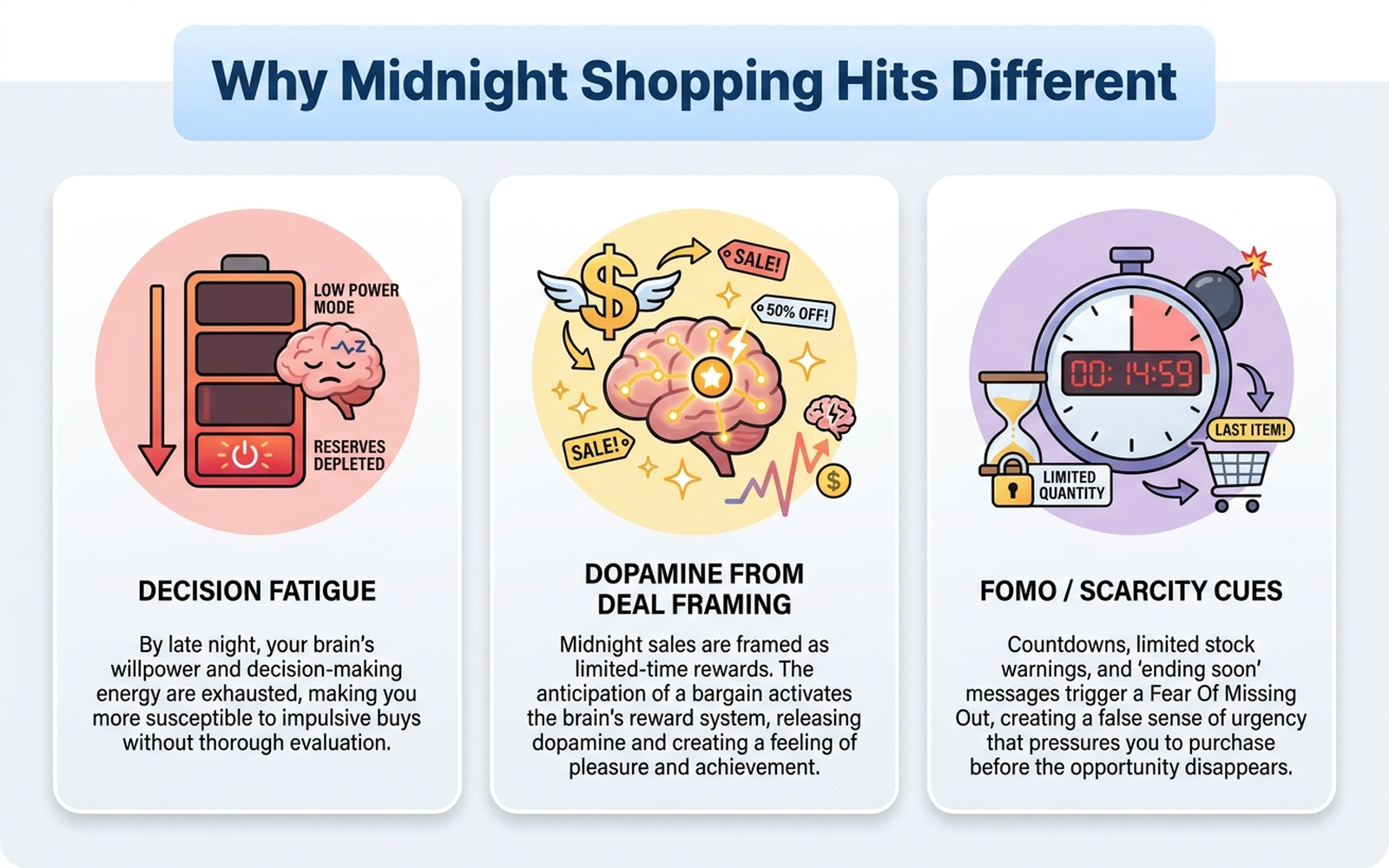
Behavioral researchers describe self-control as a limited daily resource — the same “System 2” reasoning that lets you skip a snack at 10 a.m. is measurably weaker by 11 p.m., after a full day of small decisions. A 2026 dual-process model of impulse buying published in Frontiers in Psychology — based on a survey of 564 consumers across livestream-commerce and marketplace platforms in China — describes the same underlying mechanism: as deliberate, effortful decision-making depletes, the brain leans more heavily on faster, emotion-driven judgment. That study did not test US shoppers or a specifically late-night sample, but its dual-process framework maps onto the same pattern US late-night-shopping surveys describe — a mode that favors “buy it now” over “do I actually need this.”
Three factors compound on top of that baseline fatigue:
- Deal framing activates reward circuitry regardless of need. Sale badges and limited-time countdowns trigger a dopamine response tied to the perception of getting a deal, not to the item’s actual utility — and that response fires whether or not the purchase was planned.
- FOMO-style scarcity messaging. Limited-time offers and “only 3 left” messaging are estimated to drive roughly a third of impulse purchases broadly, and late-night browsing is when these cues meet the least sales resistance.
- Isolation removes a social check. Shopping alone in bed, with no one else present to react to a purchase decision, removes an ordinary social-monitoring effect that in-person or shared-screen shopping provides.
The generational data reflects all three factors compounding differently by age group. Gen Z late-night shoppers report the highest impulse-buy rate at 58%, with estimated overspending of $541 a year — more than four times the rate reported for baby boomers, according to aggregated research on late-night shopping costs. Millennials are close behind on raw incidence: 71% report having completed a purchase from bed, per capitaloneshopping.com’s compiled 2026 impulse-spending data.
2. What the Checkout Flow Is Optimized For
Amazon’s checkout mechanics are not designed with restraint in mind — they are designed to remove friction, and removing friction is precisely what makes impulse purchases easier to complete before the 11 p.m. brain has a chance to reconsider.
| Feature | What it does | Why it matters at midnight |
|---|---|---|
| Saved payment + one-click ordering | Skips the “re-enter your card” pause that used to double as a natural cooling-off moment | Removes the one built-in friction point that most other retailers still have |
| 30-minute order cancellation window | Lets you cancel via “Your Orders” → “Cancel Items” if you act fast | Most people are asleep or scrolling on to the next thing within 30 minutes — this window closes before decision fatigue lifts |
| ”Customers also bought” / recommendation carousels | Surfaces more triggering items right after you’ve already lowered your guard once | One purchase decision often cascades into two or three more in the same session |
| Lightning Deals / limited-time badges | Creates a real or implied deadline | Combines scarcity messaging with the exact moment self-control is lowest |
The practical implication: prevention has to happen before checkout, not during it. Once you’re on the order confirmation page, the interface has already done its job.
3. Five Techniques, Ranked by How Much Evidence Backs Them
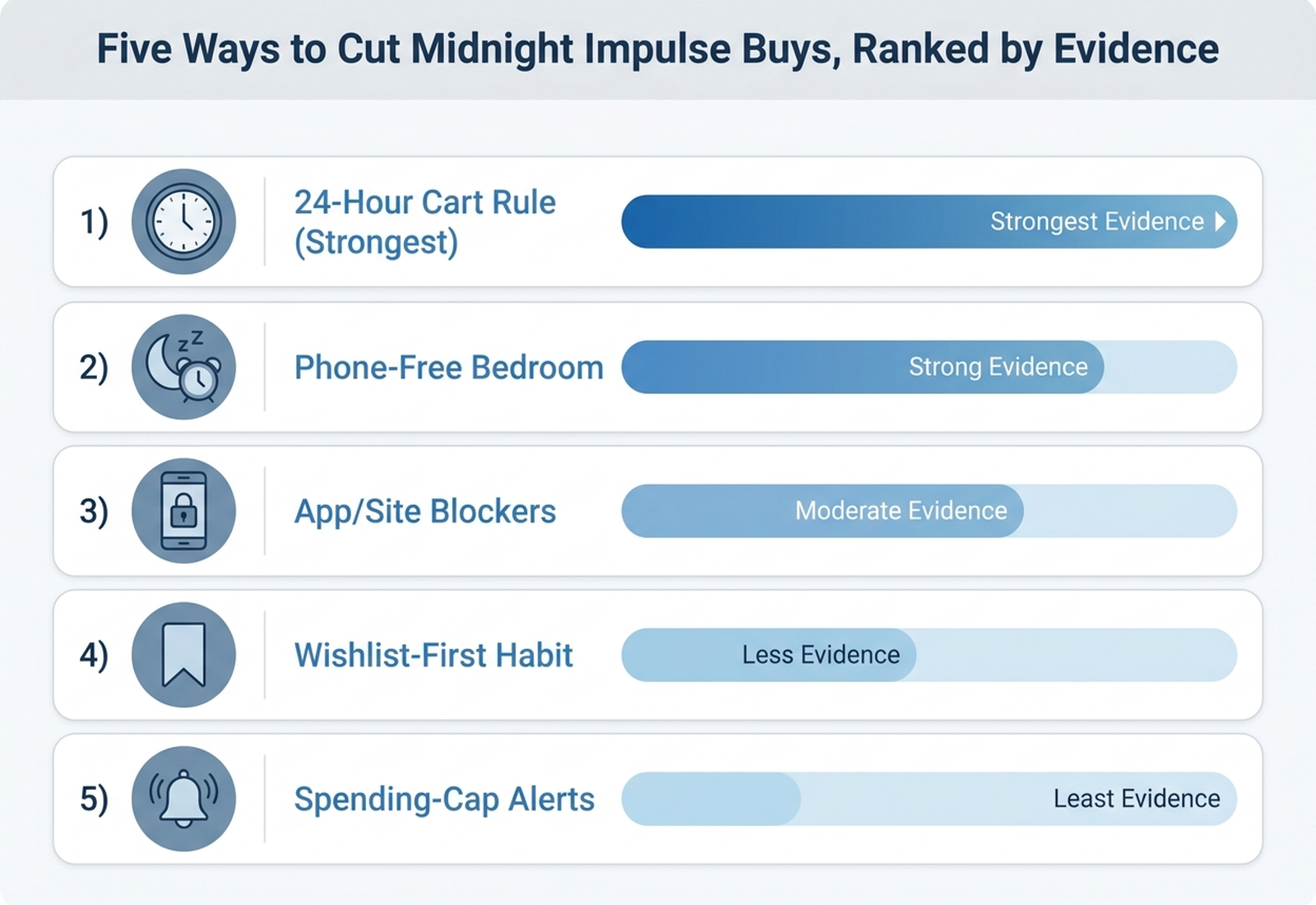
1. The 24-hour cart rule (most consistently recommended). Add the item to your cart or a wish list, then close the tab and revisit the decision the next day. Personal-finance and behavioral-spending sources consistently describe this as the single most effective habit change, and separate commentary on brief daily mindfulness pauses reports a meaningful drop in unplanned online purchases over an eight-week period; neither figure traces back to a single peer-reviewed study we could independently verify, so treat the specific percentages as directional rather than exact. The mechanism lines up with the psychology above: dopamine from seeing the item fades within hours, so the same product simply looks less urgent by morning. Amazon’s own wish-list and “save for later” cart features make this free and built-in — the discipline is in not skipping the wait, not in finding a tool.
2. A phone-free bedroom setup (strong, and addresses the root exposure). Sleep Foundation guidance on bedroom technology recommends keeping phones several feet from the bed, in part because proximity is both a sleep-quality issue and a behavioral-temptation issue — the phone being in reach at all is a large part of what makes 1 a.m. browsing possible in the first place. The practical fix is a dedicated alarm clock so the phone can charge in another room:
- Budget option (~$6): Amazon Basics Small Digital Oval Alarm Clock — no app, no notifications, battery backup so a power blip doesn’t reset your wake time.
- Radio/USB-charging option (~$20-25): Amazon Basics Digital Alarm Clock with FM Radio and USB Charging Port — useful if you still want to charge something (an e-reader, not a smartphone) at the bedside.
- Premium, purpose-built option (~$170): Loftie Alarm Clock with Sound Machine — a repeat New York Times Wirecutter pick specifically because its design is built around replacing a phone at the bedside: a two-phase gentle alarm, built-in white noise and wind-down content, and no app required to operate day to day.
3. App or site blockers with a scheduled window (moderate evidence, easy to set up). Tools like Freedom let you block shopping sites and apps across your phone and computer during a set window (for example, 10 p.m. to 7 a.m.); note that independent reviews of Freedom point out it removes access without addressing the underlying urge, so it works best paired with the 24-hour rule rather than alone. One Sec takes a lighter-touch approach — instead of a hard block, it inserts a brief pause (a prompt to take one breath) before the shopping app opens, which several reviewers describe as enough friction to break the habit loop without feeling punitive.
4. Wishlist-first as a default habit (moderate evidence, zero cost). Instead of an “add to cart,” default to “add to wish list” for anything that isn’t a planned purchase. This does the same dopamine-cooling job as the 24-hour rule but requires no external tool — it just changes which button is the default click.
5. Spending-cap or price-alert notifications (weaker standalone evidence, useful as backup). Some banking apps and browser extensions can flag or cap discretionary spending after a set hour or dollar threshold. This is a backstop rather than a primary fix — it catches the purchase after the decision is made rather than interrupting the impulse itself, but it is useful for anyone who has tried rule 1 or 2 and still slips occasionally.
4. If You Already Bought Something at 1 A.M.
Amazon gives you two after-the-fact tools, and knowing the exact windows matters:
- Within 30 minutes of ordering: go to “Your Orders” and select “Cancel Items” — the fastest and cleanest option, since the order never ships.
- Within 30 days of delivery (most items sold or fulfilled by Amazon): a standard return for a full refund. As of 2026 policy updates, some categories carry a shorter window — smartphones, tablets, laptops, and wearables have moved to a 15-day return window rather than 30. Return-window length varies by product category and seller, so confirm the exact window shown on your specific order page before assuming either figure applies.
Neither tool prevents the next midnight purchase — that’s what the five techniques above are for — but knowing them removes the “well, I already bought it, might as well keep it” resignation that often follows an impulse buy.
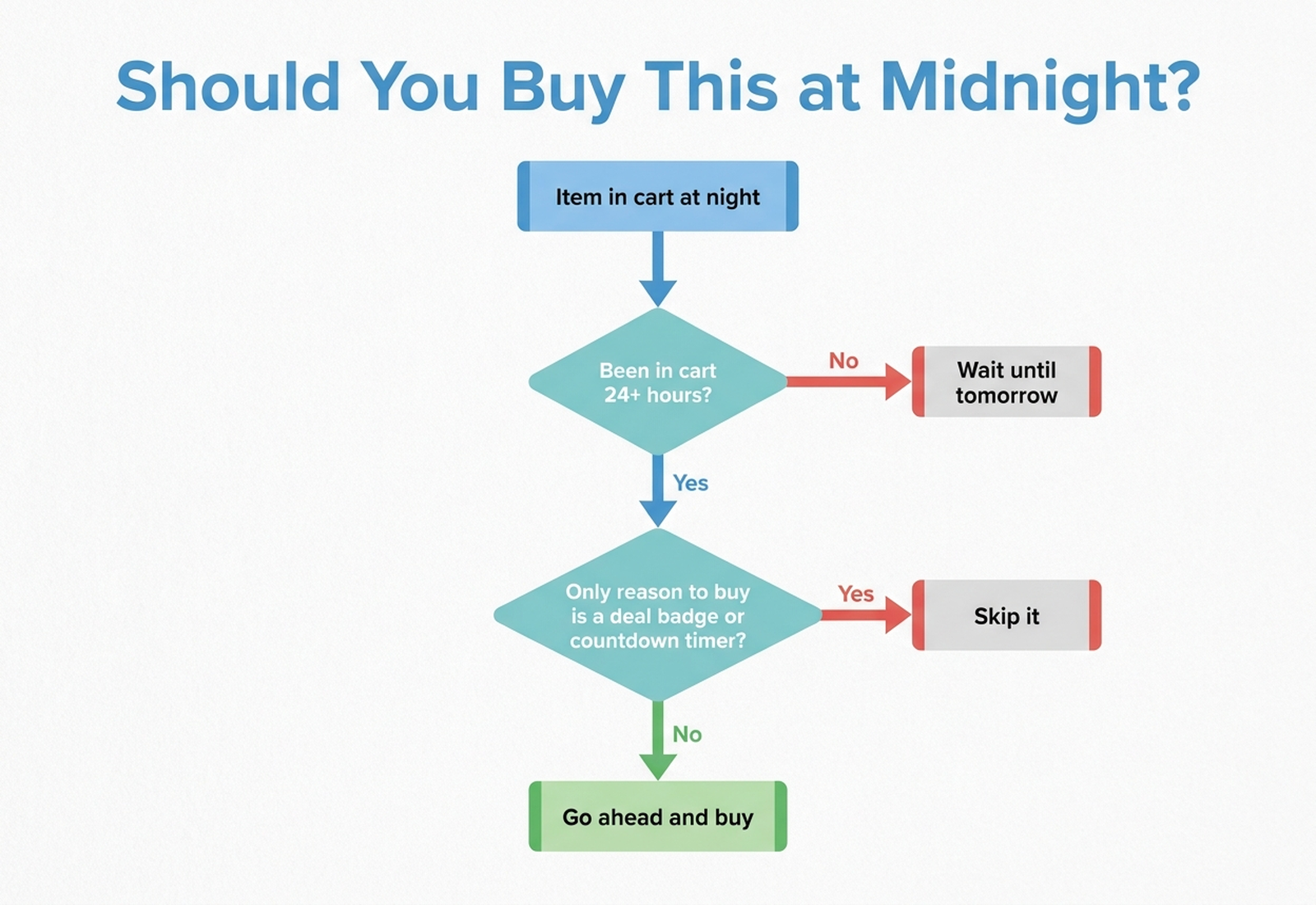
5. The Decision Flowchart
The Bottom Line
Late-night impulse buying is not a personal failing — it’s a predictable interaction between a day’s worth of decision fatigue, checkout mechanics built for speed, and a phone sitting within arm’s reach of the bed. The interventions that actually change the outcome remove either the fatigue’s timing (the 24-hour rule) or the phone’s proximity (a dedicated alarm clock), not willpower alone. Start with whichever one costs nothing — the 24-hour cart rule — before spending on a blocker app or a $170 alarm clock.
Limitations of This Analysis
- This is a synthesis of published survey and research data, not a controlled experiment we ran ourselves. Statistics on impulse-buy rates, generational overspending, and technique effectiveness are drawn from the cited third-party studies and surveys, each with its own methodology and sample.
- The 24-hour rule and mindfulness-pause figures cited above are widely repeated across personal-finance and behavioral-spending sources, but we could not trace them to a single, independently verifiable peer-reviewed study. Treat them as directional evidence, not a precise guarantee — individual results vary with the item’s price point, category, and the person’s existing shopping habits.
- The Frontiers in Psychology dual-process study cited was conducted with 564 consumers in China, in livestream-commerce and marketplace contexts — not a US, time-of-day-specific sample. We apply its self-control framework by analogy to the late-night US shopping pattern; it is not direct evidence of that specific pattern.
- App-blocker effectiveness is based on aggregated reviews and independent write-ups, not our own testing of Freedom or One Sec. Pricing and feature sets for these apps change and should be confirmed on the developer’s current page.
- Alarm-clock and pricing figures are amazon.com prices at the time of writing and fluctuate with promotions.
- Amazon’s cancellation and return windows summarized here reflect published policy as of 2026 and can vary by product category and seller; always confirm the specific window shown on your order page.