Sony vs Bose: Best Premium Wireless Earbuds in 2026

TL;DR. The Sony WF-1000XM6 ($329.99 MSRP, frequently discounted near $258) wins on battery life, sound detail, and lab-measured noise attenuation. The Bose QuietComfort Ultra Earbuds, 2nd Gen ($299 MSRP) win on comfort and on real-world noise cancellation across most everyday environments, despite a lower attenuation number in controlled lab tests. Neither earbud is a clear all-around winner — the right pick depends on whether you weigh lab noise-attenuation numbers or real-world listening comfort more heavily.
As an Amazon Associate, Arekore earns from qualifying purchases. The Amazon product links in this article include our affiliate tracking ID and may earn us a commission if you buy through them, at no additional cost to you. See our Links Policy for details on how we select products and how commissions do not influence our recommendations.
We did not personally test the units named below. Every spec, score, and sentiment claim in this article is an editorial synthesis of independent lab testing, manufacturer documentation, and aggregated customer review patterns, cited inline.
Methodology
This is an editorial analysis based on publicly available data collected in October 2026. We did not run our own controlled listening or noise-attenuation tests. Instead, we synthesized: (a) RTINGS’ published lab test scores and measurement methodology for both products, (b) a three-location real-world noise-cancellation comparison published by Android Central (coffee shop, HVAC/AC unit, and a crowded shopping mall), (c) head-to-head editorial comparisons from What Hi-Fi and SoundGuys, (d) manufacturer specification sheets from Sony and Bose, and (e) aggregated Amazon customer review sentiment read from each product’s public review panels on amazon.com. We do not report a precise review-count N because Amazon’s “Customers say” panels do not expose a stable, independently verifiable count; inventing one would be misleading.
Technical approach: how each brand gets to “quiet”
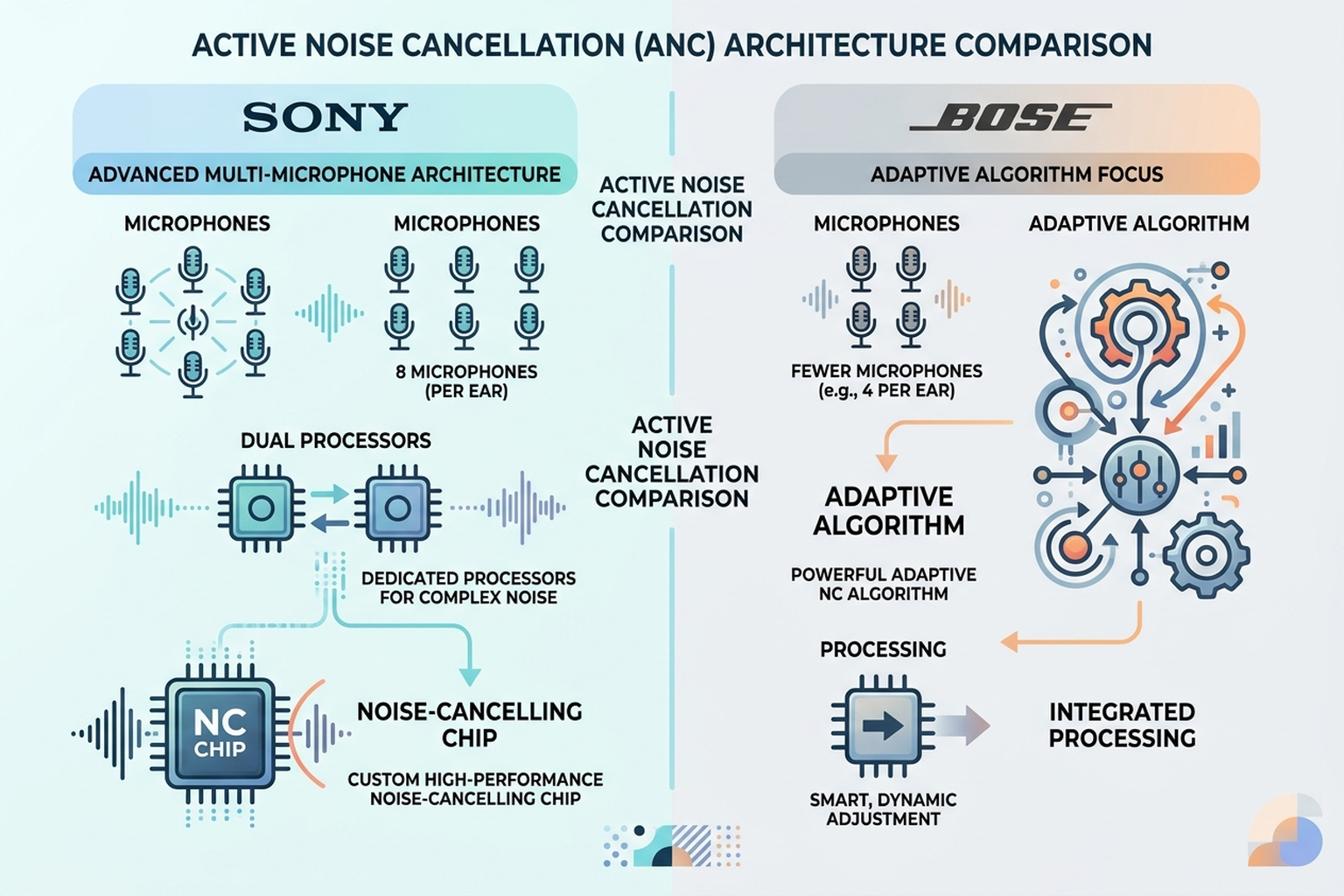
Sony and Bose arrive at noise cancellation from different engineering priorities, and that difference shows up directly in how each earbud performs depending on the type of noise.
Sony’s approach leans on hardware density. The WF-1000XM6 packs eight total microphones, two onboard processors, and a third-generation HD Noise Cancelling processor (Sony calls it QN3e) that manages microphone input and noise-cancelling signal processing together, according to Sony’s published specifications. Sony also increased the antenna size by roughly 1.5x over the prior WF-1000XM5 generation for more stable Bluetooth connections, per manufacturer specs reported by TechRadar. In RTINGS’ lab measurements, this combination produces an average noise attenuation figure of about 87%, compared to roughly 83–85% for the Bose QC Ultra Earbuds, 2nd Gen.
Bose’s approach leans more on adaptive algorithm tuning than raw microphone count. Despite a lower lab attenuation percentage, Bose’s noise-cancellation profile is tuned differently across frequency bands — and that tuning difference matters more than the headline lab number suggests once you leave the test chamber.
That gap between the lab number and real-world experience is the single most important nuance in this comparison. Android Central took both pairs to three different noisy environments — a coffee shop, a room with an active AC unit, and a crowded shopping mall on a Friday night. Sony suppressed high-pitched sounds in the coffee shop test more effectively than Bose. But Bose won the AC-unit test outright, and across the three locations combined, Bose canceled noise better “more often than not,” according to the review. In other words: Sony wins the lab spec sheet, but Bose’s adaptive tuning handles a wider range of real-world noise types more consistently.
Sony WF-1000XM6: what the data shows
Sony’s flagship truly wireless earbuds launched in February 2026 at $329.99 MSRP, with Amazon pricing frequently dropping to around $258 during sales events, according to pricing-tracker reporting. RTINGS scored the WF-1000XM6 at 8.5 out of 10 in its headphone test suite.
Where Sony pulls ahead on paper:
- Battery life. RTINGS and What Hi-Fi both measured roughly 8–9.5 hours of continuous playback with ANC and Bluetooth active (methodology and exact figures vary slightly by test conditions), with up to 24 hours total including the charging case — a meaningful lead over Bose.
- Sound signature. Independent reviewers, including RTINGS and What Hi-Fi, describe the WF-1000XM6 as having better clarity in the mids and highs than the Bose QC Ultra Earbuds, with support for Sony’s LDAC high-resolution codec alongside standard SBC, AAC, and LC3.
- Call quality. SoundGuys and RTINGS both note the WF-1000XM6’s eight-microphone array handles outdoor wind and background noise better during calls than the Bose earbuds.
Where the aggregated sentiment is less flattering: comfort is the most frequently cited complaint. Multiple independent reviewers, including TechRadar and SoundGuys, describe the WF-1000XM6’s fit as bulkier and more divisive than its WF-1000XM5 predecessor, with the earbud body protruding further from the ear. One recurring theme across customer feedback aggregated by review sites: the hybrid foam tips don’t fit every ear shape as comfortably as the simpler silicone tips on the prior generation.
Sony WF-1000XM6 Truly Wireless Noise Cancelling Earbuds — current-generation flagship, 8 mics, LDAC support, strongest battery life in this comparison.
Bose QuietComfort Ultra Earbuds (2nd Gen): what the data shows
Bose’s current flagship earbuds launched at $299 MSRP. RTINGS scored them at 8.3 out of 10, narrowly behind the Sony WF-1000XM6.
Where Bose pulls ahead:
- Comfort. What Hi-Fi’s direct head-to-head comparison names Bose the winner on design and comfort, noting a fit that sits less deep in the ear canal than Sony’s. TechGearLab’s hands-on testing echoes this, describing the QC Ultra Earbuds as more comfortable for extended wear despite protruding slightly more externally.
- Real-world ANC consistency. As noted above, Bose’s adaptive noise-cancellation tuning won two of three real-world environments in Android Central’s comparison, despite a lower lab attenuation percentage.
Where Bose falls behind: battery life is the most consistently flagged weakness. RTINGS measured roughly 5.5–6.5 hours of continuous playback with ANC on, and multiple reviewers note that figure drops further — to around 4 hours — with Bose’s Immersive Audio spatial feature enabled. TechRadar’s and Gizmodo’s reviews both independently flag battery life as the earbuds’ weakest spec relative to competitors.
Bose QuietComfort Ultra Earbuds, 2nd Gen — current-generation flagship, strongest real-world ANC consistency and comfort in this comparison, shortest battery life.
Fit and setup: what actually changes the experience
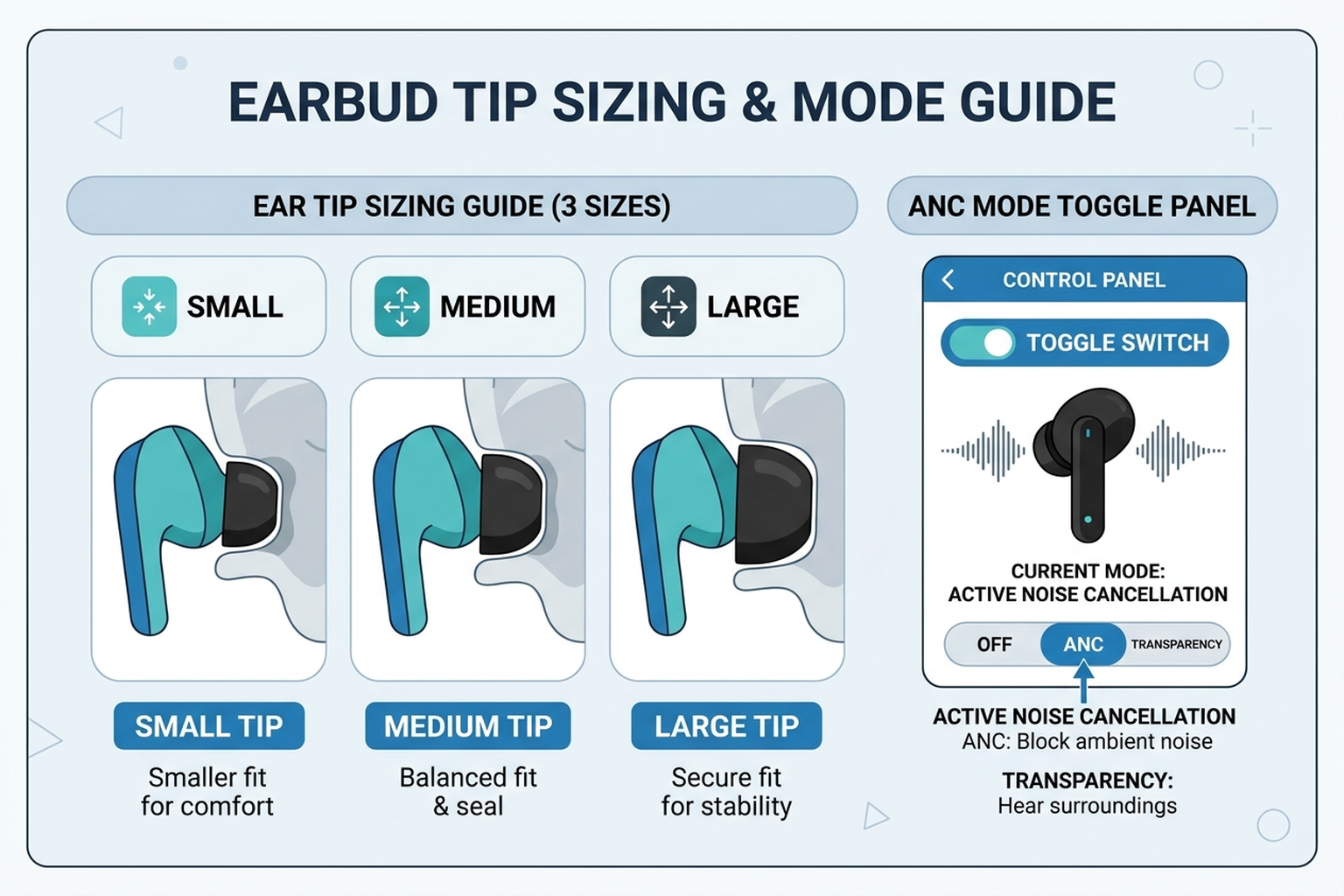
Comfort complaints for both earbuds trace back to one fixable variable more often than reviewers initially credit: ear tip sizing. Both the WF-1000XM6 and the QC Ultra Earbuds ship with multiple tip sizes, and independent reviewers who tested all included sizes before forming a final comfort verdict report noticeably better results than impressions based on the default-installed size alone. Two setup steps matter most:
- Run the manufacturer app’s fit test before judging comfort or ANC performance. Both the Sony | Sound Connect app and the Bose Music app include a seal-check feature that flags a poor fit — a loose seal measurably reduces noise cancellation on any ANC earbud, independent of brand.
- Re-test ANC strength after confirming a good seal, since a significant share of “weak ANC” complaints in aggregated reviews trace back to tip size rather than the ANC hardware itself, according to patterns noted by SoundGuys and TechGearLab across multiple ANC earbud reviews.
Comparison table
Prices as of 2026-10-30. Street prices fluctuate with sales events; check the current Amazon listing for live pricing.
| Spec | Sony WF-1000XM6 | Bose QC Ultra Earbuds (2nd Gen) |
|---|---|---|
| MSRP | $329.99 | $299.00 |
| Typical sale price | ~$258 | ~$199–$249 |
| RTINGS score | 8.5 / 10 | 8.3 / 10 |
| Lab noise attenuation (avg.) | ~87% | ~83–85% |
| Battery life (ANC on) | ~8–9.5 hrs | ~5.5–6.5 hrs (less with Immersive Audio) |
| Total battery w/ case | 24 hrs | ~18 hrs (3 recharges, per case capacity) |
| Microphones | 8 total | Fewer (exact count not independently disclosed by Bose) |
| Hi-res codec support | LDAC, LC3, AAC, SBC | AAC, SBC |
| Water resistance | IPX4 | IPX4 |
| Real-world ANC (3-location test) | Won 1 of 3 | Won 2 of 3 |
| Comfort (independent consensus) | Divisive, bulkier fit | Generally more comfortable |
Customer sentiment synthesis
Reading aggregated “Customers say” panels and review themes on amazon.com for both ASINs: Sony’s customer feedback repeatedly praises sound quality and call clarity, while comfort is the single most recurring criticism — several reviewers specifically describe the earbud body as too large for smaller ear canals. Bose’s aggregated feedback trends the opposite way: comfort and fit draw consistent praise, while battery life is the complaint that shows up most often, with some reviewers noting it falls short for long flights or full workdays without a recharge. Neither product shows a pattern of reliability complaints (defects, connection dropouts) significant enough to stand out in aggregated review themes — the splits are almost entirely about comfort versus battery life.
Warranty and support
| Brand | Typical warranty (US) | Where to check |
|---|---|---|
| Sony | 1-year limited warranty | Sony Support |
| Bose | 1-year limited warranty | Bose Support |
Both brands offer standard 1-year limited coverage in the US; neither has a published extended-warranty advantage over the other for this product category.
The decision flowchart
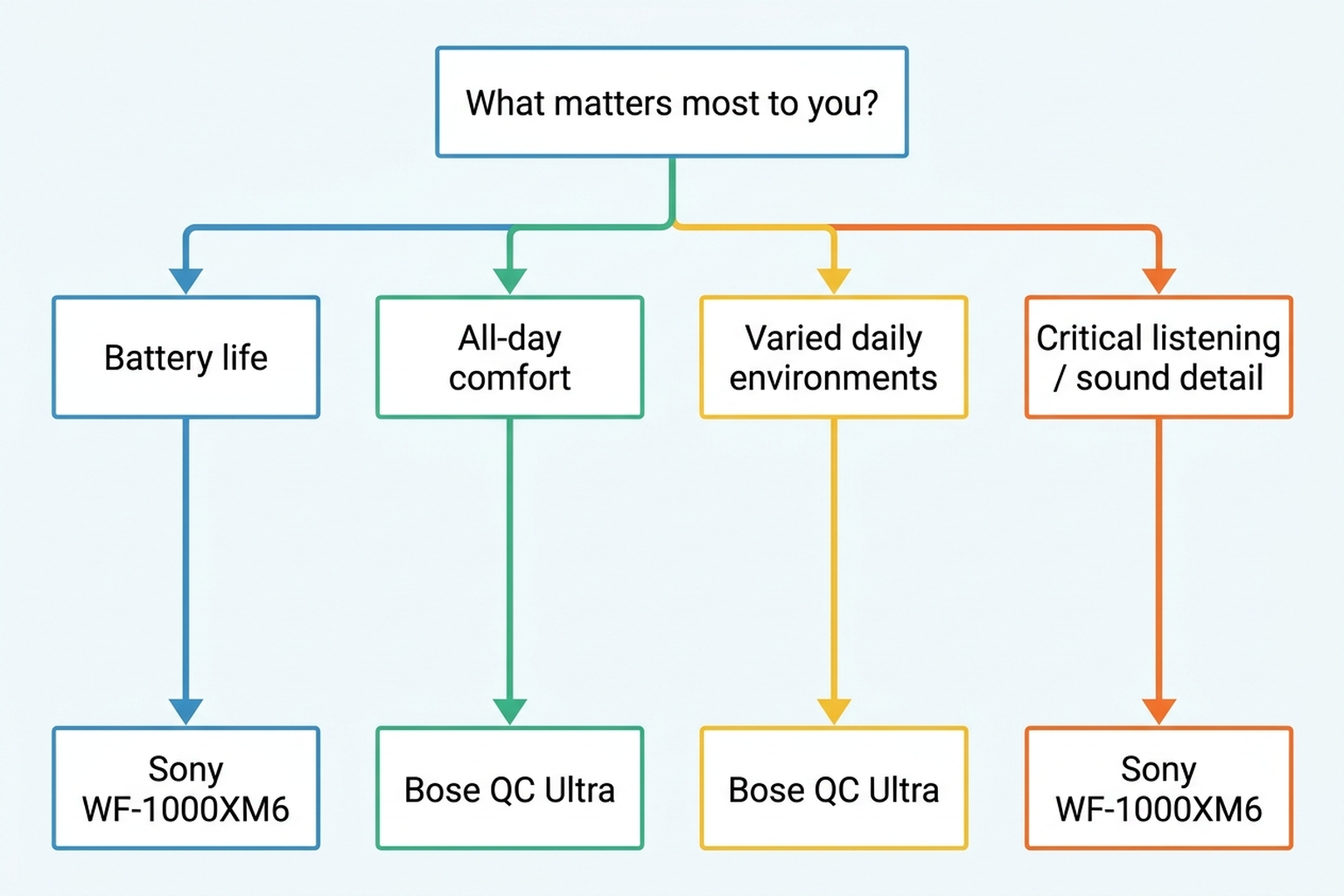
Editorial recommendation by use case
- Best for long flights and full workdays without a charging break: Sony WF-1000XM6 — its 8–9.5 hour runtime is the clearest, most consistently reported advantage in this comparison.
- Best for all-day comfort and extended listening sessions: Bose QuietComfort Ultra Earbuds, 2nd Gen — the independent comfort consensus favors Bose, and a poor fit undermines ANC performance on any earbud regardless of brand.
- Best for varied daily environments (commute, office, gym, travel): Bose QuietComfort Ultra Earbuds, 2nd Gen — the three-location real-world test favored Bose’s adaptive tuning over Sony’s higher lab attenuation number.
- Best for critical listening and audiophile-leaning sound: Sony WF-1000XM6 — independent reviewers consistently rank its mids and highs clarity, plus LDAC support, above the Bose QC Ultra Earbuds.
These recommendations are reasoning from the cited data sources above, not personal preference or hands-on testing by our editorial team.
Limitations of this analysis
To be explicit about what this article does not establish:
- We did not personally test either pair of earbuds. All comfort, sound, and battery claims are drawn from independent lab testing, manufacturer specifications, and aggregated review sentiment, not from controlled testing we ran ourselves.
- RTINGS scores and lab attenuation percentages reflect a specific test methodology and unit sample at a specific point in time. Unit-to-unit variance and firmware updates after publication can shift real-world performance without changing the published score.
- The three-location real-world ANC test reflects one reviewer’s specific environments (one coffee shop, one AC unit, one shopping mall) and is not a scientifically controlled, repeated-trial measurement.
- Comfort is inherently subjective and ear-shape-dependent. Aggregated review sentiment describes a pattern, not a guarantee for any individual buyer; trying both included tip sizes before judging fit is the single most effective step a buyer can take.
- Pricing is static text, not a live price feed. Confirm current pricing on the Amazon listing before purchase, since both products see frequent promotional discounts.
- Amazon review sentiment was read from each ASIN’s public review panels in October 2026 and reflects aggregated impressions, not a scientific sample.
The bottom line
Pick the Sony WF-1000XM6 if battery life and critical sound detail matter more to you than squeezing the last percentage point of comfort out of an all-day wear session. Pick the Bose QuietComfort Ultra Earbuds, 2nd Gen if comfort and consistent real-world noise cancellation across varied environments matter more than lab-measured attenuation numbers or runtime. Visit the product listings linked above to verify current pricing and availability before buying.