Best AC for a 400 Sq Ft Apartment in 2026
As an Amazon Associate, Arekore earns from qualifying purchases. The Amazon product links in this article may include our affiliate tracking ID and may earn us a commission if you buy through them, at no additional cost to you. See our Links Policy for details on how we select products and how commissions do not influence our recommendations.
TL;DR / Quick Verdict
- For a roughly 400-square-foot apartment, most reviewers and manufacturer sizing charts point to an 8,000-10,000 BTU unit as the sweet spot — bigger isn’t automatically better.
- Renters without landlord approval for a fixed window install generally do better with a portable AC and a window venting kit, since it requires no permanent modification.
- Window units cost less and cool more efficiently per BTU than portable units, according to aggregated lab and customer-review data, but they need a compatible window and often a landlord’s sign-off.
Methodology
This analysis synthesizes aggregated Amazon US customer review sentiment for the models discussed below, third-party lab test data from RTINGS’ portable air conditioner test bench, market and pricing context from industry research firms, and manufacturer-published spec sheets (BTU rating, SACC rating, decibel levels, coverage area). We did not personally test any of the products covered in this article. Prices and specs reflect listings captured at time of writing and are subject to change on amazon.com.
Portable vs. Window vs. Through-the-Wall: Which Approach Fits a Small Apartment?
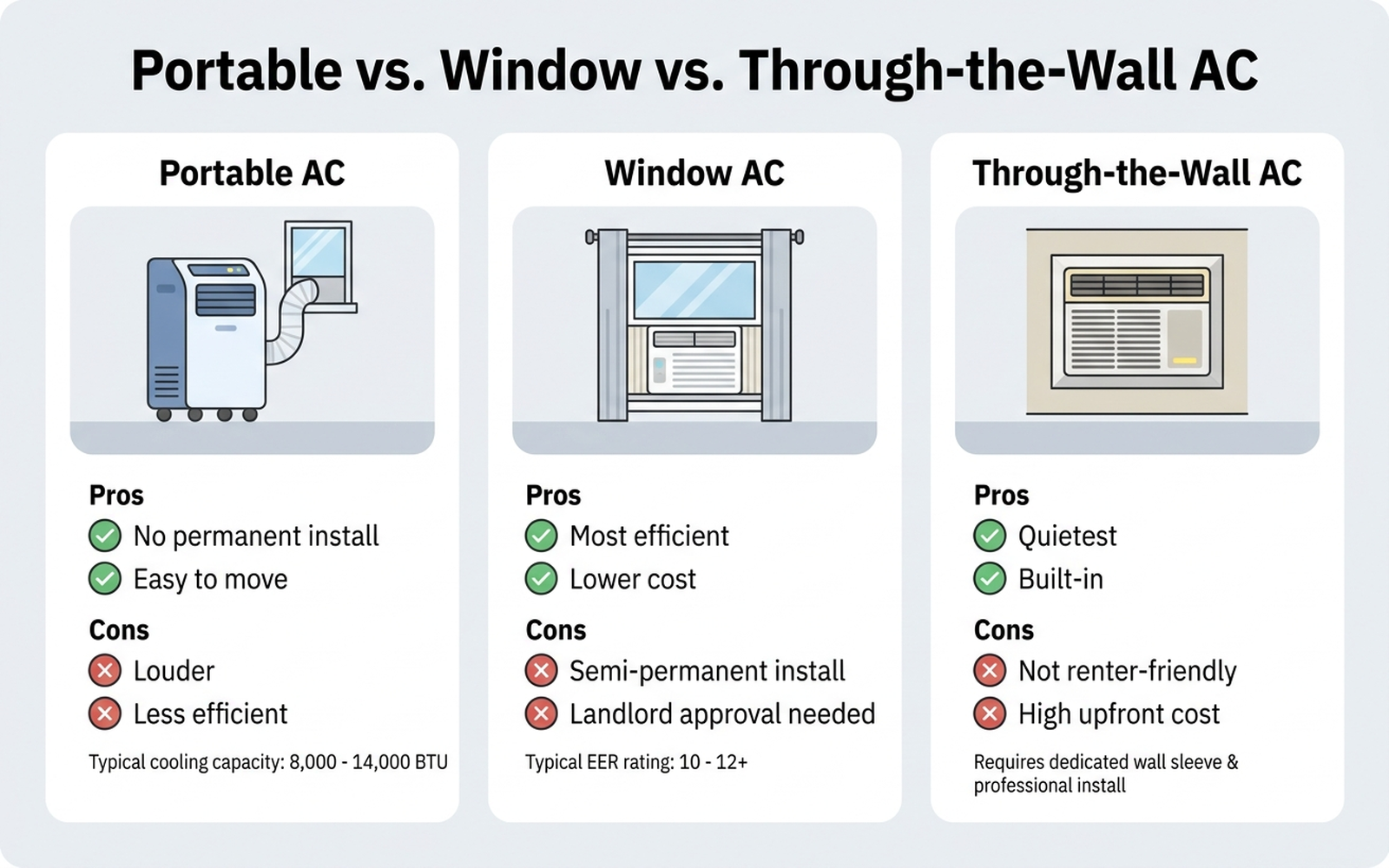
A roughly 400-square-foot apartment usually means one or two rooms, a lease that restricts permanent alterations, and a landlord who may or may not allow window-mounted equipment. That makes the “how do I mount this” question just as important as the BTU number.
Portable air conditioners sit on the floor and vent hot air through a flexible hose that runs out a cracked-open window, secured with an adjustable window kit. Aggregated Amazon reviewer feedback across the models we reviewed consistently cites “no permanent installation” and “easy to move between rooms” as the top reasons buyers choose portable over window units. The tradeoff, per RTINGS’ portable AC test data, is that portable units typically deliver less cooling per rated BTU than window units of the same rating, because a portion of the already-cooled indoor air is exhausted out through the hose along with the hot air (a phenomenon commonly described as negative pressure loss).
Window air conditioners mount in a double-hung or sliding window using an included accordion side-panel kit, with brackets or L-shaped screws (models vary) that generally do not require drilling into the frame. Reviewed.com and Consumer Reports lab testing has repeatedly found window units more energy-efficient per BTU than portable ACs of comparable rated capacity, and aggregated Amazon pricing shows window units are typically $100-$200 cheaper than a portable unit with equivalent cooling capacity. The catch for renters: many leases restrict window-mounted equipment, and installation is closer to semi-permanent, even without drilling — it stays in the window for the season.
Through-the-wall units are built into a dedicated sleeve cut into an exterior wall. They are the quietest and most efficient option in aggregated third-party testing, but they require either an existing wall sleeve (rare in most rental units) or professional installation — not realistic for the large majority of apartment renters, and effectively a non-starter without landlord sign-off. We mention them for completeness but do not recommend them for typical renters.
Renter’s rule of thumb: if your lease is silent on window units or explicitly prohibits them, a portable AC with a window kit is the lower-friction choice. Some states have started changing this calculus — Oregon’s 2022 law and a Washington state law effective June 2026 both limit landlords’ ability to prohibit portable cooling devices in certain circumstances — but always check your specific lease and local ordinance before installing anything.
Brand-by-Brand Breakdown
LG — LG’s window units are consistently among the higher-rated options in aggregated Amazon customer sentiment, with reviewers frequently citing quiet operation and smartphone/smart-speaker control (Alexa, Google Assistant) on the smart models. The LG 8,000 BTU Smart Window unit is rated by the manufacturer for rooms up to 350 square feet.
Midea — Midea’s “Duo” portable line uses an inverter compressor, which the manufacturer and multiple aggregated reviews credit with quieter operation (rated as low as 42 dB on the lowest fan setting per manufacturer specs) and better energy efficiency than standard fixed-speed portable compressors. RTINGS and other outlets have highlighted Midea and Whynter as the higher-performing portable AC brands in independent bench testing.
Frigidaire — Frigidaire’s smaller window units (5,000-8,000 BTU) skew toward budget buyers furnishing a first apartment. Aggregated Amazon review counts are large (over 1,600 ratings on the 5,000 BTU model at time of writing) with average ratings around 4.4-4.5 stars, and manufacturer specs list the compact units at roughly 52 dB.
Black+Decker — Black+Decker’s portable “3-in-1” line (AC, dehumidifier, fan in one unit) is positioned as a budget-friendly, no-frills option; the 8,000-9,000 BTU models are manufacturer-rated for 350-400 square feet, matching a typical studio living-room-plus-sleeping-area layout.
Honeywell — Honeywell’s Contempo and Compact portable series sit in the middle of the market on price, with manufacturer-published noise levels in the 49-53 dB range depending on BTU size, and window-kit hardware included with most models.
Manufacturer-claimed specs (BTU, dB, SACC) are self-reported by each brand and have not been independently re-tested by the Arekore editorial team; where available, we cross-reference against RTINGS’ independent bench figures.
How to Size and Install an Apartment AC
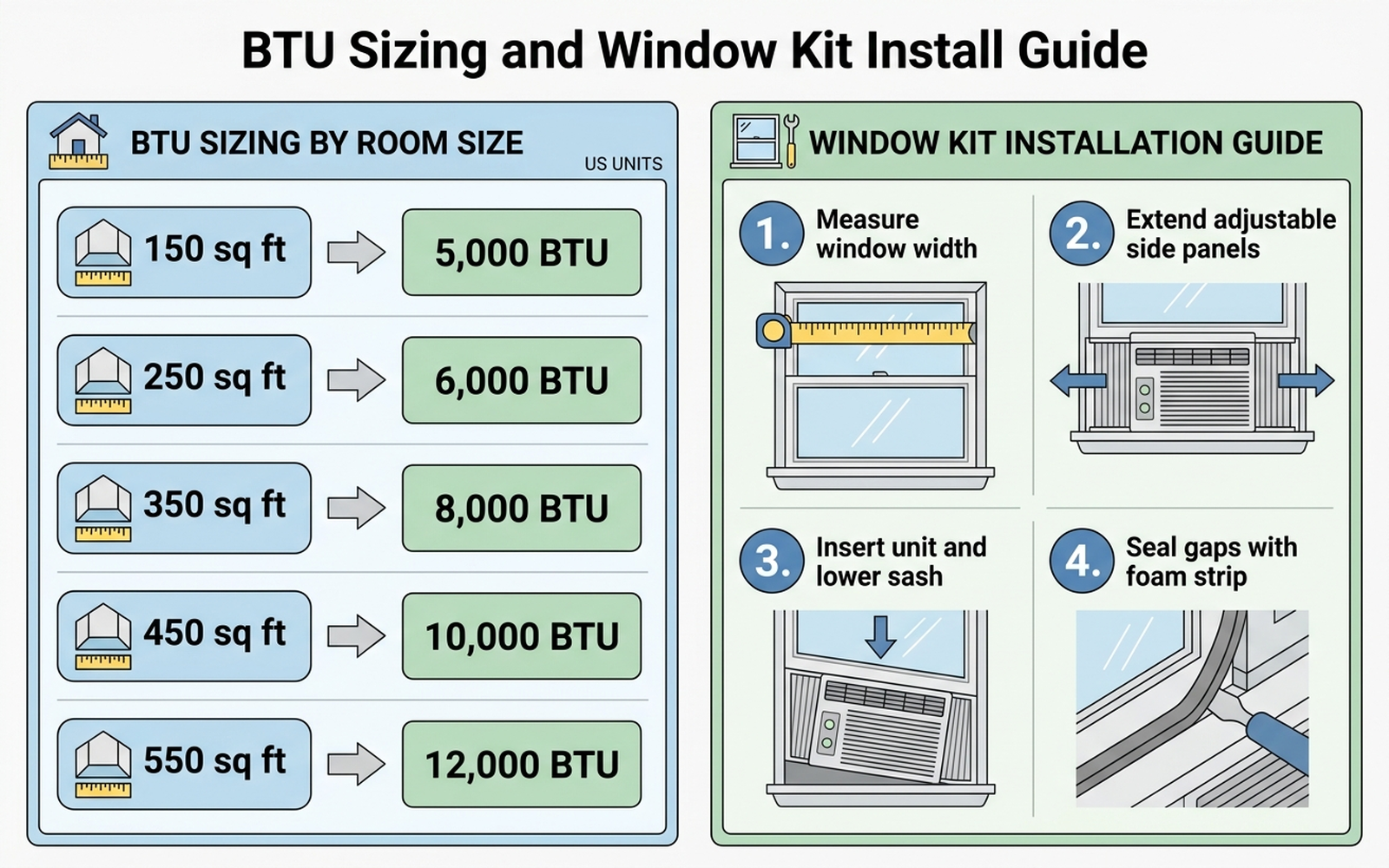
Sizing by square footage. The Department of Energy/ENERGY STAR baseline rule of thumb is roughly 20 BTU per square foot of floor space as a starting point, then adjusting up or down for room-specific factors. Rough benchmarks used across manufacturer sizing charts:
- 150 sq ft → ~5,000 BTU
- 250 sq ft → ~6,000 BTU
- 350 sq ft → ~8,000 BTU
- 450 sq ft → ~10,000 BTU
- 550 sq ft → ~12,000 BTU
Add roughly 10% more capacity for rooms with heavy south- or west-facing sun exposure, ceilings taller than 8 feet, or more than two people regularly occupying the space. Note that portable-AC manufacturers often list both a “BTU” figure and a lower “SACC” (Seasonally Adjusted Cooling Capacity) figure — SACC is the newer, more realistic number for actual cooling output, and DOE-mandated labeling has pushed most brands to display it since 2024. When comparing a portable unit’s SACC to a window unit’s plain BTU rating, expect the portable number to look smaller for similar real-world cooling.
Window-kit installation (typical steps, hardware varies by model):
- Measure your window’s width and height before ordering — most kits accommodate a range, but very wide or unusually shaped windows (sliding, casement) may need a specialty kit.
- Extend the accordion side panels or brackets included with the unit to fit your window opening.
- For portable units: route the exhaust hose through the panel opening; for window units, lower the sash down onto the top flange to hold the unit in place.
- Seal any remaining gaps with the included foam strip or weatherstripping to stop conditioned air from leaking out and outside air (and bugs) from getting in.
For a rental, keep the original window hardware and screws in a labeled bag — most kits are designed to be removed at lease-end without leaving marks, but always photograph the window before and after installation as a precaution.
Comparison Table
| Model | Type | Manufacturer BTU / SACC | Coverage (mfr. claim) | Noise (mfr. claim) | Price (at time of writing) | Amazon rating |
|---|---|---|---|---|---|---|
| LG 8,000 BTU Smart Window AC | Window | 8,000 BTU | Up to 350 sq ft | Not published for this model | ~$300-$350 | 4.3-4.5★ (aggregated) |
| Midea Duo 12,000 BTU (10,000 SACC) Portable AC | Portable, inverter | 12,000 BTU / 10,000 SACC | Up to 450 sq ft | As low as 42 dB (low fan) | ~$499.99 | 4.3-4.5★ (aggregated) |
| Frigidaire 5,000 BTU Window AC | Window | 5,000 BTU | Up to 150 sq ft | ~52 dB | ~$220 | 4.5★ (1,600+ ratings) |
| BLACK+DECKER 8,000 BTU (5,000 SACC) 3-in-1 Portable AC | Portable | 8,000 BTU / 5,000 SACC | Up to 350 sq ft | Not published for this model | ~$300-$330 | 4.0-4.3★ (aggregated) |
| Honeywell 9,000 BTU Portable AC | Portable | 9,000 BTU | Up to 400 sq ft | ~49-53 dB range (series) | ~$350-$400 | 4.0-4.3★ (aggregated) |
Star ratings and review counts on amazon.com change continuously; figures above reflect a snapshot at time of writing and should be re-checked on the live product page before purchase.
Customer Sentiment Synthesis
Across the aggregated Amazon review sets for the models above, a few consistent themes emerge. Reviewers of window units most frequently praise upfront cost and cooling speed relative to price, with recurring complaints about installation difficulty on non-standard windows (sliding or casement styles) and blocked natural light. Portable-AC reviewers most frequently cite ease of moving the unit between a bedroom and living room as the main draw — a relevant point for a studio or one-bedroom where cooling needs shift by time of day — with recurring complaints centered on the exhaust hose taking up window space and on compressor noise for non-inverter models. Inverter portable models (Midea Duo, Whynter NEX) draw noticeably more praise for quiet operation in aggregated reviews than fixed-speed portable models at a similar BTU rating.
Warranty and Limitations
Most of the units above carry a standard 1-year manufacturer warranty on parts and the sealed cooling system, per each brand’s published warranty terms; always confirm current warranty length on the manufacturer’s site, as terms can change between production runs. This analysis relies on publicly available aggregated reviews, third-party lab data (primarily RTINGS), and manufacturer specifications rather than in-house testing, so individual results — noise level in your specific apartment, actual cooling performance in a room with unusual insulation or sun exposure, unit-to-unit manufacturing variance — may differ from the averages reported here. Review counts and star ratings are a snapshot and will shift over time. Energy Star does not currently certify portable air conditioners as a category, so efficiency comparisons between portable models rely on each manufacturer’s self-reported SACC and CEER figures rather than a third-party seal.
Decision Flowchart: Price and Use Case
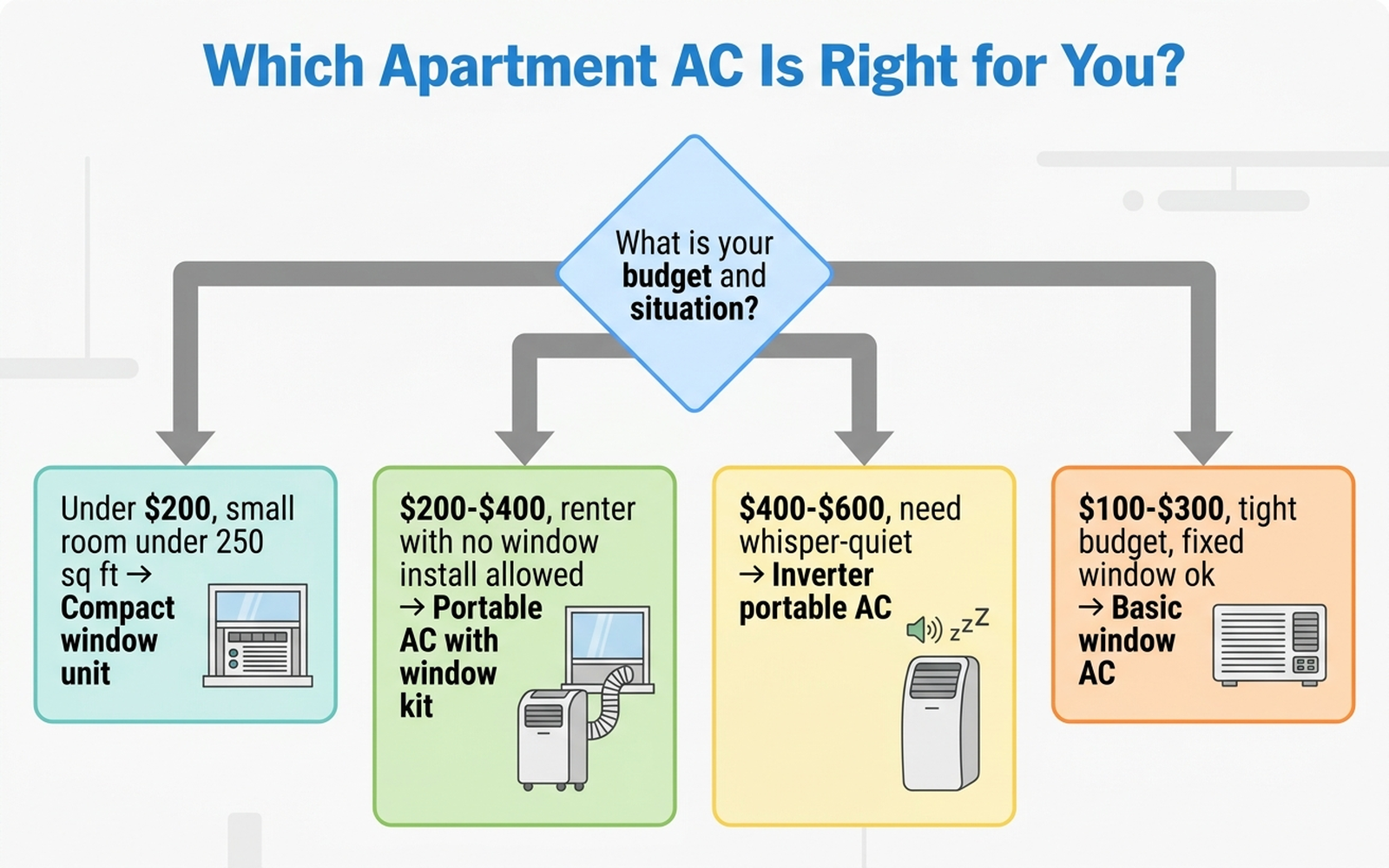
If you’re short on time, the flowchart above summarizes the tradeoffs: a tight budget and a room under about 250 square feet points toward a compact window unit; a restrictive lease with no window installs allowed points toward a portable AC with a window kit; a higher budget paired with a need for near-silent operation (e.g., a bedroom) points toward an inverter-compressor portable model; and a fixed, compatible window with the lowest possible price target points toward a basic window unit.
Editorial Recommendation by Use Case
- Best for renters who can’t install a window unit: Midea Duo 12,000 BTU (10,000 SACC) inverter portable AC — aggregated reviews and RTINGS bench data both point to it as one of the quieter, more efficient portable options, and its window kit needs no permanent modification.
- Best budget pick for a bedroom-sized space: Frigidaire 5,000 BTU window AC — the largest aggregated review sample of the models covered here (1,600+ ratings) and the lowest price point, appropriate for rooms up to about 150 square feet.
- Best for a studio combining living and sleeping space: BLACK+DECKER 8,000 BTU portable AC or LG 8,000 BTU window AC, both manufacturer-rated to 350 square feet — choose portable if your lease restricts window installs, window if it doesn’t.
- Best for whisper-quiet operation near a bed: An inverter-compressor portable model (Midea Duo or a comparable Whynter NEX unit per RTINGS’ top pick) over a fixed-speed compressor, based on aggregated noise-related review sentiment.
Before buying, visit Arekore to compare current listings and prices, and confirm the exact BTU/SACC rating and window compatibility for your specific apartment — sizing charts are a starting point, not a substitute for measuring your own space.