Slow Cooker Food Still Undercooked? 5 Real Causes (2026)

TL;DR. When a slow cooker finishes its full cook time with hard potatoes, chewy meat, or undercooked beans, the five most documented causes are an overfilled or underfilled crock, lifting the lid during cooking, starting with frozen ingredients, a low setting that runs below the 185–200°F range it should reach, and using a cooker size that doesn’t match the recipe. Filling the crock half to two-thirds full, keeping the lid on, fully thawing ingredients first, and testing the low setting with a thermometer resolves the large majority of documented cases; a unit that still won’t reach a safe temperature on a full, unopened, thawed batch should be retired rather than kept in rotation, since the USDA treats that as a food-safety issue, not just a texture one.
A note on links and methodology
As an Amazon Associate, Arekore earns from qualifying purchases. The Amazon product links in this article include our affiliate tracking ID and may earn us a commission if you buy through them, at no additional cost to you. See our Links Policy for details on how we select products and how commissions do not influence our recommendations.
We also did not personally reproduce this issue on the specific machines named below. Every cause and fix in this article is an editorial synthesis of USDA food-safety guidance, manufacturer manuals, independent product testing, and aggregated public troubleshooting and customer-review reports, cited inline.
Methodology
This is an editorial analysis based on publicly available data collected in October 2026. We did not run a controlled test ourselves; instead we synthesized:
- USDA Food Safety and Inspection Service guidance on slow cookers — the FSIS fact sheet “Slow Cookers and Food Safety,” which documents the safe internal temperature range a slow cooker needs to maintain and the food-safety risk of running below it.
- Manufacturer manuals and support documentation — Crock-Pot’s published cooking tips and fill-level guidance, and Purdue Extension’s “Fix It & Forget It” slow-cooker guidance distributed through university extension food-safety programs.
- Independent third-party testing — Food Network’s and Consumer Reports’ hands-on testing of multi-cooker slow-cook functions, including documented uneven heating and undercooked results on specific models.
- A federal safety recall record — the CPSC’s 2021 recall of roughly 940,000 Crock-Pot 6-Quart Express Crock Multi-Cookers over a lid-detachment burn hazard during pressurized cooking, cited as the most recent CPSC action in this product category and distinguished from the non-pressurized undercooking issue this article is mainly about.
- Aggregated customer-review and owner-forum reports — JustAnswer troubleshooting threads on slow cookers that run too hot or too cool, and Tasting Table’s compiled list of frequent Instant Pot complaints, including a documented pattern of beans staying firm on the slow-cook setting.
- Market and category data — per Global Market Insights’ 2026 industry analysis, Crock-Pot held over 25% of the North American slow cooker market in 2025, the top five brands (Crock-Pot, Ninja, Hamilton Beach, Instant Pot, Cuisinart) together held about 65%, and the US accounted for roughly 82% of North American slow cooker sales — context for why undercooking reports span nearly every major brand rather than clustering on one.
We deliberately do not simulate a specific personal cooking mishap or invent a fake reviewer persona. The advice below is a synthesis of federal food-safety guidance, manufacturer documentation, and aggregated troubleshooting patterns — treat it as a starting framework, not a substitute for your specific model’s manual or an active food-safety concern.
1. Five reasons slow cooker food stays undercooked
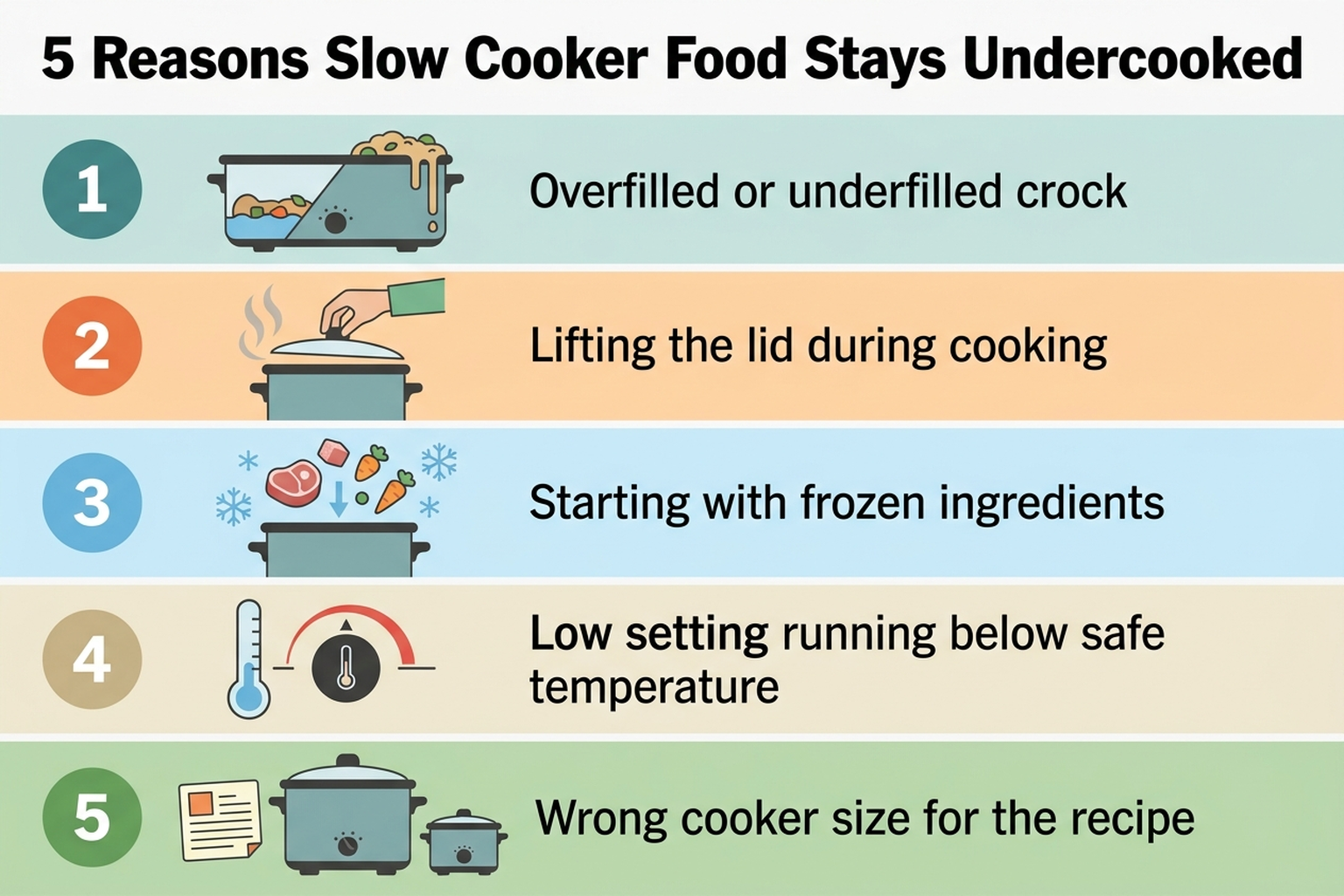
Before assuming the unit is broken, it helps to know that most undercooking reports trace back to one of five causes, and only one of them points to a hardware problem:
| Cause | What it looks like | Fixable at home? |
|---|---|---|
| Overfilled or underfilled crock | Hard spots in a packed cooker, or thin/watery results in a half-empty one | Yes — fill half to two-thirds full |
| Lifting the lid during cooking | Food is behind schedule after repeated checks mid-cook | Yes — keep the lid on; each peek costs roughly 20 minutes of heat recovery |
| Starting with frozen ingredients | Meat or vegetables still firm at the center after the full cycle | Yes — thaw fully before adding |
| Low setting running below safe temperature | Everything in the pot stays undercooked every time, regardless of recipe | Sometimes — verify with a thermometer test |
| Wrong cooker size for the recipe | A recipe written for one size runs long or short in a different-capacity unit | Yes — match cooker size to the recipe, or adjust time |
USDA food-safety guidance and manufacturer cooking tips converge on the same throughline: a properly filled, lid-on, non-frozen batch in a correctly sized cooker should reach a safe internal temperature well within the recipe’s stated time. When none of the usage factors explain the result and the unit still runs cool on a controlled test, that’s the one scenario pointing to a hardware fault rather than a cooking habit.
2. Why fill level and the lid matter more than most recipes admit
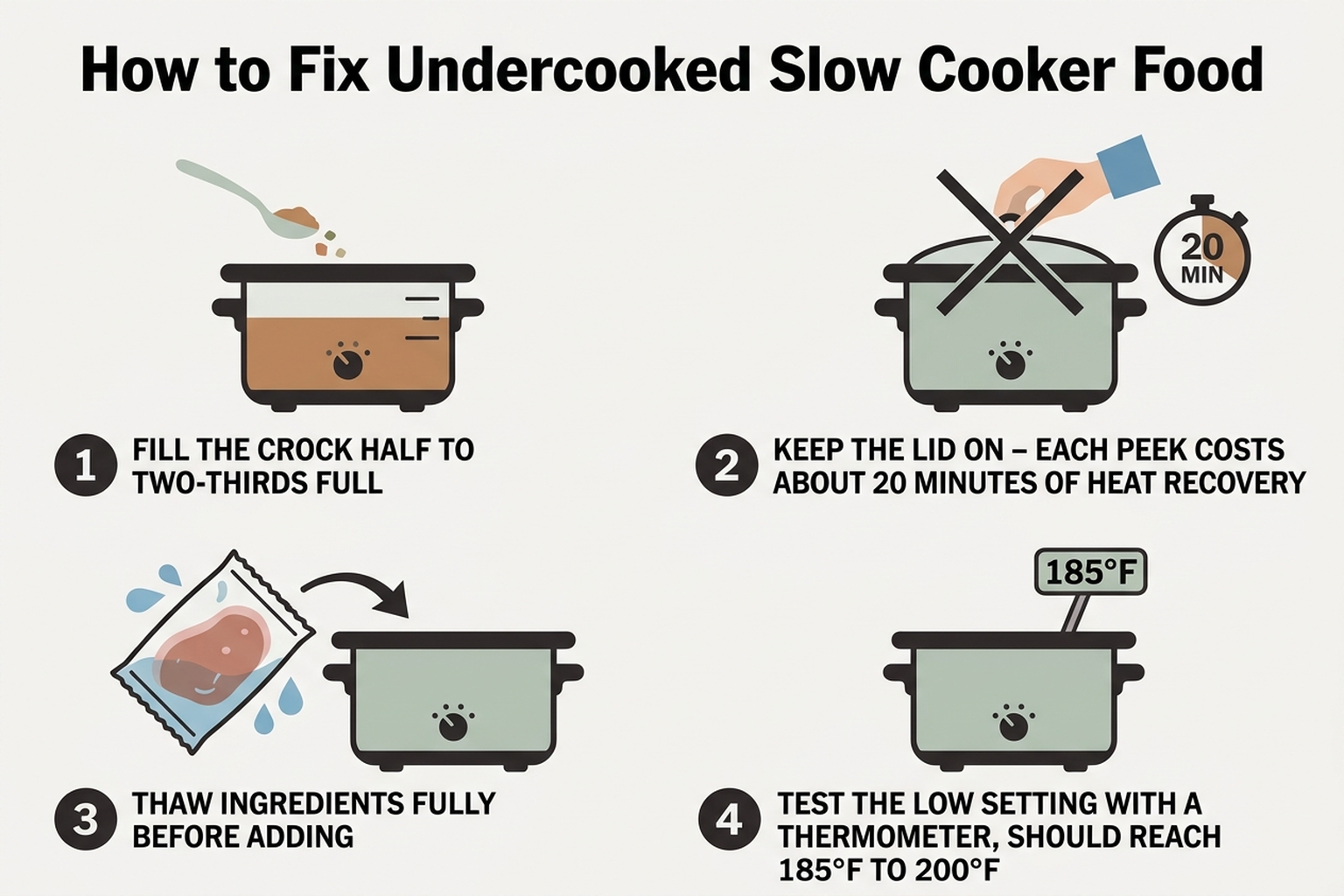
A slow cooker works by building up heat gradually in a mostly sealed crock, relying on that trapped heat and steam to bring the whole pot to a safe, even temperature over several hours. Purdue Extension’s “Fix It & Forget It” guidance and Crock-Pot’s own published cooking tips both specify filling the crock no less than half full and no more than two-thirds to three-quarters full, since an overfilled pot blocks even heat circulation — leaving a cold, undercooked center while the edges finish — and an underfilled one has too little mass to hold the steady heat the cooking process depends on.
The lid matters just as much. USDA and extension guidance both note that lifting the lid releases the steam that has built up inside, and each time it’s removed the internal temperature drops 10–15°F and takes roughly 20 minutes to recover. A recipe checked three or four times over a cook cycle has effectively lost an hour or more of cooking time without the clock on the unit reflecting it — which is a common, and easy to miss, reason a dish comes out behind schedule even though the display shows the full time elapsed.
Frozen ingredients compound both problems at once. USDA guidance explicitly advises against placing frozen meat, poultry, or prepared meals directly into a slow cooker, because the extra time needed just to thaw the food keeps it in the 40–140°F temperature danger zone longer than is safe, on top of leaving it undercooked at the end of the cycle.
3. Brand-specific patterns worth knowing
Crock-Pot (Newell Brands). As the North American category leader, per Global Market Insights’ 2026 estimate, Crock-Pot’s own published cooking guidance is also one of the most widely cited sources for fill-level and lid-handling advice across extension and troubleshooting sites. The brand’s 2021 CPSC recall covered roughly 940,000 6-Quart Express Crock Multi-Cookers over a lid that could detach while the unit was pressurized as a pressure cooker — a burn-hazard issue tied to the pressure-cooking function, not the standard slow-cook setting this article covers, and worth noting as a different failure mode entirely.
Instant Pot. Tasting Table’s compiled list of frequent Instant Pot complaints and Food Network’s hands-on testing both document that the multi-cooker’s slow-cook function doesn’t always heat as evenly as a dedicated slow cooker, with food able to scorch on the bottom in some tests, and owner reports describing beans that stayed too firm to eat even after extended time on the high setting — a pattern Tasting Table notes recurs “regardless of the type” of bean used. This points to the slow-cook mode on a multi-function appliance behaving differently from a single-purpose slow cooker, rather than to any one batch being prepared incorrectly.
Hamilton Beach. Hamilton Beach’s own recall history includes an earlier (2003) voluntary recall of roughly 2.7 million Hamilton Beach and Proctor-Silex slow cookers over a base-handle breakage hazard — again a structural/handle issue, not a heating-performance one, and now decades old. We did not find a documented pattern specific to Hamilton Beach’s current lineup for undercooking complaints; the fill-level, lid, and frozen-ingredient factors above apply across brands.
Cross-brand testing. Consumer Reports’ side-by-side testing of the Instant Pot and the Crock-Pot Express Crock multi-cooker found both produced tender pulled pork after a full day of slow cooking when used as directed — evidence that, under controlled conditions with correct fill level and timing, mainstream slow cookers from multiple brands reliably reach a fully cooked result. That makes usage error (fill level, lid discipline, starting temperature) the more statistically likely explanation than a defective unit in most individual reports.
4. What to actually do, in order
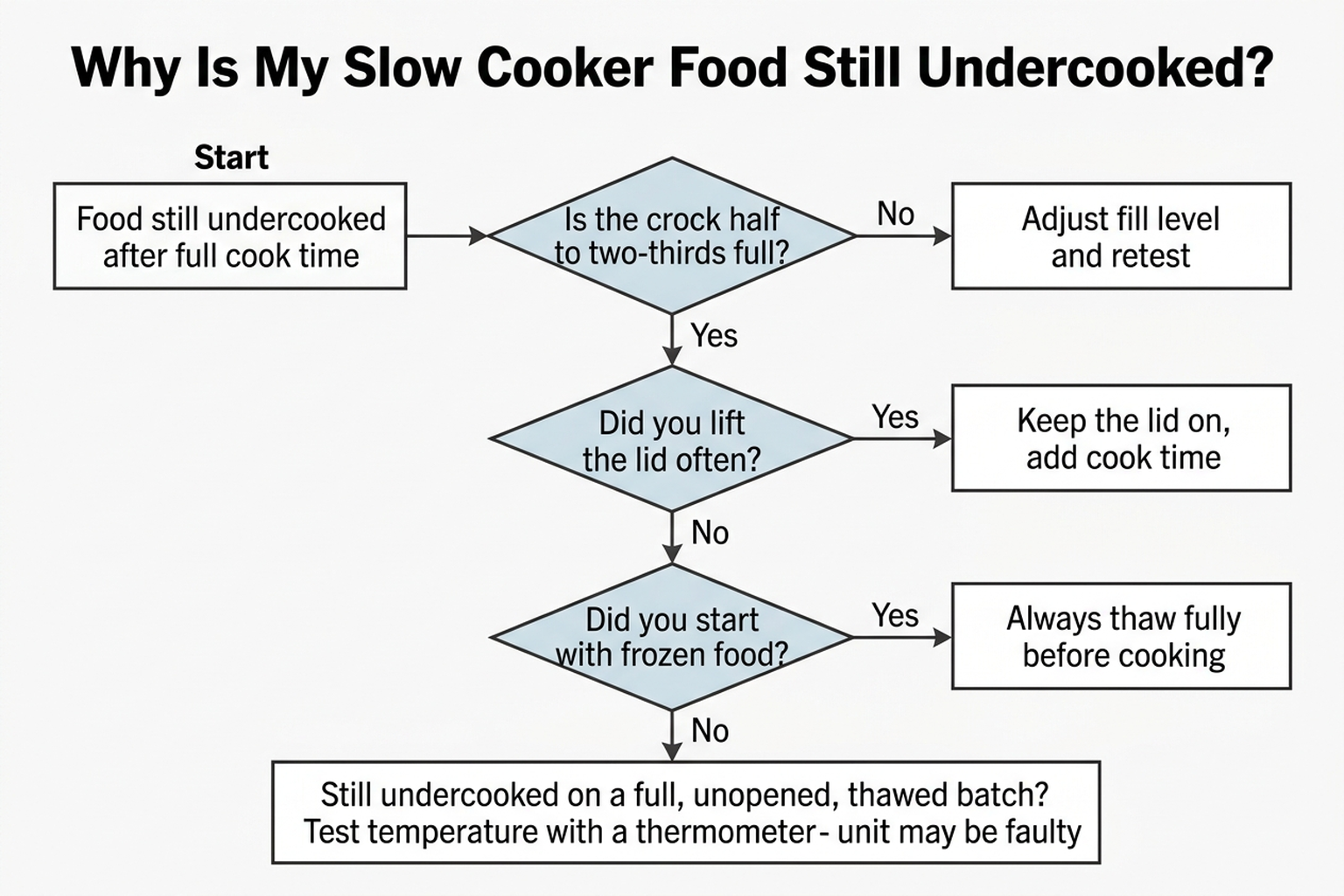
- Check the fill level first. USDA and manufacturer guidance both specify half to two-thirds (up to three-quarters) full. An overfilled crock blocks even heat circulation; an underfilled one can’t hold steady heat. Adjust the recipe’s ingredient volume or switch to a better-matched cooker size.
- Stop lifting the lid. Each removal drops the internal temperature 10–15°F and costs roughly 20 minutes of recovery time — several checks can erase an hour or more of actual cooking progress that the elapsed-time display won’t show.
- Confirm ingredients were fully thawed before they went in. USDA guidance treats frozen ingredients in a slow cooker as both a food-safety risk and a reliable cause of undercooked results; thaw meat, poultry, and prepared components in the refrigerator first.
- Match the cooker size to the recipe. A recipe written for a 6-quart cooker run in a 4-quart or 8-quart unit changes how fast the contents come up to temperature; adjust cook time accordingly or use the size the recipe specifies.
- If all of the above check out and food is still undercooked, run a water-temperature test. USDA/extension guidance for testing an appliance: fill the cooker half to two-thirds full with tap water, cover, and run on Low for 8 hours, then immediately check the water temperature with an accurate thermometer — it should read in the 185–200°F range.
- If the test comes back below that range, retire the unit. A cooker that can’t reach a safe temperature on a correctly filled, lid-on, water-only test is treated by extension food-safety guidance as unsafe to keep using for raw meat and poultry, regardless of how long you run it.
5. If the fix is confirming the temperature: current options
Editorial recommendation, not personal testing. The water-temperature test above is the single most decisive way to separate a usage mistake from an actual hardware fault.
- ThermoPro TP03B Digital Instant Read Meat Thermometer, Waterproof Kitchen Food Thermometer with Calibration & Backlight — an instant-read probe thermometer suited to the extension-service water test and to checking finished food directly, which is the more decisive diagnostic than guessing from texture alone.
6. If it’s time for a new unit: current options
Editorial recommendation, not personal testing. If the water test confirms a unit running cool, a current-generation programmable slow cooker with a digital timer removes guesswork around elapsed time and lid discipline.
- Crockpot 7-Quart Cook & Carry Programmable Slow Cooker with Digital Timer and Locking Lid — a current model from the brand whose published fill-level and cooking-tip guidance this article draws on, with a locking lid designed to reduce accidental mid-cook lid removal during transport.
7. The decision flowchart
8. The bottom line
Slow cooker food that’s still undercooked at the end of a full cycle is, in the majority of documented cases, explained by fill level, lid-opening habits, starting from frozen, or a size mismatch between the cooker and the recipe — not a defective appliance. Correcting the fill level, keeping the lid on, fully thawing ingredients, and matching cooker size to the recipe resolves most reported cases without a replacement. The one pattern that isn’t a usage fix is a unit that still can’t reach 185–200°F on a controlled water test with the lid on and no interruptions — extension food-safety guidance treats that as a sign to retire the cooker rather than keep using it for raw meat and poultry.
Limitations of this analysis
To be explicit about what this article does not establish:
- We did not personally reproduce this issue on the specific machines named here. The causes and fixes described are drawn from USDA/extension food-safety guidance, manufacturer cooking tips, independent third-party testing, a public CPSC safety record, and aggregated customer-review and owner-forum reports, not from a controlled test we ran ourselves.
- The 2021 Crock-Pot Express Crock recall addresses a lid-detachment burn hazard during pressurized cooking, not undercooking on the standard slow-cook setting — we cite it as the most recent CPSC action in this product category and as context, not as evidence linking that specific defect to the undercooking pattern this article mainly covers.
- The Instant Pot bean-undercooking reports come from Tasting Table’s compiled complaint roundup and Food Network’s product testing, not from a statistically representative sample of all Instant Pot owners.
- The 185–200°F water-test range is general extension/food-safety guidance for the low setting (drawn from Clemson HGIC, MSU Extension, and University of Arkansas Extension; we could not directly confirm the exact figure against the FSIS fact sheet page itself, which returned an access error during research), and actual performance can vary by model, cooker age, and manufacturing batch.
- Market-share figures are 2025–2026 industry estimates from Global Market Insights that vary somewhat across research firms; we cite them as directional context on brand prevalence, not a precise figure.