How Often to Clean a Robot Vacuum Filter in 2026
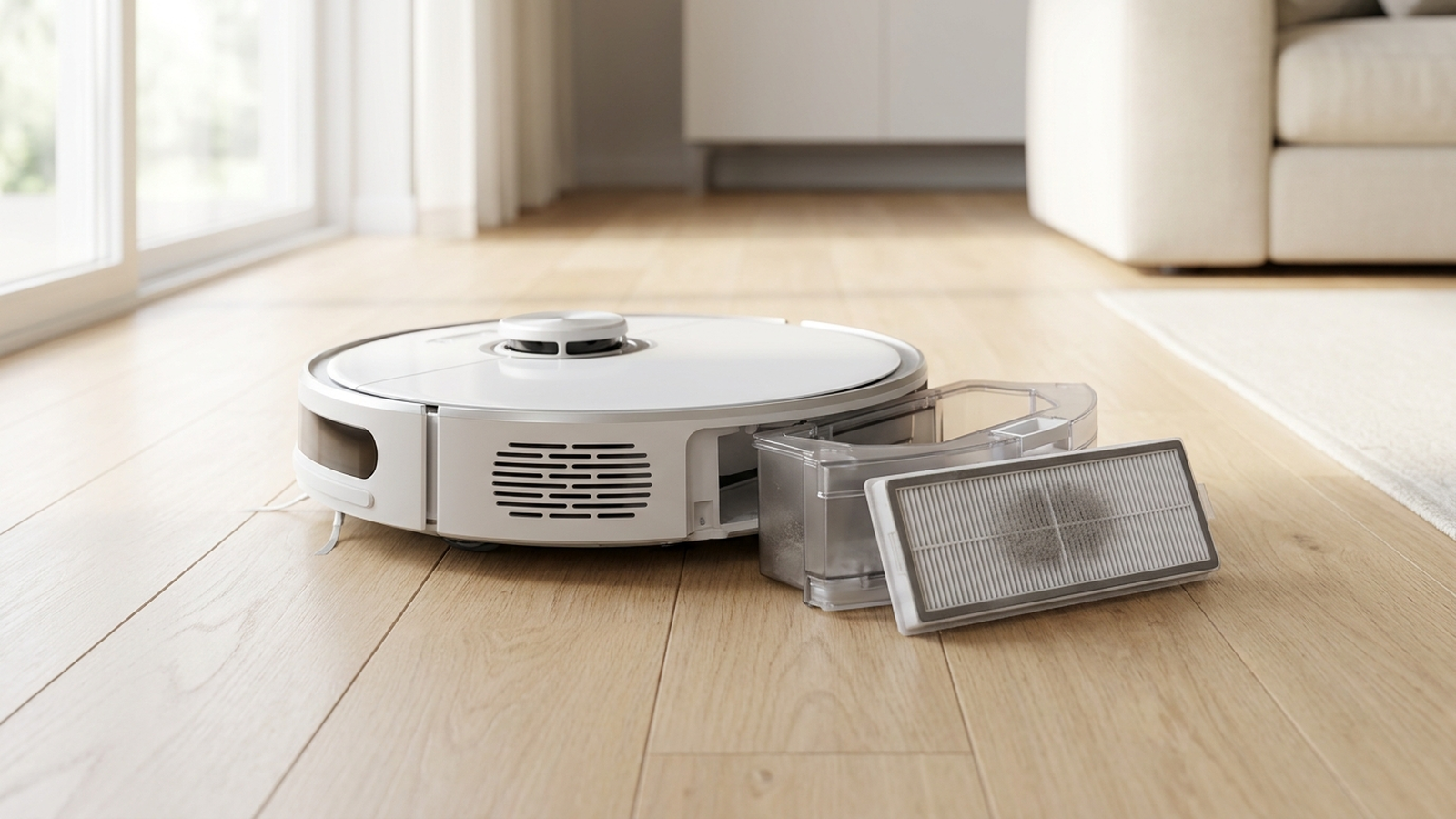
Robot vacuums are quietly becoming a mainstream US appliance — household penetration sits at roughly 18–22% in 2026, according to IndexBox market research, on a category Grand View Research values at $12.5 billion in 2025, growing toward $14.4 billion in 2026. But almost none of that adoption data mentions the one part that decides whether the thing keeps working: the filter. Search “robot vacuum losing suction” and the manuals, the forums, and the one-star reviews all point at the same overlooked disc of pleated paper or foam.
As an Amazon Associate, Arekore earns from qualifying purchases. The Amazon product links in this article may include our affiliate tracking ID and may earn us a commission if you buy through them, at no additional cost to you. See our Links Policy for details on how we select products and how commissions do not influence our recommendations.
TL;DR / Quick Verdict
- Rinse washable HEPA filters every 2 weeks; tap out dry (non-washable) filters weekly. That is the baseline manufacturers and independent maintenance guides converge on for average households.
- Pet owners and allergy households should double that pace — every 1–2 weeks for washable filters, and expect to replace non-washable filters closer to every 2 months instead of 3.
- Replace the filter itself every 2–3 months, per both iRobot and Shark manuals, regardless of how often you clean it — cleaning removes surface dust, but the pleated media itself degrades and cannot be fully restored by rinsing.
- A clogged filter is the single most common cause of “my robot vacuum lost suction” in aggregated customer reviews and repair guides — well ahead of brush-roll tangles or a full dustbin.
How We Reached These Conclusions (Methodology)
This is an editorial analysis, not a hands-on test. We did not personally test the products covered here. This guide synthesizes (a) manufacturer maintenance documentation from iRobot, Shark/SharkNinja, ECOVACS, and eufy; (b) independent appliance-maintenance guidance, including Stiftung Warentest’s ongoing robot-vacuum test database (test.de), which factors filter upkeep into its suction and durability scoring; (c) aggregated amazon.com customer-review sentiment on best-selling replacement-filter listings, sampled in July 2026, focused on complaints about suction loss and filter availability; and (d) market and ownership data from IndexBox and Grand View Research. We did not conduct a formal review-mining study and cannot report a precise sample size (N) for the aggregated review sentiment described below; those observations reflect a qualitative read of top review threads on best-selling listings, not a statistically sampled dataset. Cleaning and replacement intervals quoted from manufacturer manuals are labeled as manufacturer guidance, not independently verified lab results. Prices are amazon.com figures at the time of writing and fluctuate.
Why Filters Clog Faster Than the Manual Implies
A robot vacuum’s suction motor pulls air through the brush roll, into the dustbin, and out through the filter before exhausting it back into the room. Every one of those steps depends on air actually moving — and the filter is the narrowest point in that path. Maintenance guides consistently identify a clogged filter as the leading cause of a vacuum that “just doesn’t suck like it used to,” ahead of a full dustbin or a hair-wrapped brush roll, because the filter is also the part owners are least likely to check without being told.
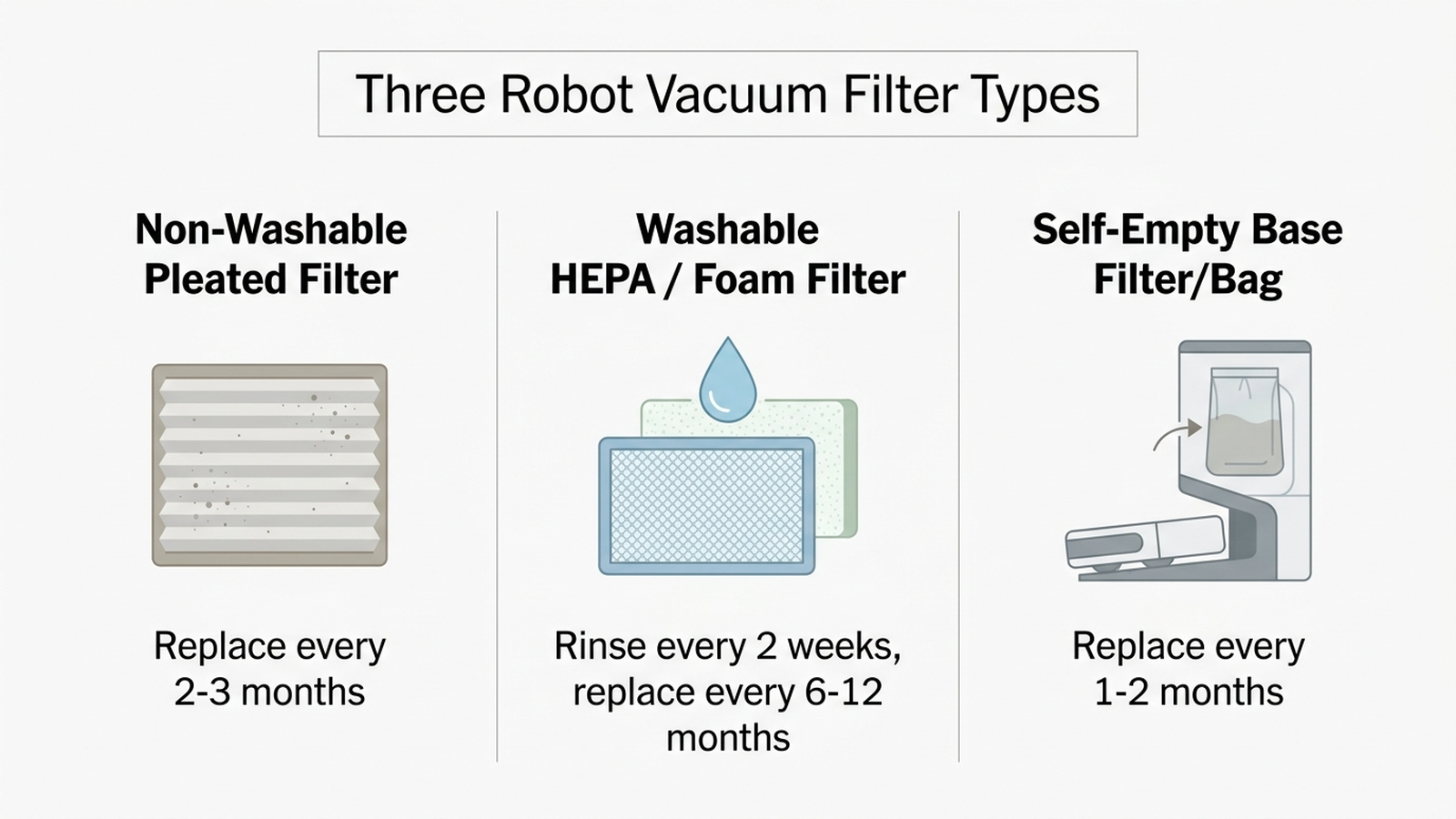
Three filter types dominate the current US Amazon market, and the honest cleaning schedule differs by type:
- Non-washable pleated filters (common across the Roomba lineup, including 600/800/900 series and the newer e/i/j series’ High-Efficiency filter, plus budget models): cannot be rinsed without damaging the media. Tap or vacuum out loose dust weekly, and plan to replace the filter itself every 2–3 months — closer to 2 for pet households, closer to 3 for a single-person apartment with no pets.
- Washable HEPA / foam-mesh filters (common on newer Shark IQ, ECOVACS, and eufy models): rinse under cool running water every 2 weeks, air-dry for 12–24 hours before reinserting (never reinsert damp — trapped moisture breeds odor and can damage the motor), and still replace the filter every 6–12 months even with regular washing, since the pleats lose structure over repeated wet cycles.
- Self-empty base filters (the bag or dust-bin liner inside a docking station, separate from the robot’s own filter): follow a separate schedule tied to how full the base gets, typically every 1–2 months for the disposable bag itself.
How to Clean a Washable Filter, Step by Step
The most common maintenance mistake in aggregated reviews is reinserting a filter while it is still damp, which traps moisture against the motor housing. Manufacturer manuals for washable HEPA and foam filters converge on the same four-step process:
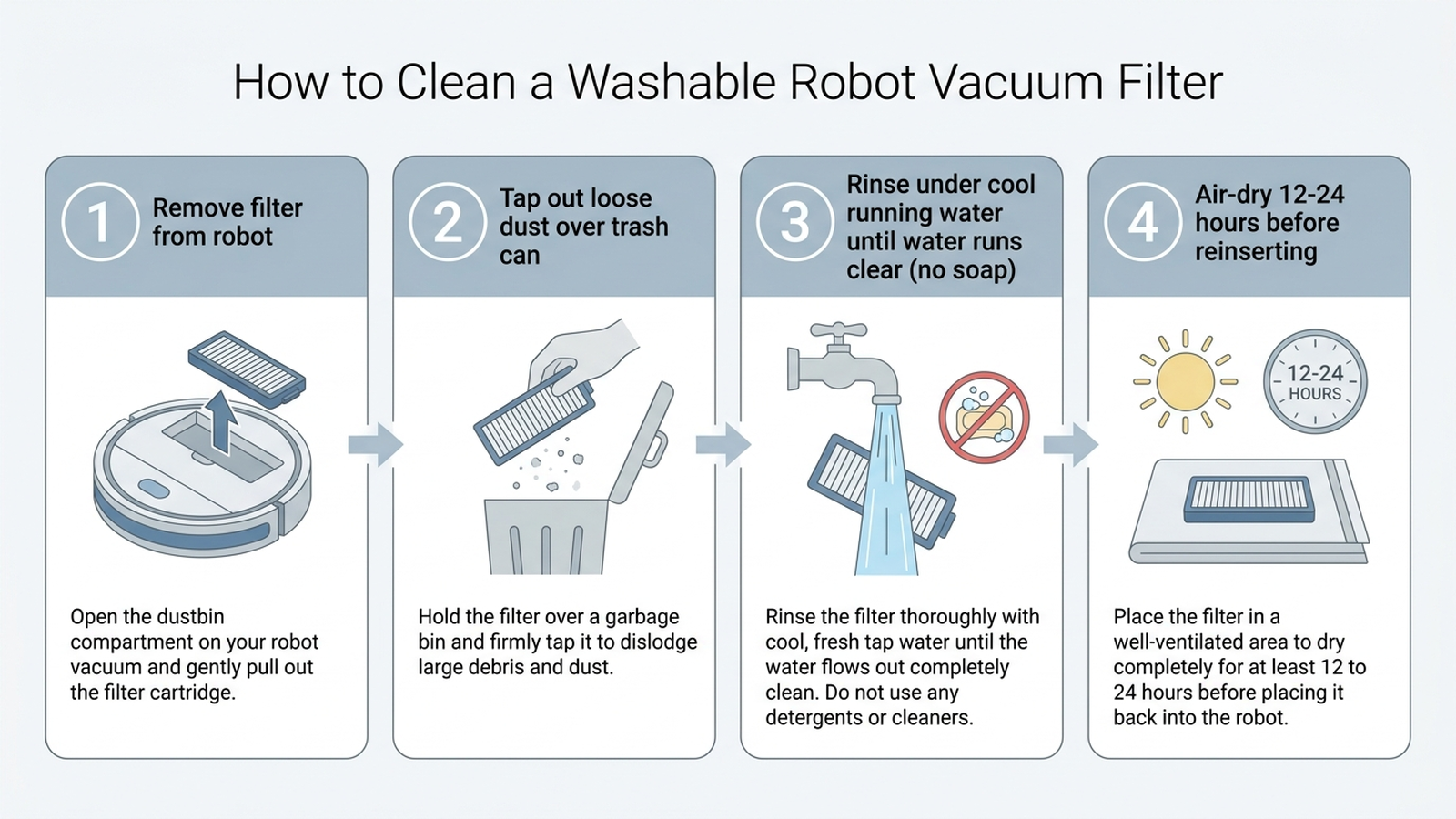
- Remove the filter from the robot or its dustbin, following the release tab shown in the model’s manual.
- Tap out loose dust over a trash can before it ever touches water — this keeps the rinse step from turning into a muddy mess.
- Rinse under cool running water until the runoff is clear. No soap or detergent, and no scrubbing with a brush or finger — both can tear the pleats or mesh.
- Air-dry for 12–24 hours before reinserting. A filter that goes back in damp is the single most common cause of a musty smell reported in reviews, and prolonged moisture can reach the motor.
What Independent Testers Say About Filter Upkeep
Stiftung Warentest — Europe’s most rigorous appliance-testing body and the closest thing this category has to a lab-grade independent authority — maintains an ongoing robot-vacuum database (test.de) that scores suction power and durability alongside ease of maintenance. Its early-2025 test cycle rated the Vorwerk VR7 as a category winner (grade 2.1, “GOOD” on the German 1–5 scale), citing consistently strong suction power as one of the deciding factors — and Stiftung Warentest’s own maintenance guidance ties sustained suction directly to keeping the filter clean and replacing it before it visibly degrades, not after. That mirrors what US repair and maintenance guides (Vacuum Wars, manufacturer support documentation) report: suction complaints filed months after purchase trace back to filter neglect far more often than to a hardware defect.
What Aggregated Amazon Reviews Actually Say
Reading through review threads on the best-selling replacement-filter listings for Roomba and Shark models surfaces a consistent pattern, even without a formal review-mining study:
- Complaints cluster around “I didn’t know I needed to replace this.” A meaningful share of one- and two-star reviews on the robot vacuums themselves (not the filter listings) describe declining suction “after a few months” — a symptom that matches filter degradation rather than a defective unit, since the manuals do specify a 2–3 month replacement window that many owners never see until suction drops.
- Positive reviews on replacement-filter listings frequently mention a suction improvement immediately after swapping the filter, which is the customer-facing confirmation of the manufacturer’s replacement-interval guidance.
- Compatibility confusion is the second-largest complaint category — Roomba alone has distinct filter part numbers across its 600, 800/900, and e/i/j series, and buying the wrong 3-pack is a common one-star driver on generic-brand listings.
Comparison Table
Prices are approximate amazon.com figures at the time of writing (July 2026) and fluctuate.
| Filter | ASIN | Type | Manufacturer clean interval | Manufacturer replace interval | Approx. price (3–4 pack) |
|---|---|---|---|---|---|
| iRobot Roomba e/i/j Series High-Efficiency Filter | B07H78FQ6R | Non-washable pleated | Tap out weekly | Every 2 months | ~$20–$25 |
| iRobot Roomba 600 Series Filter | B09MMTMJH5 | Non-washable pleated | Tap out weekly | Every 2 months | ~$20–$25 |
| iRobot Roomba 800/900 Series AeroForce Filter | B00LPV28WG | Non-washable pleated | Tap out weekly | Every 2–3 months | ~$18–$24 |
| Shark IQ Robot Replacement Filter (self-empty base compatible) | B09PH8ZSPZ | Washable foam | Rinse every 2 weeks | Every 2–3 months | ~$12–$18 |
Editorial Recommendation by Household Type
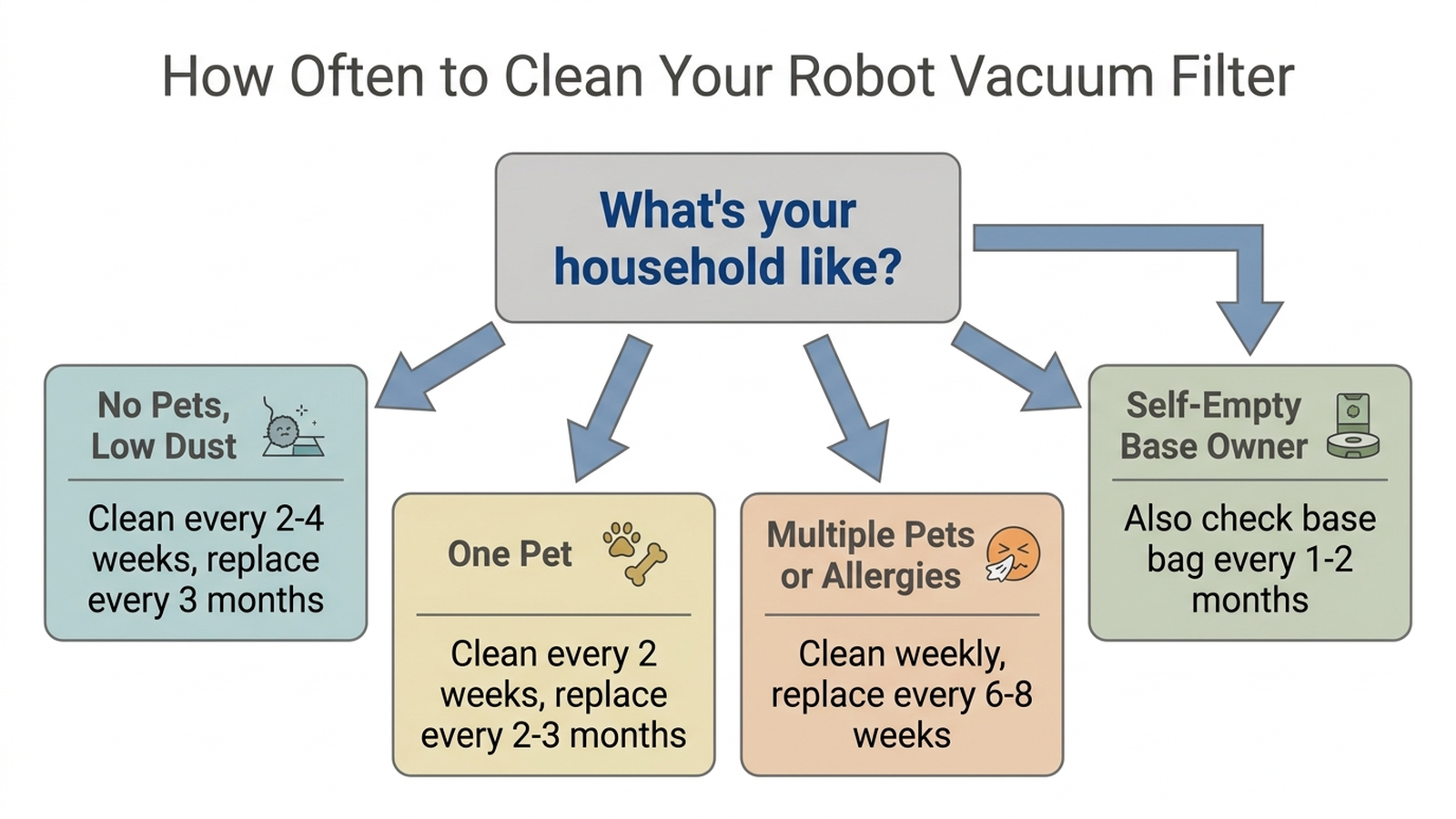
- No pets, low-dust home: rinse or tap the filter every 2–4 weeks; replace every 3 months on the manufacturer’s default schedule. This is the baseline the manuals are written for.
- One pet, average shedding: shift to every 2 weeks for cleaning and every 2–3 months for replacement — closer to the aggressive end of the manufacturer range, since pet dander loads the filter faster than household dust alone.
- Multiple pets or an allergy sufferer in the home: clean weekly and replace every 6–8 weeks. This is more frequent than any single manufacturer manual states outright, but it is the pattern that emerges when cross-referencing “heavy use” guidance from multiple filter manufacturers with allergy-focused maintenance advice.
- Self-emptying base owners: the robot’s own filter still needs the schedule above — the base’s disposable bag is a separate consumable on its own 1–2 month cycle, not a substitute for filter maintenance.
- Anyone who has already noticed weaker suction: check the filter before assuming the unit is failing. Aggregated reviews suggest this is the most common and most avoidable false alarm in the category.
Buying the Right Replacement
Filter part numbers are model-specific, and the single biggest source of buyer frustration in this category is ordering a filter that does not fit. Before ordering, confirm your exact Roomba or Shark model number (usually printed on the underside of the robot) against the listing’s compatibility chart rather than the product title alone — generic third-party filters frequently list broad compatibility that does not hold for every sub-model in a series.
Check the iRobot Roomba e/i/j Series High-Efficiency Filter on Amazon
Check the iRobot Roomba 600 Series Filter 3-Pack on Amazon
Check the iRobot Roomba 800/900 Series AeroForce Filter on Amazon
Check the Shark IQ Robot Replacement Filter on Amazon
Limitations
This analysis relies on manufacturer maintenance documentation, Stiftung Warentest’s published test commentary, and aggregated amazon.com customer-review sentiment rather than our own instrumented testing of filter degradation over time. Manufacturer cleaning and replacement intervals are guidance for average conditions and are labeled as such; actual filter lifespan varies with home size, dust load, pet presence, humidity during air-drying, and how consistently a household follows the schedule. Individual experience may vary based on use case and unit-to-unit variance.
Bottom Line
The safe default is simple: rinse a washable filter every 2 weeks, tap out a non-washable one weekly, and replace either type every 2–3 months regardless of how clean it looks — the pleated media degrades even when it is not visibly dirty. That single habit, more than any brush-roll or dustbin routine, is what aggregated reviews and manufacturer guidance agree keeps a robot vacuum’s suction from quietly fading months before anyone notices.
Before you buy a replacement filter or a new robot vacuum, paste the product link into Arekore — our AI assistant checks review authenticity, surfaces what the one-star reviews actually complain about, and compares prices, free, in about five minutes.