Robot Mop vs Robot Vacuum: 7 Questions Answered With Data

TL;DR
A robot vacuum only picks up dry debris. A robot mop (or a hybrid vacuum-mop) adds a wet pad or roller that wipes hard floors. Hybrids now make up roughly half of new robot-cleaner launches, but aggregated reliability data shows they are not a strict upgrade — mopping hardware adds its own failure points, and dedicated hand-pushed mops still out-clean robots on stubborn messes. Below we answer the seven questions shoppers actually ask when deciding between the three categories, using independent lab testing, Consumer Reports survey data, and manufacturer specs rather than first-hand use.
Methodology
This analysis synthesizes three sources: (a) Consumer Reports’ member reliability survey data covering 165,569 vacuums purchased between 2016 and 2026, including a separate problem-rate breakdown for vacuum-mop combo units; (b) independent lab testing and testing protocols from RTINGS, Consumer Reports, Forbes, and Tom’s Guide, which run standardized suction, carpet-embedded-dirt, and mopping tests; and (c) manufacturer-published specifications and aggregated Amazon US customer review sentiment, sampled October 2026. We did not personally test the products referenced here. Figures attributed to a manufacturer (suction in pascals, dock capacity, runtime) are labeled as manufacturer claims rather than independently verified results.
As an Amazon Associate, Arekore earns from qualifying purchases. The Amazon product links in this article include our affiliate tracking ID and may earn us a commission if you buy through them, at no additional cost to you. See our Links Policy for details on how we select products and how commissions do not influence our recommendations.
Comparison Table (Prices as of 2026-10-29)
| Model | Category | Price | Suction | Mop mechanism | Self-empty/clean |
|---|---|---|---|---|---|
| Shark AI Ultra (AV2501S) | Vacuum-only | $279.99 | Manufacturer spec not independently disclosed | None | Yes, 30-day HEPA base |
| Roborock Q10 S5+ | Hybrid vacuum-mop | $499.99 | 10,000 Pa (manufacturer claim) | Sonic scrubbing, auto lift over carpet | Yes, ~70-day dock |
| iRobot Roomba Combo j9+ | Hybrid vacuum-mop | $799.99 | N/A (camera-navigation focused) | Auto-lift flat pad | Yes, Clean Base Auto-Fill |
| Tineco Floor One S9 Artist Steam | Hand-pushed mop (not a robot) | $899.00 | N/A (wet/dry vacuum-mop) | Steam + roller, user-directed | Self-cleaning dock only |
7 Questions, Answered
1. What’s the actual difference between a robot vacuum, a robot mop, and a hybrid?
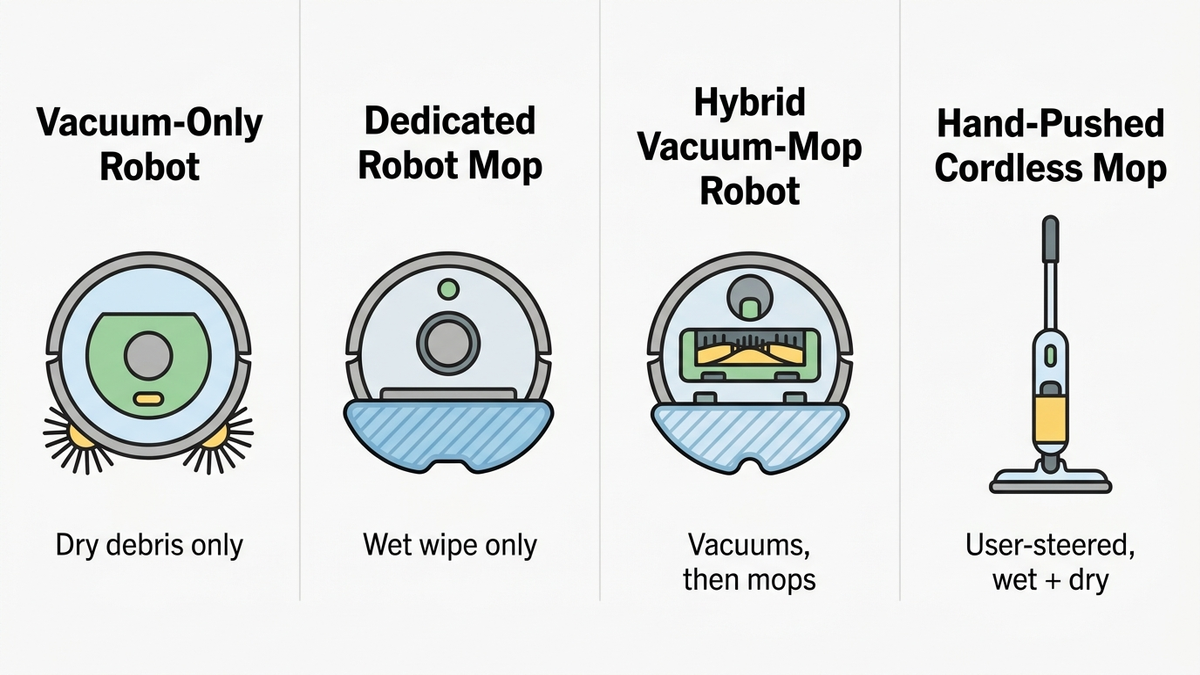
A robot vacuum picks up dry debris only — dust, crumbs, pet hair — using suction and a brush roll. A dedicated robot mop wets a pad or roller and wipes hard floors, with no dry-debris suction at all; true single-purpose robot mops are now a small niche, since most manufacturers build mopping into a hybrid instead. A hybrid vacuum-mop does both in one pass: it vacuums first, then drags or scrubs a wet pad behind it, usually lifting the pad automatically when it detects carpet. A fourth category that gets lumped into “robot mop” searches but isn’t autonomous at all is the hand-pushed cordless wet/dry mop (Tineco’s Floor One line) — you steer it like a stick vacuum, and a dock self-cleans the roller afterward.
2. Can a hybrid’s mop actually clean as well as a dedicated mop?
Not quite, according to independent testing. Forbes’ 2026 vacuum-mop combo testing and RTINGS’ robot vacuum protocol both note that a robot’s mop pad applies light, consistent pressure as it drives, which is enough for daily dust and light grime but struggles with dried-on spills or sticky residue. Hand-pushed wet/dry mops like Tineco’s Floor One line apply user-controlled pressure and, in several models, heated steam — Consumer Reports has separately praised Tineco’s stain-removal performance on hard floors, a result tied directly to the fact that a person is steering and pressing down. If your floors regularly get stubborn spills (cooking grease, dried juice), a hybrid robot won’t match a hand-pushed mop on that specific job, even though it wins on convenience for everyday maintenance.
3. Does adding a mop hurt the vacuum’s carpet performance?
It can, in two ways. First, hybrids need a mechanism to lift the wet pad off carpet — on cheaper models this lift height is shorter, and manufacturer specs for pad clearance vary widely, so a hybrid is more likely to leave a damp streak at the carpet edge than a vacuum-only model with no pad to manage at all. Second, current combo units generally aren’t as effective at pulling embedded debris out of carpet pile as dedicated vacuum-only robots in the same price tier, per independent reviewer testing — the engineering trade-offs that go into fitting a water tank, pump, and pad mechanism onto the chassis compete for space and weight budget with suction hardware. If most of your home is carpeted, a vacuum-only model is the safer bet; if you have mostly hard floors with carpet in one or two rooms, check the specific model’s pad-lift height before assuming it handles the transition cleanly.
4. Which one has a bigger hair-tangling problem?
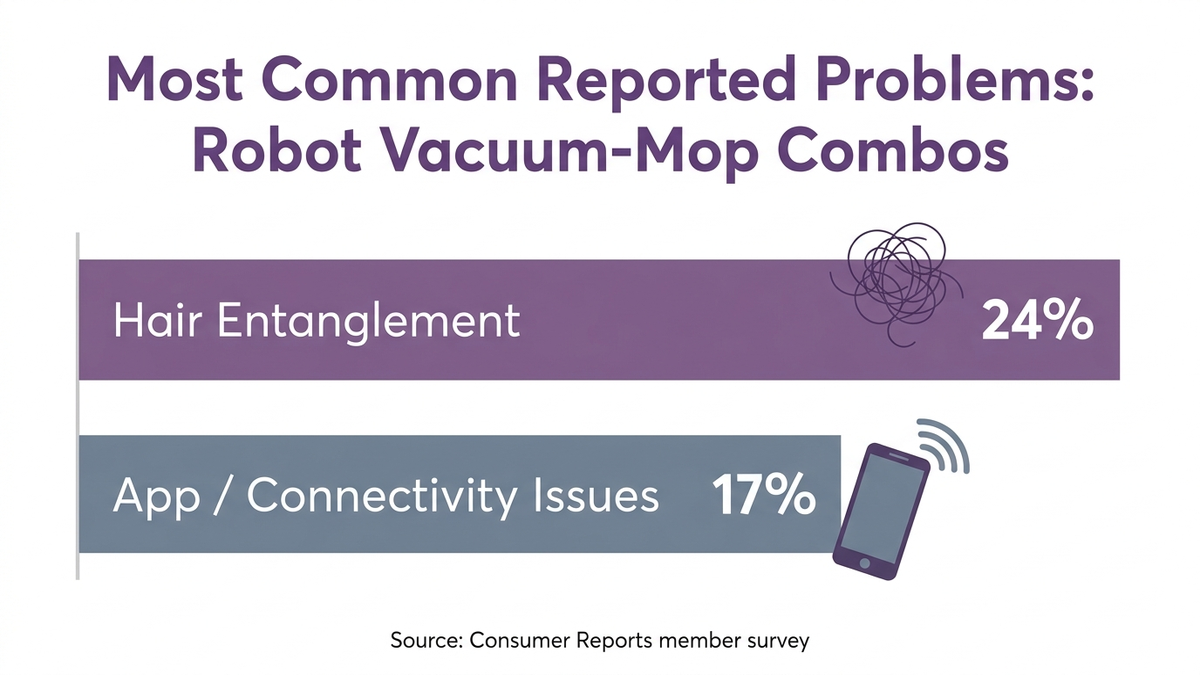
Hybrids, according to Consumer Reports’ member survey data. Hair entanglement is the single most common complaint reported for robot vacuum-mop combos, affecting 24% of units, and a wet, dirty mop pad or roller gives hair somewhere additional to stick besides the main brush roll. App and connectivity problems were the next most common issue at 17%. Vacuum-only models aren’t immune to hair tangles either, but they have one fewer wet component for hair and lint to adhere to. If you have long-haired pets or household members, factor this into the decision regardless of which brush-roll design (bristle, rubber, or anti-tangle comb) a given model uses — mopping hardware adds a second place for hair to collect that a vacuum-only robot simply doesn’t have.
5. Is the extra dock maintenance on a hybrid worth it?
That depends on how much you value not thinking about mopping at all. A hybrid’s dock needs its clean-water tank refilled, its dirty-water tank emptied, and its mop pad or roller rinsed regularly — skip this and you get the sour-smell complaints that show up repeatedly in aggregated Amazon reviews for combo units. A vacuum-only model’s maintenance is simpler: empty the bin (or let the self-empty base handle it) and periodically clear the brush roll. For a household that already mops by hand once a week and just wants automated vacuuming in between, the added dock upkeep of a hybrid may not pay for itself. For a household trying to eliminate hand-mopping entirely, the dock maintenance is the cost of that convenience, not an optional extra.
6. How much more does a hybrid actually cost, and is it worth the premium?
Hybrid units in this comparison run from roughly $500 (Roborock Q10 S5+) to nearly $800 (iRobot Roomba Combo j9+), against $280 for a comparable vacuum-only model (Shark AI Ultra) — a premium of $220 to $520. Market researchers tracking the category report hybrid 2-in-1 systems are growing at a 16.6% CAGR and now represent roughly 48% of new robot-cleaner product launches, so the premium is shrinking over time as hybrids become the default rather than the upgrade. Whether it’s worth paying now comes down to question 3 and question 4 above: if your home is mostly hard floors and hair tangling isn’t a major concern, the convenience of one robot instead of two separate cleaning routines is a reasonable trade for the extra cost. If you have significant carpet or heavy shedding, the premium buys you a worse vacuum and a maintenance headache rather than a clear upgrade.
7. So which category should I actually buy?
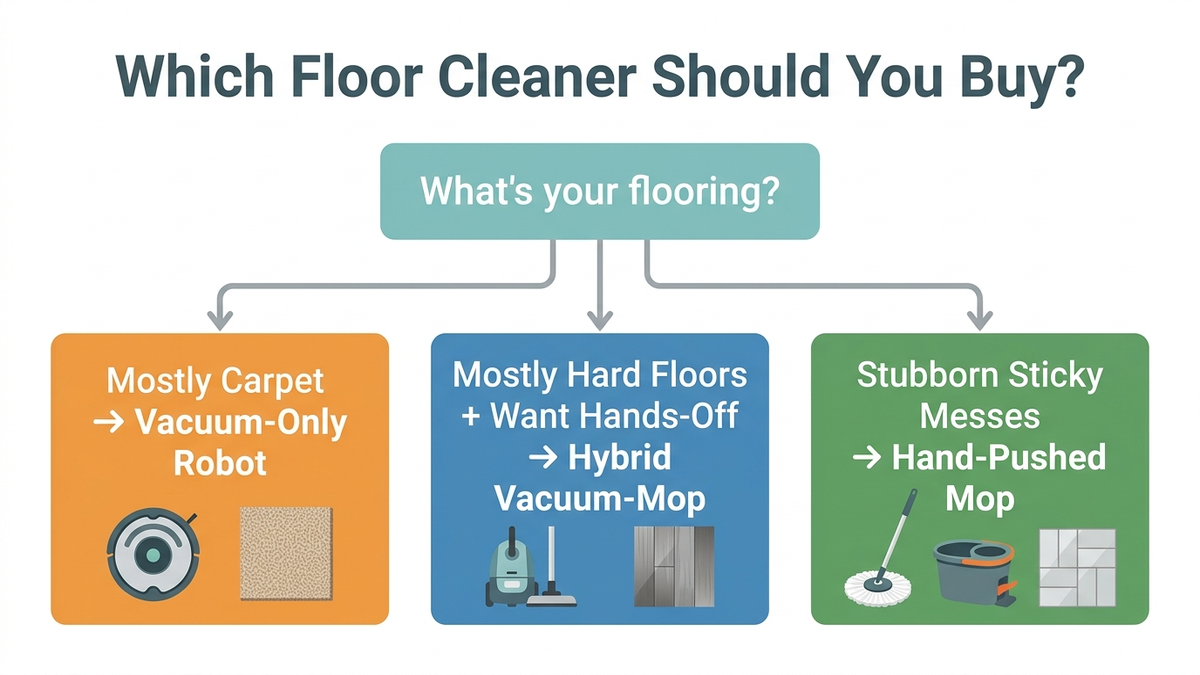
Match the category to your floors and your tolerance for maintenance, not to whichever product is marketed as “newest.” Choose a vacuum-only robot if most of your home is carpeted or you don’t want extra dock upkeep. Choose a hybrid vacuum-mop if your home is mostly hard floors, light daily mopping would genuinely save you time, and you’re willing to rinse the dock regularly. Choose a hand-pushed mop like the Tineco Floor One line instead of — or in addition to — a robot if stubborn, sticky messes are a recurring problem that a lightly-pressured robot pad won’t solve. Most households with mixed flooring end up better served by a good vacuum-only robot plus an occasional hand mop than by a mid-tier hybrid that compromises on both jobs.
Editorial Recommendation by Use Case
- Mostly carpeted home, or you don’t want extra dock maintenance: the Shark AI Ultra (AV2501S) — vacuum-only, no mop hardware to clean, lowest price in this comparison.
- Mostly hard floors, want the most hands-off hybrid for the price: the Roborock Q10 S5+ — sonic mopping and a 70-day self-emptying dock at roughly $500.
- Want a well-known hybrid brand and don’t mind the higher price: the iRobot Roomba Combo j9+ — camera-based obstacle avoidance plus auto-fill dock.
- Stubborn, sticky messes are a recurring problem no robot pad has solved: the Tineco Floor One S9 Artist Steam — hand-pushed, not a robot, but independently praised for stain removal.
Limitations
This analysis relies on Consumer Reports’ published survey data, independent lab testing from third-party publications, manufacturer specifications, and aggregated Amazon customer review sentiment — we did not independently test these specific units side by side. Consumer Reports notes it does not yet have long-term reliability or owner-satisfaction ratings for vacuum-mop combos specifically, since the category is newer; the 24% hair-entanglement and 17% app-problem figures come from its member survey of combo-unit owners rather than a controlled lab reliability test. Suction, dock capacity, and runtime figures attributed to a manufacturer have not been independently re-measured. Results vary by home layout, flooring type, and pet shedding; prices fluctuate on Amazon and should be verified before buying.
Before You Buy
Visit Arekore to check current pricing and verify a listing’s reviews before buying — paste the Amazon URL and the AI assistant surfaces the most useful low-star feedback and flags pricing that looks inflated, so you’re choosing between a vacuum-only, hybrid, or hand-pushed mop based on your actual floors rather than marketing copy.