Do Robot Mops Damage Hardwood Floors? We Checked the Data
TL;DR
Robot mops rarely cause the kind of damage owners fear. We could not source a single, precisely citable complaint-rate percentage, but the recurring pattern across hardwood-floor buying guides and owner threads is that floor-damage complaints are a small minority of reviews, and the real cause is almost never the mop pad itself — it is grit or hair trapped in the wheels or side brush, or oversaturated pads left sitting on a finish for too long. Models with rubberized wheels, precise water-flow control, and a mop-lift height of 10mm or more when they detect carpet or rugs are the safest choice for sealed hardwood.
Methodology
This analysis synthesizes (a) manufacturer technical specifications for four current robot vacuum-mop combinations sold on Amazon US, (b) third-party lab testing and buying guides from RTINGS and other hardwood-floor-specific outlets, (c) National Wood Flooring Association (NWFA) guidance on wet-mopping wood floors, and (d) published third-party summaries of Amazon customer review sentiment on floor-damage complaints, sampled in September 2026. We did not personally test the products covered here, and we did not independently compute complaint-rate statistics from raw review data.
What Actually Causes the Damage
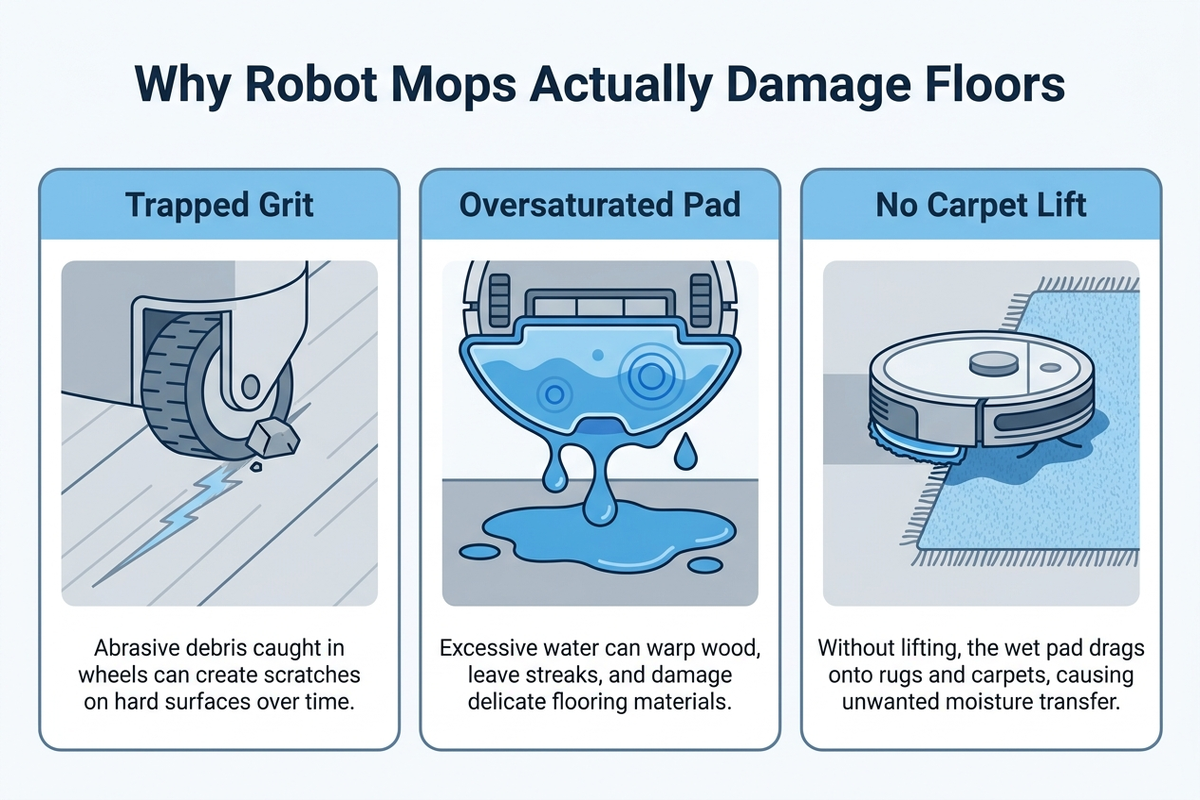
Owner reports of “my robot vacuum scratched my floor” cluster around three failure modes, not one:
- Trapped grit. Small stones or sand caught in a caster wheel or wound around a side brush act like sandpaper as the robot drags across a polyurethane-sealed finish. This is the single most common cause cited across hardwood-floor buying guides.
- Oversaturated mop pads. A pad soaked with too much water, combined with a robot that pauses or gets stuck in one spot, can leave standing moisture on a wood floor long enough to seep into seams — the same risk the NWFA flags for any wet mop, robotic or manual.
- No pad lift on carpet transitions. A robot that cannot lift its mop pad before crossing from hardwood onto a rug or area rug drags a wet pad across the rug edge and the hardwood beneath it.
None of these three failure modes require an expensive robot to avoid — they require good housekeeping (clearing loose debris before a cleaning cycle) plus hardware features that are increasingly standard at the $600+ price tier.
Customer Sentiment Synthesis
Third-party hardwood-floor buying guides that survey large volumes of Amazon and brand-site reviews consistently describe floor-damage complaints as a small fraction of total reviews for major brands, far below what the “robot mops ruin your floors” narrative implies — though the exact percentage varies by source and we were not able to verify one specific, citable figure across independent outlets. Reviewers who do report floor issues overwhelmingly describe one of the three failure modes above, not a defect in the mop mechanism itself. Independent testers echo this: RTINGS’ hardwood-floor recommendations consistently favor rubberized roller brushes over traditional bristle brushes, citing reduced surface abrasion on sealed wood as one of the deciding factors.
Comparison Table: Hardwood-Safety Specs
| Model | Suction | Mop-Lift Height | Brush Type | Water Control | Price (as of 2026-09-15) |
|---|---|---|---|---|---|
| iRobot Roomba Combo 10 Max | N/A (mop pad, not roller) | Auto-retract on carpet | Rubber multi-surface brush | AutoWash dock, sensor-based flow | ~$999–$1,399 |
| Roborock Saros 10R | 22,000 Pa | 20mm (VibraRise) | Rubberized dual roller | Adjustable, hot-water self-clean | ~$999 |
| Ecovacs Deebot X8 Pro Omni | 18,000 Pa | Auto-lift (OZMO ROLLER) | Rubberized main brush | Hot-water (167°F) roller mop wash | ~$800–$900 |
| Dreame X50 Ultra | 20,000 Pa | Retractable arm design | Detangling rubber brush | ProLeap adjustable flow | ~$900–$1,360 |
Prices fluctuate on Amazon; treat this table as a snapshot rather than a live price feed.
Brand-by-Brand Notes
iRobot built its AutoWash dock and auto-retracting mop pad specifically to address the “wet pad crossing a rug” failure mode; the company states the pad lifts before the robot moves onto carpet, though it does not publish an exact height figure the way Roborock does.
Roborock’s VibraRise system on the Saros line lifts the mop pad 20mm when it detects carpet — twice the height some competing designs use — which the brand positions as reducing the odds of dampening thick rugs laid over hardwood.
Ecovacs’s OZMO ROLLER design self-washes the mop roller with 167°F water inside the dock rather than letting a saturated flat pad sit on the floor between passes, which independent reviewers note reduces the standing-moisture window compared to older flat-pad designs.
Dreame’s retractable-arm mop system on the X50 Ultra is built to cross furniture legs and thresholds without leaving the pad engaged the whole time; some third-party comparisons note its mop-lift height is shallower than Roborock’s, which modestly raises moisture risk specifically at carpet edges.
How to Use a Robot Mop Safely on Hardwood
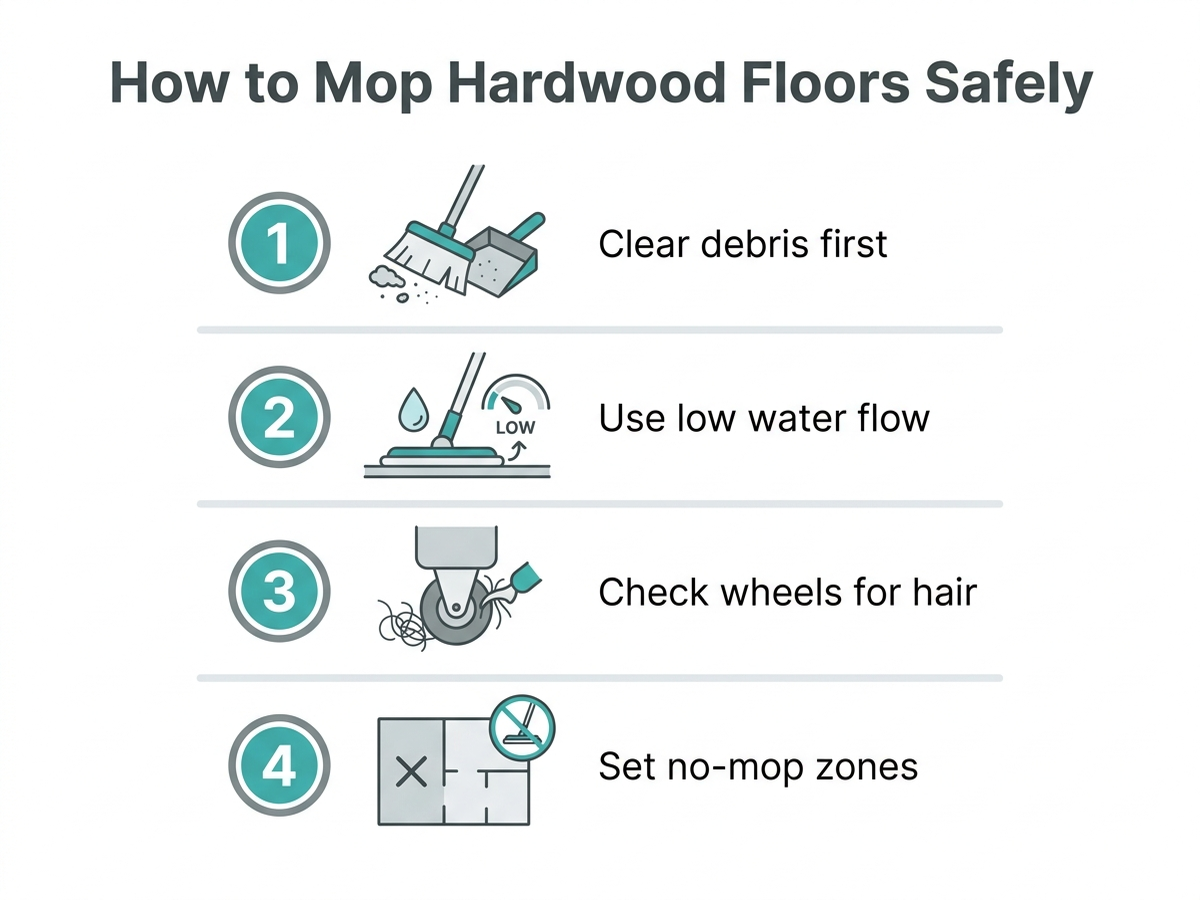
For daily maintenance mopping, the lowest water-flow setting is sufficient; reserve higher settings for occasional deep cleans or spill zones, consistent with NWFA guidance that wood floors should be damp-mopped, not wet-mopped. Empty the dustbin and check the brush and casters for tangled hair or grit before each cycle — this single habit addresses the majority of reported floor-damage cases. Set no-mop zones over area rugs in the companion app even if the robot claims automatic carpet detection, since detection sensors can miss thin or low-pile rugs.
Decision Guide: Do You Need a Robot Mop, or Just a Robot Vacuum?
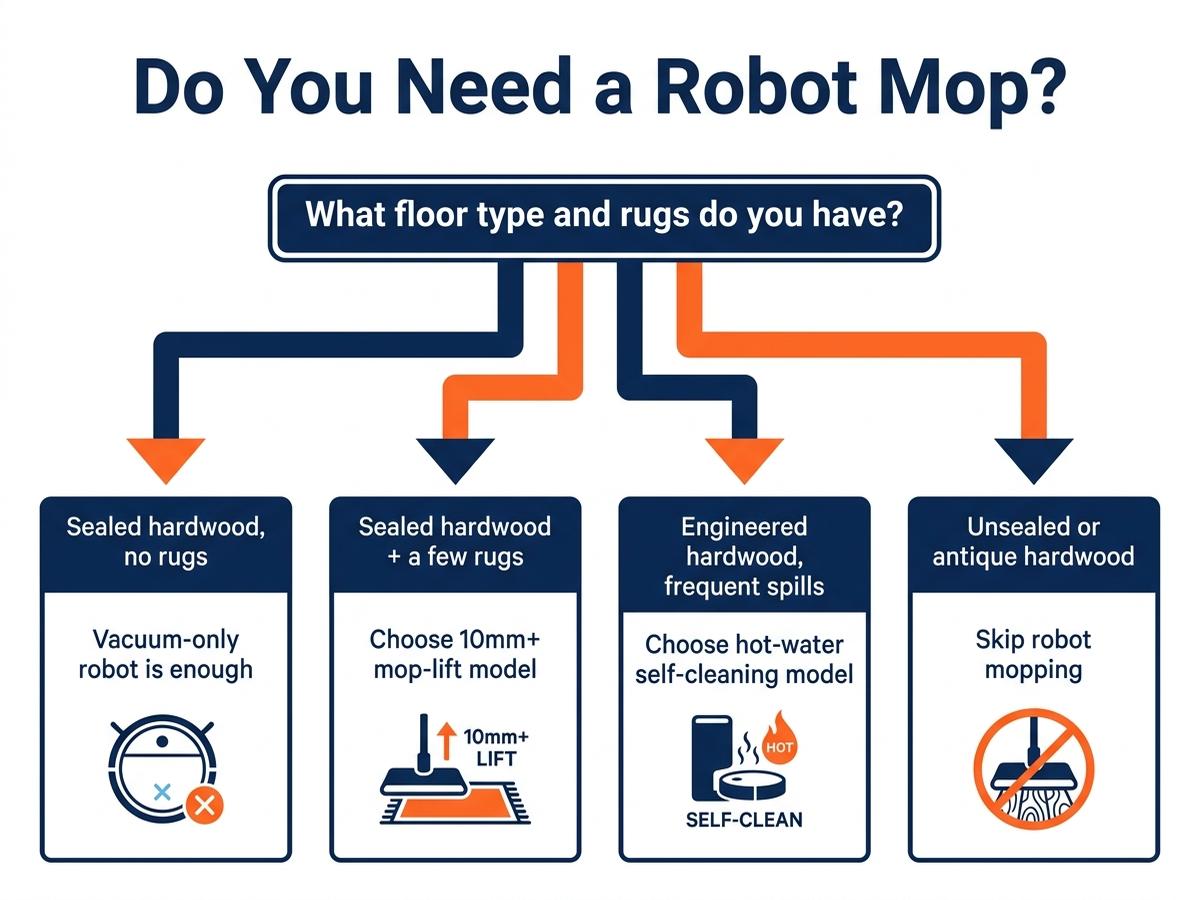
- Sealed hardwood, no area rugs, mostly dry debris (pet hair, dust): A vacuum-only robot avoids the moisture question entirely.
- Sealed hardwood with a few area rugs: Prioritize a model with a documented mop-lift height of 10mm or more and app-configurable no-mop zones.
- Engineered hardwood in a kitchen or entryway (higher spill frequency): Choose a model with hot-water self-cleaning and adjustable flow, and follow the manufacturer’s specific cleaning instructions rather than assuming the “engineered” label means more water tolerance.
- Unsealed, oiled, or antique hardwood: Skip robot mopping; the NWFA’s caution against wet and steam mops applies most strongly to finishes that were never designed for standing moisture.
Warranty Coverage
Warranty length is a reasonable proxy for how much confidence a manufacturer places in its own hardware: iRobot and Roborock both offer 2-year standard warranties on current models, while Ecovacs standardizes on 1 year and Dreame offers 1 year extendable to 2 years through app registration within 30 days of purchase.
Editorial Recommendation
For most sealed-hardwood homes with occasional area rugs, the Roborock Saros 10R’s 20mm mop lift and 2-year warranty combination gives the largest safety margin among the models compared here. Households that specifically need automatic pad washing without managing a flat pad by hand may prefer the Ecovacs Deebot X8 Pro Omni’s roller-based self-cleaning at a lower price point. Buyers already inside the iRobot ecosystem, or who prioritize a documented long-term support history over the newest hardware, should weigh the iRobot Roomba Combo 10 Max — with the caveat that iRobot filed for Chapter 11 bankruptcy in December 2025 and is being acquired by contract manufacturer Shenzhen Picea Robotics, a transition the company says will not disrupt existing product support in the near term, but is worth factoring into a purchase decision focused on long-term reliability.
As an Amazon Associate, Arekore earns from qualifying purchases. The Amazon product links in this article include our affiliate tracking ID and may earn us a commission if you buy through them, at no additional cost to you. See our Links Policy for details on how we select products and how commissions do not influence our recommendations.
- iRobot Roomba Combo 10 Max Robot Vacuum and Mop + AutoWash Dock
- Roborock Saros 10R Robot Vacuum and Mop
- ECOVACS DEEBOT X8 PRO OMNI Robot Vacuum and Mop
- DREAME X50 Ultra Robot Vacuum and Mop
Limitations
This analysis relies on publicly available reviews, third-party buying guides, and manufacturer specifications rather than controlled side-by-side testing on identical hardwood samples. We were unable to locate a single, precisely citable complaint-rate percentage that independent outlets agree on, so statements about damage prevalence in this article are directional (based on the consistent pattern across sources) rather than a specific measured statistic. Individual floor finish, age, and installation quality all affect real-world risk; a floor with a worn or unsealed finish carries meaningfully more moisture risk than the sealed, newer floors most reviews describe.
Visit Arekore to verify current pricing, ASINs, and availability before buying any product mentioned here.