Roborock Saros Review 2026: Is the Extendable Arm Worth It?
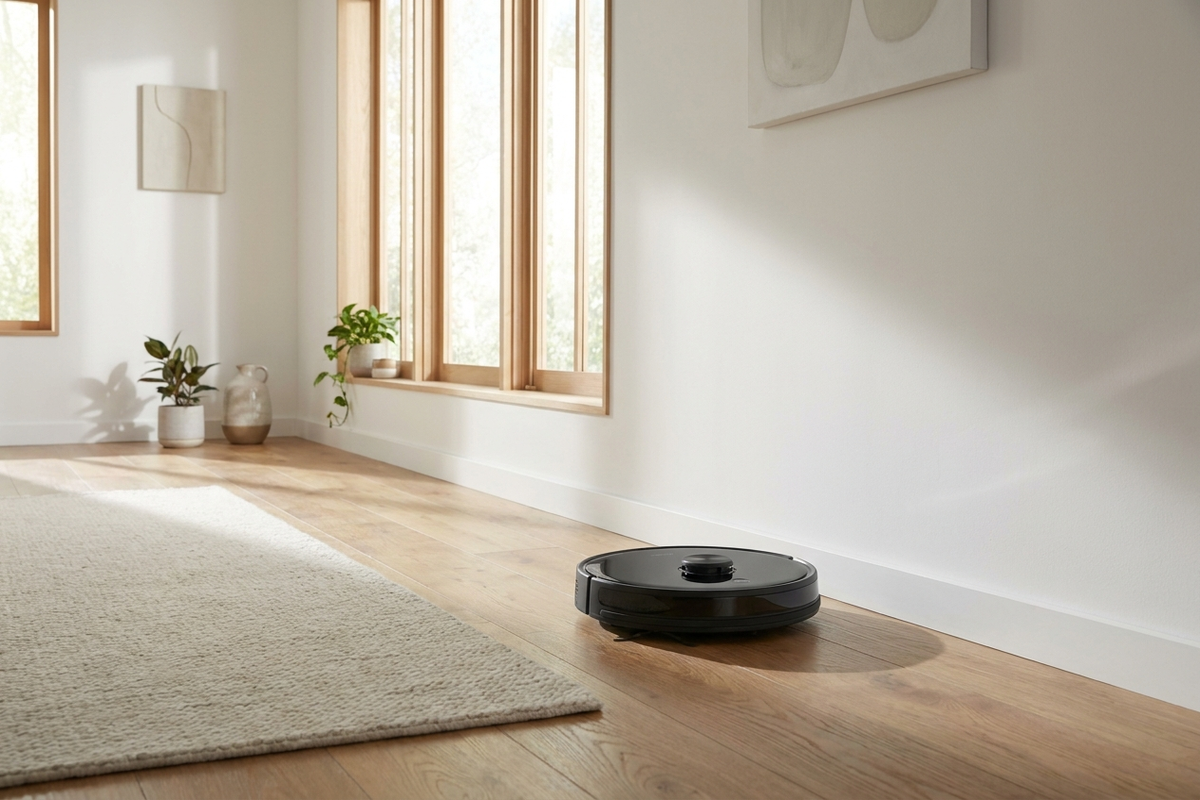
Roborock’s Saros 10 series is built around one headline feature: a side brush that physically extends outward on a jointed arm to reach corners and baseboards that a standard circular brush misses. It’s the kind of spec that looks great in a marketing render and raises an obvious question for anyone comparing a $1,000-plus robot vacuum against cheaper models that skip it — does the extendable arm meaningfully change how clean your edges get, or is it a feature most owners barely notice after the first week? We pulled apart manufacturer claims, independent lab testing, and aggregated owner feedback to find out.
As an Amazon Associate, Arekore earns from qualifying purchases. The Amazon product links in this article may include our affiliate tracking ID and may earn us a commission if you buy through them, at no additional cost to you. See our Links Policy for details on how we select products and how commissions do not influence our recommendations.
TL;DR / Quick Verdict
- The FlexiArm Riser side brush is a genuine functional upgrade, not just a marketing gimmick. Independent testing found it picks up debris within roughly 0.1 inches of a wall, and its arc-shaped, asymmetric design is built to hug baseboards rather than glance off them like a standard circular brush.
- Navigation quirks, not the arm itself, are the most common owner complaint. An analysis of Amazon reviews and Reddit threads found routing and re-mapping issues cited in roughly a third of documented negative experiences — a software issue, separate from the extendable-arm hardware.
- The Saros 10 (LiDAR) and Saros 10R (camera-based StarSight navigation) share the FlexiArm brush, so the choice between them comes down to navigation preference and price, not edge-cleaning capability.
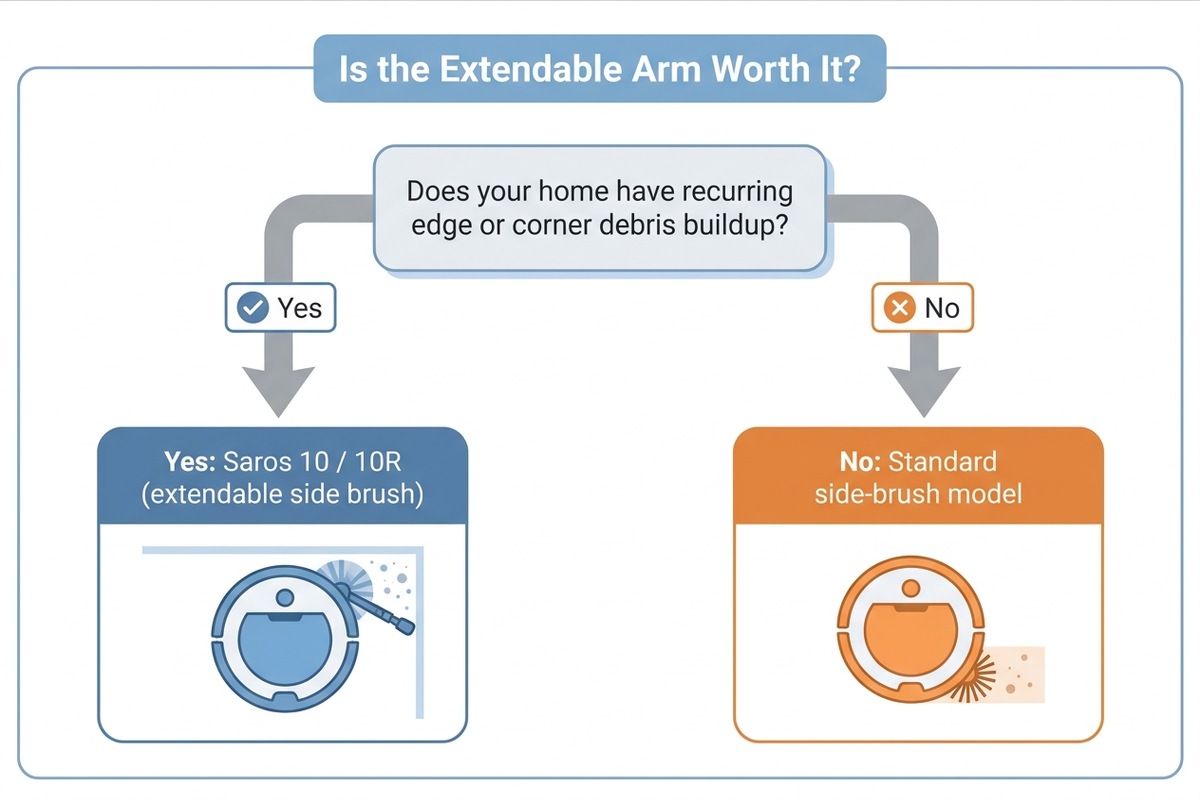
- The arm is worth paying for if edge and corner buildup is a recurring complaint in your household (pet hair along baseboards, kitchen crumbs in corners); it’s a weaker case if you mainly care about open-floor suction, where cheaper models perform similarly.
How We Reached These Conclusions (Methodology)
This is an editorial analysis, not a hands-on review; we did not personally test the products covered here. It synthesizes (a) independent lab testing and reporting from RTINGS, Vacuum Wars, TechRadar, and Tom’s Guide, (b) Roborock’s published manufacturer specifications for the Saros 10 and Saros 10R, and (c) aggregated owner sentiment drawn from a published analysis of Amazon reviews rated four stars or lower alongside Reddit discussion threads, which documented 108 distinct user-reported issues across 13 recurring categories. We did not personally test the products covered here, and we avoid citing a specific unverified Amazon review count, since exact totals fluctuate. Manufacturer figures (suction power in Pa, coverage claims) are labeled as such. Prices are amazon.com figures at the time of writing (August 2026) and change frequently, especially around sales events.
What the FlexiArm Riser Actually Does
Most robot vacuums use a single spinning side brush mounted at a fixed angle near one front corner. It flicks debris toward the main roller, but because it’s round and fixed in place, it typically leaves a thin strip of dust along straight walls and struggles in tight interior corners where the chassis itself can’t get close enough for the brush to reach.
Roborock’s FlexiArm Riser side brush, introduced across the Saros 10 series, is mounted on a small jointed arm that swings outward when the robot detects it’s tracking along an edge, then retracts when it isn’t needed — for example, when the robot is mopping only, or cleaning open floor space where a wider brush radius offers no benefit. The brush head itself uses an arc-shaped, asymmetric bristle pattern rather than a simple circle, which is designed to conform to the angle where a wall meets the floor instead of glancing off it.
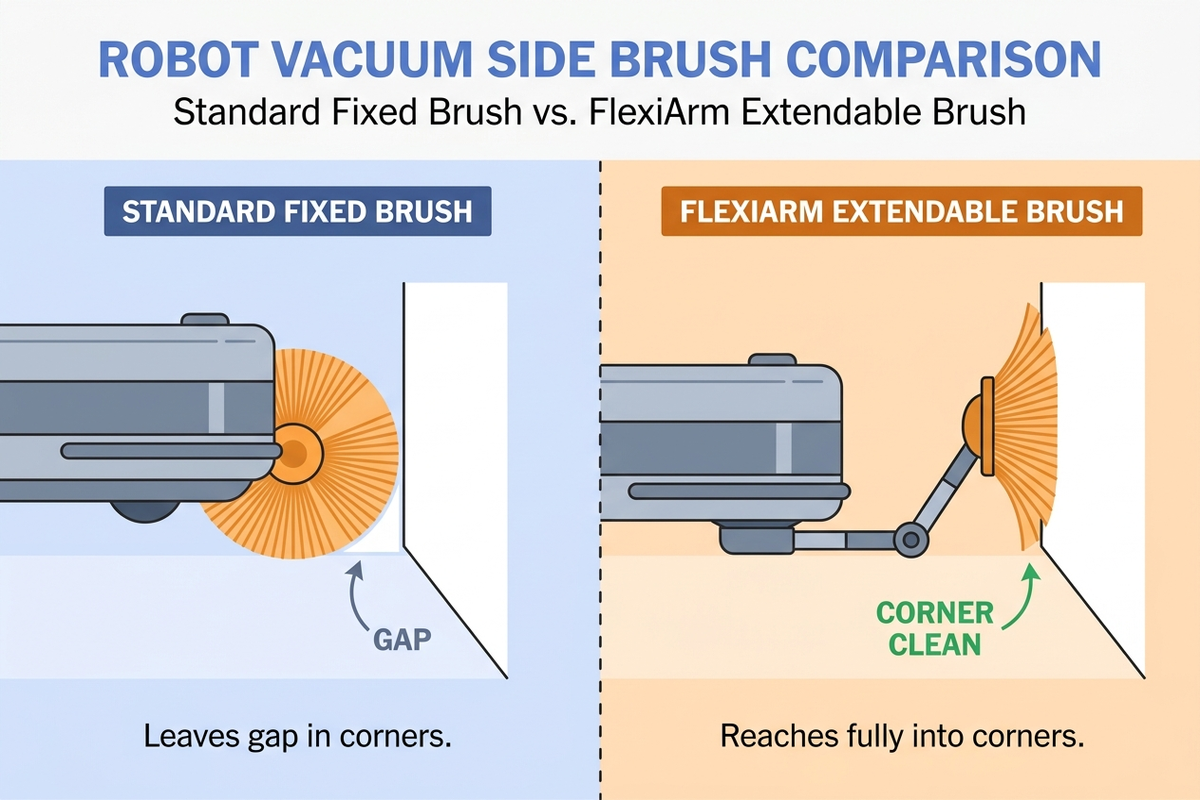
In independent testing, this design difference showed up in a concrete way: Vacuum Wars found the FlexiArm brush picked up scattered coffee grounds within about 0.1 inches of a wall during corner-cleaning tests, and reported the brush’s asymmetric shape hugging baseboards more consistently than the circular side brushes on competing flagship models. Roborock’s own marketing claims “100% edge and corner coverage,” which we treat as a manufacturer claim rather than an independently verified figure — but it’s directionally consistent with what third-party testers observed.
Competing manufacturers have converged on similar ideas from different angles. Ecovacs’ newer Deebot models use a V-shaped side brush intended to shake hair loose before it wraps around the bristles, and its TruEdge 2.0 system claims up to 99% corner coverage via a 3D edge sensor that adjusts brush behavior near recessed corners. Dreame’s X40 Ultra takes a different approach entirely, extending its mopping pad arm rather than the vacuum side brush, aimed specifically at wall-edge mopping rather than dry debris pickup. None of these are identical mechanisms, which makes direct like-for-like comparison difficult — but the industry-wide shift toward some form of extending or reshaped edge hardware suggests the fixed circular side brush is increasingly seen as the weak point of the category, not a solved problem.
Saros 10 vs. Saros 10R: The Arm Is the Same, the Navigation Isn’t
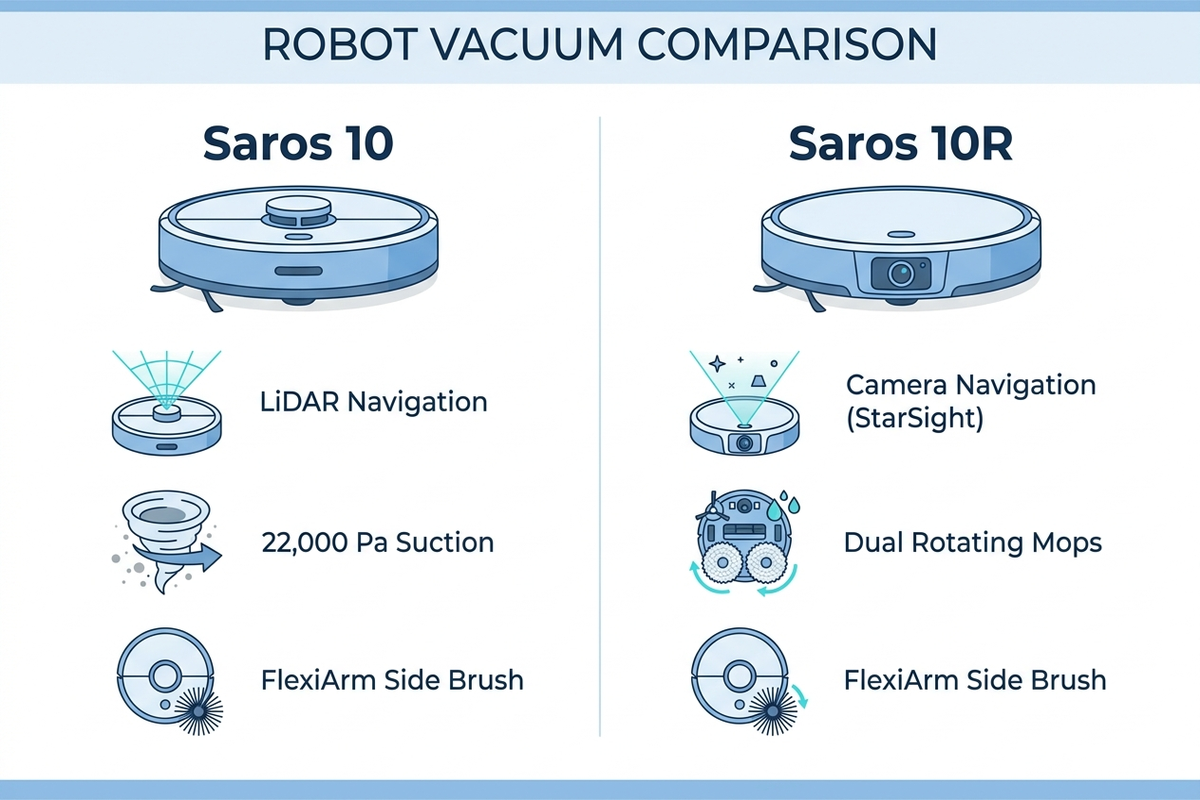
The Saros 10 and Saros 10R share the FlexiArm Riser side brush and roughly the same 3.14-inch ultra-slim chassis height, which lets both models reach under furniture that taller robot vacuums can’t clear. Where they diverge is navigation and a few mopping details:
- Saros 10 uses LiDAR navigation with a retractable LDS turret (Roborock calls it RetractSense) that lowers into the chassis to preserve the slim profile, paired with manufacturer-rated 22,000 Pa suction and VibraRise 4.0 sonic mopping.
- Saros 10R replaces the LiDAR turret with StarSight System 2.0, a combination of RGB cameras and time-of-flight sensors, paired with dual counter-rotating mop pads that RTINGS and other testers found more effective on dried-on stains than a single oscillating pad.
Vacuum Wars’ side-by-side testing found the Saros 10R’s dried-stain mopping score (103 points) far ahead of the Saros 10’s single oscillating pad (57 points), and separately awarded the 10R a perfect 24-of-24 score for obstacle avoidance; RTINGS’ own review also rates the Saros 10R as among the best robot vacuums it has tested, and Tom’s Guide recorded a 98.5% cleaning-performance result in its own test suite. Both models have carried the same roughly $1,599 manufacturer list price at launch, though the Saros 10R in particular has been discounted as low as $999 during sales events — worth checking before assuming list price is what you’ll actually pay.
What Owner Reviews Say the Arm Doesn’t Fix
The FlexiArm brush itself draws consistently positive mentions in aggregated owner feedback, but it isn’t the source of the category’s most common complaints. The Amazon-and-Reddit review analysis cited above found navigation and re-mapping quirks were the single most frequently mentioned issue, appearing in roughly 31% of the documented negative experiences — things like the robot losing its place mid-clean or requiring a re-map after furniture moves, which is a software and sensor-fusion issue unrelated to the side brush hardware. A smaller but recurring complaint involves pet hair: testers and owners both noted that while the FlexiArm brush improves edge coverage, long hair strands can still temporarily catch between the two halves of the Saros 10 series’ split main roller on the first pass over heavily shed carpet, usually clearing on a second pass.
That distinction matters for setting expectations: the extendable arm solves a specific, narrow problem — debris sitting flush against a wall or in a tight corner — and does it well by most independent accounts. It does not meaningfully change navigation reliability or main-brush hair handling, which are separate engineering problems tied to different components.
Comparison Table
Prices are amazon.com figures at the time of writing (August 2026) and fluctuate significantly around sales events.
| Model | ASIN | Navigation | Suction (mfr. claim) | Side brush | Best for |
|---|---|---|---|---|---|
| Roborock Saros 10 | B0DLH247PS | LiDAR (RetractSense) | 22,000 Pa | FlexiArm Riser (extendable) | Buyers who prefer LiDAR mapping consistency |
| Roborock Saros 10R | B0DHCJ571Z | StarSight camera + ToF | Up to 22,000 Pa (listing-dependent) | FlexiArm Riser (extendable) | Buyers prioritizing mopping performance and frequent sale pricing |
| Ecovacs Deebot T80 Omni | — | LiDAR | ~16,000 Pa | V-shaped fixed brush + TruEdge sensor | Buyers who want strong edge coverage at a lower price tier |
Both Saros 10-series models sit at the premium end of the category; the Ecovacs alternative in this table uses a fixed brush paired with sensor-based edge adjustment rather than a physically extending arm, illustrating that manufacturers are solving the same edge-cleaning problem with different hardware trade-offs at different price points.
Check the Roborock Saros 10R on Amazon · Check the Roborock Saros 10 on Amazon
Editorial Recommendation: Who Should Pay for the Extendable Arm
- If baseboard dust, pet hair along walls, or corner crumbs are a recurring frustration in your home: the FlexiArm brush addresses that specific problem better than a fixed circular brush, per independent testing — this is the strongest use case for paying the premium.
- If you mainly care about open-floor suction and don’t have much furniture-adjacent debris: cheaper models without an extending arm perform similarly on open floor space, and the arm’s benefit will be less noticeable day to day.
- Between the Saros 10 and Saros 10R specifically: choose the Saros 10 if you prefer LiDAR’s consistent mapping behavior; choose the Saros 10R if dried-stain mopping performance matters more to you and you can catch it during a sale, since it has historically dropped several hundred dollars below list price.
- If navigation reliability is your top priority over edge cleaning: the review data suggests routing quirks are a bigger recurring frustration for some owners than anything related to the side brush, so read recent reviews on the specific listing before buying.
Warranty
Roborock backs the Saros 10 series with a standard manufacturer warranty; always confirm current coverage terms and any extended-protection offers on the product listing, since terms are updated periodically and can vary by retailer and promotion.
Limitations of This Analysis
This analysis relies on third-party testing from RTINGS, Vacuum Wars, TechRadar, and Tom’s Guide, Roborock’s published manufacturer specifications, and a third-party synthesis of Amazon and Reddit owner feedback; we did not personally test either the Saros 10 or Saros 10R. Individual results vary with home layout, flooring type, and pet presence, and manufacturer-claimed figures like “100% edge and corner coverage” and specific suction ratings are not independently verified in every test we cite. The global robotic vacuum cleaner market was estimated at roughly $7 billion in 2026 by one industry research firm, with iRobot, Ecovacs, and Roborock together holding an estimated half of the category — these figures come from research firms whose methodologies differ, so we present them as directional context rather than precise figures specific to this one product line. Prices, ASIN availability, and warranty terms change frequently — always confirm current details on the product page before buying.
The Bottom Line
The FlexiArm Riser extendable side brush is one of the more substantive hardware differentiators in recent robot-vacuum design, backed by independent testing showing meaningfully better edge and corner pickup than a standard fixed brush. It is not, however, a fix for the category’s more common complaint of navigation and re-mapping quirks, which owner reviews suggest is a bigger day-to-day frustration for some buyers than anything related to the side brush. Whether the arm is worth the premium comes down to whether edge and corner debris is actually a problem in your home — check the current price and recent reviews on the specific listing before buying, and if you want a second opinion, paste the URL into Arekore and let the AI scan the reviews and price history for you in about five minutes.