Ring vs Arlo: Which Security Camera Wins in 2026?
Ring and Arlo are the two brands US shoppers land on most often when they search for a security camera, and for good reason: SafeHome.org’s 2026 Home Security Market Report finds 43% of US smart-camera owners name Ring their primary brand, while Arlo has built its identity as the image-quality leader for buyers willing to pay for it. But the two companies are not really selling the same thing. Ring ties nearly every useful feature to an Amazon-only ecosystem and a cloud subscription with no local-storage escape hatch. Arlo costs more per camera and per month at most tiers, but it works across Alexa, Google Home, Apple HomeKit, and SmartThings, and it offers a local-recording option Ring simply does not have. This guide compares the two brand-for-brand, tier-for-tier, using aggregated Amazon customer data, independent lab testing, and manufacturer specifications.
As an Amazon Associate, Arekore earns from qualifying purchases. The Amazon product links in this article may include our affiliate tracking ID and may earn us a commission if you buy through them, at no additional cost to you. See our Links Policy for details on how we select products and how commissions do not influence our recommendations.
TL;DR / Quick Verdict
- Best for Alexa households and widest accessory lineup: Ring. It is the dominant brand for a reason — chimes, floodlights, and an alarm panel with cellular backup all snap into one app, and its cameras are cheaper up front.
- Best video quality and the only one that avoids full ecosystem lock-in: Arlo. 2K–4K HDR video, and it is the only one of the two that works with Apple HomeKit, Google Home, and SmartThings, not just its own app.
- Only real local-storage option: Arlo, and only when paired with an Arlo SmartHub and a USB drive. Ring has zero local-storage path — every clip beyond a live look requires a Ring Protect subscription.
- Cheaper hardware, pricier long-run math for multi-camera homes: Ring’s cameras cost less individually, but its whole-home Protect Plus plan and Arlo’s unlimited-camera Secure plan land close enough in price that a 3+ camera household should run the three-year math, not just compare sticker prices.
- Ring Protect got more expensive in 2026: Amazon raised Ring Protect pricing 17–20% across every tier effective February 2026, narrowing the price gap with Arlo’s subscription.
How We Reached These Conclusions (Methodology)
This is an editorial analysis, not a hands-on review; we did not personally test the products covered here. This guide synthesizes three kinds of public information: (a) aggregated amazon.com customer reviews for current-generation Ring and Arlo cameras and doorbells, sampled in September 2026; (b) independent third-party testing and reporting from Consumer Reports and Tom’s Guide; and (c) manufacturer-published specifications for resolution, field of view, and subscription pricing. Where we cite a manufacturer figure — resolution, zoom, battery-life estimate — we label it as a manufacturer claim rather than an independently verified result. Prices are amazon.com figures at the time of writing and change frequently; treat every price below as approximate.
Technical Approach: Ecosystem Lock-In vs. Local Storage
The two brands make fundamentally different bets about who controls your footage and which smart-home platform you’re allowed to use.
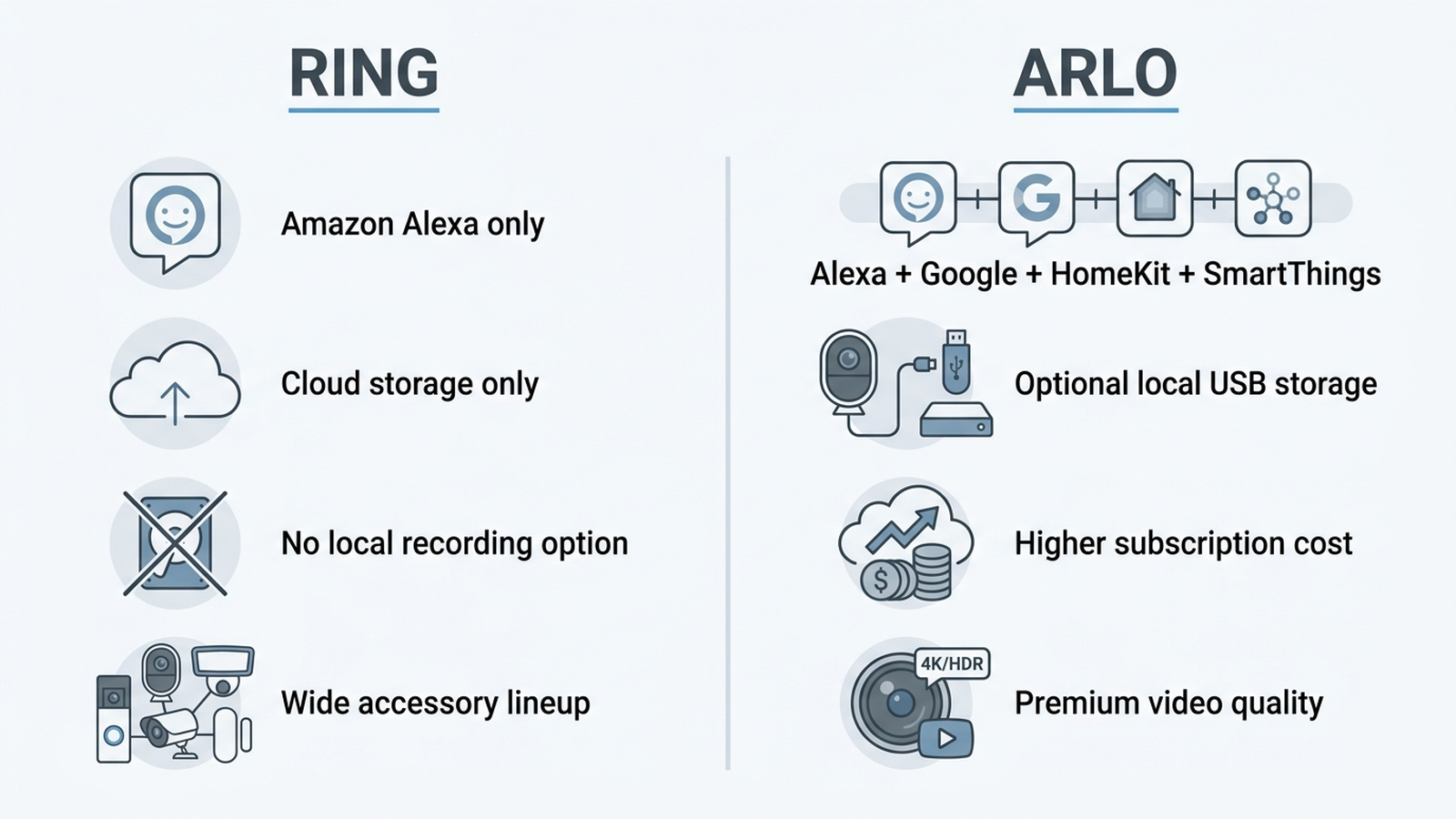
- Smart-home compatibility. Ring cameras and doorbells do not support Apple HomeKit and cannot be added to the Apple Home app or controlled with Siri — the platform is built exclusively around Amazon Alexa. Arlo, by contrast, supports Apple HomeKit, Google Assistant, Amazon Alexa, and Samsung SmartThings, though its HomeKit connection requires an active Arlo SmartHub or compatible base station rather than working directly camera-to-app.
- Local storage. Ring has no local-storage option at all: every clip beyond a live look routes through Amazon’s cloud, and any video history requires a Ring Protect subscription. Arlo’s SmartHub and compatible base stations accept a USB drive (up to 2TB) for local recording with no subscription required for basic clips — a real advantage for buyers who want to record without an ongoing bill, though Arlo’s smart alerts (person, package, vehicle detection) still require the paid Secure plan either way.
- Subscription-gated features. Both brands ship live view and basic motion alerts for free, but person detection, package alerts, and cloud video history sit behind a paid plan on both platforms — this is not a Ring-only limitation.
- Video resolution. Ring’s current flagship plug-in camera, the Outdoor Cam Pro, shoots Retinal 4K — actually ahead of Arlo’s mainstream Pro 5S line on paper resolution — but it requires a wall outlet; Ring’s comparable battery-powered cameras top out around 1080p–1536p HDR. Arlo’s Pro 5S ships 2K HDR with a wider 160-degree field of view across its full battery-powered lineup, which is why independent reviewers still rank Arlo ahead on image quality for wire-free installs specifically.
Manufacturer Deep Dive
Ring
Ring is Amazon’s answer to whole-home security, not just a camera — cameras, video doorbells, sensors, and an alarm panel with cellular backup and emergency dispatch through the Protect Pro tier all live in one app. That scale is reflected in SafeHome.org’s finding that 43% of US smart-camera owners name Ring their primary brand, well ahead of Google Nest and Arlo. Amazon raised Ring Protect subscription pricing 17–20% across every tier effective February 1, 2026: the single-camera Basic tier moved to $5.99/month, the whole-home Plus tier is $12/month, and the professional-monitoring Pro tier is $24/month, according to pricing trackers at SafeHome.org. Consumer Reports’ broader camera-testing program, which factors in roughly 70 data-security and privacy criteria alongside video quality and alert speed, notes that no current Ring model breaks into the very top of its overall ratings, though several individual Ring devices have scored well on CR’s data-security criteria specifically. On the doorbell side, Consumer Reports’ review of the Ring Battery Doorbell Pro (2nd Gen) — the brand’s current 4K flagship — found daytime video “about as sharp and clear” as the outlet has seen, with alerts arriving in an average of 1.5 seconds, but nighttime video rated “poor,” notably weaker than its daytime performance.
Arlo
Arlo markets itself as the image-quality leader, and independent testing largely backs that positioning. The Arlo Pro 5S shoots 2K HDR with a 160-degree diagonal field of view, color night vision, and an integrated spotlight, and Tom’s Guide’s own hands-on review called its video quality “excellent” while flagging the camera as a “pricey investment” overall. Arlo’s Secure subscription costs more than Ring’s at every comparable tier: $7.99–$9.99/month for a single camera, $17.99–$19.99/month for unlimited cameras, and a professional-monitoring Secure Premium tier around $29.99/month (or roughly $25/month billed annually). The tradeoff buyers get for that premium: platform flexibility (HomeKit, Google, Alexa, SmartThings) and the SmartHub local-storage option Ring doesn’t offer at all. Arlo’s own investor disclosures put annual recurring subscription revenue at roughly $365 million as of Q2 2026, up from around $300 million at the end of 2025, underscoring how central the Secure plan is to the company’s business model rather than an optional add-on.
Head-to-Head: Video Doorbells
Ring Battery Doorbell Pro (2nd Gen) is Ring’s current 4K flagship doorbell, adding 10x zoom and improved night vision over the original Battery Doorbell Pro. It lists at $249.99 (as of 2026-09-18) and, per Consumer Reports’ testing above, delivers sharp daytime video and fast 1.5-second alerts, with nighttime video as its clear weak point.
Check the Ring Battery Doorbell Pro on Amazon
Arlo Essential Video Doorbell (Wire-Free) shoots HD video with a 180-degree field of view, night vision, and two-way audio, and does not require a hub for basic operation. It typically sells for $99.99–$149.99 on Amazon (as of 2026-09-18), well under the Ring Battery Doorbell Pro, though at 1080p-class resolution rather than 4K.
Check the Arlo Essential Video Doorbell on Amazon
Verdict at this tier: the Ring Battery Doorbell Pro wins outright on resolution and daytime clarity, at roughly double the price. Budget-focused buyers who don’t need 4K get a serviceable, cheaper doorbell in the Arlo Essential — but should expect its 180-degree, HD-class video to look noticeably softer next to Ring’s flagship.
Head-to-Head: Outdoor Cameras
Ring Outdoor Cam Pro (Plug-In) is Ring’s current flagship standalone camera: Retinal 4K video, 10x enhanced zoom, and radar-powered 3D Motion Detection, at roughly $199.99 (as of 2026-09-18). The catch is in the name — it’s plug-in only, so it needs a nearby outlet, not a fully wire-free install.
Check the Ring Outdoor Cam Pro on Amazon
Arlo Pro 5S 2K ships 2K HDR video, a 160-degree field of view, color night vision, and an integrated spotlight, fully battery-powered with no outlet required. It lists at $249.99 but has been discounted as low as $89.99–$129.99 in recent Amazon pricing (as of 2026-09-18) — check the live listing, since Arlo’s street price swings widely.
Check the Arlo Pro 5S 2K on Amazon
Verdict at this tier: on paper resolution, Ring’s Outdoor Cam Pro now edges out Arlo’s Pro 5S — but only if you’re willing to run power to the mounting spot. For a fully wire-free install with a wider field of view, Arlo’s Pro 5S remains the more flexible pick, and it’s frequently the cheaper one once Amazon’s discounts kick in.
Customer Sentiment Synthesis
- False alerts. Aggregated owner feedback consistently reports Ring cameras triggering on shadows, headlights, and tree movement, especially in windy or high-traffic areas, more often than reviewers report for Arlo’s AI-based person/vehicle filtering.
- Battery life varies by model, not just brand. Some Ring doorbell models have been reported by outlets to outlast comparable Arlo models on a single charge under heavy use, while other Arlo owners report reduced battery life in cold weather — battery life claims from both brands are manufacturer estimates, and real-world results depend heavily on motion-event frequency and temperature at the mounting location.
- Data privacy is one factor, not the whole story, in why Ring trails at the very top of Consumer Reports’ ratings — its testing program weighs roughly 70 data-security and privacy criteria alongside video quality and response time, and individual Ring devices have scored well on the security criteria specifically even as the brand’s overall ratings stop short of the top spot.
- Net read: aggregated sentiment favors Arlo on AI alert accuracy and platform flexibility, and favors Ring on price, ecosystem breadth, and accessory selection — neither brand is complaint-free, and both gate their best features behind a subscription.
Comparison Table
Prices as of 2026-09-18 — Amazon frequently runs short-term discounts on both brands; check the live listing before buying.
| Product | Type | Resolution | Smart-home platforms | Local storage | Price |
|---|---|---|---|---|---|
| Ring Battery Doorbell Pro (2nd Gen) | Doorbell | 4K | Alexa only | None (cloud only) | ~$249.99 |
| Arlo Essential Video Doorbell (Wire-Free) | Doorbell | HD (1080p-class) | Alexa, Google, HomeKit* | None without SmartHub | ~$99.99–$149.99 |
| Ring Outdoor Cam Pro (Plug-In) | Outdoor camera | 4K | Alexa only | None (cloud only) | ~$199.99 |
| Arlo Pro 5S 2K | Outdoor camera | 2K HDR | Alexa, Google, HomeKit*, SmartThings | USB via SmartHub (optional) | ~$89.99–$249.99 |
*Requires an active Arlo SmartHub or compatible base station for Apple HomeKit connectivity.
How to Decide
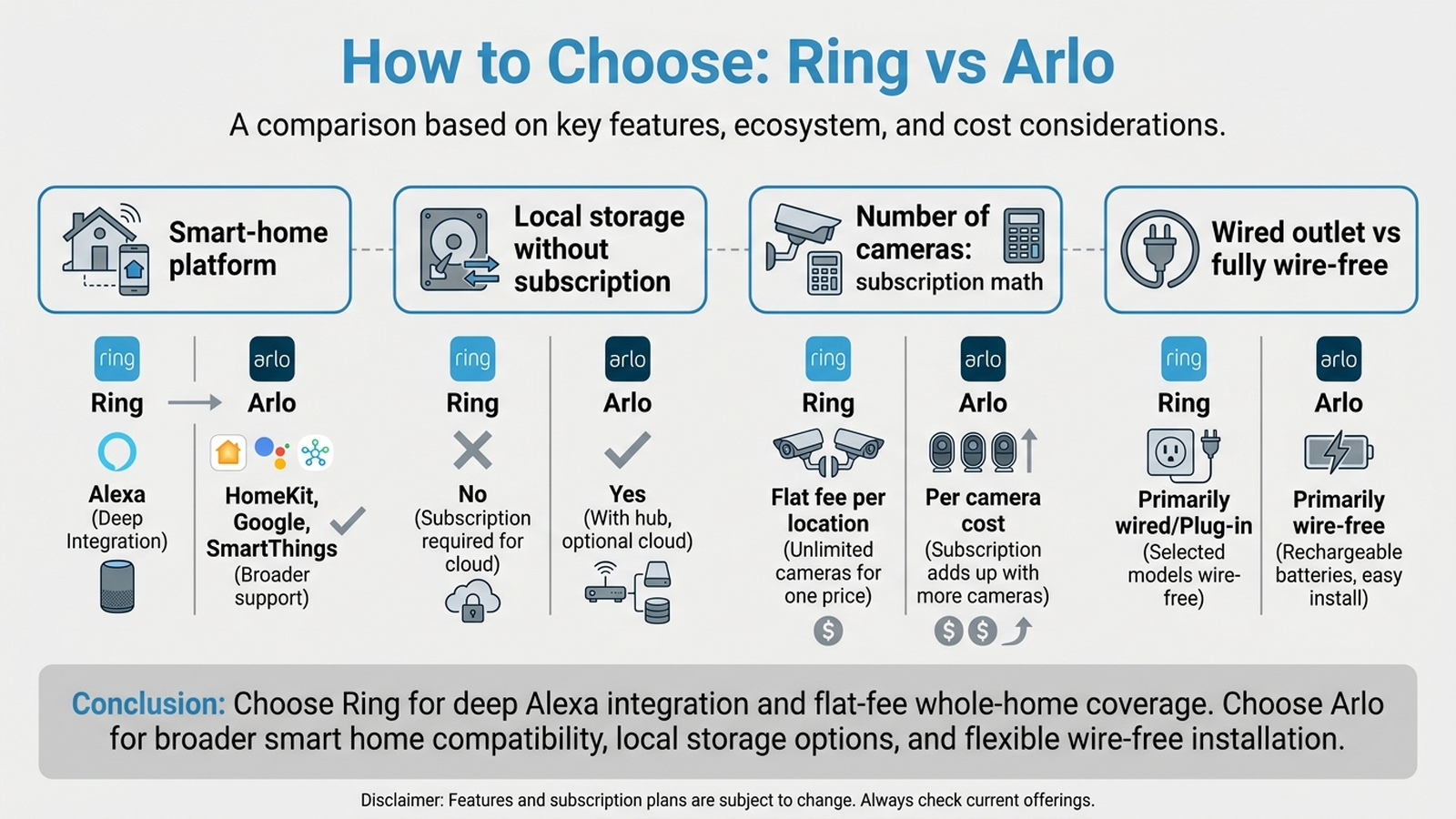
- You already use Alexa or other Ring devices: stay in the Ring ecosystem — chimes, floodlights, and Alexa routines all work together, and Ring’s hardware costs less up front.
- You use Apple HomeKit, Google Home, or SmartThings, or you don’t want to commit to Amazon: Arlo is the only one of the two that works with your platform at all.
- You want any local-recording option without a subscription: Arlo, paired with a SmartHub and USB drive, is the only path — Ring has none.
- You have 3+ cameras and want the lowest long-run cost: run the annual math on Ring Protect Plus ($12/month = $144/year) against Arlo’s unlimited-camera Secure plan ($17.99–$19.99/month = ~$216–$240/year) rather than comparing hardware price alone.
- Video quality in a fully wire-free install matters most: Arlo’s Pro 5S’s 160-degree field of view and battery-only design beat Ring’s comparable battery cameras; Ring’s 4K resolution advantage only applies to its plug-in models.
Decision Flowchart: Ecosystem, Storage, or Price
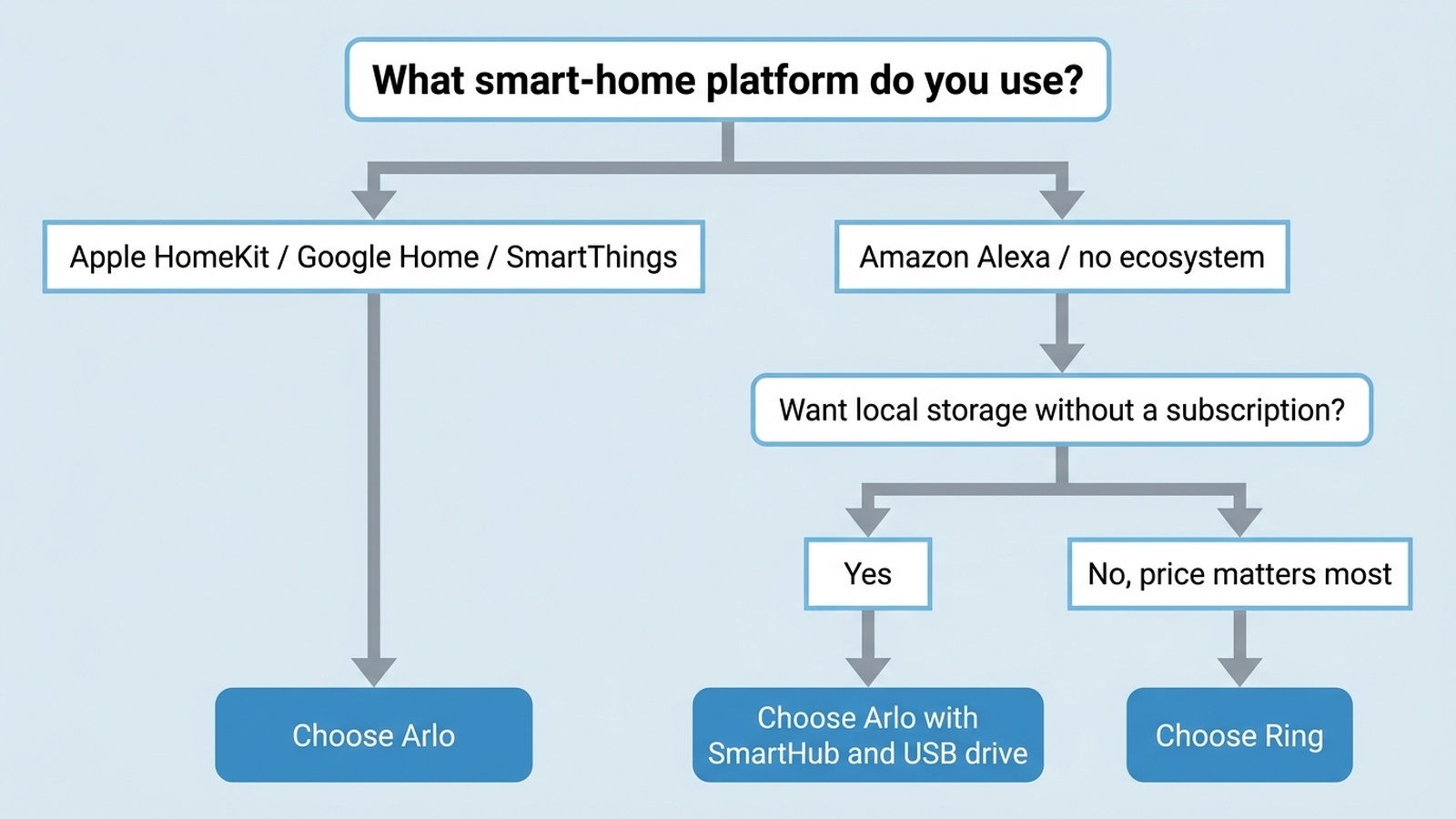
Start with the ecosystem question, since it’s the one constraint neither brand lets you work around after the fact: if you’re on Apple HomeKit, Google Home, or SmartThings, Ring is off the table entirely, and Arlo is your only option between these two brands. If you’re Alexa-based or platform-agnostic, move to the storage question — want a no-subscription local-recording path, even an optional one? Only Arlo’s SmartHub route offers it. If storage doesn’t matter and price does, Ring’s hardware is generally cheaper, and its single-camera Protect Basic plan undercuts Arlo at the low end; multi-camera households should still run the three-year subscription math before deciding on hardware price alone.
Warranty and Support
Both brands offer a standard 1-year limited hardware warranty in the US on new units (manufacturer terms; confirm at purchase), covering manufacturing defects but not battery degradation from normal use or weather-related damage beyond a camera’s rated IP rating. Neither brand bundles extended hardware coverage into its base subscription tier as of this writing. Resolution, zoom, and battery-life figures cited above are manufacturer specifications unless attributed to Consumer Reports or Tom’s Guide by name; actual battery life and alert responsiveness vary with motion-event frequency, temperature, and Wi-Fi signal strength at the mounting location.
Editorial Recommendation by Use Case
- You want the widest accessory ecosystem and the cheapest entry price, and you’re already on Alexa: the Ring Outdoor Cam Pro or Ring Battery Doorbell Pro.
- You’re on Apple HomeKit, Google Home, or SmartThings — or want the option to switch platforms later: Arlo is the only choice of these two brands, full stop.
- You want a local-recording option with no ongoing subscription: the Arlo Pro 5S paired with a SmartHub and USB drive.
- You have three or more cameras: compare Ring Protect Plus against Arlo’s unlimited-camera Secure plan on a three-year basis, not sticker price on the hardware.
- You care most about nighttime video quality on a doorbell specifically: treat both brands’ nighttime performance as a weak point relative to their daytime video, per Consumer Reports’ testing of the Ring Battery Doorbell Pro, and check current-model reviews before assuming either has fully solved it.
Limitations
This analysis relies on publicly available reviews, third-party test reporting from Consumer Reports and Tom’s Guide, and manufacturer specifications; we did not independently lab-test these units. Resolution, field-of-view, zoom, and battery-life figures are manufacturer claims unless specifically attributed to a named third-party tester. Subscription pricing for both Ring Protect and Arlo Secure has changed multiple times in the past year and may change again; confirm current tier pricing directly with each brand before subscribing. Prices and availability were accurate to our research at the time of writing and fluctuate frequently on Amazon — verify the current listing price before buying. Individual experience with false-alert rates, battery life, and Wi-Fi reliability varies with home layout, mounting location, and network conditions.
Before you buy either brand’s camera, it pays to check that a listing’s reviews are genuine and that a sale price is an actual discount rather than an inflated “was” price. That is exactly what Arekore does: paste the Amazon URL and our AI analyzes review authenticity, surfaces the most useful low-star feedback, and compares pricing in about five minutes — so you end up with the security camera that actually fits your home and your smart-home platform, not just the one with the biggest brand name on the box.