Best Budget Soundbars for NFL Sunday 2026: Under $150
The single most common complaint about watching NFL football on a modern flat-screen TV has nothing to do with picture quality. It is that you cannot hear the announcer over the crowd. Thin flat-panel TVs pack their speakers into a chassis just an inch or two deep, which makes them physically incapable of reproducing a clean vocal frequency range once a broadcast mix pushes crowd noise and stadium ambiance louder for effect — a pattern that gets worse, not better, during the exact moments (a two-minute drive, a replay challenge) when you most want to hear the call. A budget soundbar under $150 fixes most of this without a full home-theater installation. This guide compares three of the most-discussed sub-$150 options on Amazon — the Sony HT-S100F, the Vizio V21x-J8, and the Hisense HS2100 — using aggregated review data, independent lab testing, and manufacturer specifications.
As an Amazon Associate, Arekore earns from qualifying purchases. The Amazon product links in this article may include our affiliate tracking ID and may earn us a commission if you buy through them, at no additional cost to you. See our Links Policy for details on how we select products and how commissions do not influence our recommendations.
TL;DR / Quick Verdict
- Simplest setup, no subwoofer: the Sony HT-S100F — a single 2.0-channel bar with a built-in bass reflex speaker and Sony’s S-Force front surround processing. No second box to place, and independent reviewers consistently rate it the best all-around cheap soundbar.
- Best value with bass for big hits: the Vizio V21x-J8 — a 2.1-channel setup with a wireless subwoofer, DTS Virtual:X, and one of the widest connection sets in this price range.
- Most EQ presets for sports dialogue: the Hisense HS2100 — a 2.1-channel bar with a wireless subwoofer and six dedicated EQ modes, a rare feature count below $150.
- The real choice: decide whether you want the fewest boxes to place (Sony), the best combination of bass and value (Vizio), or the most tunable dialogue and sports presets (Hisense).
How We Reached These Conclusions (Methodology)
This is an editorial analysis, not a hands-on review. We did not personally test the products covered here. This guide synthesizes three kinds of public information: (a) aggregated amazon.com customer ratings and the substance of low-star reviews, sampled in August 2026; (b) independent third-party testing and reporting from RTINGS, Tom’s Guide, and What Hi-Fi; and (c) manufacturer specifications. Where we cite a manufacturer figure — a wattage rating, an EQ mode count, or a Bluetooth version — we label it as a manufacturer claim rather than an independently verified result. Prices are amazon.com figures at the time of writing and fluctuate, especially in the weeks around the NFL season opener and Black Friday.
Why TV Speakers Struggle With Football Specifically
Sports broadcasts intentionally boost crowd noise and stadium ambiance to make the game feel immersive at home, which means play-by-play commentary can get buried in the mix — especially during a big play, when the crowd noise spikes right as the announcer needs to be heard clearly. A built-in TV speaker, typically two small drivers firing downward or backward out of a thin chassis, has no dedicated channel to isolate a human voice from that mix. Independent audio outlets that test dialogue clarity consistently point to the same fix: a soundbar with a dedicated center channel and a sports or dialogue-enhancement EQ mode, which processes the mix to boost vocal frequencies rather than simply raising overall volume. Turning the TV up does not solve this — it makes the crowd noise louder too. All three soundbars in this guide include some form of dialogue-focused audio mode for exactly this reason.
1. First, Decide What Matters Most to You
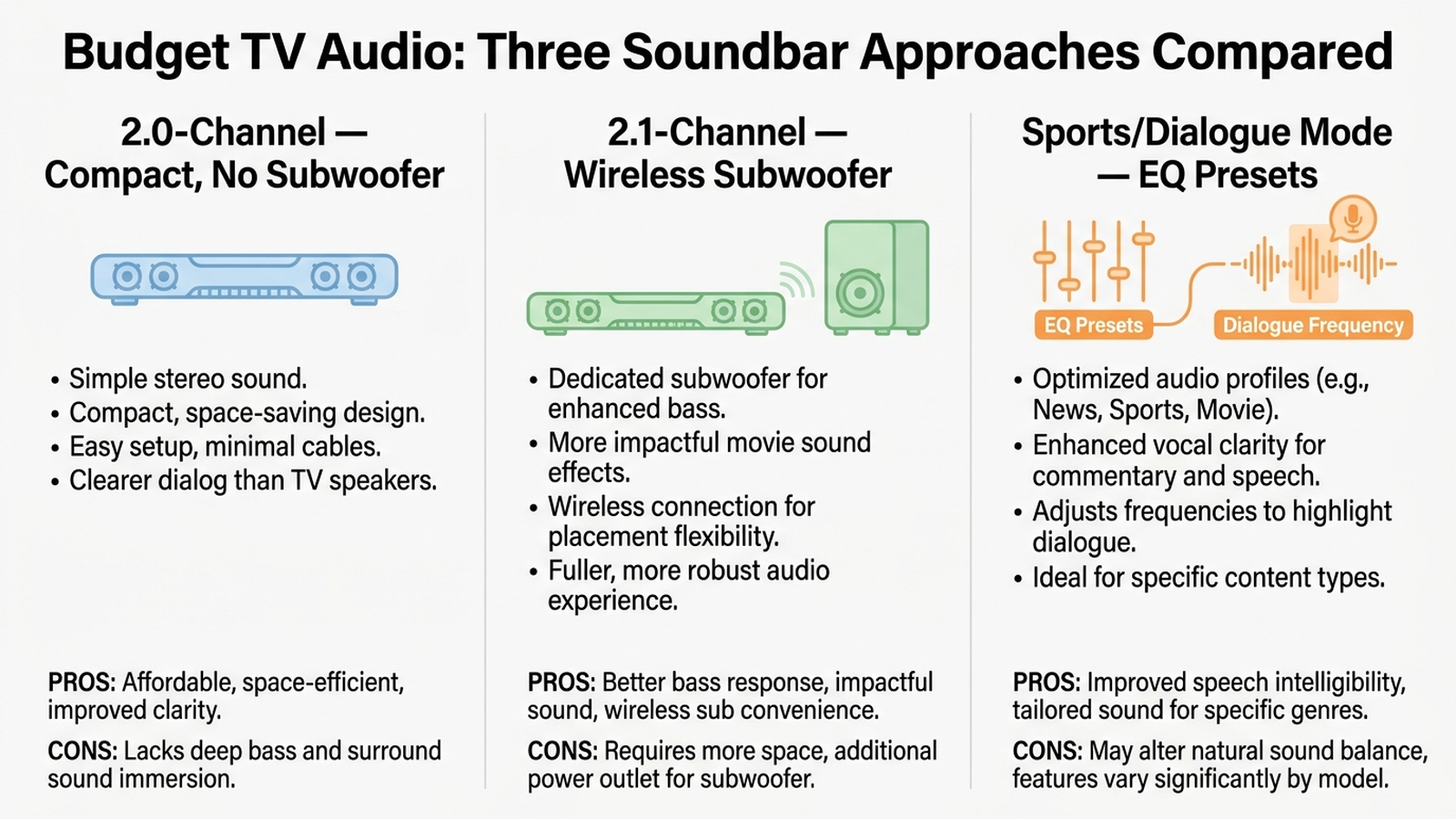
- Do you want the fewest boxes to place, with no subwoofer to find a spot for? The Sony HT-S100F is a single bar with an integrated bass reflex speaker — plug it in below the TV and you are done.
- Do you want real low-end punch for big hits and crowd roars, and don’t mind placing a second wireless box? The Vizio V21x-J8 pairs a soundbar with a wireless subwoofer and DTS Virtual:X surround processing.
- Do you want the most control over the sound profile for different kinds of games or rooms? The Hisense HS2100 ships with six EQ presets and a wireless subwoofer, giving you more tuning options than either rival.
A useful rule of thumb from the aggregated reviews: any of these three is a meaningful upgrade over stock TV speakers for dialogue clarity alone. Above that baseline, you are mostly paying for simplicity (Sony), bass and value (Vizio), or EQ flexibility (Hisense).
2. The Technology: Channels, Subwoofers, and Dialogue Modes
- Channel count. A “2.0” bar (Sony HT-S100F) has left and right drivers only, plus an internal bass reflex port for some low end. A “2.1” bar (Vizio, Hisense) adds a dedicated wireless subwoofer box for real bass extension — useful for stadium roars and kickoff hits, less useful if you live in an apartment with thin walls.
- Virtual surround processing. Sony’s S-Force Front Surround and DTS’s Virtual:X (used by both Vizio and Hisense) simulate a wider soundstage using psychoacoustic processing rather than physical rear speakers — a real but modest effect, not a substitute for a true surround setup.
- Dialogue and sports EQ modes. This is the single most relevant spec for football viewing. The Hisense HS2100 ships with six EQ modes (a manufacturer figure) that reviewers note include a dialogue-forward preset useful for commentary-heavy content; the Vizio and Sony bars offer fewer presets but still include some form of dialogue enhancement.
- Connectivity. All three connect over HDMI ARC (the simplest option — one cable, TV remote controls volume) or optical, plus Bluetooth for streaming audio from a phone during pregame or halftime.
Bottom line: if dialogue clarity during commentary is your single biggest complaint, prioritize the EQ mode count and dialogue-enhancement feature over raw wattage.
3. Comparison Table
Prices are amazon.com figures at the time of writing (August 2026) and fluctuate, especially around the NFL season opener in September.
| Model | ASIN | Approx. price | Channels | Subwoofer | Surround processing | EQ modes | Connectivity |
|---|---|---|---|---|---|---|---|
| Sony HT-S100F | B07F6JSM7N | ~$98–$158 | 2.0 | Built-in bass reflex (no external sub) | S-Force Front Surround | Standard/Movie/Music (manufacturer) | HDMI ARC, optical, Bluetooth, USB |
| Vizio V21x-J8 | B09HMRJRH7 | ~$120–$150 | 2.1 | Wireless, external | DTS Virtual:X | Standard sound modes | HDMI ARC, optical, Bluetooth |
| Hisense HS2100 | B0C5476K3K | ~$100–$120 | 2.1 | Wireless, external | DTS Virtual:X | 6 EQ modes (manufacturer) | HDMI ARC, optical, Bluetooth 5.3 (manufacturer), USB |
4. Sony HT-S100F — The Simplest Setup
The Sony HT-S100F is the answer for anyone who wants a single, no-fuss upgrade over TV speakers with nothing extra to place or wire. It is a 2.0-channel bar with a built-in bass reflex speaker, an integrated tweeter for clearer high frequencies, and Sony’s S-Force Front Surround processing to widen the soundstage without rear speakers. It connects over HDMI ARC, optical, USB, or Bluetooth, and typically lists around $158 but is frequently discounted well below $100.
RTINGS and Tom’s Guide have both, in various testing rounds, called out this class of Sony entry-level bar as a strong cheap all-rounder, citing clear dialogue and surprisingly present bass for a bar with no external subwoofer. The trade-off is exactly what you would expect from a 2.0 design: it will not deliver the same low-end rumble as a bar with a physical subwoofer, so a stadium crowd roar or a big hit will sound clean but not chest-thumping.
Aggregated sentiment: consistently high ratings among budget soundbars, with reviewers frequently mentioning easy setup and a noticeable dialogue-clarity improvement over TV speakers. The most common complaints involve limited bass depth and a lack of a dedicated sports or dialogue EQ button.
Check the Sony HT-S100F on Amazon
5. Vizio V21x-J8 — The Value-and-Bass Pick
The Vizio V21x-J8 is a 2.1-channel setup that pairs the soundbar with a wireless subwoofer, giving it noticeably more low-end weight than the Sony for the kind of low-frequency stadium ambiance and hit sounds that come with an NFL broadcast. It supports DTS Virtual:X for a wider virtual soundstage, connects over HDMI ARC, optical, or Bluetooth, and typically sits right around the $150 mark at full price — often discounted into the $120s.
Vizio’s V-Series has built a reputation, echoed across budget-audio roundups, as an entry point that delivers more bass and impact than its price suggests, at the cost of a plainer feature set (no companion app, fewer EQ presets) than pricier bars. For a football-watching setup specifically, the external subwoofer is the practical advantage: crowd noise and on-field impact sounds get real low-end presence that a bar-only design can’t match.
Aggregated sentiment: strong ratings for the price, with reviewers highlighting the wireless subwoofer’s bass output and easy HDMI ARC setup. Recurring criticisms mention the remote’s limited controls and a lack of a distinct sports or dialogue mode compared to the Hisense.
Check the Vizio V21x-J8 on Amazon
6. Hisense HS2100 — The Most Tunable for Sports
The Hisense HS2100 is the pick for viewers who want to actively tune the sound rather than accept one fixed profile. It is a 2.1-channel bar with a wireless subwoofer, DTS Virtual:X, Bluetooth 5.3 (a manufacturer figure), and — the standout spec — six EQ modes (a manufacturer figure), which reviewers note include presets useful for boosting dialogue over ambient and crowd noise. It typically lists around $119.99, making it the least expensive of the three at full price.
RTINGS’ review of the HS2100 noted it punches above its price for a 2.1 system, and consumer coverage from outlets like Homes & Gardens has similarly highlighted its room-filling sound and EQ flexibility relative to cost. The trade-offs are typical of the budget tier: build quality is plastic-forward, and the six-mode EQ system, while more flexible than rivals, still relies on fixed presets rather than a true parametric equalizer.
Aggregated sentiment: favorable ratings for the price point, with reviewers frequently citing the EQ modes and wireless subwoofer bass as standout value. The most common complaints are a basic remote and app-free operation compared to pricier smart soundbars.
Check the Hisense HS2100 on Amazon
7. Setup Tips for Game Day
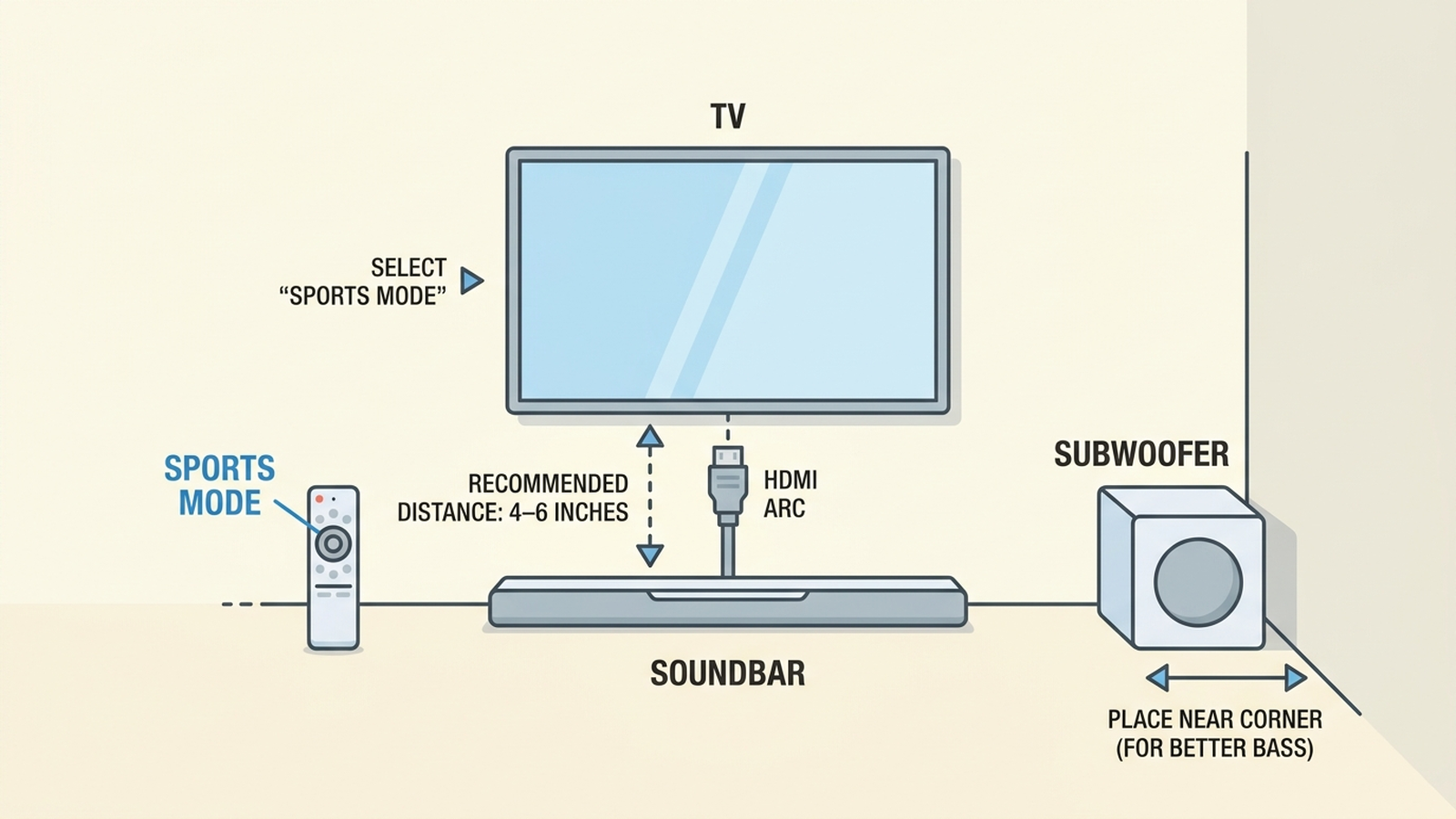
- Use HDMI ARC, not optical, if your TV supports it. ARC lets your existing TV remote control the soundbar’s volume and can pass through more audio formats — no extra remote to juggle during a game.
- Center the bar directly below the TV, not off to one side. Off-axis placement is the single most common setup mistake reviewers flag, and it noticeably weakens dialogue clarity from a seated position.
- Select a sports or dialogue-forward EQ preset if the bar offers one (the Hisense’s six-mode system is the most flexible here), rather than simply raising the volume when commentary gets buried in crowd noise.
- Place a wireless subwoofer near a wall or corner, which reinforces bass output, but keep it a few feet from the seating area so kickoffs and crowd noise don’t overwhelm the room in a small apartment.
8. How to Choose: A Decision Flowchart
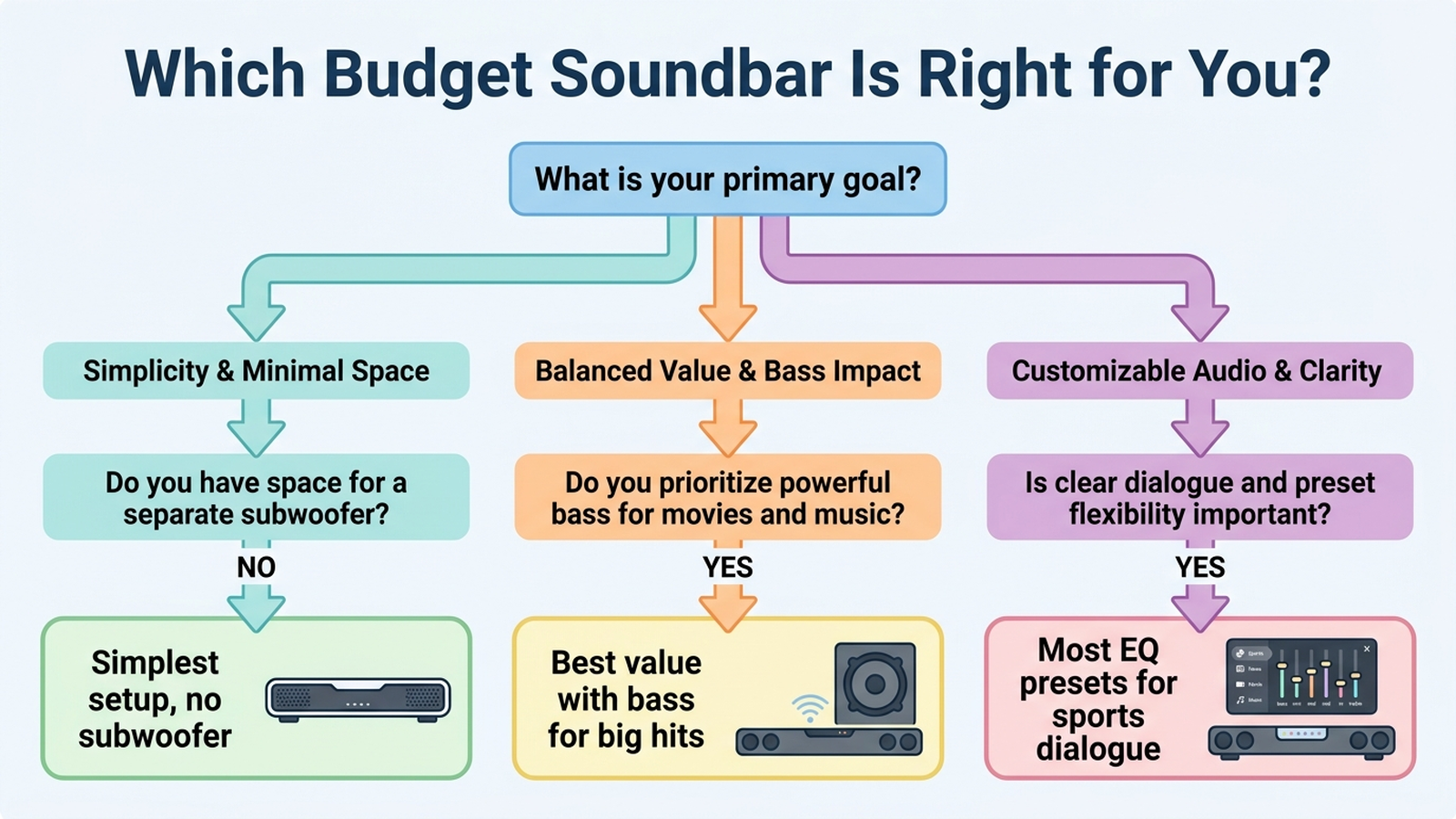
- Want the fewest boxes to place? The Sony HT-S100F has no external subwoofer to find a spot for.
- Want real bass for crowd noise and big hits without a big price jump? The Vizio V21x-J8’s wireless subwoofer is the value play.
- Want to tune the sound for different games or rooms? The Hisense HS2100’s six EQ modes give you the most control.
9. Editorial Recommendations by Use Case
- Best for a simple, one-box upgrade: Sony HT-S100F. No subwoofer to place, strong dialogue clarity, and frequently available well under its $158 list price.
- Best value with real bass: Vizio V21x-J8. The wireless subwoofer adds low-end weight for crowd noise and impacts without a big price jump over the Sony.
- Best for tuning the sound to different games or rooms: Hisense HS2100. Six EQ modes and a wireless subwoofer at the lowest typical price of the three.
- Best for a small apartment or thin-walled unit: Sony HT-S100F, since it has no external subwoofer to manage or that might bother neighbors.
10. Warranty and Longevity
All three brands offer a standard one-year limited warranty typical of the budget soundbar category in the US (confirm current terms on each product page, as they occasionally change). Longevity in this price tier comes down mostly to build quality and connector wear rather than driver failure — HDMI and optical ports are the most common failure point cited in low-star reviews across the category, so handle cables gently and avoid repeatedly unplugging from the port itself.
11. Limitations of This Analysis
This analysis relies on publicly available reviews, independent third-party tests, and manufacturer specifications; we did not personally test these soundbars, and individual experience varies with room size, TV audio settings, and unit-to-unit variance. EQ mode counts, wattage, and Bluetooth version figures are manufacturer claims and are labeled as such rather than independently verified here. Market-size and viewership statistics come from third-party research firms and broadcasters whose methodologies differ, so we present them as directional. Prices, ASIN availability, and warranty terms change frequently and often dip around the NFL season opener and Black Friday — always confirm the current price and configuration on the product page before buying.
The Bottom Line
Any of these three sub-$150 soundbars will fix the single biggest complaint about watching football on a modern flat-screen TV: not being able to hear the announcer over the crowd. Choose the Sony HT-S100F if you want the simplest possible upgrade, the Vizio V21x-J8 if you want real bass without a big price jump, and the Hisense HS2100 if you want the most EQ flexibility at the lowest price. Whichever you lean toward, verify the exact configuration and current price before you check out — and if you want a second opinion on a specific listing, paste the URL into Arekore and let the AI scan the reviews and price history for you in about five minutes.