Nanit Pro Review 2026: Is the Subscription Worth It?

The Nanit Pro has been Wirecutter’s top pick for Wi-Fi baby monitors for several years running, and at $289.99-$299 for the camera and wall mount, it isn’t cheap. What makes the pricing harder to evaluate is that Nanit sells the hardware separately from its software: the camera itself does one set of things for free, and a tiered subscription called Nanit Insights unlocks another set entirely. Buyers consistently report confusion about where that line falls, and a recurring complaint is that some features marketed as part of the camera experience turn out to require an active plan. We pulled together Nanit’s own specs, independent test coverage, and aggregated owner sentiment to map exactly what’s free, what costs extra, and whether the subscription is worth paying for.
As an Amazon Associate, Arekore earns from qualifying purchases. The Amazon product links in this article include our affiliate tracking ID and may earn us a commission if you buy through them, at no additional cost to you. See our Links Policy for details on how we select products and how commissions do not influence our recommendations.
TL;DR / Quick Verdict
- The core monitor works fully without a subscription. Live 1080p video, sound/motion/cry notifications, two-way audio, temperature and humidity readings, a nightlight, and access for two caregivers are all included with no recurring fee.
- The paid Nanit Insights tiers add sleep analytics, not basic monitoring. Sleep (free for 3 months, then under $10/month), Memories ($120/year), and Milestones ($300/year) layer on sleep-pattern tracking, video highlight reels, and growth milestones — none of which are required to simply watch your baby.
- Independent testing rates the camera itself highly. Wirecutter calls the Nanit the most security-conscious Wi-Fi monitor it tested, with sharp 1080p day-and-night video and a well-designed app.
- The most common complaint isn’t about video quality — it’s about account limits. Aggregated Amazon review data and Reddit threads both describe added-caregiver access and some setup steps being gated behind a plan in ways that don’t match the “no subscription required” marketing.
How We Reached These Conclusions (Methodology)
This is an editorial analysis, not a hands-on review; we did not personally test the product. It synthesizes (a) manufacturer specifications and pricing published directly by Nanit, (b) independent third-party testing and coverage from Wirecutter and other parenting-tech outlets that have evaluated the Nanit Pro against competing Wi-Fi and non-Wi-Fi monitors, and (c) aggregated owner sentiment from Amazon’s product listing, where the Nanit Pro carries roughly 4.6 out of 5 stars across more than 4,700 ratings as of this writing, along with recurring themes identified across multiple independent review roundups and parent-forum discussions. Manufacturer-published figures (camera resolution, Wi-Fi requirements, subscription pricing) are labeled as such. Prices are amazon.com and nanit.com figures at the time of writing (November 2026) and change frequently, especially around Black Friday and Cyber Monday.
What the Nanit Pro Actually Does
The Nanit Pro is a 1080p Wi-Fi camera designed to mount overhead — on a wall or a floor stand — so it looks straight down into the crib, a different angle from most baby monitors that sit at crib-rail height. Nanit’s own spec sheet lists the camera body at 4.2” x 3.3” x 8”, support for up to six cameras on one account, two-way talk, digital zoom, split-screen for multi-camera households, a nightlight, and a sensor-free Breathing Band — a small fabric band that clips to a onesie and uses motion, not a wearable sensor on the baby’s skin, to estimate breathing-related movement. A small band for ages 0-3 months ships in the box; the larger band for 3-24 months costs roughly $25 extra.
Every one of those features — live video, notifications, two-way audio, room temperature and humidity, the nightlight, and support for two caregiver accounts — works without any paid plan, according to Nanit’s own published feature breakdown. What requires the Nanit Insights subscription is the layer built on top of that raw video and motion data: sleep-pattern graphs, overnight sleep scores, time-lapse “Memories” highlight reels, and milestone tracking tied to your baby’s age.
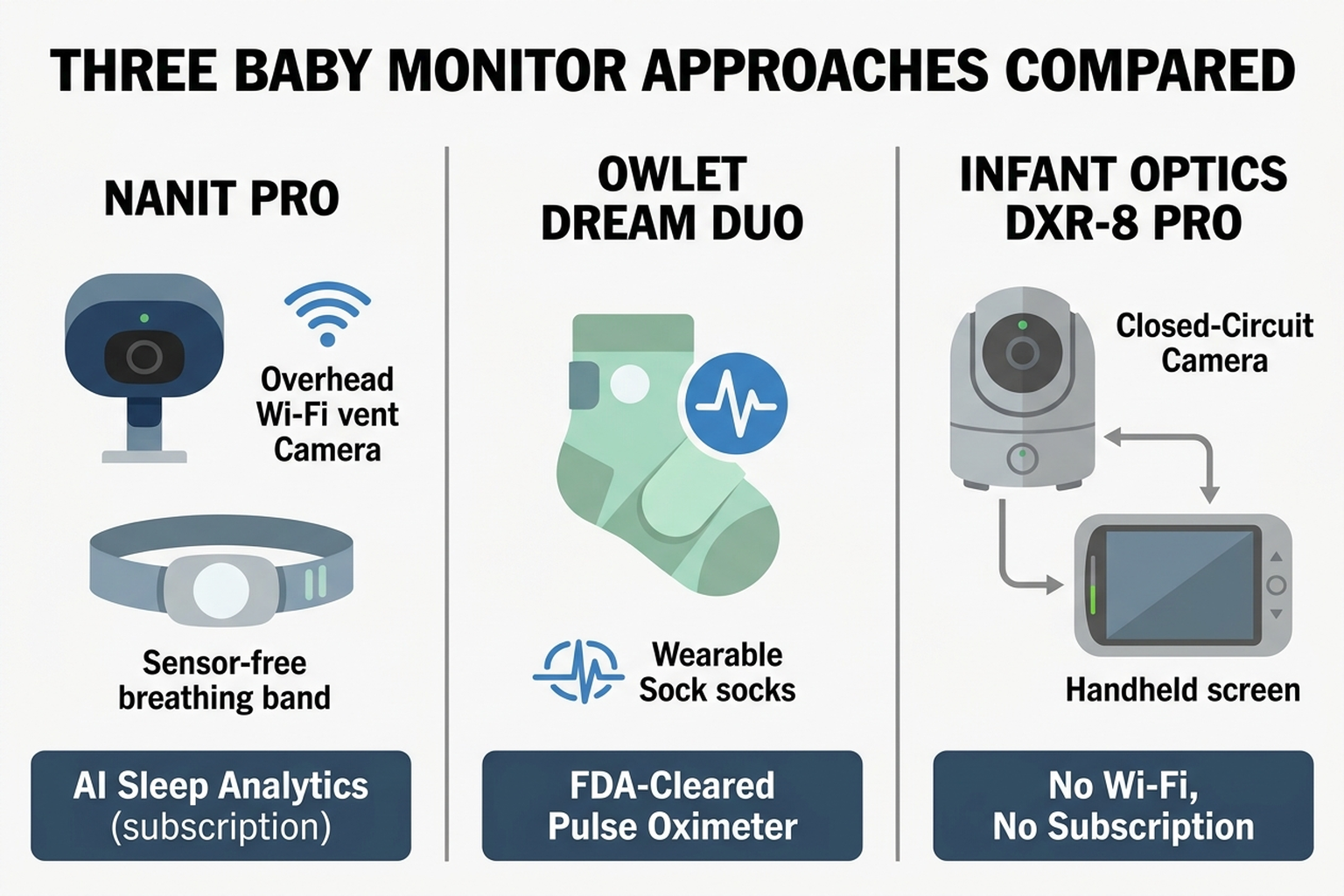
Technical Approach: Video Analytics vs. Wearable Sensor vs. Closed-Circuit
- Nanit Pro: An overhead Wi-Fi camera paired with a motion-sensing Breathing Band. Sleep tracking is inferred from video and the band’s movement data, processed through Nanit’s app and cloud account — which is why the richer analytics live behind a subscription rather than on the camera itself.
- Owlet Dream Duo: Pairs an Owlet Cam with the Dream Sock, a wearable pulse oximeter that directly measures pulse rate and blood oxygen. The Dream Sock received FDA De Novo clearance as an over-the-counter infant pulse oximeter in November 2023, a direct health-measurement claim that Nanit’s video-based approach does not make.
- Infant Optics DXR-8 Pro: A closed-circuit, non-Wi-Fi monitor that transmits directly from camera to a dedicated parent unit over a roughly 1,000-foot radio link. There’s no app, no cloud account, and no subscription of any kind — the trade-off is no sleep analytics and no remote access away from home.
- Practical distinction: Nanit’s approach is the only one of the three that turns raw monitoring into longitudinal sleep data over weeks and months, but that same cloud-based design is what creates a recurring software cost. The Infant Optics and base-tier Owlet hardware both work the day you buy them with zero ongoing fees, just with a narrower feature set.
The Subscription Problem
This is the part of Nanit ownership that doesn’t show up until after the free trial ends. Nanit Insights has three tiers, all billed annually: Sleep (free for the first three months, then under $10/month), Memories at $120/year, and Milestones at $300/year. None of them are required to use the camera as a monitor — Nanit’s own marketing and spec sheet both confirm live video, notifications, and two-way audio work without a plan.
Where the friction shows up is in the gap between that marketing claim and what some owners report experiencing. Aggregated Amazon review data and independent coverage both describe a recurring pattern: the free tier covers two caregiver phones, and adding a third caregiver’s access requires a paid plan. Multiple reviewers also describe specific setup or activation steps that, despite the “no subscription required to monitor” messaging, effectively nudge or require a plan to get through onboarding. Separately, a number of owners report technical complaints — Wi-Fi disconnects, laggy or missing audio, and app instability — that are independent of the subscription question but compound the frustration when they occur during a paid trial period.
None of this means the subscription has no value. The Sleep tier’s overnight sleep-score tracking and Memories’ automatically-generated video highlight reels are the features parents cite most often as worth paying for, particularly in the first year when sleep patterns change rapidly. The practical issue is less “is the subscription worth it in isolation” and more “the free-tier boundary is drawn in a place that surprises some buyers after the trial ends.”
How to Use the Nanit Pro
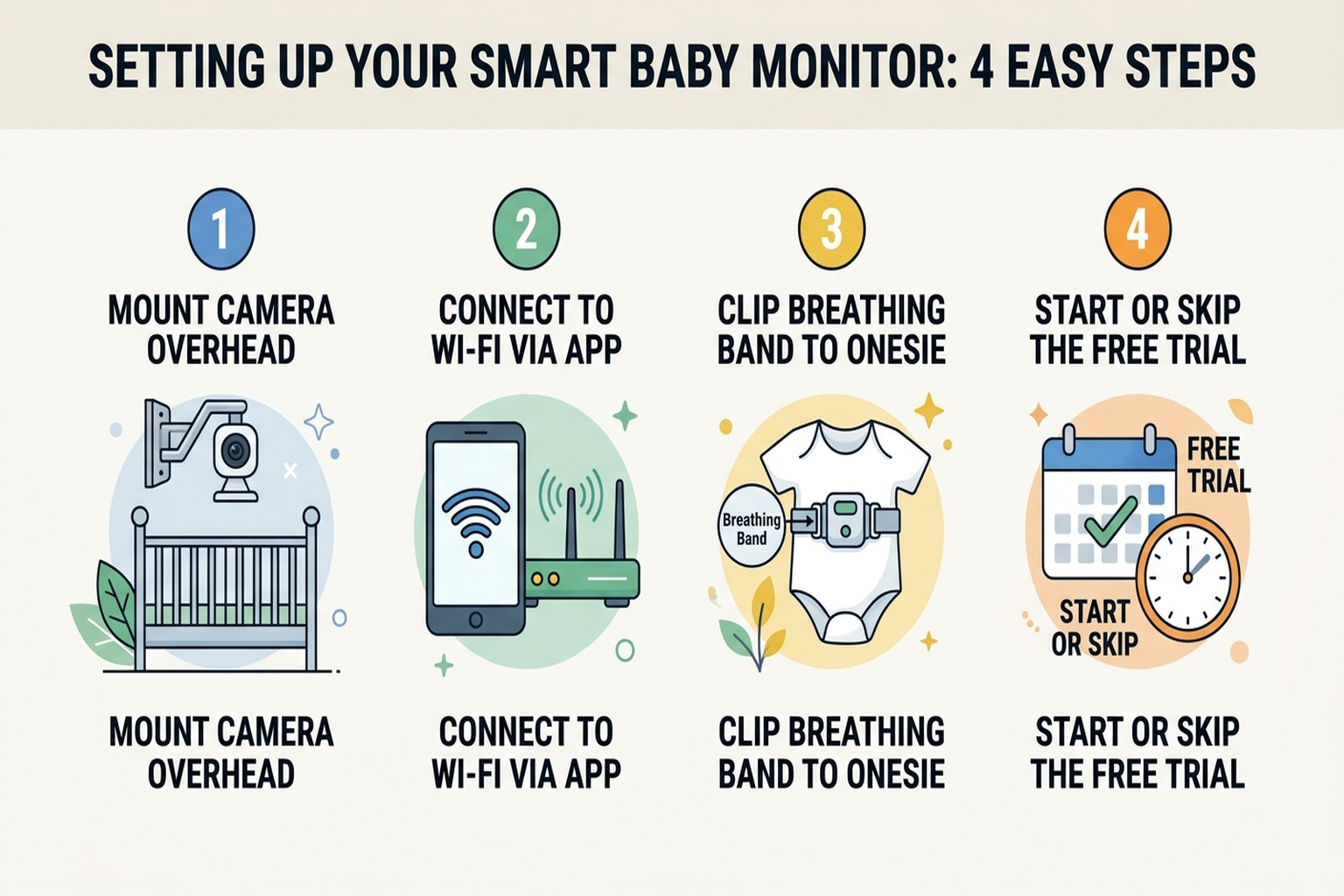
- Mount the camera overhead, using either the included wall mount (positioned above and facing down into the crib) or an optional floor stand, since Nanit’s overhead angle is the main design difference from crib-rail monitors.
- Connect the camera to home Wi-Fi through the Nanit app and add up to two caregiver accounts at no cost — a third caregiver requires an active Insights plan, according to aggregated owner reports.
- Clip the included Breathing Band to a onesie (the 0-3 month size ships in the box; the 3-24 month band is a separate roughly $25 purchase) to enable motion-based breathing tracking.
- Decide on the Insights trial before it converts to paid. The free trial period runs three months; set a calendar reminder to evaluate whether the sleep-analytics features are worth continuing, canceling, or downgrading before the annual billing kicks in.
What Independent Testing and Owner Reviews Say
Wirecutter’s testing of Wi-Fi baby monitors has repeatedly placed the Nanit at or near the top of the category, citing sharp 1080p day-and-night video, a well-designed app, thoughtful hardware details like cord covers, and security practices it rated more stringent than competing Wi-Fi monitors it tested. That security framing matters specifically for Wi-Fi-connected cameras, a category where privacy concerns are a recurring theme across parenting-tech coverage generally.
Aggregated Amazon feedback is broadly positive on the hardware — the listing sits around 4.6 out of 5 stars across more than 4,700 ratings — but a consistent minority of reviews and parent-forum discussions raise the same two issues: confusion or frustration about exactly which features require a paid plan, and intermittent technical problems (Wi-Fi drops, audio lag, app crashes) that are independent of the subscription question but show up often enough in owner reports to be a pattern rather than isolated incidents.
Comparison Table
Prices as of 2026-11-07. These are amazon.com prices seen at the time of writing; actual prices fluctuate frequently and are commonly discounted around Black Friday and Cyber Monday — always check the current price on the product page.
| Model | ASIN | Approx. price | Subscription required? | Best for |
|---|---|---|---|---|
| Nanit Pro Smart Baby Monitor & Wall Mount | B0CX5H17LT | ~$289.99-299 | No (core features); Insights plans from free trial to $300/yr for sleep analytics | Parents who want an overhead view plus optional long-term sleep tracking |
| Owlet Dream Duo 2 | B0B5283WSZ | ~$359.99-399 | No (base monitoring); Owlet360 plan adds extended history | Parents who want FDA-cleared pulse rate and oxygen alerts, not just video |
| Infant Optics DXR-8 Pro | B08FF4GV5C | ~$199.99 | None — no app, no cloud account | Parents who want zero ongoing cost and no Wi-Fi dependency |
Editorial Recommendations by Use Case
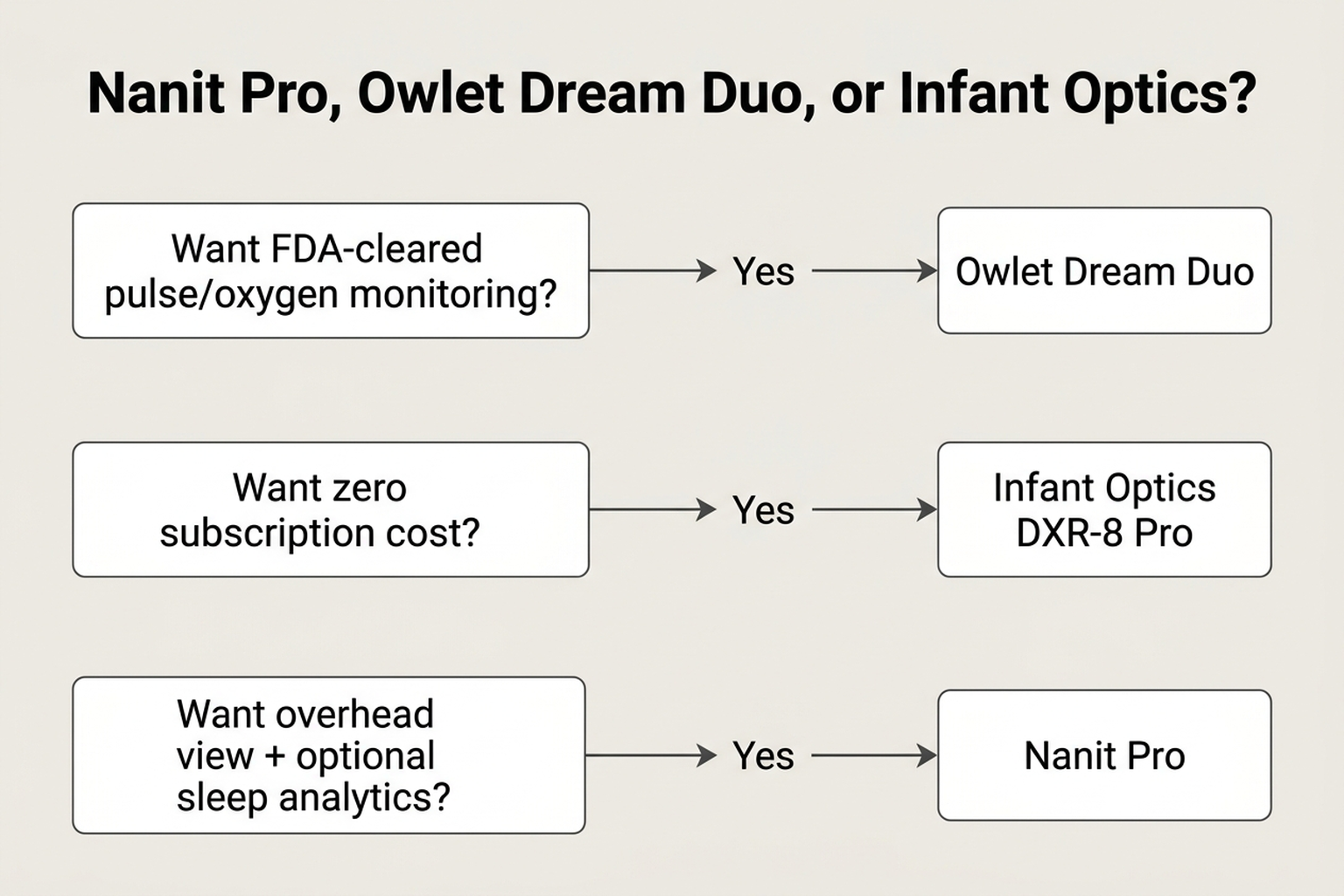
- Best for parents who want the overhead angle and are open to paying for sleep analytics later: the Nanit Pro — Wirecutter’s top-rated Wi-Fi monitor, with the core camera functioning fully for free and Insights as an optional add-on. Check the Nanit Pro on Amazon
- Best for parents most concerned with a physiological health signal rather than video analytics: the Owlet Dream Duo 2 — its Dream Sock has FDA De Novo clearance for pulse rate and oxygen monitoring, a direct health claim the Nanit’s video-based approach doesn’t make. Check the Owlet Dream Duo 2 on Amazon
- Best for parents who want zero ongoing software cost and no Wi-Fi dependency: the Infant Optics DXR-8 Pro — a closed-circuit monitor with no app, no account, and no subscription at any tier, at roughly a third cheaper than the Nanit. Check the Infant Optics DXR-8 Pro on Amazon
- If the subscription confusion itself is the dealbreaker: read the current Nanit Insights terms carefully before buying, specifically around the two-caregiver free-tier limit and what happens automatically when the three-month trial ends, since that’s where most of the documented frustration originates.
Warranty
Nanit covers the Pro camera with a standard manufacturer’s limited warranty, and registering the product through the app at setup is worth doing given that Wi-Fi and app-stability complaints appear often enough in aggregated reviews to be a real, if inconsistent, risk. Always confirm current warranty length and terms on the product listing or Nanit’s own site, since coverage details can change.
Limitations of This Analysis
This analysis relies on manufacturer specifications and pricing published by Nanit, Owlet, and Infant Optics, independent testing coverage from Wirecutter, and aggregated Amazon customer review data; we did not personally test any of the three products, and individual experience varies with home Wi-Fi reliability, how a household uses multi-caregiver access, and unit-to-unit manufacturing consistency. The specific complaints about subscription-gated caregiver access and activation friction are drawn from a mix of aggregated review themes and independent reporting rather than a controlled usability study, so they should be read as a documented pattern rather than a guaranteed experience for every buyer. We did not find a controlled side-by-side lab comparison measuring breathing-tracking accuracy between Nanit’s video-based Breathing Band and Owlet’s wearable pulse oximeter under identical conditions, so that comparison in this article reflects each manufacturer’s own published claims and FDA clearance status rather than independently verified equivalence. Smart baby monitor market-size estimates vary widely across research firms depending on category definitions used, so we did not cite a single figure as precise. Prices, ASIN availability, and subscription terms change frequently — always confirm current details on the product page before buying.
The Bottom Line
The Nanit Pro’s camera hardware earns its reputation — Wirecutter’s praise for video quality, app design, and security practices holds up, and every core monitoring function works without paying anything. The subscription itself isn’t the problem; Sleep, Memories, and Milestones are genuinely optional add-ons layered on top of a fully functional free camera. The real friction, based on aggregated owner reports, is the gap between “no subscription required” marketing and a two-caregiver free-tier limit and trial-conversion process that catches some buyers off guard. If you want the overhead angle and might want sleep analytics down the road, the Nanit Pro remains the best-reviewed option in its category — just read the Insights terms before the three-month trial ends. If a health-specific signal or a zero-subscription setup matters more, the Owlet Dream Duo 2 and Infant Optics DXR-8 Pro are both well-documented alternatives. Check the current price and read the most recent reviews before buying — and if you want a second opinion on a specific listing, paste the URL into Arekore and let the AI scan the reviews and price history for you in about five minutes.