LG C5 vs Samsung S90F: Which OLED TV Wins in 2026?

The LG C5 and the Samsung S90F sit in nearly the same price band, occupy nearly the same shelf space in a living room, and come from the two companies that together control roughly 85% of the global OLED TV market by shipments. They are also built on genuinely different panel technology — WOLED versus QD-OLED — which shows up in real, measurable differences rather than marketing noise. This guide compares both TVs at the 55-inch and 65-inch sizes using aggregated Amazon customer data, independent lab testing from RTINGS and Consumer Reports, and manufacturer specifications.
As an Amazon Associate, Arekore earns from qualifying purchases. The Amazon product links in this article include our affiliate tracking ID and may earn us a commission if you buy through them, at no additional cost to you. See our Links Policy for details on how we select products and how commissions do not influence our recommendations.
TL;DR / Quick Verdict
- Overall winner for most buyers: it depends on your room and your HDR source library. The C5 is the stronger pick for bright rooms and Dolby Vision libraries; the S90F is the stronger pick for dark, color-critical viewing and HDR10+ content.
- Best for bright or sunlit rooms: the LG C5 — its anti-glare coating and higher SDR brightness handle ambient light better, and independent testing credits it with more versatile processing overall.
- Best for color accuracy and dark-room viewing: the Samsung S90F — its QD-OLED panel produces noticeably more saturated, vivid color and a glare-fighting matte coating that several outlets rate as the better reflection handler.
- Format fight that actually matters: the C5 supports Dolby Vision but not HDR10+; the S90F supports HDR10+ but not Dolby Vision. Check which format your main streaming services and discs use before choosing.
- Where Consumer Reports breaks the tie: Consumer Reports’ testing put the Samsung S90F at the top of its 2026 individual TV rankings, scoring at or near the maximum across HD, UHD, HDR, viewing-angle, and motion-blur categories.
- The nuance aggregated reviews add: Samsung’s broader S90-series line has drawn a recurring (though not universal) complaint thread about power-supply failures in some units a few months after purchase — a reliability data point independent of picture quality.
How We Reached These Conclusions (Methodology)
This is an editorial analysis, not a hands-on review; we did not personally test the products covered here. This guide synthesizes three kinds of public information: (a) aggregated amazon.com customer ratings and the substance of both positive and critical reviews, sampled in October 2026 — we did not tabulate a precise review count across all four models, so treat “aggregated review data” below as directional rather than a scored sample; (b) independent third-party lab testing and reporting from RTINGS, Consumer Reports, Tom’s Guide, and Germany’s Stiftung Warentest; and (c) manufacturer specifications from LG and Samsung. Where we cite a manufacturer figure — processor name, peak-brightness claim, refresh rate — we label it as a manufacturer claim rather than an independently verified result. Prices are amazon.com figures at the time of writing and change frequently, especially around Black Friday and Cyber Monday sale events.
Technical Approach: WOLED vs. QD-OLED
The performance differences between these two TVs trace back to a fundamental panel-technology split, not brand polish.
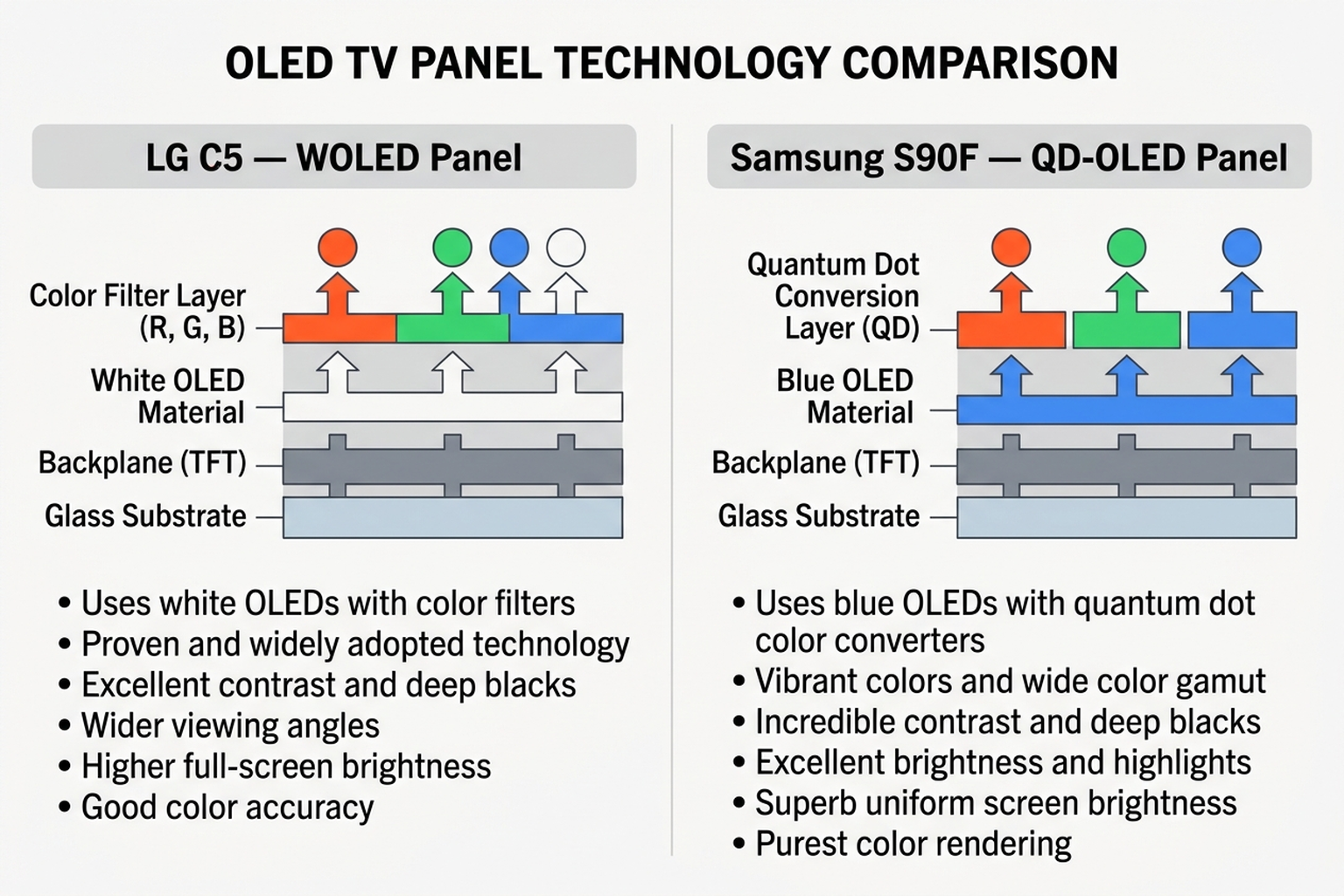
- Panel technology. The LG C5 uses a WOLED (White OLED) panel with a color filter layer, the architecture LG has refined since 2013. The Samsung S90F uses a QD-OLED panel, which pairs a pure-blue OLED light source with a quantum-dot layer instead of a color filter. RTINGS’ direct comparison found the S90F’s QD-OLED panel “far more colorful” than the C5’s WOLED panel, a structural advantage rather than a calibration difference.
- Brightness profile. The two trade blows depending on content type: RTINGS measured the C5 as significantly brighter in SDR content, while the S90F edges ahead in HDR Game Mode; across most HDR content the two are roughly comparable in peak brightness (manufacturer-independent, RTINGS-measured).
- Black levels and reflections. The C5’s black levels barely rise in a bright room, while the S90F’s blacks shift toward charcoal gray under the same ambient light — but the S90F’s matte anti-reflective coating handles direct light sources and glare noticeably better than the C5’s coating, according to RTINGS’ reflection testing. Which matters more depends on whether your room problem is ambient brightness or direct glare off windows and lamps.
- Processing. LG’s Alpha 9 AI Processor Gen8 (manufacturer naming) drives the C5’s upscaling and motion handling; RTINGS’ broader LG-vs-Samsung comparisons across the 2026 lineup describe LG’s processing as the more versatile option for mixed, varied source material. Samsung’s processor on the S90F is tuned more specifically for its own Tizen smart-TV platform and gaming feature set.
- HDR format support. This is the most practical difference for everyday streaming: the C5 supports Dolby Vision and HDR10 but not HDR10+; the S90F supports HDR10+ and HDR10 but not Dolby Vision. Most major streaming services (Netflix, Disney+, Apple TV+) favor Dolby Vision, while Amazon Prime Video and some 4K Blu-rays use HDR10+ — check your actual viewing habits before this becomes a deciding factor.
Head-to-Head: 65-Inch Tier (~$1,400–$1,800)
LG OLED65C5PUA pairs the WOLED panel with four HDMI 2.1 ports, a 144Hz refresh rate (manufacturer claim), and the Alpha 9 AI Processor Gen8. RTINGS rated the full C5 lineup 8.7/10, citing great HDR brightness, excellent motion handling, and outstanding build quality, including a brushed-metal pedestal stand with snap-on cable management. Listed at $1,796.99 on Amazon, it has been discounted as low as roughly $1,455.99 in recent sale events (as of 2026-10-31).
Check the LG OLED65C5PUA on Amazon
Samsung QN65S90F pairs its QD-OLED panel with the NQ4 AI Gen3 processor, 144Hz Motion Xcelerator, and Samsung’s Vision AI smart-TV suite. Consumer Reports’ testing scored this exact model, the QN65S90F, 91 points and placed it at the top of its 2026 individual TV rankings, with near-perfect marks across HD, UHD, HDR, viewing angle, and motion blur. Listed at $1,697.99 on Amazon, it has sold for as low as roughly $999.99 in past sale events (as of 2026-10-31).
Check the Samsung QN65S90F on Amazon
Verdict at this tier: the S90F has the stronger independent lab score at this exact size (Consumer Reports’ top 2026 individual TV ranking) and the more colorful panel, while the C5 remains the better pick for a bright room and for Dolby Vision-heavy streaming libraries. At true list price the two sit within $100 of each other, so the deciding factor should be your room’s lighting and which HDR format your main content sources use, not price.
Head-to-Head: 55-Inch Tier (~$1,000–$1,400)
LG OLED55C5PUA carries the same panel technology, processor, and port configuration as its 65-inch sibling, scaled down. Tom’s Guide and What Hi-Fi both single out the 55-inch (and smaller 48-inch) C5 as an exceptional value entry point into the lineup, since the core picture-quality strengths — Dolby Vision, strong SDR brightness, outstanding build quality — carry over unchanged from the larger sizes. Listed at $1,396.99 on Amazon (as of 2026-10-31).
Check the LG OLED55C5PUA on Amazon
Samsung QN55S90F likewise inherits the QD-OLED panel and NQ4 AI Gen3 processor from the 65-inch model. Independent reporting on the 55-inch S90F highlights the same matte anti-reflective coating and color saturation that earned the larger model its Consumer Reports score. Listed at $1,097.99 on Amazon in recent sale pricing (as of 2026-10-31).
Check the Samsung QN55S90F on Amazon
Verdict at this tier: at the 55-inch size the S90F has consistently carried a lower street price than the C5 in recent Amazon sale cycles, which shifts the value calculus toward Samsung more than it does at 65 inches — worth checking current prices on both before buying, since the gap narrows and widens with sale timing.
Customer Sentiment and Reliability Synthesis
- Picture quality satisfaction is high for both brands, with aggregated review sentiment consistently praising the C5’s brightness and motion handling and the S90F’s color vibrancy and black levels — the split mirrors the lab testing almost exactly.
- Samsung’s power-supply complaint thread is the most consequential reliability data point in this comparison. Owner reports on Samsung’s prior-generation S90-series models (S90D) describe units failing to power on after four to five months of use, attributed to a power-supply component; Samsung has reportedly updated the power supply in newer production runs, though owners report this has not been universally confirmed as fully resolved. We found no equivalent volume of power-supply failure reports for the C5.
- Software complaints run in opposite directions. LG’s webOS interface draws repeated criticism in reviews and reporting as slow and dated-feeling, while Samsung’s Tizen platform draws complaints about AI-feature glitches — sound or picture briefly cutting out — and occasional random restarts requiring a reboot to restore a Wi-Fi connection.
- Remote quality favors neither brand strongly. The C5’s bundled remote is frequently described in reviews as feeling subpar relative to the TV’s price point; Samsung’s Solar Cell remote draws more positive mentions for its battery-free charging but occasional complaints about button feedback.
- Net read: aggregated sentiment and lab testing both point to the S90F as the stronger all-around picture at the 65-inch size, with the power-supply complaint thread as the one reliability caveat worth weighing against that; the C5 remains the safer pick specifically for bright rooms and Dolby Vision-first streaming habits.
Side-by-Side Comparison
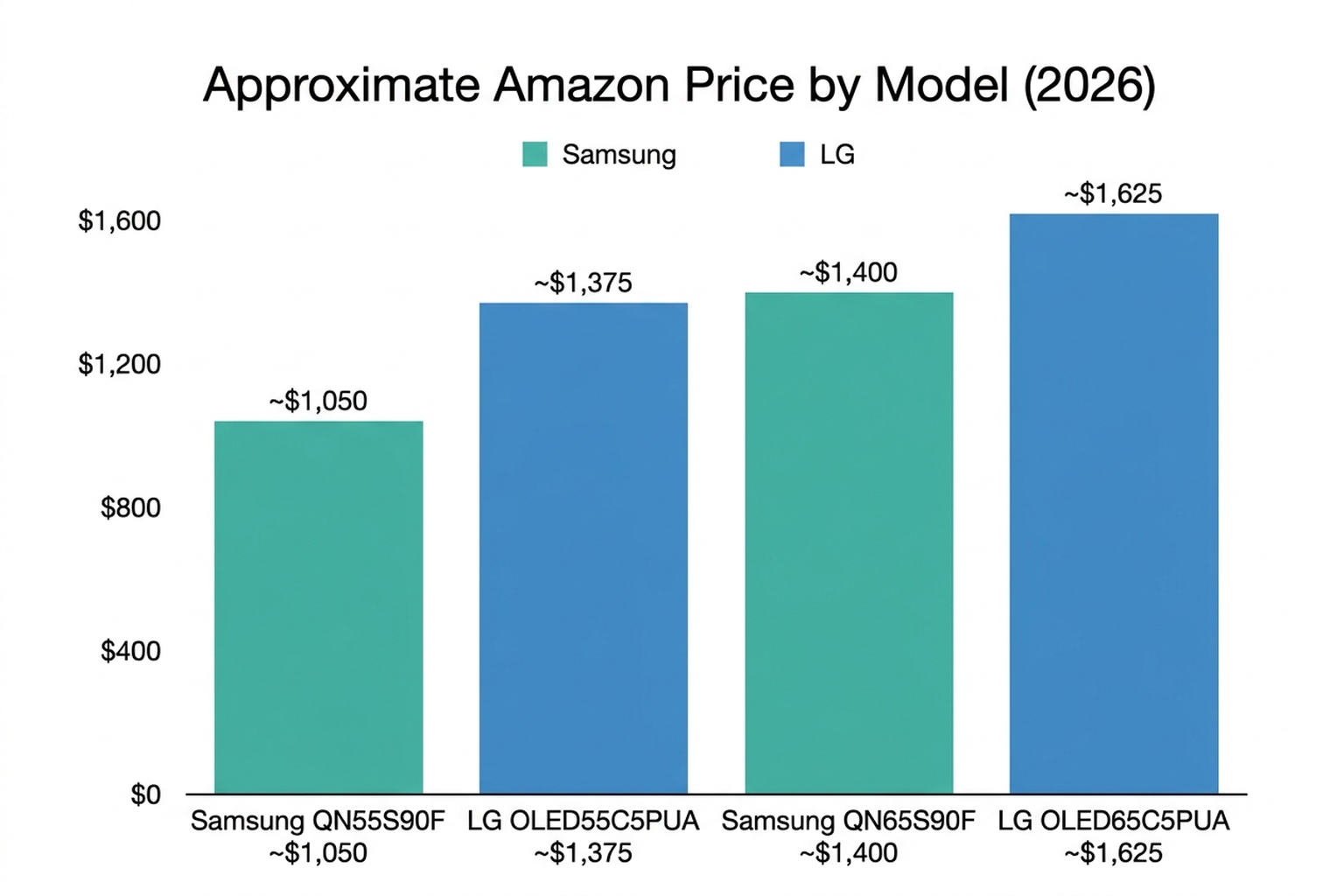
| Model | ASIN | Size | Panel | HDR formats | Refresh rate | Approx. price (as of 2026-10-31) |
|---|---|---|---|---|---|---|
| Samsung QN55S90F | B0F2R5VZHM | 55” | QD-OLED | HDR10, HDR10+ | 144Hz | $1,000–$1,100 |
| LG OLED55C5PUA | B0FBT6JCH1 | 55” | WOLED | HDR10, Dolby Vision | 144Hz | $1,350–$1,400 |
| Samsung QN65S90F | B0DXMJGQWC | 65” | QD-OLED | HDR10, HDR10+ | 144Hz | $1,000–$1,700 |
| LG OLED65C5PUA | B0F7FJ2ZBW | 65” | WOLED | HDR10, Dolby Vision | 144Hz | $1,450–$1,800 |
Panel type and refresh rate are manufacturer specifications; the Consumer Reports and RTINGS test findings cited elsewhere in this article are independently measured. Prices fluctuate significantly around sale events — verify the current amazon.com price before buying.
How to Decide
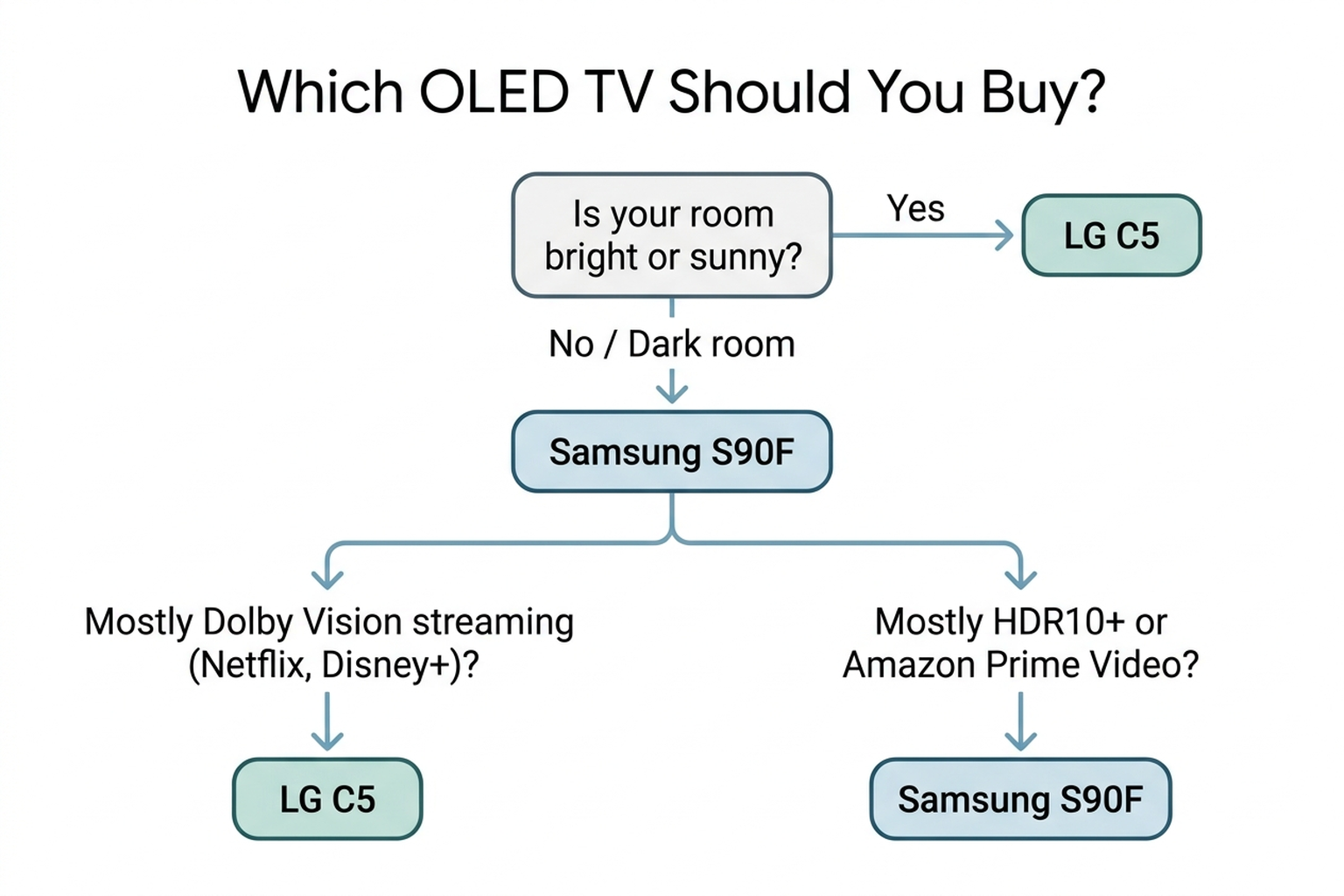
Start with your room’s lighting and your streaming habits, not brand loyalty. If your living room gets significant daylight or sits near bright lamps, the C5’s brightness and glare handling make it the steadier choice. If your room is dim or you can control the lighting, the S90F’s QD-OLED color and Consumer Reports-topping lab scores make it the stronger picture at the same size. If Dolby Vision titles dominate your watchlist (most Netflix, Disney+, and Apple TV+ originals), lean C5; if you lean on Amazon Prime Video or HDR10+ discs, lean S90F.
Warranty and Support
Both LG and Samsung back these models with a standard 1-year limited manufacturer warranty covering parts and labor (manufacturer terms; confirm at purchase). Amazon separately offers its own 2-year protection plan as an add-on at checkout for both models, which several reviewers note as a more affordable extended-coverage option than retail in-store warranties. Given the power-supply complaint thread on Samsung’s prior-generation S90-series units, S90F buyers in particular may want to weigh the value of extended coverage against the roughly 4-to-5-month failure window some owners reported on the earlier model.
Editorial Recommendation by Use Case
- You have a bright or sunlit living room: the LG C5 (either size) — its SDR brightness and glare handling are the better match for ambient light.
- You want the single best-tested picture at 65 inches: the Samsung QN65S90F — Consumer Reports’ top-ranked 2026 individual TV score.
- You stream mostly Dolby Vision content (Netflix, Disney+, Apple TV+): the LG C5 — HDR10+ titles will fall back to standard HDR10 on this TV, while Dolby Vision titles get the full format.
- You stream mostly HDR10+ or watch via Amazon Prime Video: the Samsung S90F — the reverse compatibility gap applies here.
- You’re shopping strictly on price at 55 inches: check current sale pricing on both — the S90F has recently undercut the C5 at this size, narrowing a gap that runs the other way at 65 inches.
Limitations
This analysis relies on publicly available reviews, independent lab testing, and manufacturer specifications; we did not independently lab-test these units. Brightness, refresh rate, and processor naming are manufacturer claims unless attributed to a named third-party tester such as RTINGS or Consumer Reports, and real-world picture quality varies with room lighting, source content, calibration, and unit-to-unit variance. Prices and availability were accurate to our research at the time of writing and change frequently, especially around Black Friday and Cyber Monday — verify current specs and pricing on the product page before buying.
Before you buy either TV, it pays to check that a listing’s reviews are genuine and that a sale price is an actual discount rather than an inflated “was” price. That is exactly what Arekore does: paste the Amazon URL and our AI analyzes review authenticity, surfaces the most useful low-star feedback, and compares pricing in about five minutes — so you end up with the OLED TV that actually fits your room, not just the one with the biggest brightness number on the box.