7 Kitchen Gadgets Amazon Shoppers Return Most (2026)
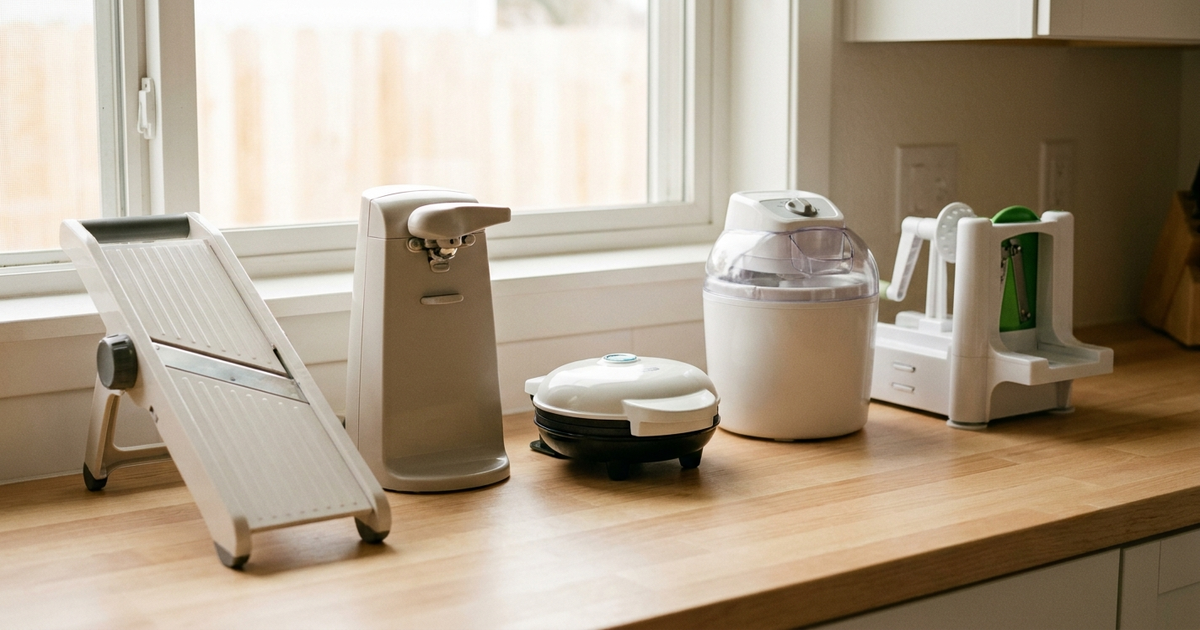
Small kitchen appliances account for roughly 28.5% of all electronics returns industry-wide — the single largest share of any category, ahead of entertainment products and small gadgets — according to returns-management data cited by post-purchase platform Corso. Amazon does not publish product-level return statistics, but it does now flag some listings with a public “Frequently Returned” badge, introduced in mid-February 2026, when a product’s return rate significantly exceeds its category average. Between that mechanism, aggregated customer-review complaint patterns, and independent testing from outlets like Wirecutter and Consumer Reports, a consistent shortlist of repeat offenders emerges.
As an Amazon Associate, Arekore earns from qualifying purchases. The Amazon product links in this article may include our affiliate tracking ID and may earn us a commission if you buy through them, at no additional cost to you. See our Links Policy for details on how we select products and how commissions do not influence our recommendations.
TL;DR
- Amazon does not publish per-product return-rate data. This is an editorial synthesis of aggregated customer-review complaint patterns, expert testing (Wirecutter, Consumer Reports), and the mechanics of Amazon’s public Frequently Returned badge — not proprietary return statistics.
- The seven repeat-return categories we identified: push-style mandoline slicers, electric can openers, mini/personal waffle makers, freezer-bowl ice cream makers, single-use produce slicers, manual vegetable spiralizers, and sous vide immersion circulators.
- The common thread across all seven isn’t quality — it’s a mismatch between how the product is marketed (fast, effortless, space-saving) and how it actually performs in a real household kitchen (extra prep steps, single-portion output, or a learning curve nobody mentioned at checkout).
- Wirecutter’s testing found that kitchen tools under $30 perform within about 90% of $100+ versions for most everyday tasks — which cuts against the “buy cheap, upgrade later” instinct that drives a lot of these purchases in the first place.
How We Reached These Conclusions (Methodology)
This is an editorial analysis, not a hands-on test; we did not personally test the products covered here, and we did not have access to Amazon’s internal return-rate data for any specific ASIN. Amazon does not publish that data publicly. Instead, this guide synthesizes three public signals: (a) the documented mechanics of Amazon’s Frequently Returned Item badge, which the company began displaying on product pages in mid-February 2026 when a listing’s return rate exceeds its category average — a real, public return-rate signal, even though Amazon does not disclose the exact underlying numbers or confirm which specific listings currently carry it; (b) aggregated amazon.com customer-review sentiment and recurring complaint language on best-selling listings in each category, sampled in August 2026; and (c) independent testing and editorial coverage from Wirecutter, Consumer Reports, and other outlets on single-use and specialty kitchen tools. We report complaint themes qualitatively (recurring patterns across many reviews) rather than as precise percentages, because we did not have access to a verified sample size for each product. Manufacturer specifications (wattage, capacity, freeze time) are labeled as manufacturer claims unless attributed to an independent test. Prices are amazon.com figures at the time of writing and fluctuate.
Comparison of Technical Approaches Across the Seven Categories
These seven gadgets fail in different ways, and understanding the mechanism helps explain why the same purchase mistake keeps repeating across totally different product types.
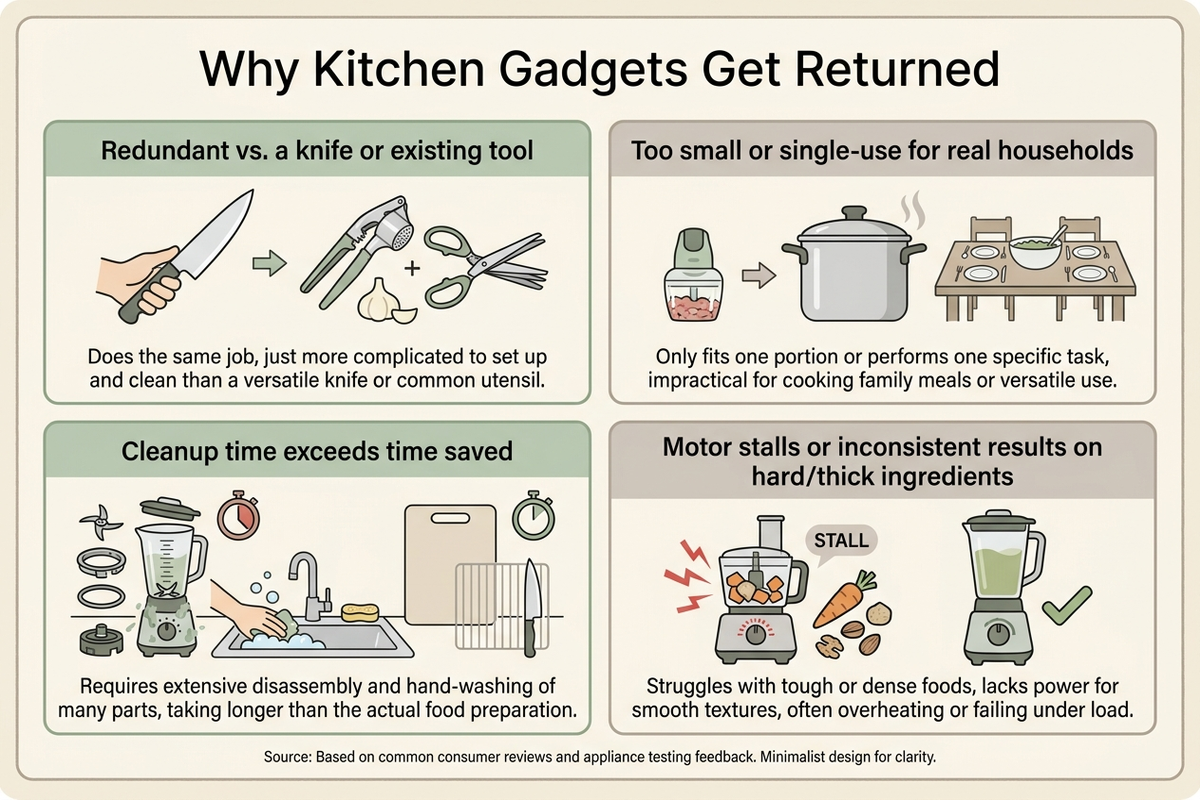
- Redundancy against a knife. Push-style mandolines and single-use produce slicers exist to do a job a sharp chef’s knife already does — often in less time once you factor in setup, blade selection, and washing multiple parts.
- Portion mismatch. Mini waffle makers and freezer-bowl ice cream makers are built around a single-serving or single-batch output. That’s fine for one person; it becomes a bottleneck the moment more than one or two people want food at the same time.
- Cleanup-to-payoff ratio. Manual spiralizers and multi-blade choppers save real time on the cutting board but can cost that time back at the sink, disassembling blades, hoppers, and containers for hand-washing.
- Steep or hidden learning curve. Sous vide immersion circulators are the outlier here — not badly designed, but they require a separate container, a rack or clips, and a time-and-temperature chart most first-time buyers didn’t budget mental effort for.
- Mechanical strain under real conditions. Electric can openers and underpowered slicers are the categories most likely to physically fail — skipping on a bent lid, jamming on an odd-shaped can, or refusing to grip through a coating.
The 7 Gadgets, One at a Time
1. Push-Style Mandoline Slicers
The category’s core appeal — restaurant-thin, perfectly even slices in seconds — is real and well-documented in independent testing. The catch is the exposed blade sits inches from your fingers, and the included hand guard is small enough that many buyers stop using it after the first close call, which then shows up in reviews as a safety complaint rather than a returns-for-refund one. The Mueller Austria V-Pro 5-Blade Mandoline (ASIN B0854QXM7C) is one of the category’s best-selling models, with a large aggregated review base and a strong average rating; the most consistent lower-starred feedback centers on the effectiveness of the hand guard and the difficulty of hand-washing the exposed blade assembly.
Check the Mueller Austria V-Pro Mandoline on Amazon
2. Electric Can Openers
Electric can openers solve a real accessibility problem — reviewers with arthritis or limited grip strength consistently praise the category — but they’re built around a specific gripping mechanism that doesn’t universally fit every can shape. Pop-top cans, unusually tall cans, and dented lids are the recurring failure points. The Hamilton Beach Smooth Touch Electric Can Opener (ASIN B07NY3HP8F), reviewed favorably by The Kitchn for its smooth-edge cutting action, is a long-running best seller with tens of thousands of reviews; the most common lower-starred complaint is inconsistent grip on certain can sizes rather than outright failure.
Check the Hamilton Beach Smooth Touch Can Opener on Amazon
3. Mini / Personal Waffle Makers
These are marketed on cuteness and counter-space savings, and they deliver on both. What the packaging doesn’t emphasize is throughput: a single 4-inch waffle per cook cycle means anyone cooking for more than one person is standing at the counter in relay mode, and the first waffle is cold by the time the second is ready. The Dash Mini Waffle Maker (ASIN B010TCP3SC) is the category’s dominant best seller; it heats quickly and cleans easily, but the single-portion output is the single most repeated caveat in aggregated reviews.
Check the Dash Mini Waffle Maker on Amazon
4. Freezer-Bowl Ice Cream Makers
This category has a genuine, well-reviewed payoff — smooth, additive-free ice cream and sorbet — but it depends on a step buyers routinely skip or misjudge: the double-insulated freezer bowl needs 16–24 hours in the freezer before use, per Cuisinart’s own product guidance, and it typically can’t be reused again same-day. Buyers who don’t pre-freeze the bowl long enough get a soft-serve consistency instead of scoopable ice cream, which reads as a product defect rather than a missed step. The Cuisinart ICE-21 1.5-Quart Ice Cream Maker (ASIN B00KUG9M1M) is a long-running category leader; independent reviews (Foodal, Dream Scoops) confirm strong texture results when the bowl is properly frozen, and flag the one-batch-per-freeze limitation as the main household-fit issue.
Check the Cuisinart ICE-21 Ice Cream Maker on Amazon
5. Single-Use Produce Slicers
Handheld slicers built for one specific fruit or vegetable — strawberries, mushrooms, kiwi — are the textbook example Forbes and Consumer Reports both point to when arguing that most single-use kitchen gadgets aren’t worth their drawer space. They can be genuinely faster than a knife for their one job, but they add a dedicated tool that has to be found, washed, and stored for a task most households do a few times a month at most. The Chef’n FreshForce Hand-Held Slicer (ASIN B099NZSV5J) has a solid aggregated rating for the specific job it does; the recurring lower-starred theme is buyers expecting broader versatility than a single-purpose slicer can offer.
Check the Chef’n FreshForce Hand-Held Slicer on Amazon
6. Manual Vegetable Spiralizers
Spiralizers had a genuine moment during the low-carb and “zoodle” boom, and Consumer Reports has documented real time savings from multi-blade vegetable tools for everyday prep. The friction shows up at the sink: most manual spiralizer models involve several small blade inserts and a suction-cup base, all of which need careful hand-washing, and harder vegetables (sweet potato, beets) can require real arm effort to crank through. The Brieftons 5-Blade Vegetable Spiralizer (ASIN B01MSZE4YK) is a well-reviewed, best-selling option in the category; the most common complaint theme is the cleanup and hand-crank effort on denser vegetables, not blade quality.
Check the Brieftons 5-Blade Spiralizer on Amazon
7. Sous Vide Immersion Circulators
Sous vide circulators are the one gadget on this list that consistently earns strong marks from both owners and independent testers for doing exactly what they claim — precise, consistent temperature control is well documented, including in a case where Anova’s customer support replaced a malfunctioning unit without hassle, per an independent long-term review. The mismatch here isn’t performance; it’s expectation. Buyers picture restaurant-grade steak on a weeknight and don’t budget for the extra gear (a dedicated container, a rack or clips to hold bags submerged, freezer space for the bags) or the mental step of following a time-and-temperature chart. The Anova Culinary Precision Cooker Pro (ASIN B07QFC6LN6) carries a strong aggregated rating; underuse after the first few tries — not malfunction — is the theme that shows up most in longer-term owner feedback.
Check the Anova Culinary Precision Cooker Pro on Amazon
How to Avoid the Return-Triggering Pitfall for Each
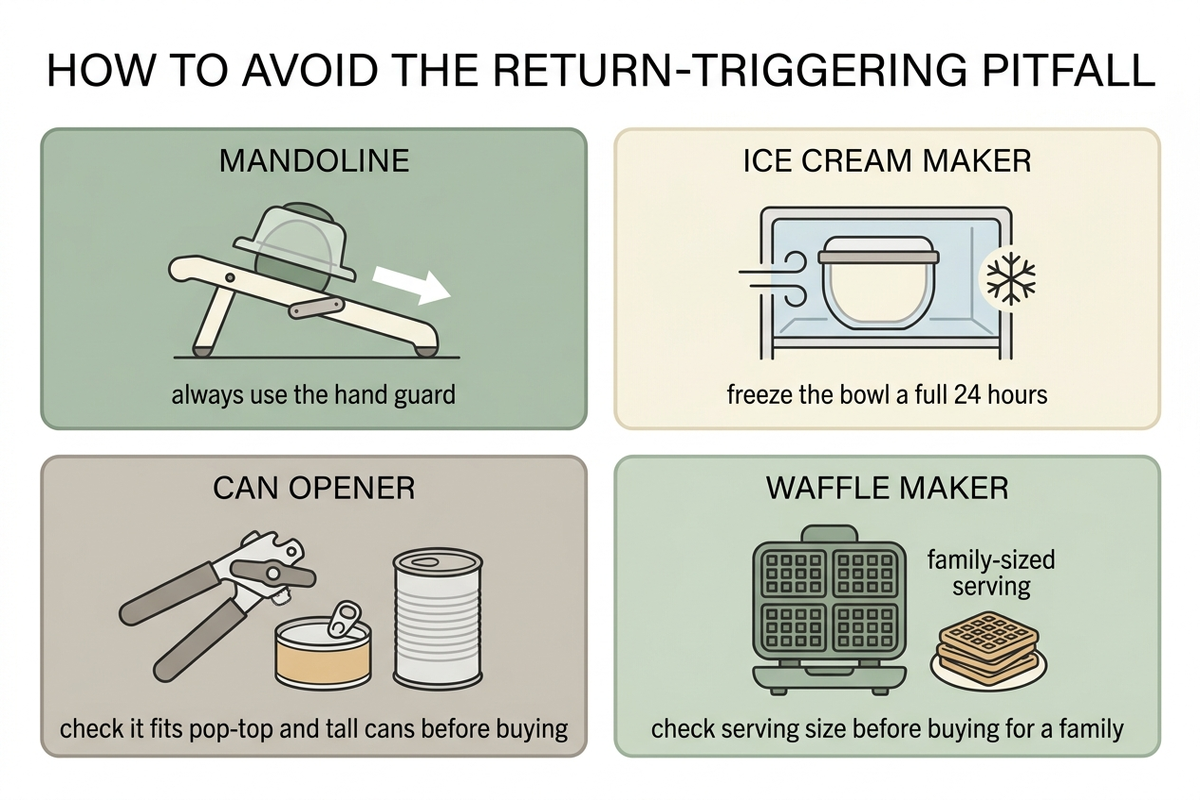
- Mandoline: Always use the hand guard, even after you feel confident — most safety complaints come from experienced users who got comfortable and stopped using it.
- Electric can opener: Before buying, check the listing’s Q&A or reviews specifically for pop-top and extra-tall can compatibility if that’s most of what you buy.
- Mini waffle maker: Multiply your household size by the per-cycle cook time before buying; if it doesn’t fit your morning routine, size up to a double or Belgian model instead.
- Ice cream maker: Freeze the bowl a full 24 hours, not “overnight” if that’s less than 16 hours, and don’t plan on a second batch the same day unless you own a spare bowl.
- Single-use produce slicer: Only buy if you genuinely prep that one ingredient multiple times a week — otherwise a good knife covers the same job with one less thing to store.
- Spiralizer: Check the blade-cleaning process in reviews before buying; if disassembly looks tedious in the product video, it will be tedious in your kitchen too.
- Sous vide circulator: Budget for the container and rack as part of the purchase, not an afterthought, and try one simple recipe (eggs or chicken breast) before committing to a bigger cook.
Comparison Table
Prices are approximate amazon.com figures as of 2026-08-28 and fluctuate.
| Product | ASIN | Approx. price | Main return-risk factor | Best mitigation |
|---|---|---|---|---|
| Mueller Austria V-Pro Mandoline | B0854QXM7C | ~$25–$35 | Hand-guard disuse, blade cleaning | Always use guard; hand-wash immediately |
| Hamilton Beach Smooth Touch Can Opener | B07NY3HP8F | ~$30–$45 | Fit on pop-top/tall cans | Check can-type compatibility first |
| Dash Mini Waffle Maker | B010TCP3SC | ~$10–$16 | Single-portion output | Match cook cycles to household size |
| Cuisinart ICE-21 Ice Cream Maker | B00KUG9M1M | ~$70–$90 | Bowl not frozen long enough | Freeze bowl a full 24 hours |
| Chef’n FreshForce Hand-Held Slicer | B099NZSV5J | ~$13–$18 | Single-purpose, limited use | Buy only if used weekly |
| Brieftons 5-Blade Spiralizer | B01MSZE4YK | ~$20–$30 | Cleanup time, hard-vegetable effort | Check disassembly/cleaning in reviews |
| Anova Precision Cooker Pro | B07QFC6LN6 | ~$150–$200 | Underuse after initial novelty | Budget for container/rack; start simple |
Keep or Return? A Price x Purpose Decision Guide
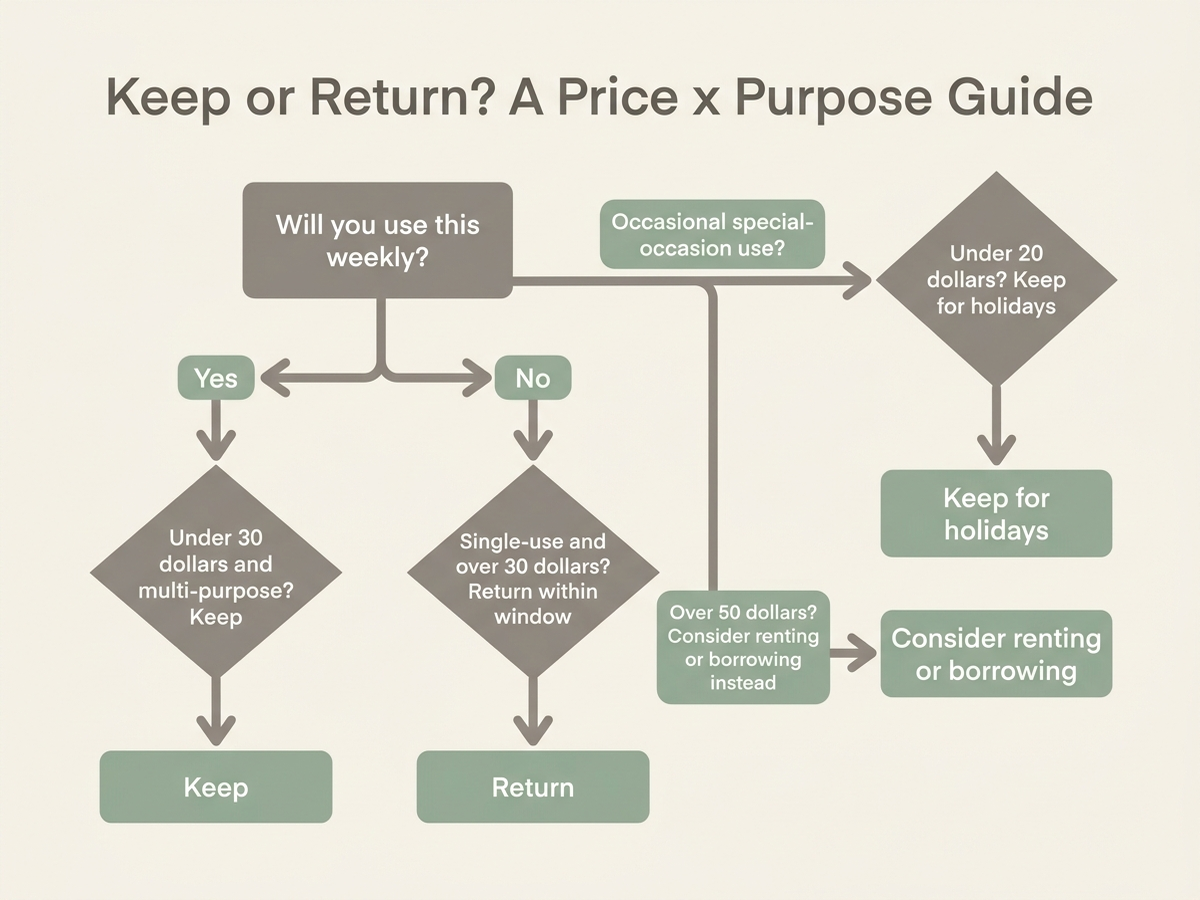
Use this as a general framework, not a hard rule, for any single-purpose kitchen gadget already in your cart or on your counter:
- Will you use it weekly? If yes and it’s under roughly $30 with more than one use case, it’s usually worth keeping. If no and it’s single-use above $30, that’s the clearest return signal.
- Occasional, special-occasion use only? Under about $20, it’s often worth keeping for the few times a year it earns its keep (a waffle maker for holiday breakfasts, for example). Above roughly $50 for something you’ll use a handful of times a year, renting, borrowing, or buying used are worth considering before a full-price purchase.
Warranty and Return-Policy Notes
Standard Amazon return windows apply to all seven products here: most non-defective small kitchen appliances can be returned within 30 days of delivery for a full refund, per Amazon’s general return policy, provided the item is in original condition. Beyond Amazon’s own window, manufacturer warranties vary by category and are worth checking before the return window closes:
- Cuisinart backs the ICE-21 with a 3-year limited warranty on the appliance.
- Anova has a reputation, per independent long-term reviews, for replacing malfunctioning Precision Cooker units under warranty without extensive back-and-forth — worth confirming current terms on Anova’s own site before buying, since warranty length can change between model generations.
- Mueller, Hamilton Beach, Dash, Chef’n, and Brieftons each publish their own limited warranty terms (commonly one to two years for small appliances); check the current listing or manufacturer site for exact terms, since these can be updated without notice.
If a defect shows up after Amazon’s return window closes, the manufacturer’s warranty — not Amazon — is the path to pursue.
Recommendations
- If you cook for more than two people regularly: skip the mini waffle maker and freezer-bowl ice cream maker in favor of full-size versions, or accept the tradeoff consciously (e.g., a mini waffle maker for solo weekday breakfasts is a different use case than feeding a family on Sunday).
- If you’re drawn to a single-use slicer for one specific ingredient: ask honestly how many times a week you actually prep that ingredient. Weekly-plus use justifies the drawer space; occasional use usually doesn’t.
- If you’re considering a mandoline: buy one with a documented hand guard and commit to using it every time, or consider a mandoline with a built-in food holder rather than a separate clip-on guard.
- If you’re considering sous vide for the first time: buy the circulator alone before investing in a full setup, and try one simple recipe in week one to confirm it fits your actual cooking habits before it becomes a countertop fixture.
- Across all seven categories: Wirecutter’s finding that sub-$30 tools perform within about 90% of premium versions for typical home tasks is a reasonable default — start at the lower end of a category before assuming you need the premium model.
Limitations
Amazon does not publish product-level or category-level return-rate data, and we did not have access to any such proprietary dataset for this analysis. We do not know, and do not claim to know, the exact return rate of any specific ASIN cited here, and we did not verify whether any of these specific listings currently carry Amazon’s public Frequently Returned badge — we cite the badge’s existence and mechanics as context for how return-rate signals surface publicly, not as a claim about these particular products. This analysis instead relies on recurring themes in aggregated customer reviews, independent editorial testing (Wirecutter, Consumer Reports, Foodal, The Kitchn), and manufacturer product guidance. Individual results vary by cooking habits, household size, and how closely a buyer follows manufacturer instructions (freeze time, hand-guard use, and so on). Prices and warranty terms shown are current as of the time of writing and are subject to change; confirm current terms on the product listing or manufacturer site before purchasing.
Bottom Line
None of these seven products are poorly made — independent testing and aggregated reviews back up real strengths in every category, from the Cuisinart’s texture results to the Anova’s temperature precision. What they share is a gap between the marketing pitch (fast, effortless, space-saving) and a real household’s actual routine (extra steps, single-portion output, or a learning curve). Matching the purchase to your actual weekly habits — not the demo video — is the single biggest factor in whether any of these seven becomes a kitchen staple or a return label.
Before you buy, paste the product link into Arekore — our AI assistant checks review authenticity, surfaces what the one-star reviews actually complain about, and compares prices, free, in about five minutes.