iRobot Roomba vs Roborock: Which Robot Vacuum Wins in 2026?
For most of the last decade, “robot vacuum” and “Roomba” were nearly synonymous. That is no longer true. Roborock, a Beijing-founded challenger that entered the US market less than ten years ago, now sits at or near the top of nearly every independent robot vacuum ranking, and iRobot spent part of late 2025 in Chapter 11 bankruptcy court. Shoppers comparing the two brands today are not just picking a feature set — they are picking between a legacy brand mid-restructuring and a challenger that increasingly defines the category’s cutting edge. This guide compares Roomba and Roborock model-for-model across price tiers, using aggregated Amazon customer data, independent lab testing, and manufacturer specifications.
As an Amazon Associate, Arekore earns from qualifying purchases. The Amazon product links in this article may include our affiliate tracking ID and may earn us a commission if you buy through them, at no additional cost to you. See our Links Policy for details on how we select products and how commissions do not influence our recommendations.
TL;DR / Quick Verdict
- Overall winner for most buyers: Roborock. RTINGS currently ranks Roborock’s flagship above every Roomba model it has tested, and Roborock’s mid-tier models typically undercut equivalent Roomba pricing by $300–$500. (Consumer Reports’ own top pick for 2026 is still an iRobot model on raw cleaning score — see the Customer Sentiment section for that nuance.)
- Best flagship: the Roborock Saros 10R — RTINGS’ top-ranked robot vacuum overall, with a 24/24 obstacle-avoidance rating and a 98.5% cleaning score from Tom’s Guide’s own lab testing.
- Best premium Roomba: the iRobot Roomba Combo 10 Max — stronger on deep-pile carpet and pet hair thanks to dual rubber counter-rotating brushes, but reviewers flag its camera-based navigation as slower than Roborock’s LiDAR.
- Best value in the mid-tier: the Roborock Q7 Max+ — LiDAR mapping and a self-emptying dock at roughly half the price of the comparable Roomba j9+.
- The one scenario favoring Roomba: heavy carpet and pet-hair homes, where iRobot’s brush design still has a measurable edge, and where the iRobot “P.O.O.P. Guarantee” (replacement if the robot runs over pet waste) matters to the buyer.
- The context that changes the calculus: iRobot filed for Chapter 11 bankruptcy in December 2025, with Chinese manufacturer Picea Robotics acquiring the company through the court process. iRobot has stated its apps, warranties, and customer service are expected to continue uninterrupted, but the ownership change is a real consideration for a purchase you expect to support for years.
How We Reached These Conclusions (Methodology)
This is an editorial analysis, not a hands-on review; we did not personally test the products covered here. This guide synthesizes three kinds of public information: (a) aggregated amazon.com customer ratings and the substance of both positive and critical reviews, sampled in September 2026; (b) independent third-party testing and reporting from RTINGS, Consumer Reports, Tom’s Guide, and Vacuum Wars; and (c) manufacturer specifications and public filings, including bankruptcy-court reporting on the iRobot–Picea transaction. Where we cite a manufacturer figure — suction in pascals (Pa), runtime, self-empty capacity — we label it as a manufacturer claim rather than an independently verified result. Prices are amazon.com figures at the time of writing and change frequently.
The Context Buyers Can’t Ignore: iRobot’s Bankruptcy
On December 14, 2025, iRobot filed a prepackaged Chapter 11 bankruptcy in Delaware after years of declining market share and tariff pressure, following a previously failed Amazon acquisition attempt. Under the plan, secured lender and long-time contract manufacturer Shenzhen Picea Robotics converted roughly $264 million in claims into 100% equity, with the plan becoming effective January 23, 2026. Picea is not a small player: manufacturing-industry reporting describes it as a Shenzhen-founded company with more than 7,000 employees that has produced robot vacuums for Xiaomi, Haier, and Electrolux, and that sells its own robots under the 3i brand.
iRobot has said its apps, warranties, and customer service are expected to remain active through the transition, and that product availability and supply chains should continue without interruption. That is a reasonable expectation given Picea’s manufacturing role in iRobot’s existing supply chain, but it is still a company that changed owners through a bankruptcy court in the past year — a fact worth weighing against Roborock’s comparatively stable, well-capitalized position as the category’s current market leader. This is not a reason to avoid Roomba outright; it is a reason to factor ownership continuity into a purchase you expect to support with software updates and spare parts for years.
Technical Approach: Navigation and Brush Design
The two brands make different engineering bets, and those bets explain most of the performance gap.
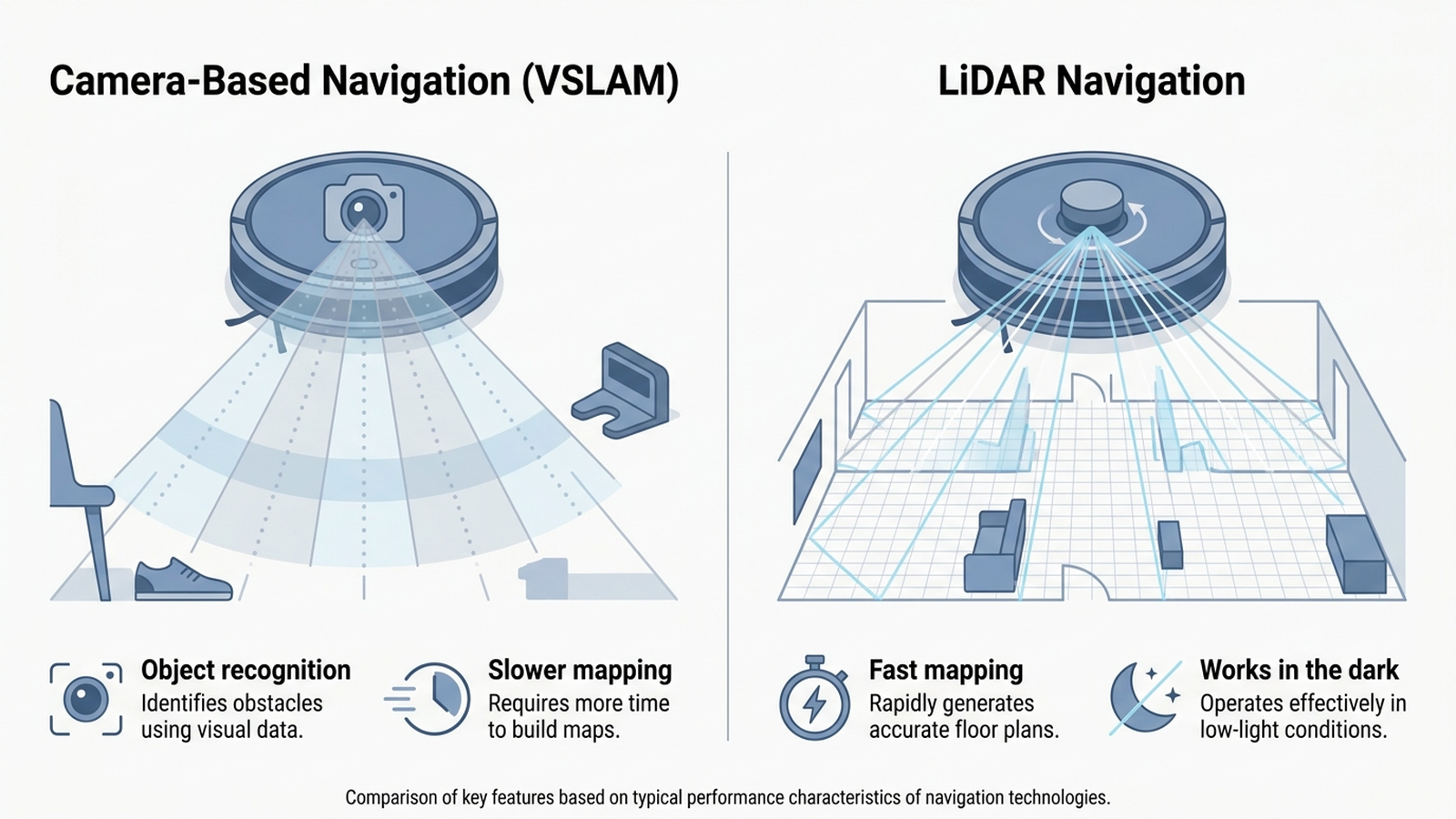
- Navigation. iRobot’s current flagships use camera-based VSLAM navigation, which is good at recognizing specific obstacle types — a phone charger cord, a sock, pet waste — but tends to map more slowly and depends more on ambient light. Roborock’s lineup uses LiDAR (laser) navigation across nearly every model, which builds an accurate map quickly and works in the dark. RTINGS’ top-ranked Saros 10R combines multiple solid-state LiDAR sensors with obstacle recognition to reach a perfect 24/24 obstacle-avoidance score without needing a tall, protruding turret.
- Brush design. iRobot’s dual rubber counter-rotating brushes remain a genuine strength on medium-to-thick carpet, where they dig into pile more effectively than the single-roller designs common on many Roborock models. On bare hard floors and for general pet-hair pickup, the gap narrows considerably, and Roborock’s anti-tangle comb systems have closed much of the difference on hair-wrap complaints.
- Suction. Manufacturer-claimed suction has widened sharply in Roborock’s favor at the top end: the Saros Z70 is rated at 22,000 Pa and the S8 MaxV Ultra at 10,000 Pa (manufacturer claims), against an estimated ~2,200 Pa on the Roomba j9+. Past roughly 5,000–8,000 Pa, brush design and anti-tangle engineering matter more than the raw number, so treat these figures as a ceiling rather than a guarantee of real-world performance.
- Mopping. Roborock’s VibraRise sonic-scrubbing mop system is a full technical generation ahead of Roomba’s flat mop-pad approach, according to multiple reviewers; Roomba’s mopping is functional but consistently rated as its weakest feature relative to price.
Head-to-Head: Flagship Tier (~$900–$1,600)
iRobot Roomba Combo 10 Max pairs an AutoWash dock — which self-empties, refills the bin, and washes and dries the mop pad — with an auto-retracting mop that lifts onto the robot’s body over carpet so it never drags a wet pad onto a rug. Reviewers consistently praise its vacuuming and pet-hair pickup, driven by its dual rubber brush design, but criticize its camera-based navigation as slower and more bump-prone than top LiDAR rivals, and its mopping as merely adequate for a flagship price. Listed at $1,399.99, it has been discounted to roughly $779.95 in recent Amazon pricing (as of 2026-09-17).
Check the iRobot Roomba Combo 10 Max on Amazon
Roborock Saros 10R is RTINGS’ top-ranked robot vacuum overall, earning a perfect 24/24 obstacle-avoidance score thanks to multiple solid-state LiDAR sensors — achieved with a slim, 3.14-inch profile that fits under more furniture than most flagship rivals. Tom’s Guide’s own lab testing separately scored it 98.5% in cleaning trials (Cheerios pickup 99%, kitty litter 100%, pet hair 99%, hardwood 97.3%, carpet 97.3%). Its 22,000 Pa suction figure is a manufacturer claim, but the independently measured scores from both outlets back up the marketing. A self-cleaning dock washes its mop with hot water for hands-free operation. Listed at $1,599.99, it has recently sold for around $999.99 on Amazon (as of 2026-09-17).
Check the Roborock Saros 10R on Amazon
Verdict at this tier: Roborock’s Saros 10R wins on independently verified cleaning performance and navigation, and currently costs roughly $200–$400 less than the Roomba Combo 10 Max even before ongoing discounts. The Roomba remains the stronger pick specifically for heavy carpet and pet-hair households that value its brush design over its navigation.
Head-to-Head: Mid Tier (~$300–$700)
iRobot Roomba j9+ is a vacuum-only model (no mopping) that averages an estimated 94–96% pickup on hard floors in aggregated review data, with the dual counter-rotating rubber brushes giving it a real edge on medium-to-thick carpet compared with single-roller competitors at a similar price. It typically sells for around $700 on Amazon (as of 2026-09-17), though it discounts during sale events.
Check the iRobot Roomba j9+ on Amazon
Roborock Q7 Max+ adds LiDAR (PreciSense) navigation, 4,200 Pa suction (manufacturer claim), a self-emptying Auto-Empty Dock Pure rated for up to 7 weeks of hands-free use, and 30-level adjustable-water mopping — at a price that has recently fallen as low as roughly $359.99 on Amazon (as of 2026-09-17), often under half the Roomba j9+‘s price for a unit that both vacuums and mops.
Check the Roborock Q7 Max+ on Amazon
Verdict at this tier: the Q7 Max+ is the clearer value story — it adds mopping and self-emptying at a lower price than a Roomba that only vacuums. The j9+ remains defensible mainly for buyers replacing an existing Roomba who want ecosystem continuity or who prioritize its carpet performance.
Customer Sentiment and Reliability Synthesis
Independent testing tells only part of the story; day-to-day reliability is where the brands diverge most in aggregated owner feedback.
- Consumer Reports’ member reliability surveys give iRobot only middling marks for predicted reliability and a below-par rating for owner satisfaction. Notably, Consumer Reports’ own top-rated robot vacuum for 2026 is still an iRobot model, the Roomba Max 705, which scored well on cleaning performance despite the brand’s weaker reliability marks — a reminder that cleaning performance and long-term reliability are separate questions, and a single brand can lead on one while trailing on the other.
- Roborock is not immune to complaints. Customers commonly report Wi-Fi connections that require frequent resets, occasional auto-empty dock malfunctions, and some dissatisfaction with customer-service responsiveness on unresolved technical issues.
- Pet-owner sentiment on Roomba remains a genuine strength. iRobot’s P.O.O.P. Guarantee — a no-questions replacement if the robot runs over pet waste — is frequently cited favorably in pet-household reviews, and its carpet performance draws real praise even from reviewers otherwise critical of its navigation.
- Net read: aggregated sentiment favors Roborock on navigation reliability and value, and favors Roomba specifically on carpet/pet-hair performance and its pet-waste guarantee — neither brand is complaint-free.
Side-by-Side Comparison
| Model | ASIN | Tier | Navigation | Mopping | Self-empty | Approx. price (as of 2026-09-17) |
|---|---|---|---|---|---|---|
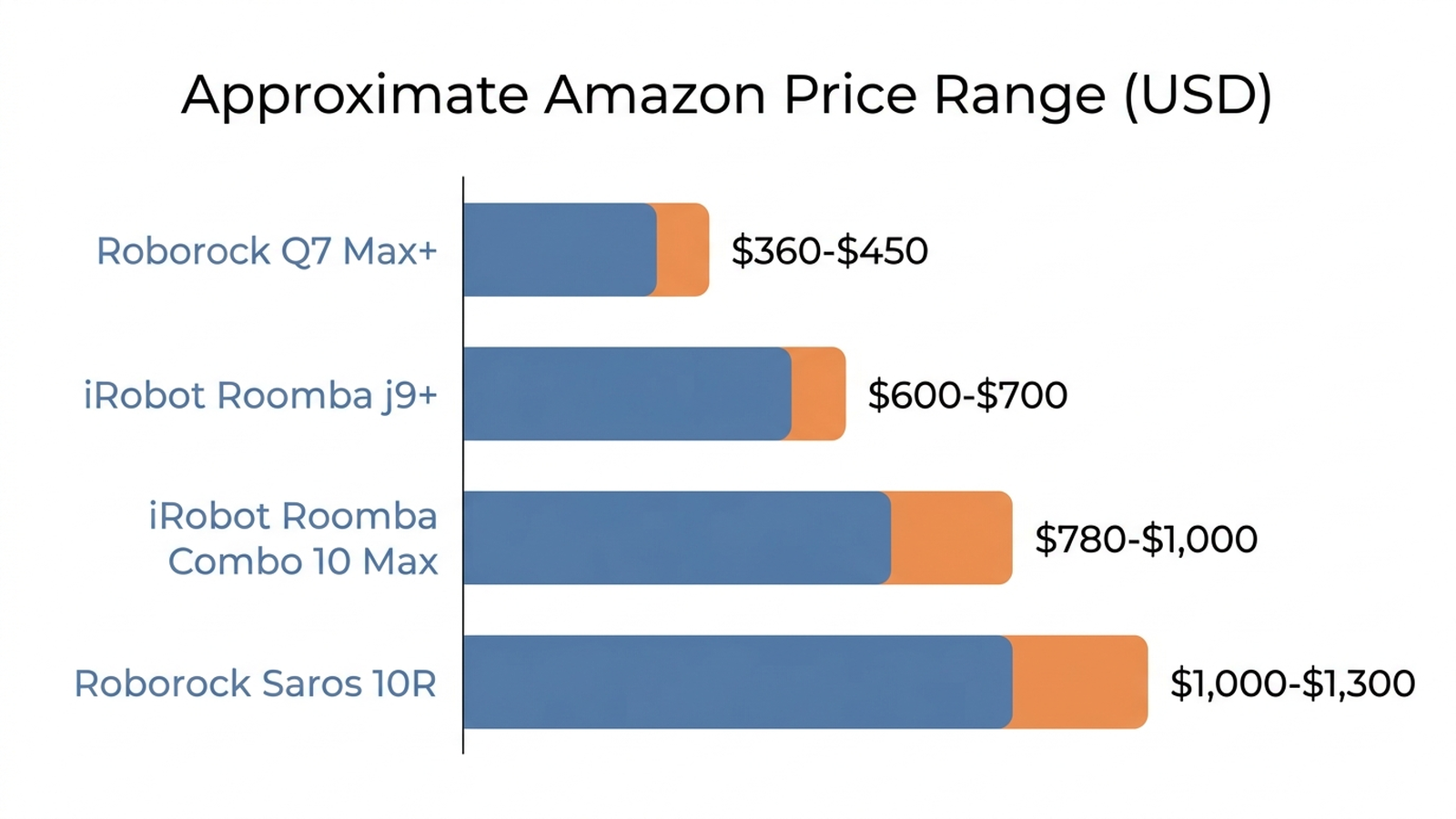
| Roborock Q7 Max+ | B09NNF5RHN | Mid | LiDAR | Yes (30-level water) | Yes (~7 wk) | $360–$450 |
| iRobot Roomba j9+ | B0C415NHBM | Mid | Camera/VSLAM | No | No | $600–$700 |
| iRobot Roomba Combo 10 Max | B0D9ZRH61T | Flagship | Camera/VSLAM | Yes (AutoWash) | Yes (full station) | $780–$1,000 |
| Roborock Saros 10R | B0DHCJ571Z | Flagship | LiDAR | Yes (hot-water self-clean) | Yes (full station) | $1,000–$1,300 |
Suction, runtime, and self-empty capacity figures are manufacturer specifications; RTINGS cleaning-test scores are independently measured. Prices fluctuate — verify the current amazon.com price before buying.
How to Decide
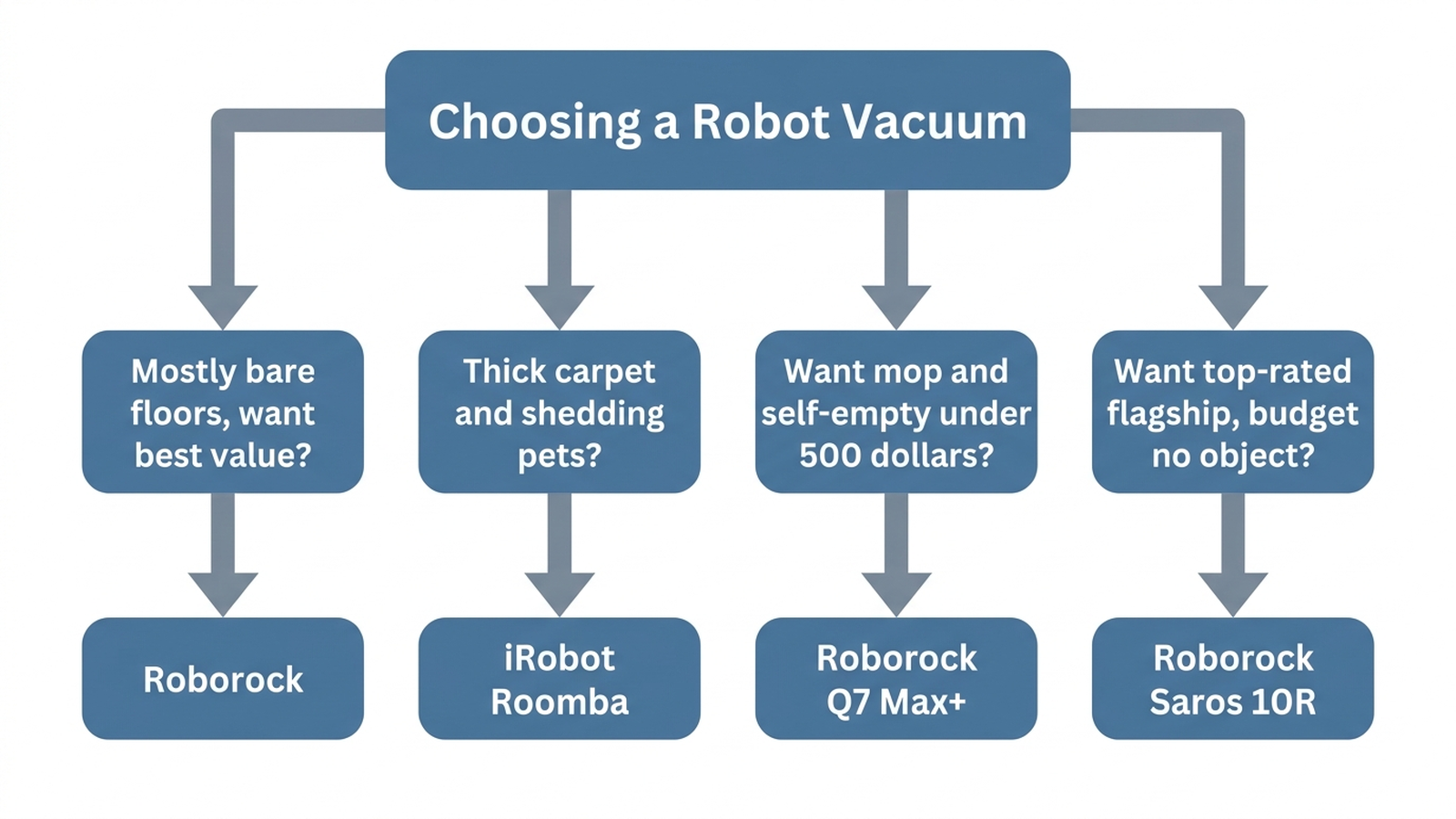
Start with your floors and your priorities, not the brand name. If your home is mostly bare floors and you want the best value at a given price, Roborock wins at nearly every tier on cleaning score and dollar-for-dollar features. If you have thick carpet, shedding pets, and specifically want the pet-waste replacement guarantee, the Roomba’s brush design and P.O.O.P. Guarantee are real, tested advantages worth the premium. If ownership continuity matters to you as much as performance, weigh Roborock’s stable market position against iRobot’s recent bankruptcy and change of ownership — even though iRobot has committed to uninterrupted app and warranty support.
Warranty and Support
Both brands commonly offer a 1-year limited warranty on the robot and dock (manufacturer terms; confirm at purchase). iRobot has stated that warranties, app support, and customer service are expected to continue without interruption through its ownership transition to Picea Robotics, though buyers should confirm current warranty terms directly with iRobot before purchasing, given the recency of the change. Roborock, as the more established market leader by unit share, has not had comparable ownership disruption, though its own customer-service responsiveness draws mixed reviews in aggregated feedback. As with any robot vacuum, most warranty claims trace to maintenance issues — tangled brushes, clogged docks, worn mop pads — rather than manufacturing defects, so registering the unit and following the cleaning schedule matters regardless of brand.
Editorial Recommendation by Use Case
- You want the single best-tested robot vacuum, budget aside: the Roborock Saros 10R.
- You want the best value in the mid-tier, vacuum and mop included: the Roborock Q7 Max+.
- You have thick carpet, shedding pets, and want the pet-waste guarantee: the iRobot Roomba Combo 10 Max (flagship) or Roomba j9+ (mid-tier, vacuum only).
- You are replacing an existing Roomba and want app/ecosystem continuity: stick with iRobot, but confirm current warranty terms given the recent ownership change.
- Everyone: clean the brushroll and empty the dock on schedule — maintenance, not brand, is the biggest driver of long-term satisfaction with either company’s robots.
Limitations
This analysis relies on publicly available reviews, third-party test reporting, and manufacturer specifications and public filings; we did not independently lab-test these units. Suction, runtime, and self-empty capacity figures are manufacturer claims unless attributed to a named third-party tester such as RTINGS, and real-world results vary with floor type, home size, pet shedding, clutter, and unit-to-unit variance. The iRobot bankruptcy and Picea acquisition were reported as of the plan’s January 23, 2026 effective date; ownership, warranty terms, and product roadmaps can change further as the transition proceeds, so confirm current terms directly with iRobot before purchasing. Prices and availability were accurate to our research at the time of writing and change frequently — verify current specs and pricing on the product page before buying.
Before you buy either brand’s robot, it pays to check that a listing’s reviews are genuine and that a sale price is an actual discount rather than an inflated “was” price. That is exactly what Arekore does: paste the Amazon URL and our AI analyzes review authenticity, surfaces the most useful low-star feedback, and compares pricing in about five minutes — so you end up with the robot vacuum that actually fits your home, not just the one with the biggest suction number on the box.